
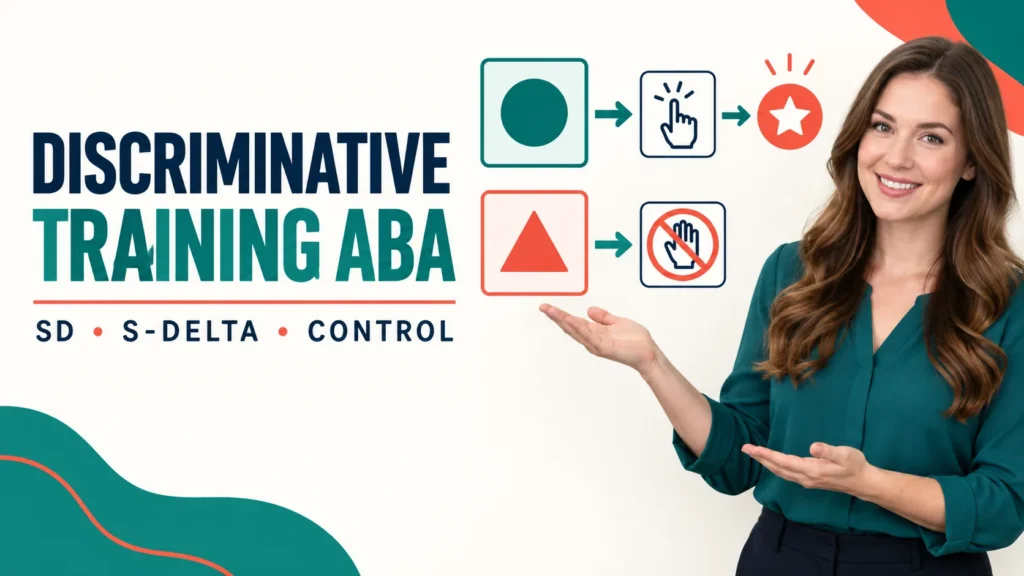
Discriminative training ABA is the planned arrangement of antecedents, responses, and consequences that teaches a learner to respond differently in the presence of different stimuli. The goal is not simply to make a correct response occur. The goal is for the relevant stimulus to become the reason the response changes, while irrelevant features such as position, color, or an adult’s prompt do not accidentally take control.
Table of Contents
- Discriminative Training ABA: The Core Idea
- Build the SD and S-Delta Contingency
- Teach Differential Responding Without Teaching a Position
- Troubleshoot Faulty Stimulus Control
- Test Generalization and Maintenance
- BCBA Exam Distinctions and FAQ
- Sources for Further Study
- Quick Review Checklist
- Take the Free BCBA Mock Exam
For BCBA study, the fastest way to reason through a discrimination-training question is to follow the contingency. Ask which stimulus signals reinforcement, which stimulus signals that reinforcement is unavailable, what response is being measured, and whether the learner responds differently when those stimuli change. Then check whether the response generalizes to new examples and maintains when the teaching arrangement is faded.
Discriminative Training ABA: The Core Idea
In a simple discrimination, an antecedent stimulus is correlated with reinforcement for a particular response, while another stimulus is correlated with a different consequence or with no reinforcement for that response. The stimulus correlated with reinforcement is commonly written as SD. The stimulus correlated with the absence of reinforcement is commonly written as S-delta or SΔ. The learner demonstrates discrimination when responding is more likely in the SD condition than in the S-delta condition.
This relationship is learned through a history of differential consequences. A card that looks different from other cards does not become an SD merely because it is bright or easy to notice. It becomes an SD because the relevant response has been reinforced in its presence. Likewise, an S-delta is not just a “wrong answer” card; it is part of the arranged relation that tells the learner that the target response will not contact the same reinforcement in that condition.
Discrimination training is different from teaching a response with a prompt. A prompt may temporarily increase the probability of a correct response. Training is successful when the intended stimulus, rather than the prompt, controls the independent response after prompts are faded. This distinction matters in receptive-language, matching, sorting, safety, and academic programs as well as in BCBA exam vignettes.
Build the SD and S-Delta Contingency
Before arranging trials, define the target response and the stimulus feature that should matter. If the learner is supposed to select the picture of a cup when hearing “cup,” decide whether the auditory word, the visual item, the array, or a combination is the intended controlling stimulus. If the intended feature is unclear, a high correct-response percentage may hide position bias, color preference, or control by an adult’s movement.
| Element | What it signals | Question to ask |
|---|---|---|
| SD | The arranged condition in which reinforcement is available for the target response. | What response should be more likely here, and what consequence follows it? |
| S-delta | The arranged condition in which the same reinforcement is unavailable for that response. | What should happen when the learner contacts this condition? |
| Response | The observable behavior whose probability should differ across stimulus conditions. | Can an observer identify its topography, onset, and completion? |
| Consequence | The event that differentially strengthens or does not strengthen the response. | Is the consequence immediate, consistent, and tied to the intended response? |
In a conditional discrimination, the controlling relation can be more complex. A sample stimulus may alter which comparison stimulus functions as the SD, while the other comparisons function as S-deltas for that trial. The learner is not merely memorizing one item. The learner is learning a conditional relation: given this sample or instruction, select this comparison and not the others.
Keep the consequence relation visible in the plan. If every comparison produces the same outcome regardless of the response, the arrangement may not teach the intended discrimination. If reinforcement is delivered for prompted and independent responses in exactly the same way, the learner may not contact a clear difference between independent control and prompt control. The solution is not automatically “more trials”; first inspect the contingency.
Teach Differential Responding Without Teaching a Position
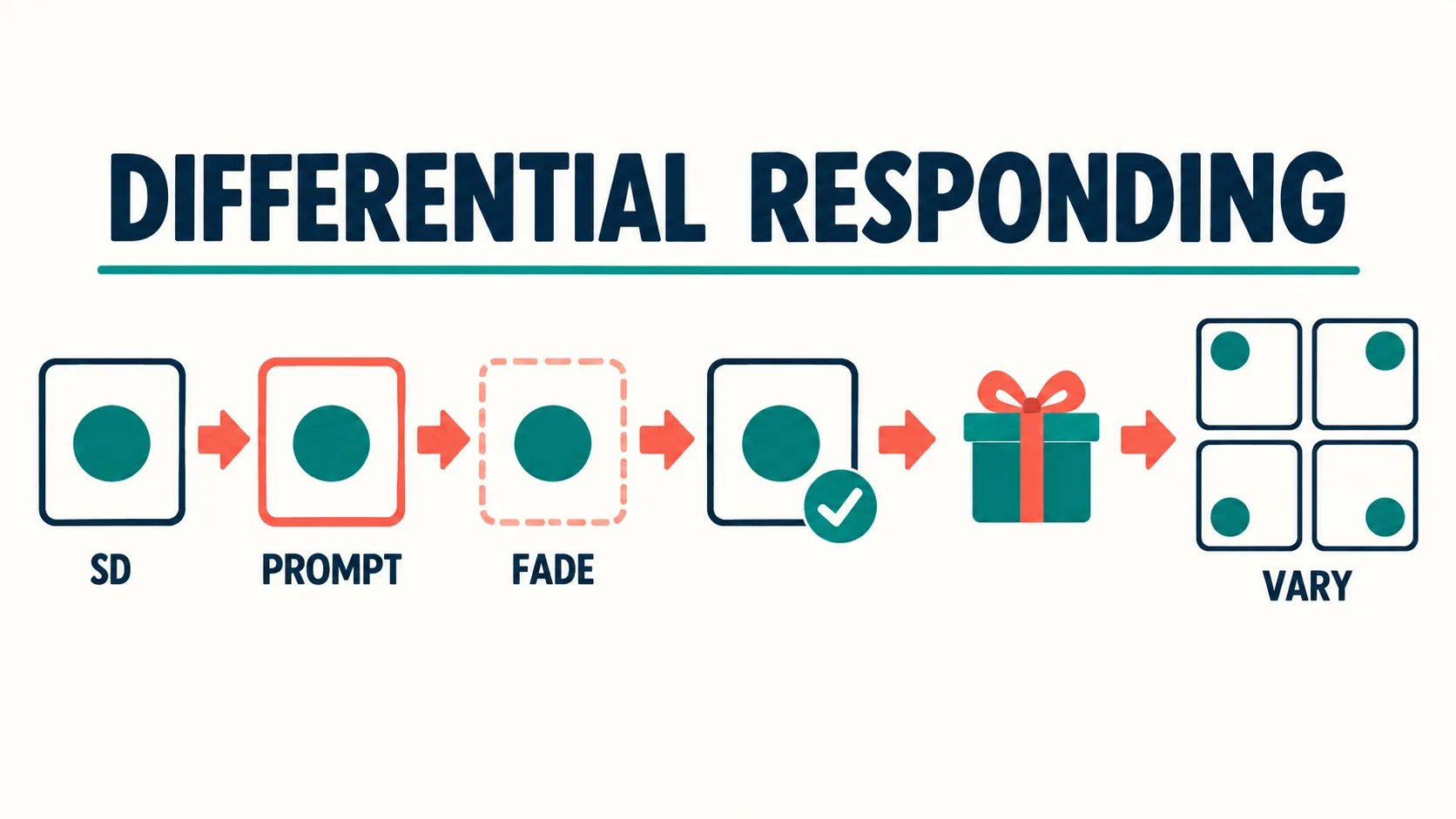
A practical discrimination-training sequence begins with a clear target and a manageable contrast. Present the relevant stimulus, arrange the response opportunity, deliver the programmed consequence for the target response, and use an error-correction or prompting plan that does not become the permanent cue. Then vary the position, materials, instructors, and noncritical features as the learner demonstrates stable responding.
One common failure is position control. A learner may select the item on the left because the target has repeatedly appeared there, not because the learner is responding to the sample or instruction. Rotate positions in a planned way and record performance by position. Another failure is control by an irrelevant feature. If every correct item is red and every S-delta is blue, the learner may learn color rather than the intended category. Vary irrelevant features while keeping the target relation intact.
| Training step | Implementation focus | Data to review |
|---|---|---|
| Define the relation | Identify the relevant SD, S-delta, target response, and consequence. | Can a second observer describe the same trial? |
| Arrange a contrast | Make the relevant stimuli sufficiently discriminable while avoiding unnecessary clutter. | Are errors tied to similarity, salience, or a missing feature? |
| Prompt and fade | Use the least intrusive effective support and systematically transfer control to the intended stimulus. | Do independent responses rise as prompt dependence falls? |
| Rotate and vary | Change position, materials, examples, and people without changing the target relation. | Does accuracy remain high across planned variations? |
Prompting and discrimination training can work together, but they answer different questions. A prompt is an added antecedent or assistance that helps evoke the response. The SD is the stimulus intended to occasion the independent response because of its reinforcement history. If the learner only responds after a gesture, a particular vocal tone, or a hand moving toward the correct item, the program needs a stimulus-control analysis rather than a simple accuracy celebration.
Troubleshoot Faulty Stimulus Control
When a learner makes errors, avoid changing several variables at once. First look for a pattern. Are errors concentrated on one position, one exemplar, one instructor, one background, or one type of verbal instruction? A pattern can show what is controlling behavior and can point to a focused adjustment.
| Observed pattern | Possible source of control | First check |
|---|---|---|
| Correct only when the target is on one side. | Position bias or a predictable array arrangement. | Randomize position and graph accuracy by position. |
| Correct with one item but not new exemplars. | Restricted control by a narrow feature or memorized item. | Vary noncritical features and test multiple exemplars. |
| Errors increase when the array is visually busy. | Weak stimulus disparity, poor salience, or competing features. | Simplify, highlight the relevant feature, and fade modifications gradually. |
| Correct only after an adult gesture or repeated phrase. | Prompt control has not transferred to the intended SD. | Review prompt delay, fading, and independent-response consequences. |
| Accuracy looks high but drops with a new person. | Control may be tied to instructor behavior or a narrow context. | Test planned variations before calling the skill generalized. |
Stimulus disparity is the difference between the relevant positive and negative stimuli. Salience concerns how much a stimulus stands out from background stimulation. Increasing disparity or salience can help establish a discrimination, but it can also create a new problem if the learner learns an artificial feature that will not be present in the natural environment. A strong plan therefore includes a fading path: make the critical relation easier to detect, then gradually remove extra supports while checking independent responding.
Differential reinforcement can also clarify the contingency. If independent correct responses, prompted correct responses, and errors all produce identical outcomes, the learner may have little reason to contact the difference between them. Consequences should be arranged ethically and according to the learner’s plan; the point is not to make reinforcement unpredictable, but to make the relevant response–stimulus relation learnable and observable.
Test Generalization and Maintenance
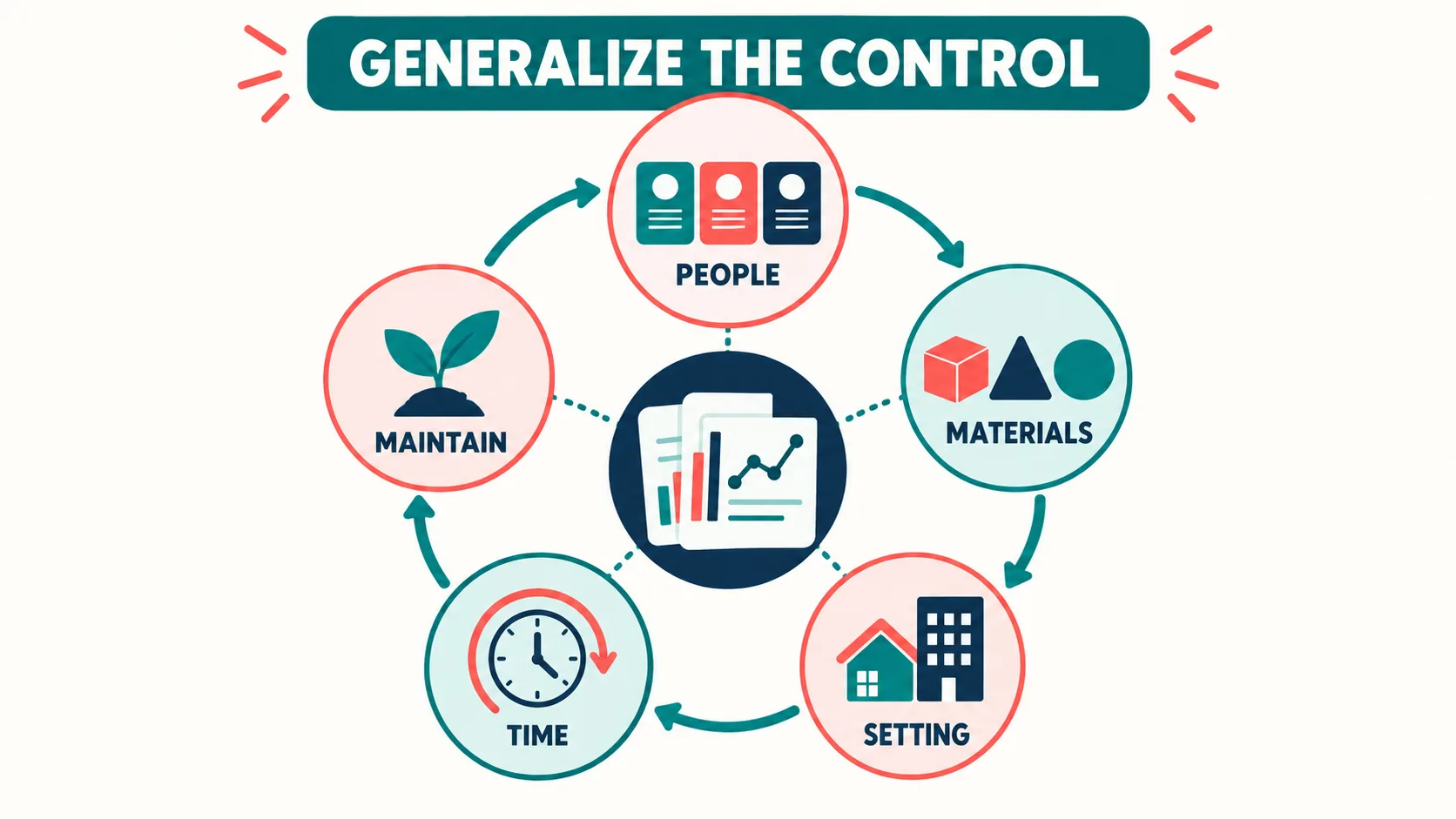
Acquisition in the teaching arrangement is only one checkpoint. Generalization means the relevant response occurs under new but appropriate stimulus conditions, people, materials, settings, or examples. Maintenance means the response continues over time after the initial teaching arrangement changes. A learner who selects one picture correctly with one instructor may still need instruction to respond with new exemplars, in a new room, or when the position of the comparison changes.
Plan generalization rather than waiting for it. Select variations that matter to the learner’s daily life, change one or two dimensions at a time, and record the same response definition across conditions. If performance drops, the data do not prove that the skill was never learned. They show that stimulus control may be too narrow, the new stimuli may be too difficult, or the teaching arrangement needs a programmed transfer step.
For a BCBA exam scenario, distinguish generalization from maintenance. Changing the instructor or materials tests stimulus generalization. Checking the response weeks later tests maintenance. Both are important, but they answer different questions. Also distinguish generalization from overgeneralization: responding to relevant new examples is useful; responding to irrelevant examples may indicate that the controlling feature is too broad.
For targeted practice applying SD/S-delta relations, stimulus control, prompting, and generalization to scenarios, the Free BCBA Mock Exam can help you identify gaps. It is a study diagnostic, not a clinical treatment plan or a guarantee of passing.
BCBA Exam Distinctions and FAQ
Is an SD the same as a prompt?: No. An SD has a reinforcement history that signals the availability of reinforcement for a response. A prompt is an added support that increases the probability of a correct response. A prompt can become an unintended controlling stimulus if it is not faded and if the learner does not contact the target relation independently.
Does an S-delta mean punishment?: Not automatically. In the standard discrimination-training explanation, the S-delta is correlated with the unavailability of reinforcement for the target response. That is different from arranging a punishment contingency. Always read the consequence described in the scenario instead of adding punishment language that is not present.
What is the difference between discrimination and stimulus control?: Discrimination describes differentiated responding across stimulus conditions. Stimulus control describes the functional relation in which an antecedent stimulus reliably changes the probability of a response because of its history with consequences. In practice, discrimination training is one way to establish or refine stimulus control.
Why is generalization included in discrimination training?: A useful discrimination should not depend on one accidental feature of the teaching setup. Planned generalization probes reveal whether the learner responds to the relevant stimulus relation across meaningful examples and contexts. If the skill does not generalize, revise the teaching arrangement rather than assuming that a high acquisition score is enough.
What should I verify before using this for BCBA exam study?: Check the current BACB task-list and examination materials for the version that applies to your exam. Terminology such as SD, S-delta, discrimination, generalization, and maintenance is foundational, but the published outline and exam policies can change.
Sources for Further Study
- Behavior Analyst Certification Board: Task Lists for BACB Certifications
- Stimulus Control Research and Practice: Considerations of Stimulus Disparity and Salience for Discrimination Training
- Designing Receptive Language Programs: Pushing the Boundaries of Research and Practice
- Discrimination Training for Persons with Developmental Disabilities
This article is for educational and BCBA exam-preparation purposes. A qualified behavior analyst should select and evaluate an individualized discrimination-training procedure using current assessment information, client preferences, safety requirements, social validity, and applicable professional standards.
Quick Review Checklist
Use this final checklist to turn discriminative training aba into exam-ready reasoning. The goal is not to memorize a label in isolation; it is to identify the relevant evidence and explain why the best answer fits the scenario. Key ideas to review:
- State the central definition or decision point for discriminative training aba in your own words.
- Identify the detail that makes discriminative training aba different from its closest related ABA term.
- Separate the observable facts in a scenario from assumptions that are not supported by the facts.
- Write one example and one nonexample so you can recognize the concept in a new setting.
Exam application checks:
- Ask what the question is actually requesting before comparing the answer choices.
- Mark the antecedent, response, consequence, or other evidence that supports the selected answer.
- Look for a distractor that describes a related process but does not answer the specific question.
Final self-check:
- Explain how you would verify the interpretation with clear observations or data.
- Change one detail in the scenario and decide whether your answer should change.
- Give a one-sentence rationale that a supervisor or study partner could evaluate.
Take the Free BCBA Mock Exam
When you are ready to apply the idea, use the free practice resource below for additional feedback. Take the Free BCBA Mock Exam



