
Measures of behavior can mean several different things in behavior analysis. A practitioner may be asking how often a response occurs, how long it lasts, how quickly it begins, how intense it is, whether it occurs during an interval, or whether it leaves a measurable product. In ABA and BCBA exam questions, the correct choice depends on the operational definition, the dimension that matters, the decision the data must support, and what an observer can realistically record.
Table of Contents
- Measures of Behavior in ABA: The Short Answer
- Match the Measure to the Behavior Dimension
- Choose Count, Rate, Time, or Magnitude
- Choose a Practical Recording Procedure
- Anticipate Measurement Bias
- Check Data Quality Before Interpreting a Trend
- BCBA Exam Distinctions and FAQ
- Sources for Further Study
- Quick Review Checklist
- Take the Free BCBA Mock Exam
The most important distinction is between a dimension of behavior and a recording procedure. Frequency, rate, duration, latency, and intensity describe what aspect of behavior is being measured. Event recording, duration recording, interval recording, momentary time sampling, and permanent-product recording describe how data are collected. A good measurement system connects both parts instead of choosing a familiar method automatically.
Measures of Behavior in ABA: The Short Answer
In an ABA context, a measure is useful when it captures a behavior in a way that answers a specific question. If the question is “How many times did the learner request?” a count or rate may fit. If the question is “How long did the learner engage in the routine?” duration may fit. If the question is “How quickly did the learner start after the instruction?” latency may fit. If the question is “Was the behavior present at any point during each interval?” an interval procedure may be appropriate.
Start with the behavior’s observable beginning and ending, not with the name of a favorite data sheet. Define what counts, define the observation period, identify the important dimension, and then select a procedure that the team can implement accurately. A technically sophisticated measure is not useful if observers cannot collect it consistently or if it does not answer the decision at hand.
Match the Measure to the Behavior Dimension
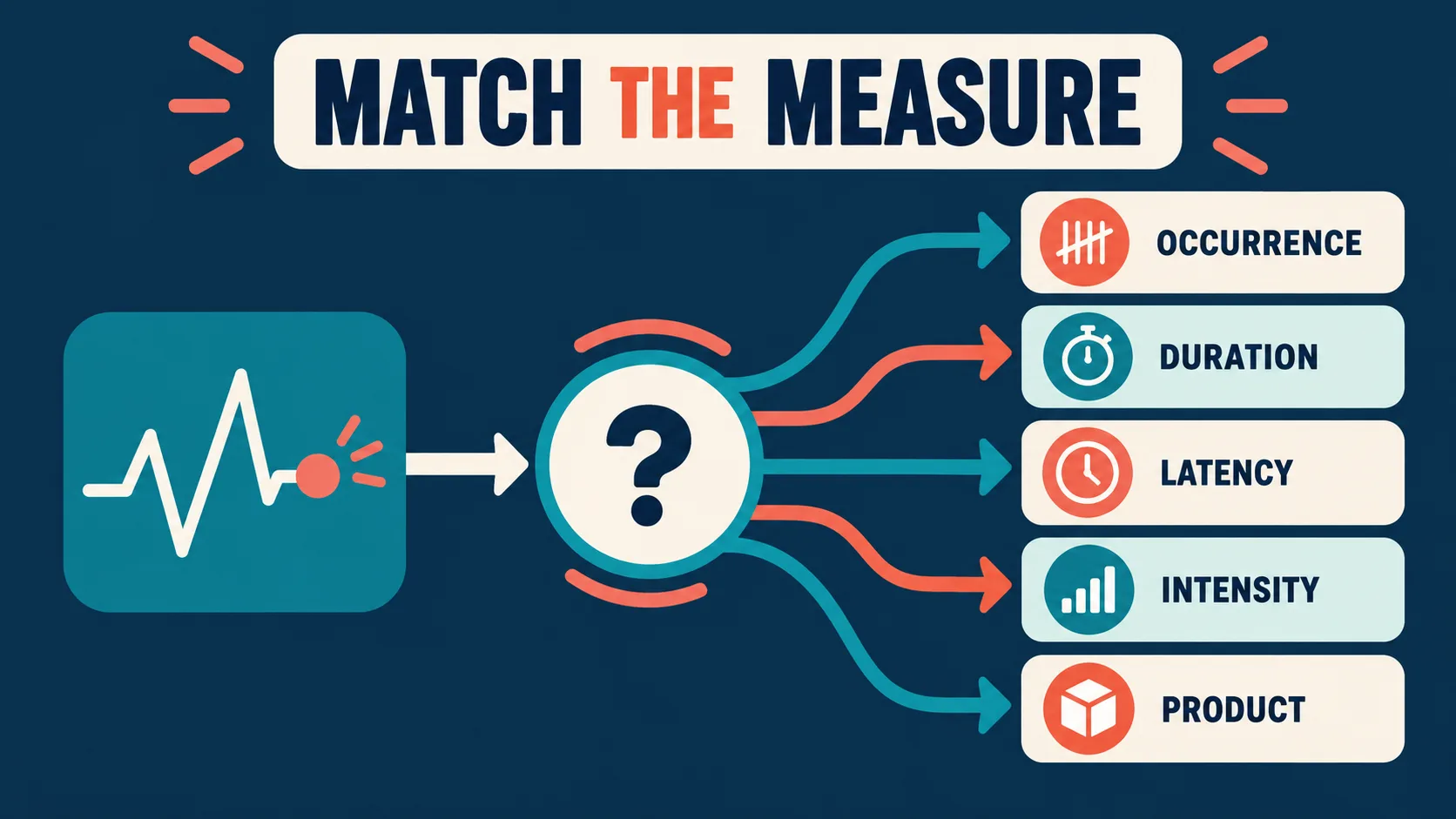
The first decision is what you need to know about the response. “Behavior increased” is incomplete until you state whether the count, rate, duration, latency, intensity, percentage, or another dimension changed. Two measures can move in opposite directions: a behavior may happen fewer times but last longer, or occur at the same count during a shorter observation.
| Dimension | Question it answers | Example decision |
|---|---|---|
| Occurrence | How many responses happened? | Compare the number of independent requests per session. |
| Temporal | How long, how quickly, or how far apart were responses? | Track duration of a routine or latency to begin a task. |
| Magnitude | How strong, loud, forceful, or severe was the response? | Use a defined rating or device when intensity is the relevant risk dimension. |
| Product or outcome | What observable result remains after the behavior? | Count completed assignments, clean items, or correctly assembled products. |
| Opportunity-based | How often did the response occur out of available chances? | Report correct responses divided by clearly defined opportunities. |
Operational definitions protect the measurement. “Aggression,” “off task,” or “communication” can mean different things to different observers. Specify the topography, onset, offset, context, and examples and nonexamples before choosing the data system. Otherwise, a clean-looking graph may represent inconsistent observer decisions rather than a real change in behavior.
Choose Count, Rate, Time, or Magnitude
Count or event recording fits discrete responses with a reasonably clear beginning and end when the observer can detect each occurrence. Rate adds a time denominator, such as responses per minute or per hour, which makes sessions of different lengths easier to compare. Frequency and rate are often discussed together, but the time basis must be visible when observations are not equal.
Duration fits behavior for which the amount of time matters. Latency measures the elapsed time between a defined event and the start of a response. Intensity requires a defensible scale, device, or rating rule; “looked worse” is not an intensity measure unless the team defines and trains the rating.
| If the scenario emphasizes… | Consider… | Do not forget… |
|---|---|---|
| Brief, countable responses | Event recording for count or frequency | The observation length and whether responses are discrete enough to count. |
| Different session lengths | Rate using a consistent time unit | Rate standardizes time; it does not solve an unclear behavior definition. |
| Sustained behavior | Duration recording | Define onset and offset and use a timing method the observer can operate. |
| Delay after a cue or instruction | Latency recording | Define the antecedent and the response onset before starting the timer. |
| Force, volume, or severity | Intensity recording | Use a reliable scale or device and train observers on anchor examples. |
A common exam trap is selecting duration because a behavior sounds serious, or selecting rate simply because the scenario gives a session length. Choose the measure that matches the question. Extra numerical details may be irrelevant unless the question asks you to standardize or compare across time.
Choose a Practical Recording Procedure
Continuous procedures attempt to capture each relevant occurrence or its time dimension. Discontinuous procedures divide observation into intervals and record whether the behavior happened according to the rule. Permanent-product recording measures a lasting result after the behavior, which can be useful when direct observation is difficult and the product reliably reflects the response.
| Procedure | What the observer records | Best-fit caution |
|---|---|---|
| Event recording | Each defined instance as it occurs | May be impractical for very frequent, continuous, or hard-to-discriminate behavior. |
| Partial-interval | Whether behavior occurred at any point in an interval | Can overestimate time engaged because one brief response marks the interval positive. |
| Whole-interval | Whether behavior occurred for the entire interval | Can underestimate behavior when a response stops briefly before the interval ends. |
| Momentary time sampling | Whether behavior is occurring at the instant the interval ends | A snapshot is not the same as observing the full interval. |
| Permanent product | A durable outcome left by the response | Confirm that the product can be linked to the target behavior and not another person or event. |
Anticipate Measurement Bias
Every recording system trades precision, feasibility, and observer burden. If the team chooses an interval method because continuous recording is impossible, document that choice and interpret the resulting percentage as the output of that procedure. Do not quietly describe positive intervals as the exact percentage of time unless the procedure supports that conclusion.
Also watch for denominator problems. A rate calculated from a ten-minute observation is not directly comparable with a count from a forty-minute observation. A percentage of opportunities is meaningless if opportunities are not defined consistently. A permanent product may look better because the observer misses incomplete attempts. These are measurement questions, not merely arithmetic questions.
Check Data Quality Before Interpreting a Trend
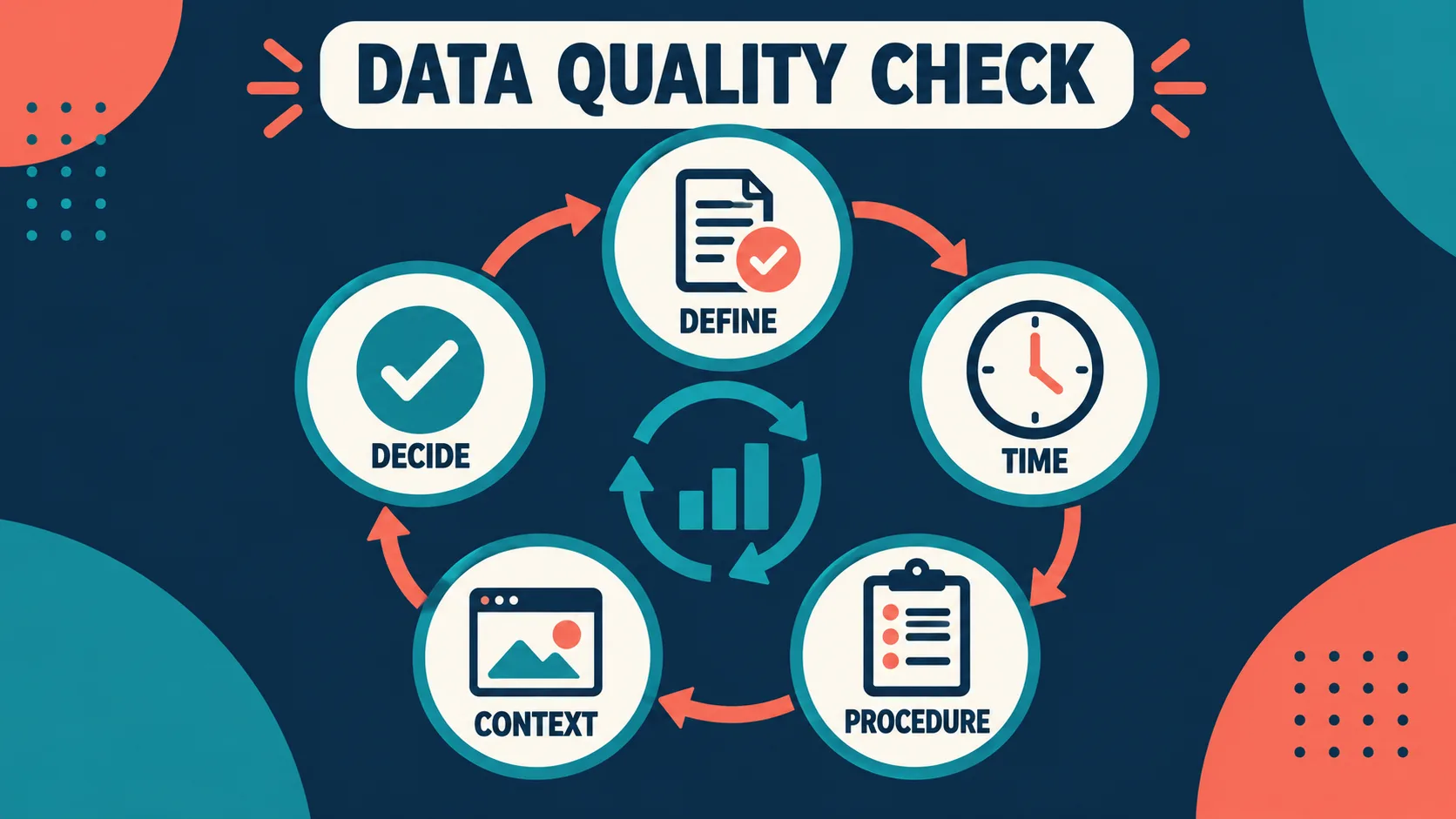
Before deciding that behavior improved or worsened, check whether the measurement system stayed stable. Review the operational definition, observation length, observer training, recording procedure, prompt level, opportunity count, and any change in context. If two observers disagree, investigate whether the definition or examples need refinement rather than averaging away the disagreement.
- Definition: Can two trained observers identify the response and its onset and offset?
- Denominator: Is the observation time or number of opportunities clear?
- Procedure: Did the team use the same continuous, interval, time-sampling, or product rule?
- Context: Did the setting, task, communication support, staff, or schedule change?
- Decision: Does the measure capture the outcome that matters to the learner and team?
For BCBA exam questions, the strongest answer often begins with the dimension and ends with feasibility. A measurement system should be valid enough for the decision, practical enough for the observer, and transparent enough that another person can interpret the graph without guessing.
BCBA Exam Distinctions and FAQ
Remember these fast distinctions: frequency is a count of occurrences, rate adds time, duration measures how long, latency measures time from an event to response onset, intensity measures magnitude, and interval procedures sample occurrence according to a rule. Permanent product measures an outcome rather than watching every instance directly. The scenario’s wording should tell you which dimension matters.
For targeted practice applying measurement, data display, ethics, and assessment concepts to scenarios, the Free BCBA Mock Exam can help you find gaps. It is a study diagnostic, not a clinical measurement plan or a guarantee of passing.
What are the main measures of behavior in ABA?: Common dimensions include occurrence or count, rate, duration, latency, intensity, interresponse time, percentage of opportunities, and permanent products. The appropriate choice depends on the operational definition and the question being answered.
What is the difference between frequency and rate?: Frequency is commonly used for the number of responses observed. Rate expresses occurrence relative to a time unit, such as responses per minute. Rate is especially useful when observation sessions are different lengths.
Which measure is best for a behavior that lasts a long time?: Duration is often a logical candidate when the amount of time engaged is the important dimension. The team still needs a clear onset and offset and a recording plan that can be implemented accurately.
Does partial-interval recording measure exact duration?: No. Partial-interval recording marks an interval positive if the behavior occurs at any point in it. It can be practical, but the percentage of positive intervals should be interpreted as the output of that sampling procedure rather than automatically treated as exact time engaged.
Sources for Further Study
Review the BACB measurement task-list material, Vanderbilt’s Measuring Behavior resource, and the peer-reviewed measurement-procedure selection model. Current task-list editions and professional requirements can change, so confirm the version used for your BCBA exam and keep clinical decisions individualized and supervised.
Quick Review Checklist
Use this final checklist to turn measures of behavior into exam-ready reasoning. The goal is not to memorize a label in isolation; it is to identify the relevant evidence and explain why the best answer fits the scenario. Key ideas to review:
- State the central definition or decision point for measures of behavior in your own words.
- Identify the detail that makes measures of behavior different from its closest related ABA term.
- Separate the observable facts in a scenario from assumptions that are not supported by the facts.
- Write one example and one nonexample so you can recognize the concept in a new setting.
Exam application checks:
- Ask what the question is actually requesting before comparing the answer choices.
- Mark the antecedent, response, consequence, or other evidence that supports the selected answer.
- Look for a distractor that describes a related process but does not answer the specific question.
Final self-check:
- Explain how you would verify the interpretation with clear observations or data.
- Change one detail in the scenario and decide whether your answer should change.
- Give a one-sentence rationale that a supervisor or study partner could evaluate.
Take the Free BCBA Mock Exam
When you are ready to apply the idea, use the free practice resource below for additional feedback. Take the Free BCBA Mock Exam



