If you are preparing for the BCBA exam, you have likely encountered the VB-MAPP milestones and wondered how to keep them straight. The Verbal Behavior Milestones Assessment and Placement Program is a cornerstone tool in applied behavior analysis, and exam questions often test your ability to interpret its scores and identify verbal operants. This guide provides a clear, example-driven walkthrough of the milestones, their scoring, and the common traps that trip up even well-prepared candidates.
Table of Contents
- Introduction to VB-MAPP Milestones
- Understanding the VB-MAPP Milestones Framework
- Key VB-MAPP Milestones by Domain
- Worked Examples: VB-MAPP Milestones in Practice
- Exam Relevance and Common Traps
- Quick Checklist for Mastering VB-MAPP Milestones
- Summary and Next Steps
- Quick Review Checklist
- Take the Free BCBA Mock Exam
Introduction to VB-MAPP Milestones
The VB-MAPP is a criterion-referenced assessment tool designed by Mark Sundberg in 2008. It evaluates language and social skills in individuals with autism or other developmental delays, using a framework based on B.F. Skinner’s analysis of verbal behavior. The assessment is divided into three components: the Milestones Assessment, the Barriers Assessment, and the Transition Assessment. For the BCBA exam, the milestones are the most heavily tested, as they measure acquisition of key verbal and listener skills.
Why should you invest time in understanding these milestones? Because the exam frequently asks you to identify which skill domain a specific behavior falls under or to interpret a milestone score. The VB-MAPP milestones are not just a scoring rubric; they are a map of typical language development. When you can quickly categorize a behavior as a mand, tact, intraverbal, or listener response, you can answer scenario-based questions with confidence.
Understanding the VB-MAPP Milestones Framework
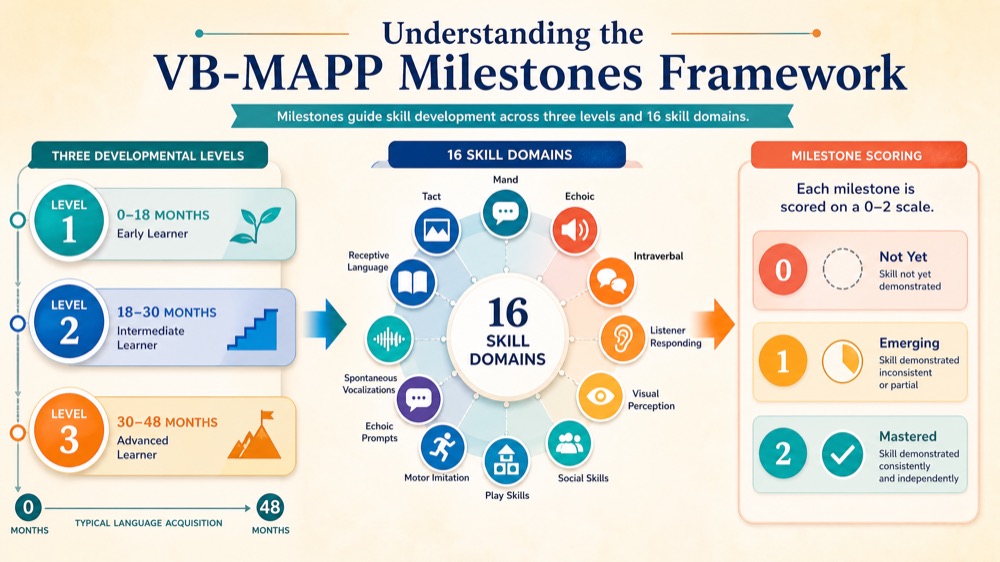
The milestones are organized into three developmental levels, mirroring typical language acquisition from birth to 48 months. Each level contains a set of milestones across 16 skill domains, including mand, tact, echoic, intraverbal, listener responding, visual perception, and more. In total, there are 105 milestones across all levels.
Each milestone is scored on a 0–2 scale, where 0 = not present, 1 = emerging (partially or inconsistently demonstrated), and 2 = mastered (demonstrated consistently across contexts). This scoring system allows clinicians to track progress and identify areas needing intervention. For exam purposes, you need to understand what each score means and how to apply it in practice.
The Three Levels: 0–18 Months, 18–30 Months, and 30–48 Months: Level 1 covers skills typically acquired between 0 and 18 months, focusing on foundational skills like requesting (mand), labeling (tact), and responding to simple instructions. Level 2 spans 18–30 months and includes more complex skills such as requesting others to perform actions, answering questions, and early conversational skills. Level 3 covers 30–48 months, targeting advanced skills like explaining reasons, telling stories, and engaging in group behavior. Understanding the progression helps you anticipate the type of skills tested at each level.
The Verbal Operants Addressed: Mand, Tact, Echoic, Intraverbal, and More: Skinner’s analysis of verbal behavior identifies several functional units called verbal operants. In the VB-MAPP, these include the mand (request), tact (label), echoic (repeating what is heard), and intraverbal (responding to verbal stimuli with non-matching verbal responses). Additionally, listener responding and visual perception are assessed. Knowing the differences and examples is crucial for exam questions that present a behavior and ask you to identify the operant.
Scoring: 0, 1, or 2 – What Do the Scores Mean?: Scoring is straightforward but requires careful observation. A score of 0 means the behavior was not observed even with prompts. A score of 1 indicates the behavior occurred but inconsistently or with partial prompting. A score of 2 means the behavior is demonstrated reliably across settings and with multiple examples. The score sheet is designed to capture these nuances, and you may be asked to interpret a score in a written scenario.
Key VB-MAPP Milestones by Domain
While you do not need to memorize all 105 milestones, you should be familiar with the most commonly tested ones. The exam often asks about milestones that illustrate distinct verbal operants. Below is a quick reference of key milestones across several domains.
Mand and Tact Milestones: Mands are requests, and tacts are labels. At Level 1, a mand milestone might involve asking for a desired item without a prompt. A tact milestone might involve labeling a common object when asked, like saying “ball” when seeing a ball. At higher levels, tacts become more complex, such as tacting actions or adjectives.
Listener Responding and Visual Perception: Listener responding involves following instructions, such as “clap” or “give me the cup.” Visual perception milestones include matching identical pictures or completing simple puzzles. These are foundational for academic readiness and are often assessed in early intervention settings.
Intraverbal and Echoic Milestones: Echoics are repeating what is heard, like saying “meow” after the clinician says “meow.” Intraverbals are more advanced, such as filling in the blank of a song or answering “What do you wear on your feet?” with “shoes.” These skills are essential for conversational language.
Worked Examples: VB-MAPP Milestones in Practice
To solidify your understanding, let’s walk through three practical examples that mirror how you might apply VB-MAPP milestones in a real assessment. Each example includes an ABC (antecedent-behavior-consequence) breakdown to illustrate the behavior’s function, which is a common exam format.
Example 1: Mand Milestone (Level 1, Milestone 6): Definition: The child requests a missing item without a prompt. For instance, when given a puzzle with a missing piece, the child says “piece” to get it.
Scenario: During a play session, the child is working on a 4-piece puzzle. One piece is missing. The child looks at the clinician and says, “Piece, please.” The clinician hands the piece. The behavior is maintained by social positive reinforcement (access to the piece). In this case, the child scores a 2 because the response occurred independently and in the natural context. Example 2: Tact Milestone (Level 2, Milestone 10): Definition: The child labels actions in pictures, such as pointing to a photo of a person jumping and saying “jumping.”
Scenario: The clinician presents a set of action cards and asks, “What is he doing?” The child responds, “jumping.” This behavior is likely maintained by social reinforcement (praise or acknowledgement). The child scores a 2 because he responded correctly to the verbal stimulus. Example 3: Intraverbal Milestone (Level 3, Milestone 15): Definition: The child answers “what” questions about functions, such as “What do you use to cut paper?” – “scissors.”
Scenario: During a conversation, the clinician asks, “What do you wear on your feet?” The child says, “shoes.” This is maintained by access to continued conversation or social reinforcement. The child scores a 2, demonstrating a strong intraverbal repertoire.
Exam Relevance and Common Traps
The BCBA exam often includes questions that require you to apply VB-MAPP knowledge in novel situations. You might be asked to identify which operant is being assessed, determine the correct score based on a description, or recognize a flaw in the assessment process. Knowing the common pitfalls can help you avoid them.
How BCBA Exam Questions Test VB-MAPP Knowledge: Many questions present a brief scenario of a clinician administering a milestone and then ask you to select the correct score or the operant being measured. For example: Question: A clinician shows a child a picture of a dog and asks, “What is it?” The child says, “dog.” Which verbal operant is this? Answer: This is a tact, because the child is labeling the visual stimulus.
Common Misconceptions About Milestones: One major trap is treating milestones as developmental norms. The VB-MAPP is criterion-referenced, not norm-referenced; it does not compare a child to a peer group but rather to a specific skill criterion. This distinction is vital for interpreting results and writing goals. Another misconception is that a score of 1 means failure. In reality, a score of 1 indicates emerging skill, which is valuable for tracking progress and shaping instruction.
Scenario-Based Pitfalls: What to Watch Out For: A common exam blunder is assuming a child failed a milestone when the antecedent conditions were not optimal. For example, if the assessment was conducted in a distracting environment, the child might not respond, leading to a false 0. The BCBA code emphasizes adequate sampling and ensuring the environment is conducive to the assessment.
Quick Checklist for Mastering VB-MAPP Milestones
Here is a five-step study aid to help you internalize the milestones before exam day. Step 1: Memorize the three levels and their age ranges, plus the 16 skill domains. Step 2: Define each verbal operant (mand, tact, echoic, intraverbal) and give one example. Step 3: Practice scoring with sample scenarios, as we did above. Step 4: Identify common traps, such as confusing tacts and mands. Step 5: Review with practice questions, focusing on application.
Summary and Next Steps
The VB-MAPP milestones are a vital part of your assessment toolbox. By understanding the framework, scoring, and examples, you can approach exam questions with confidence. Remember these key points:
- The VB-MAPP is criterion-referenced and assesses verbal and social skills in three levels.
- Each milestone is scored 0, 1, or 2, reflecting the skill’s presence.
- Verbal operants (mand, tact, echoic, intraverbal) are fundamental to interpreting milestones.
- Practice with realistic scenarios to avoid common traps.
For additional support, explore our guide on assessment in ABA to deepen your understanding of how tools like the VB-MAPP fit into the broader assessment process. Also, check the BACB website for official Task List details and the VB-MAPP resources for further reading. Keep practicing, and you will master the milestones in no time.
Quick Review Checklist
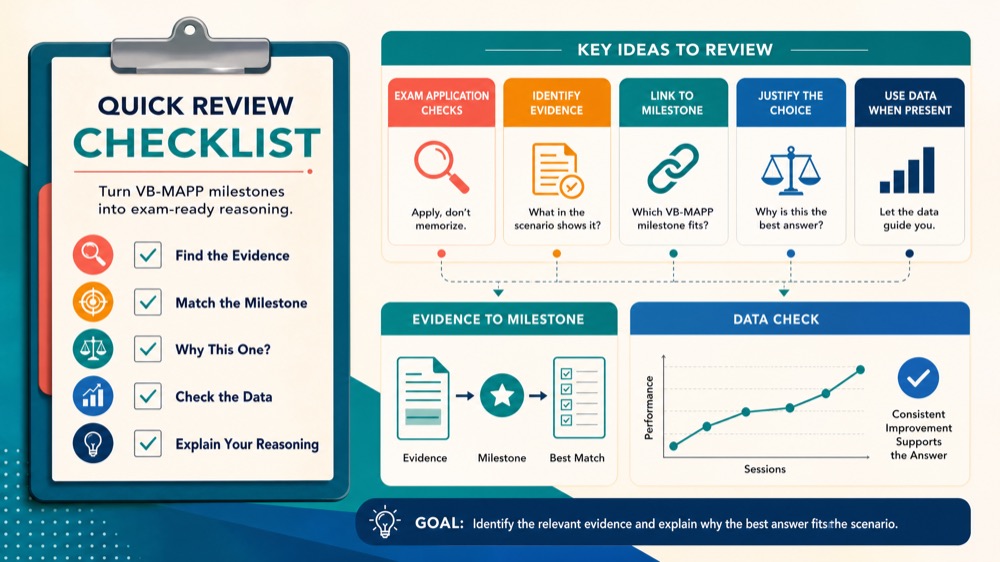
Use this final checklist to turn VB-MAPP milestones into exam-ready reasoning. The goal is not to memorize a label in isolation; it is to identify the relevant evidence and explain why the best answer fits the scenario. Key ideas to review:
- State the central definition or decision point for VB-MAPP milestones in your own words.
- Identify the detail that makes VB-MAPP milestones different from its closest related ABA term.
- Separate the observable facts in a scenario from assumptions that are not supported by the facts.
- Write one example and one nonexample so you can recognize the concept in a new setting.
Exam application checks:
- Ask what the question is actually requesting before comparing the answer choices.
- Mark the antecedent, response, consequence, or other evidence that supports the selected answer.
- Look for a distractor that describes a related process but does not answer the specific question.
Final self-check:
- Explain how you would verify the interpretation with clear observations or data.
- Change one detail in the scenario and decide whether your answer should change.
- Give a one-sentence rationale that a supervisor or study partner could evaluate.
Take the Free BCBA Mock Exam
Ready for more practice? Use the free mock exam to keep testing your accuracy with realistic BCBA-style items. Take the Free BCBA Mock Exam
Next step for BCBA exam prep
Turn this topic into exam-day practice
You have reviewed the key ideas. Take a full-length practice test to see what you can apply under exam conditions, then use your results to choose your next study step.
Take the Free BCBA Mock Exam
Continue with Five Full-Length Mocks — $99
Start with the free mock if you are still measuring your readiness. No pass guarantee is implied.