
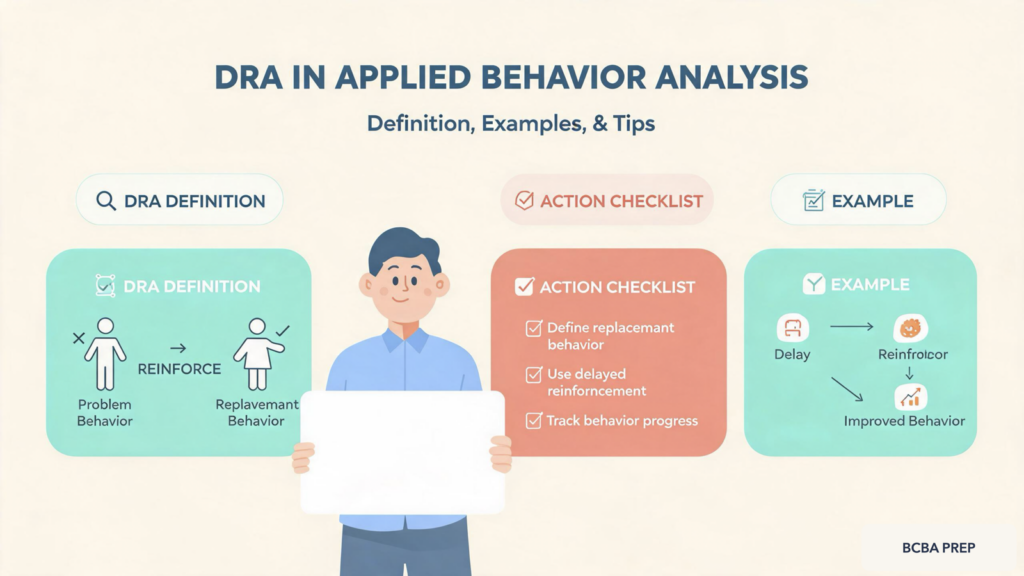
What Is DRA in Applied Behavior Analysis?
DRA stands for differential reinforcement of alternative behavior. It is a procedure in which a functionally equivalent alternative behavior is reinforced while the problem behavior is placed on extinction. In other words, you teach and reward a better way to get the same outcome, and you stop reinforcing the unwanted behavior.
Table of Contents
- What Is DRA in Applied Behavior Analysis?
- DRA in Practice: ABC Examples with Hypothesized Function
- BCBA Exam Relevance: Common Traps and Study Tips
- Quick Checklist for Implementing DRA
- Summary: Mastering DRA for Your BCBA Exam
- References
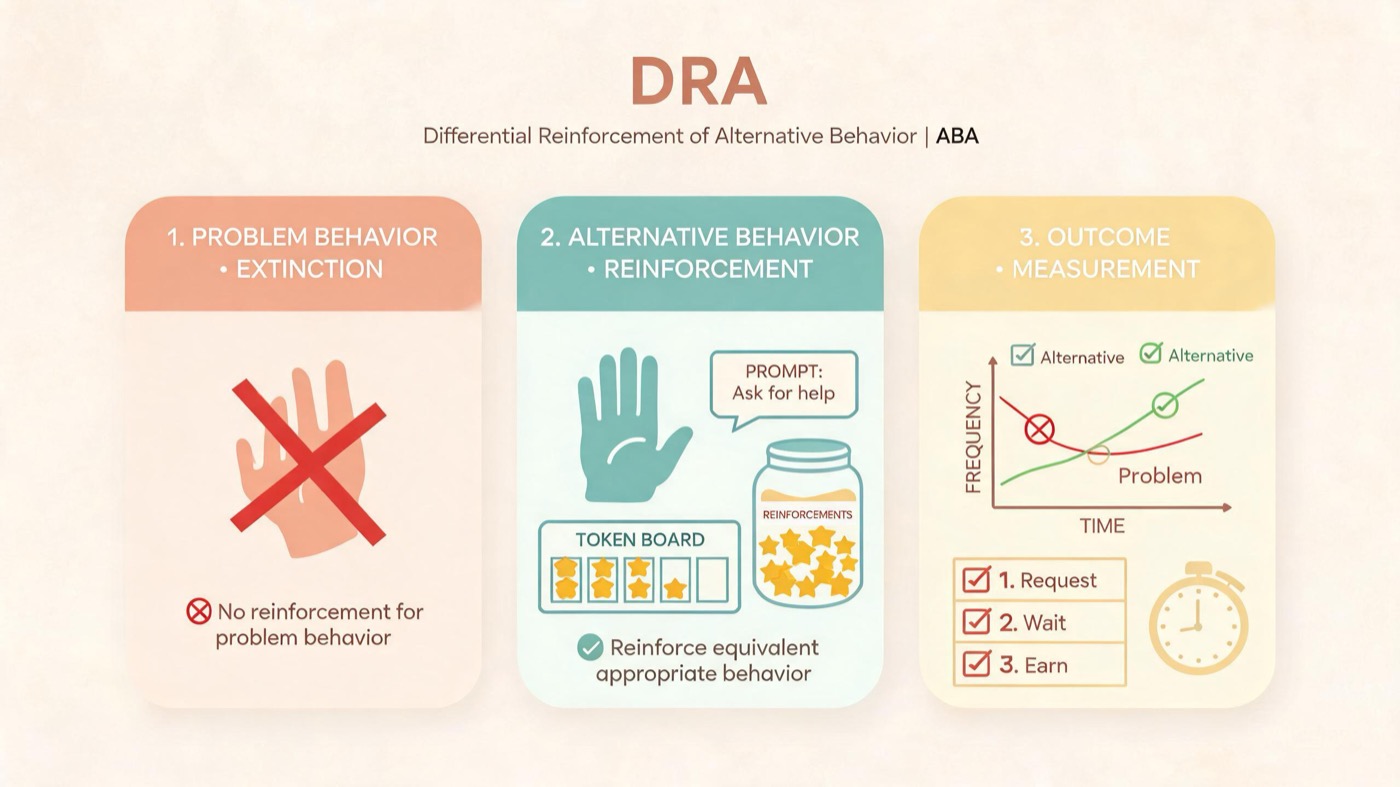
Key Components of DRA
Three elements are essential for DRA to work effectively:
- Reinforcement of alternative behavior: Provide a reinforcer (e.g., attention, escape, tangible) immediately after the learner engages in the selected alternative behavior.
- Extinction of problem behavior: Withhold the reinforcer that previously maintained the problem behavior. For example, if screaming was reinforced by teacher attention, that attention must no longer follow screaming.
- Functionally equivalent alternative: The alternative behavior should produce the same reinforcer as the problem behavior. This makes the new behavior more likely to replace the old one.
How DRA Differs from DRO, DRI, and DRL
DRA is often confused with other differential reinforcement procedures. The key distinction: DRA reinforces a specific alternative behavior, not just the absence of problem behavior (DRO) or a lower rate (DRL).
- DRO (differential reinforcement of other behavior): Reinforcement is delivered when the problem behavior does not occur for a set interval, regardless of what other behavior occurs.
- DRI (differential reinforcement of incompatible behavior): The alternative behavior is physically incompatible with the problem behavior (e.g., sitting vs. running). In DRA, the alternative need not be incompatible.
- DRL (differential reinforcement of low rates): Reinforcement follows only when the problem behavior occurs at or below a predetermined low rate, not an alternative.
Understanding these differences is critical for selecting the right intervention and for answering BCBA exam questions.
DRA in Practice: ABC Examples with Hypothesized Function
Real-world examples help solidify your understanding. Each example follows the ABC framework: Antecedent, Behavior, Consequence.
Example 1: Attention-Maintained Behavior
Antecedent: The teacher is working with another student and the child does not have her attention.
Target behavior: Child screams loudly to get teacher’s attention.
Alternative behavior: Child raises his hand or taps the teacher’s arm gently.
Consequence after alternative: Teacher immediately looks at the child and says, ‘I see your hand up!’ – providing attention.
Consequence after target: Teacher ignores the scream (extinction).
Hypothesized function: Attention.
Example 2: Escape-Maintained Behavior
Antecedent: A difficult math worksheet is placed on the student’s desk.
Target behavior: Student throws the paper and yells.
Alternative behavior: Student hands the teacher a ‘break card’ or says ‘I need a break.’
Consequence after alternative: Teacher provides a 2-minute break from the worksheet.
Consequence after target: Teacher prompts the student to pick up the paper and continue working (no break).
Hypothesized function: Escape from aversive task.
Example 3: Access to Tangibles
Antecedent: Child sees a candy bar at the checkout counter.
Target behavior: Child tantrums, falls to the floor, and screams.
Alternative behavior: Child says ‘please’ or points to the candy and uses a picture exchange card.
Consequence after alternative: Parent gives the candy after the polite request.
Consequence after target: Parent ignores the tantrum and does not provide candy.
Hypothesized function: Access to tangible items.
These examples illustrate how DRA must be function-based to be effective.
BCBA Exam Relevance: Common Traps and Study Tips
DRA appears frequently on the BCBA exam. Many candidates lose points because of subtle misunderstandings.
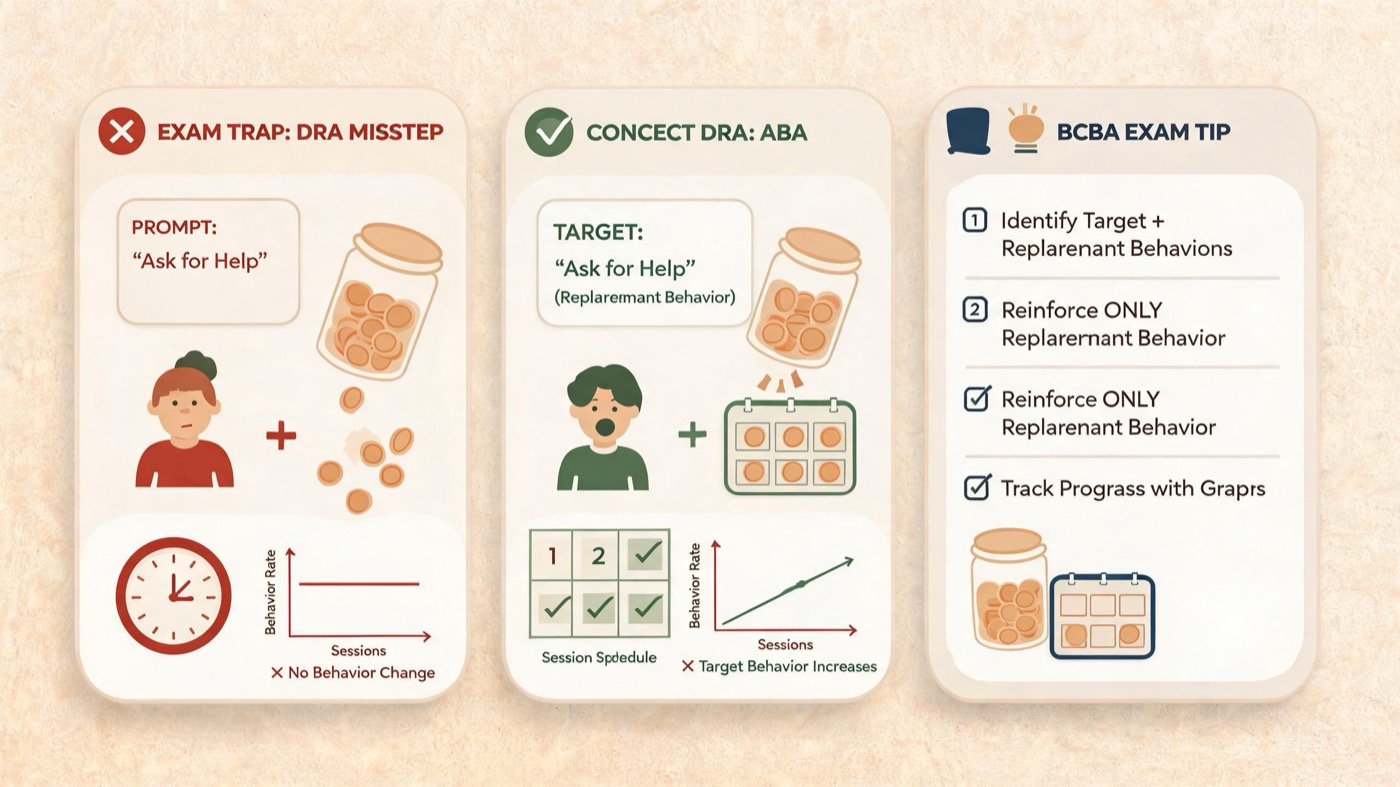
Common Exam Traps to Avoid
- Trap 1: Confusing DRA with DRO – DRO reinforces any behavior except the problem behavior; DRA reinforces a specific alternative. Always check whether the procedure targets a particular behavior.
- Trap 2: Thinking the alternative must be incompatible – In DRA, the alternative can be any appropriate behavior that serves the same function. Incompatibility is only required for DRI.
- Trap 3: Forgetting extinction – DRA requires extinction of the problem behavior. If the problem behavior is still reinforced, DRA will not be effective.
- Trap 4: Assuming slow effects – DRA can produce rapid behavior change if the alternative is easier to perform and delivers the same reinforcer immediately.
Study Checklist for DRA
- Define DRA accurately in your own words.
- Identify the two key components: reinforcement of alternative and extinction of target.
- Distinguish DRA from DRO, DRI, and DRL.
- Practice selecting an alternative behavior based on function.
- Describe an extinction burst and how to handle it.
- Apply DRA to case scenarios on mock exams.
For more exam practice, check out our detailed guide on differential reinforcement.
Quick Checklist for Implementing DRA
When designing a behavior intervention plan using DRA, follow these steps:
- Conduct a functional behavior assessment to identify the function of the problem behavior.
- Select an alternative behavior that is functionally equivalent and easier or equally easy to perform.
- Ensure the alternative behavior is in the learner’s repertoire or can be taught.
- Arrange the environment so the alternative behavior contacts reinforcement quickly.
- Implement extinction for the problem behavior; monitor for extinction bursts.
- Continuously collect data on both behaviors to evaluate progress.
Remember to always reinforce the alternative behavior consistently and ensure the reinforcer is powerful enough to compete with the problem behavior.
Summary: Mastering DRA for Your BCBA Exam
DRA is a powerful and widely tested procedure in applied behavior analysis. The key takeaways:
- DRA reinforces a specific alternative behavior and extinguishes the problem behavior.
- The alternative must be functionally equivalent.
- Do not confuse DRA with DRO, DRI, or DRL.
- Always apply extinction to the target behavior.
- Practice with case examples to solidify your understanding.
Use our BCBA exam guide on differential reinforcement and take free practice exams to strengthen your skills. Good luck!



