
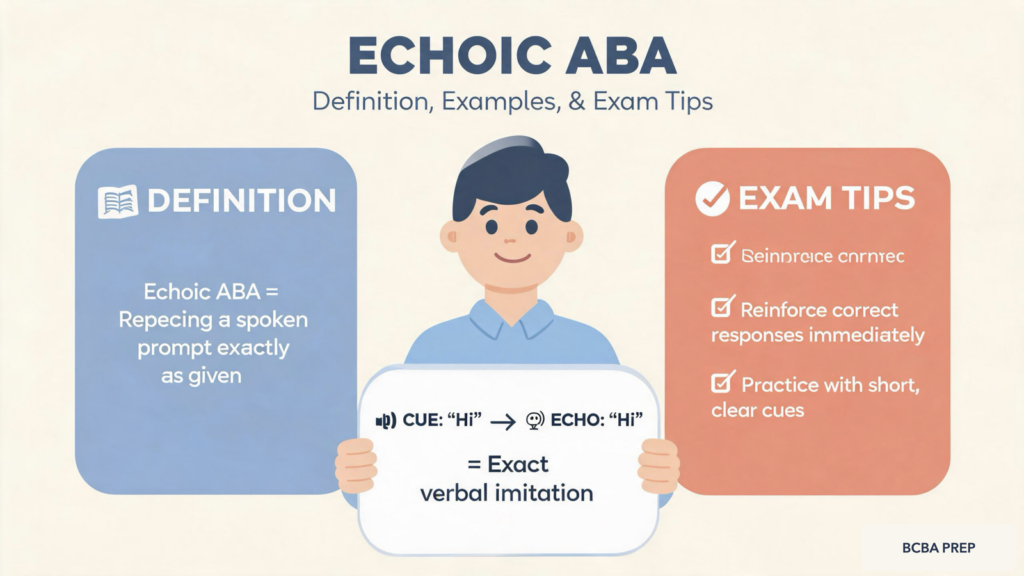
What is an Echoic in ABA?
An echoic is a verbal operant where the speaker repeats what someone else says. In ABA, the echoic is controlled by a verbal discriminative stimulus (SD) that has point-to-point correspondence and formal similarity with the response. For example, if a therapist says ‘cat’ and the learner says ‘cat’, that’s an echoic.
Table of Contents
- What is an Echoic in ABA?
- ABA Examples of Echoic Behavior
- Why Echoic Matters for the BCBA® Exam
- Quick Reference Checklist for Echoic
- Summary
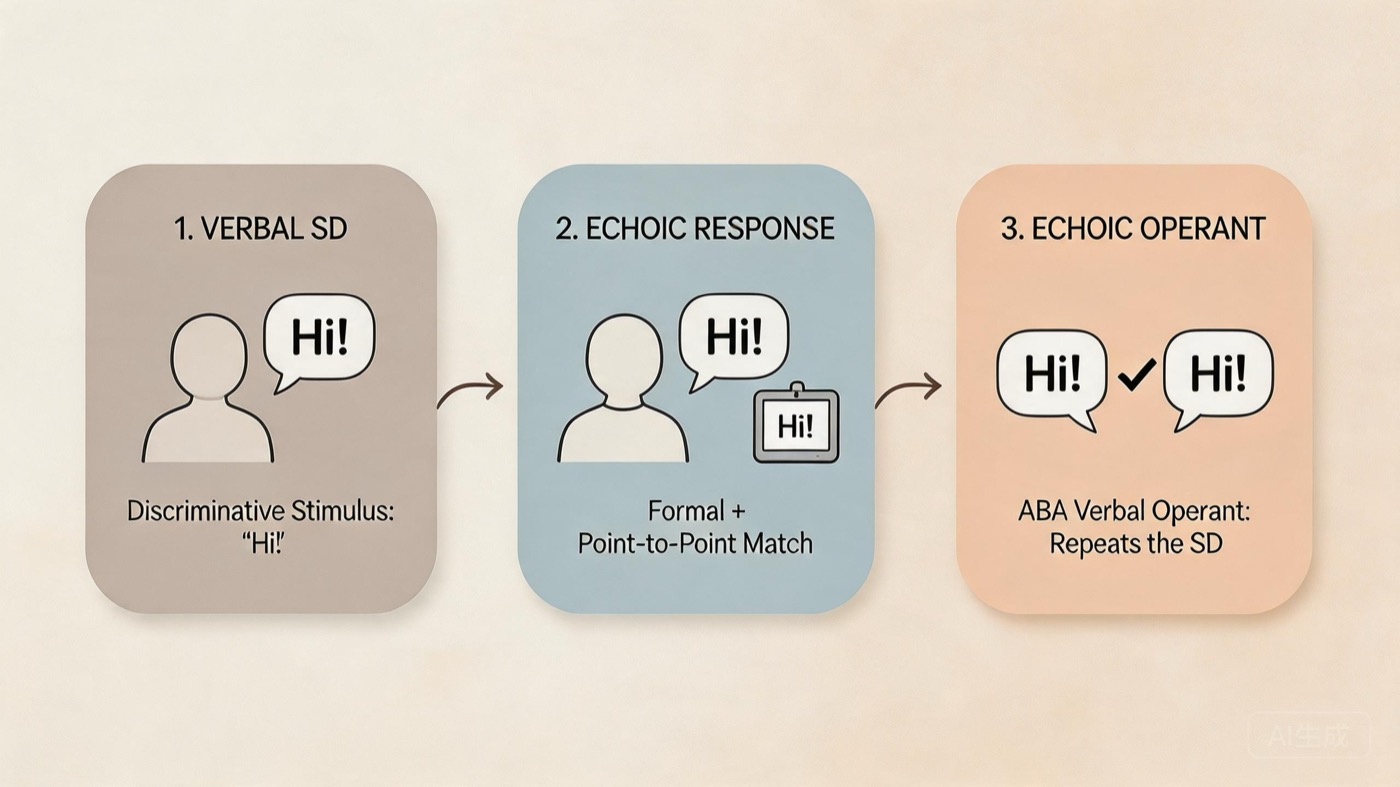
Point-to-Point Correspondence and Formal Similarity
Point-to-point correspondence means each part of the verbal stimulus matches each part of the response. Formal similarity means the stimulus and response are in the same sense mode (e.g., both auditory). Together, these features distinguish echoic from other verbal operants.
Echoic vs. Other Verbal Operants
Understanding controlling variables is key. Compare echoic with mand, tact, and intraverbal:
- Echoic: Controlled by a verbal SD; point-to-point correspondence and formal similarity.
- Mand: Controlled by an establishing operation (MO) and a specific reinforcer.
- Tact: Controlled by a non-verbal stimulus (e.g., seeing a dog).
- Intraverbal: Controlled by a verbal SD but no point-to-point correspondence (e.g., answering a question).
ABA Examples of Echoic Behavior
Here are practical echoic ABA examples with ABC data to illustrate how echoic teaching works in real settings.
Example 1: Language Acquisition in Early Intervention
- Antecedent: Therapist holds a ball and says ‘ball’.
- Behavior: Child says ‘ball’.
- Consequence: Therapist praises and gives the ball.
- Function: Social positive reinforcement (praise).
Example 2: Echoic in Natural Environment Teaching
- Antecedent: Parent says ‘more’ while offering a snack.
- Behavior: Child says ‘more’.
- Consequence: Parent gives more snack.
- Function: Access to tangibles (though still echoic because the SD is verbal).
Example 3: Echoic with Errors (Corrective Feedback)
- Antecedent: Teacher says ‘apple’.
- Behavior: Learner says ‘ap-pull’.
- Consequence: Teacher repeats ‘apple’ clearly (shaping).
- Function: Corrective feedback to shape accurate echoic.
Why Echoic Matters for the BCBA® Exam
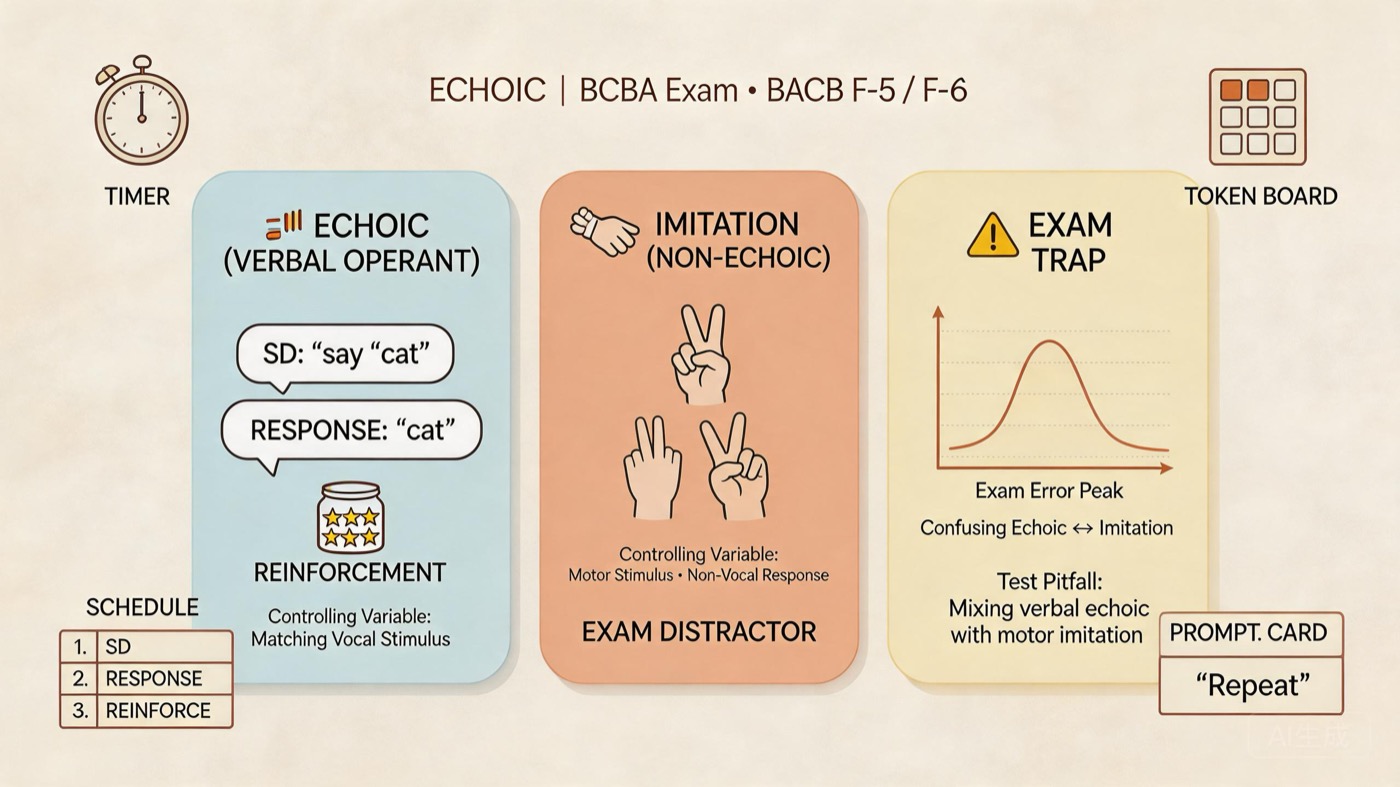
The echoic is frequently tested on the BCBA exam under the verbal operants content area (BACB Task List items F-5, F-6). You’ll need to identify the controlling variables and distinguish echoic from imitation and other operants.
Common Exam Traps to Avoid
Watch out for these common traps:
- Confusing echoic with imitation: Echoic is verbal (saying what you hear), imitation is motor (doing what you see).
- Forgetting formal similarity: Echoic requires the stimulus and response to be in the same modality (e.g., both auditory).
- Mixing up the controlling variable: The echoic is controlled by a verbal SD, not an MO or a non-verbal stimulus.
Quick Reference Checklist for Echoic
Use this checklist to review before the exam:
- Identify the antecedent verbal SD.
- Check for point-to-point correspondence between SD and response.
- Verify formal similarity (same sense mode).
- Determine if the consequence is generalized social reinforcement (not specific to the SD).
- Compare to other operants: mand (MO-driven), tact (non-verbal SD), intraverbal (verbal SD but no point-to-point).
Summary
The echoic ABA definition revolves around point-to-point correspondence and formal similarity. It’s a foundational verbal operant for language acquisition. On the BCBA exam, you’ll need to recognize echoic scenarios and avoid traps like confusing it with imitation. For more practice, check out our verbal operants guide and take our free BCBA mock exam. For official standards, refer to the BACB website.



