
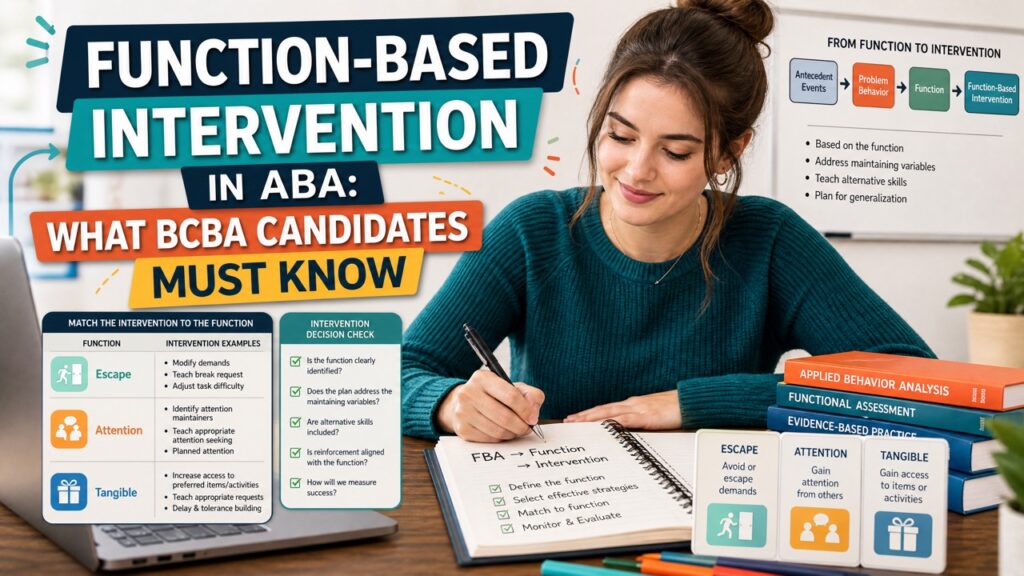
Introduction to Function-Based Intervention in ABA
When you sit for the BCBA exam, you will encounter scenarios that ask you to select the most appropriate intervention for a challenging behavior. The key is not to look at the behavior alone but to understand why it occurs. This is where function based intervention aba comes into play. At its core, a function-based intervention is a treatment strategy that directly addresses the environmental variables maintaining a behavior, rather than simply suppressing the behavior itself. This approach is grounded in the principles of applied behavior analysis and is a critical competency for any future BCBA.
Table of Contents
- Introduction to Function-Based Intervention in ABA
- The Four Common Functions of Behavior and Their Interventions
- Conducting a Functional Assessment to Inform Intervention
- Worked Examples: From ABC Data to Intervention
- Exam Relevance and Common Traps for BCBA Candidates
- Quick Checklist for Function-Based Intervention Review
- Summary and Final Recommendations
- Take the Free BCBA Mock Exam
In this guide, we will walk you through the foundational concepts, the four common functions of behavior, and how to translate assessment data into effective intervention plans. You will also find practical examples, common exam traps, and a handy checklist to solidify your understanding. By the end, you should feel more confident in your ability to reason through function-based questions on the exam and, more importantly, in your future practice.
The Four Common Functions of Behavior and Their Interventions
Behavior analysts typically categorize the maintaining variables of behavior into four major functions. Each function suggests a different type of intervention, so identifying the function is the first step in designing a successful plan. Let’s explore each function and the interventions that are most likely to be effective.
Social Positive Reinforcement: Attention and Tangibles: When behavior is maintained by social positive reinforcement, the individual gains access to attention or a preferred item as a result of the behavior. For example, a child might throw a tantrum to get a parent’s attention or to gain access to a toy. Interventions for this function focus on teaching alternative ways to request attention or tangible items. Functional communication training is a common approach, where the individual is taught to mand (request) for attention or items in a more appropriate manner. Additionally, differential reinforcement procedures, such as DRA, are often used to reinforce appropriate requests while extinguishing the problematic behavior.
Another key aspect is ensuring that the intervention is practicable in real-world settings. For example, if the learner requests attention verbally, the parent or teacher must be prepared to deliver attention promptly and consistently. If the request is not reinforced, the intervention may not be effective.
Social Negative Reinforcement: Escape and Avoidance: Escape-maintained behavior occurs when the individual engages in a behavior to remove or avoid an aversive situation, such as a difficult task or a noisy environment. For instance, a student might engage in self-injury to escape a math worksheet. Interventions for this function often involve task modification, such as breaking tasks into smaller steps, and teaching the learner to request a break using a break card or a verbal request. Demand fading, where the number of required responses is gradually increased, and extinction of the escape behavior (ensuring the behavior does not result in escape) are also common components.
It is crucial to reinforce the alternative behavior (e.g., requesting a break) and to ensure that the environment is structured so that escape is not available for the problem behavior. In practice, this means the teacher or parent must be trained to respond consistently to both the appropriate request and the problematic behavior.
Automatic Reinforcement: Sensory Stimulation: Automatic reinforcement refers to behavior that is maintained by the sensory stimulation it produces, independent of social consequences. For example, a child might flap their hands because the visual sensation is reinforcing. Interventions for automatically reinforced behavior are often more challenging because the reinforcer is not under the control of others. Common strategies include environmental enrichment, where the environment is filled with alternative sources of sensory stimulation, and teaching the learner to engage in more appropriate behaviors that produce similar sensory input. For example, if a child enjoys spinning, they might be taught to spin a top instead of spinning their body. In some cases, sensory integration techniques are recommended, but as a BCBA, we focus on the behavioral strategies.
When the automatic reinforcement is the primary function, it is important to rule out any medical causes first. Often, these behaviors can be reduced by providing more appropriate alternative sensory activities that are matched to the individual’s preferences.
Conducting a Functional Assessment to Inform Intervention
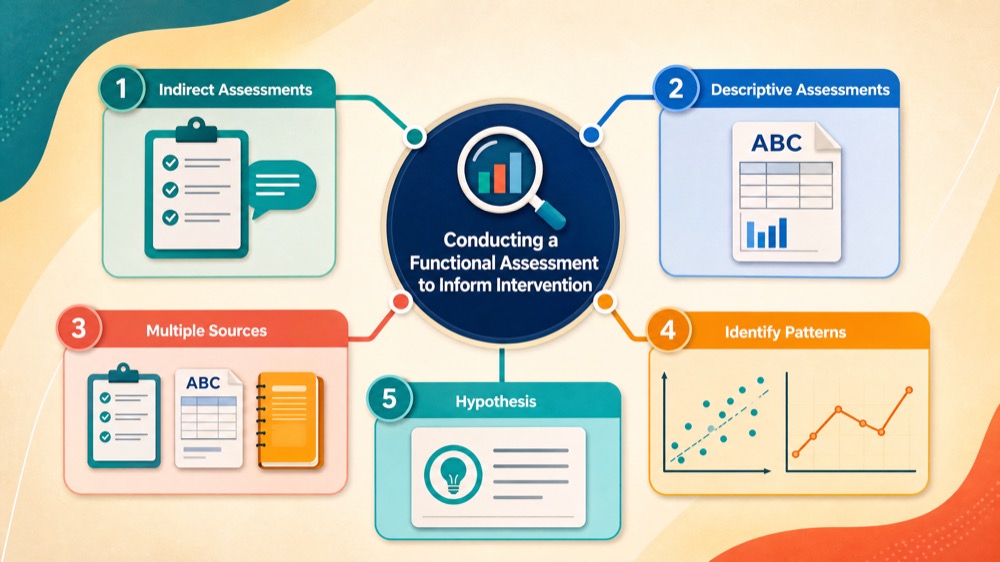
Before designing a function-based intervention, you must identify the function of the behavior through a functional assessment. This process involves gathering information from multiple sources to form a hypothesis about the maintaining variables. The BCBA exam will test your knowledge of various assessment methods and your ability to interpret the results.
Indirect and Descriptive Assessments: Indirect assessments include interviews and rating scales, such as the Functional Analysis Screening Tool (FAST) or the Questions About Behavioral Function (QABF). These tools rely on the reports of caregivers or teachers who have observed the behavior. Descriptive assessments involve direct observation and data collection in the natural environment, often using ABC (antecedent-behavior-consequence) recording. These methods are useful for generating hypotheses, but they can be limited by the observer’s presence and the potential for reactivity.
During the exam, you may be asked to analyze ABC data and hypothesize the function. It is essential to look for patterns in the antecedents and consequences. If the consequence often involves a reprimand (attention) or the removal of a demand (escape), that is a clue to the function.
Functional Analysis and the BCBA Exam: A functional analysis (FA) is the gold standard for confirming the function of behavior because it systematically manipulates environmental variables to test hypothesized functions. In an FA, conditions such as attention, escape, alone, and tangible are compared to a control condition. While FAs are considered the most rigorous method, they require controlled settings and are not always feasible in everyday practice.
On the BCBA exam, you will need to understand the conditions of a standard FA, interpret its results, and know when it is appropriate to conduct one. For example, if a behavior is dangerous, you may opt for a more conservative assessment. You should also be aware of the ethical considerations, such as ensuring the individual’s safety and obtaining informed consent.
Worked Examples: From ABC Data to Intervention
To see how function-based intervention works in practice, let’s walk through two examples. These examples mirror the type of reasoning you will use on the exam. Example 1: Escape-Maintained Behavior: ABC Data: During a reading task, when the teacher presents a worksheet, the student throws the pencil and puts their head down. The teacher removes the worksheet and tells the student to take a break. The behavior is more likely to occur when the task is long or difficult. Hypothesized Function: The behavior is likely maintained by escape from the aversive task. The consequence of removing the task reinforces the throwing behavior. Intervention Plan:
- Implement demand fading: start with a short, easy task and gradually increase difficulty.
- Teach the student to request a break using a break card or a verbal phrase like “break please”.
- Reinforce the appropriate request with a brief break, while ensuring that throwing the pencil does not result in escape (extinction).
- Make tasks more interesting by incorporating the student’s preferred topics or using interspersed easy tasks.
In this plan, the intervention directly addresses the function of escape by providing an alternative way to access a break and by reducing the aversive nature of the task. Example 2: Attention-Maintained Behavior: ABC Data: When the teacher is working with another student, the child calls out “Look at me!” repeatedly. The teacher responds with “I’m working, but you know I see you,” and then walks over to the child. The behavior occurs more often when the teacher is busy. Hypothesized Function: The behavior is maintained by attention from the teacher. Intervention Plan:
- Implement differential reinforcement of alternative behavior (DRA): reinforce the child for raising their hand or waiting quietly.
- Provide noncontingent attention on a fixed-time schedule, so the child receives attention regularly without having to exhibit calling out.
- Teach the child to say “excuse me” or tap the teacher on the shoulder, and provide immediate attention when they do.
- Use extinction for calling out: ignore the calling out behavior, but ensure that the alternative behavior is reinforced.
This intervention shifts the child’s behavior from attention-seeking that interrupts instruction to a more appropriate method of gaining attention.
Exam Relevance and Common Traps for BCBA Candidates
The BCBA exam will present you with a variety of scenario-based questions that require you to choose the best intervention. Many candidates miss these questions because they fall into common traps. Let’s explore the typical mistakes and how to avoid them.
Common Exam Traps to Avoid: Trap 1: Confusing topographical interventions with functional interventions. A topographical intervention targets the form of the behavior (e.g., stopping a child from flapping hands) without addressing the function (e.g., sensory stimulation). Always look for an option that acknowledges the function.
Trap 2: Ignoring multiple functions. Some behaviors serve more than one function. For example, a behavior may be reinforced by both attention and escape. An exam question might test whether you can identify a multi-function behavior and select an intervention that addresses all functions, such as teaching a communication response that provides both attention and a break.
Trap 3: Selecting punishment when reinforcement-based strategies should be tried first. The BCBA exam emphasizes ethical and effective interventions. Punishment-based procedures are often not the best first choice, especially if a function-based reinforcement approach is available.
Trap 4: Overlooking the role of setting events and motivating operations. The value of a reinforcer can change. For instance, if a student hasn’t had water all day, access to water will be a stronger reinforcer. An intervention that doesn’t account for the current MO may be less effective.
Trap 5: Failing to ensure the intervention is socially valid. The exam may ask you to choose an intervention that is acceptable to the client’s caregivers. If an intervention is too intrusive or difficult, it may not be implemented consistently.
How to Approach Scenario-Based Questions: When you encounter a scenario-based question on the exam, use a systematic approach: Step 1 – read the behavior description and identify the potential function. Step 2 – look at the consequences that follow the behavior. Step 3 – select the intervention that matches the function and includes reinforcement for an alternative behavior. Step 4 – eliminate choices that are topographical or that do not address the function.
For example, if the scenario describes a student who hits peers to get their toys, the function is likely tangible. The correct intervention might be to teach the student to request the toy or to use a timer to share. Punishing the hitting would not teach the student an appropriate alternative. Remember that the best intervention is not just about reducing the problem behavior; it must also result in the learner acquiring a functionally equivalent skill.
Quick Checklist for Function-Based Intervention Review
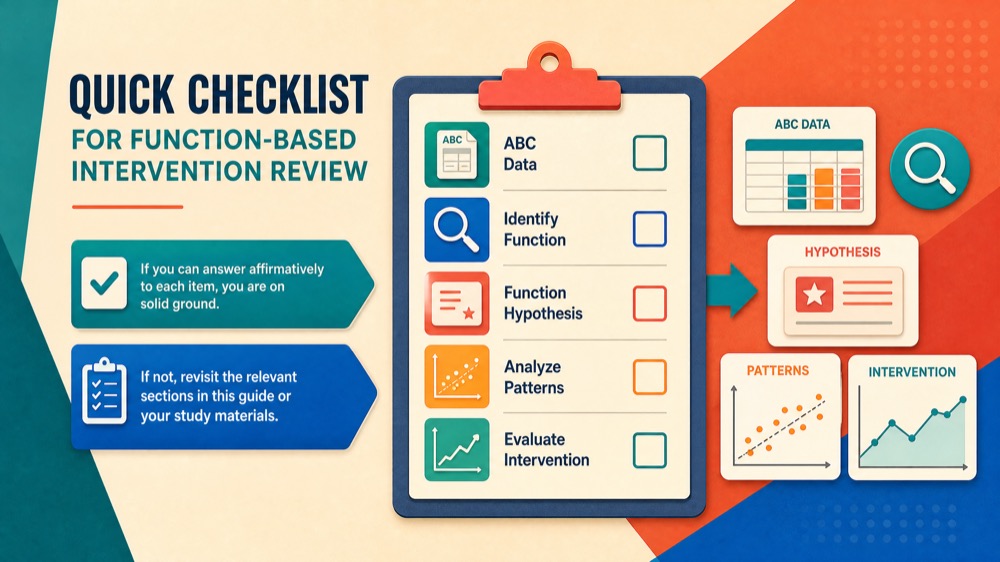
Use this checklist to review key concepts before the exam:
- Can you define the four functions of behavior? Social positive, social negative, automatic positive, automatic negative.
- Can you describe the key components of a functional behavior assessment? Indirect, descriptive, and functional analysis.
- Can you think of an example intervention for each function? FCT for attention, demand fading for escape, and sensory enrichment for automatic reinforcement.
- Can you identify the common pitfalls in intervention selection? Topographical vs. functional, multiple functions, and overlooking MOs.
- Can you explain why function-based interventions are more durable and generalizable than punishment-based approaches? They teach appropriate behavior and address the root cause.
- Do you know how to use ABC data to hypothesize a function? Look for consistent antecedents and consequences.
- Are you familiar with the BCBA exam’s emphasis on ethical practices and social validity? Choose interventions that are acceptable and feasible.
- Have you reviewed the BACB ethical code regarding function-based interventions? Always use the least restrictive, most effective intervention.
If you can answer affirmatively to each item, you are on solid ground. If not, revisit the relevant sections in this guide or your study materials.
Summary and Final Recommendations
Function-based intervention is a fundamental skill for any BCBA. It involves identifying the environmental variables that maintain behavior and designing interventions that make the problem behavior less effective and efficient while reinforcing an appropriate alternative. The BCBA exam will test your ability to apply these principles in a variety of scenarios.
As you prepare, practice with mock questions that require you to identify the function and select an intervention. Review your errors to see if you fell into common traps. Also, consider reading our FBA BCBA exam guide to deepen your understanding of the assessment process. For more on the functions of behavior, check out our functions of behavior study guide.
Finally, remember that a function-based intervention is not just about stopping behavior; it is about improving the quality of life for the individual by teaching new, adaptive skills. Approach every intervention with this goal in mind, and you will be both a better exam-taker and a better behavior analyst. You can also consult the BACB ethics information for more on ethical practice in intervention selection.
Take the Free BCBA Mock Exam
Ready for more practice? Use the free mock exam to keep testing your accuracy with realistic BCBA-style items. Take the Free BCBA Mock Exam



