
What Is a Functional Analysis?
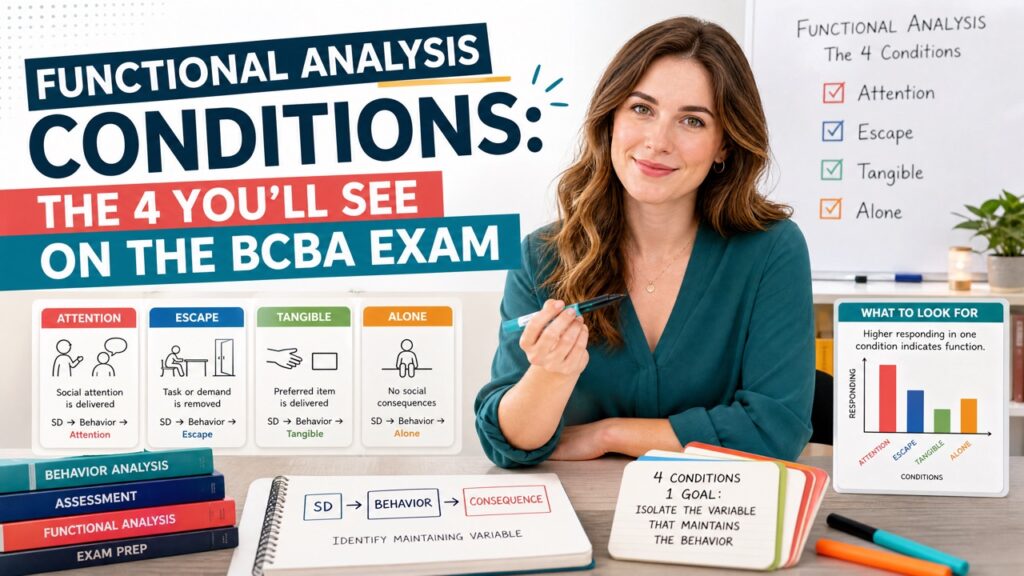
In applied behavior analysis, a functional analysis (FA) is an experimental method used to identify the function of a target behavior. It systematically manipulates environmental conditions to observe how behavior changes, allowing clinicians to determine whether a behavior is maintained by attention, escape, automatic reinforcement, or other consequences. The 4 conditions of a functional analysis are the standard test conditions used to uncover these functions.
Table of Contents
- What Is a Functional Analysis?
- The Full Breakdown of the Four Functional Analysis Conditions
- How to Interpret Functional Analysis Results
- FA vs. Functional Behavior Assessment (FBA)
- Working Through BCBA Exam-Style Questions
- Final Review: Quick Checklist for the BCBA Exam
- Take the Free BCBA Mock Exam
For BCBA candidates, understanding FA is essential because it is considered the gold standard for behavioral assessment. Unlike descriptive assessments that rely on observation alone, an FA actively controls variables to demonstrate a causal relationship between environment and behavior.
Why Functional Analysis Matters in ABA: FA is critical because it provides high-confidence evidence about why behavior occurs. Without knowing the function, interventions may be ineffective or even counterproductive. For instance, if a behavior is maintained by escape from demands, providing attention (a common default) would not reduce the behavior. FA data guides the selection of function-based interventions, making treatment more efficient and ethical. The 4 Conditions at a Glance: The four standard conditions are:
- Alone condition: Tests for automatic reinforcement (sensory stimulation).
- Attention condition: Tests for attention as a reinforcer.
- Play condition (control): Provides non-contingent attention and preferred items; serves as a baseline.
- Demand condition: Tests for escape or avoidance of demands.
The Full Breakdown of the Four Functional Analysis Conditions
Each condition is designed to create a specific establishing operation (EO) that increases the value of a particular reinforcer. By observing where the behavior is highest, you can infer its function. In this section, we break down each condition with practical examples, so you can visualize how they are implemented.
Alone Condition (Automatic/Sensory Reinforcement): In the alone condition, the individual is placed in a room with no social interaction or materials (or with neutral materials). The purpose is to test if the behavior is maintained by automatic reinforcement—that is, the behavior itself produces reinforcing sensory stimulation. If the behavior occurs frequently when alone, it suggests the function is automatic (sensory).
Example: A therapist places a child alone in a therapy room with no toys. The child begins hand-flapping. The consequence is the sensory feedback from the hand flaps. If hand-flapping is high in this condition, the behavior is likely maintained by automatic reinforcement.
Attention Condition (Social Positive Reinforcement): In the attention condition, the therapist is present but not attending to the individual. The individual has access to some neutral toys, and the therapist is engaged in another activity. The condition is set up so that the behavior produces attention (e.g., a reprimand, a comment). If the behavior increases when it is followed by attention, the function is socially mediated positive reinforcement—specifically attention.
Example: A child is in a room with the therapist turned away reading a magazine. The child hits the therapist. The therapist turns and says, “Stop that!” The attention (verbal reprimand) serves as the reinforcer. If hitting is high in this condition, the function is attention.
Play Condition (Control/Comparison): The play condition is the control condition in a functional analysis. It provides non-contingent attention, access to preferred items, and no demands. The goal is to create an environment where the behavior should be low because all potential reinforcers are freely available. If the behavior is low in this condition, it suggests that the behavior is not automatically reinforced and that the other conditions are controlling the behavior.
Example: The child has access to a favorite toy, and the therapist provides attention every 30 seconds (non-contingent). The child plays appropriately, and no consequence is delivered for the target behavior. The expected result is a low rate of the target behavior.
Demand Condition (Escape/Avoidance): In the demand condition, the therapist presents academic or daily living demands. The target behavior results in the removal or termination of the demand, typically a break. If the behavior is high in this condition, the function is escape from demands (socially mediated negative reinforcement).
Example: The therapist presents a worksheet and says, “Do your math.” The child screams and throws the pencil. The therapist removes the worksheet and says, “Okay, no more work.” The removal of the demand reinforces the screaming. High rates of screaming in this condition indicate the function is escape.
How to Interpret Functional Analysis Results
After implementing the FA, you collect data on the target behavior across conditions. Interpretation involves visually analyzing the data to determine which condition is associated with the highest, most consistent rates of behavior. The condition with the highest rate is likely to indicate the primary function.
Reading the Data: Clear patterns are easy to read: If behavior is elevated in the attention condition, the function is attention; if elevated in the demand condition, the function is escape; if elevated in the alone condition, the function is automatic. The play condition should show low levels. However, sometimes data are undifferentiated, meaning behavior occurs at similar rates across several conditions. This can happen for several reasons, including multiple functions, insufficient condition length, or poor implementation. Common Pitfalls in Interpretation: When reviewing FA data, be aware of these common traps:
- Undifferentiated data: If behavior is high in multiple conditions, the behavior may have multiple functions, or the FA wasn’t controlled well.
- Carryover effects: Behavior from one condition may continue into the next if conditions are too short or not separated.
- Inadequate condition length: Each condition needs enough sessions (often 5-10 minutes) to allow for stable responding.
- Poorly implemented conditions: Inaccurate implementation of the EO or consequences can invalidate results.
FA vs. Functional Behavior Assessment (FBA)
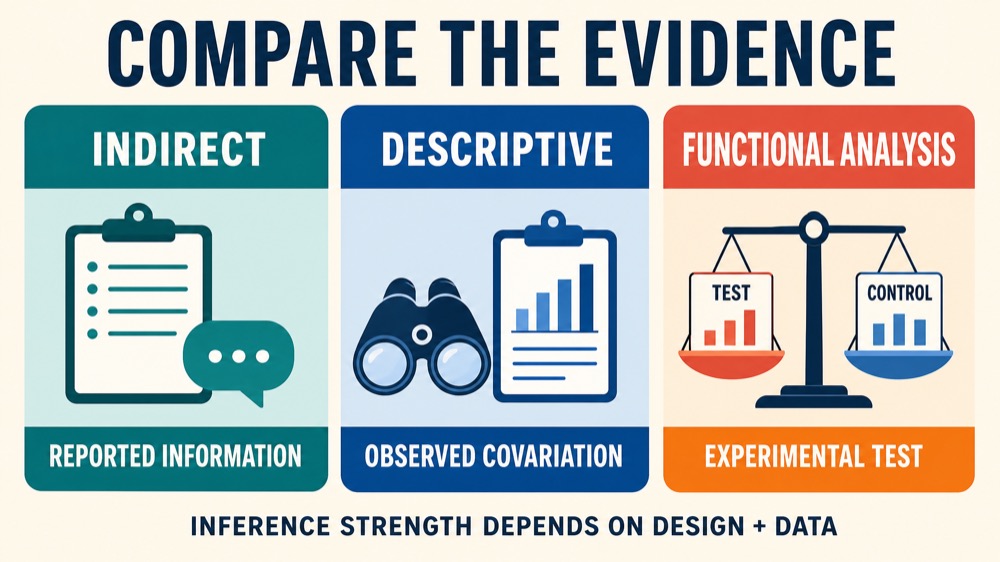
It’s common to confuse FA with FBA, but they are not the same. A Functional Behavior Assessment (FBA) is a broader, comprehensive process that includes indirect assessments (e.g., interviews, rating scales) and descriptive assessments (e.g., ABC observations). An FA is an experimental component that may be part of an FBA, but an FBA does not always include an FA. Understanding the difference is crucial for the BCBA exam because questions may ask you to identify which is experimental versus descriptive.
What is an FBA?: An FBA is a systematic process to identify the function of problem behavior. It often involves multiple methods: indirect assessments (gathering information from caregivers), descriptive assessments (direct observation in natural settings), and sometimes functional analysis (experimental manipulation). While descriptive assessments are less invasive and quicker, they only provide correlational information; an FA provides experimental evidence of function.
Why Both Matter for the BCBA Exam: The BCBA exam tests your ability to choose the appropriate assessment method. For example, if a behavior is dangerous or occurs at low rates, an FA may not be feasible; you might rely on descriptive assessment. Conversely, if the behavior is severe and you need high confidence in the function, an FA is warranted. Ethical considerations (e.g., risk) also factor into the decision.
Working Through BCBA Exam-Style Questions
Let’s put your knowledge into practice with a few exam-style scenarios. These examples mirror how you might apply your understanding of FA conditions. Example 1: Identifying Function from FA Graphs: Scenario: You are presented with a multi-element FA graph. Data show high rates of behavior in the attention condition, low rates in the play condition, and moderate rates in the demand condition. Question: What is the likely function? Answer: The function is attention, because the highest and most differentiated rates occur in the attention condition. The demand condition may show some escape, but the primary function is attention. Example 2: Designing an FA Condition: Scenario: A client’s self-injurious behavior is hypothesized to be maintained by attention. You are designing an FA to confirm this. Which condition would you need to include?
Answer: You would include an attention condition where behavior results in attention (e.g., verbal reprimand). You would also include a play condition as a control. If behavior is high in the attention condition and low in the play condition, the hypothesis is confirmed. Example 3: Troubleshooting an FA: Scenario: An FA yields undifferentiated results—behavior occurs at similar rates across all conditions. List two possible reasons and how you might address them.
Answer: One reason is insufficient session length; increase session duration to allow for differentiation. Another reason is that the behavior is automatically reinforced; consider adding an alone condition or a no-consequence condition. Also, check procedural integrity to ensure the conditions were implemented correctly.
Final Review: Quick Checklist for the BCBA Exam
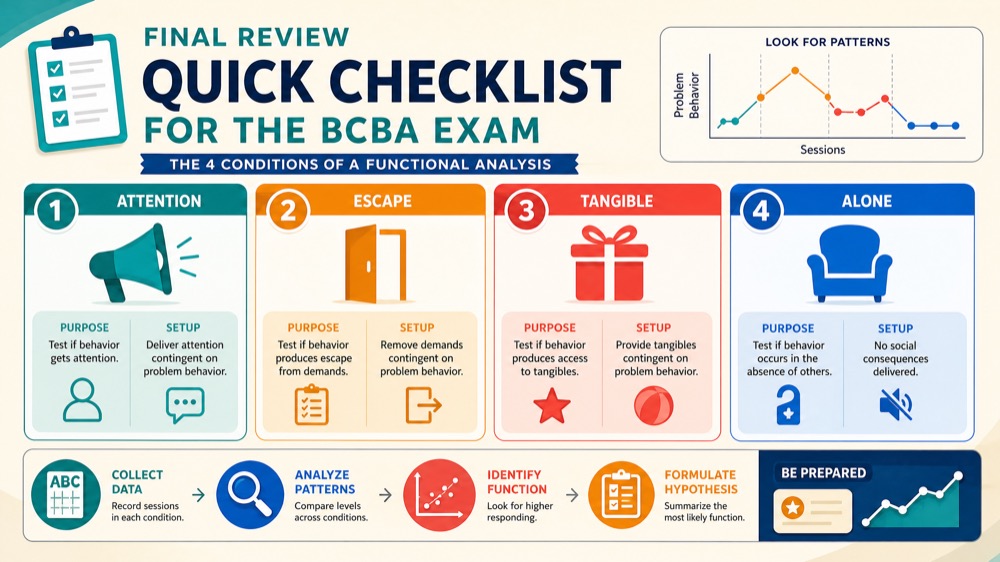
Use this checklist to solidify the key points before your exam.
- Alone condition: Tests automatic reinforcement; ensure no social consequences are delivered.
- Attention condition: Behavior results in attention; use a brief non-contingent attention schedule as control.
- Demand condition: Behavior results in escape from task demands; remove the demand immediately following behavior.
- Play condition: Control condition; non-contingent attention and preferred items; expected low rates.
- Data interpretation: Compare rates across conditions; the condition with the highest, most stable rates indicates the function.
- Common traps: Watch for undifferentiated data, carryover effects, and poor implementation.
Remember, the 4 conditions of a functional analysis are essential knowledge for the BCBA exam. By memorizing the purpose and setup of each, you’ll be prepared for any question that comes your way. For more in-depth review, check out our guide to functions of behavior and FBA guide. For further reading, you can explore the Behavior Analyst Certification Board and research articles on FA methodology.
Take the Free BCBA Mock Exam
Ready for more practice? Use the free mock exam to keep testing your accuracy with realistic BCBA-style items. Take the Free BCBA Mock Exam
Next step for BCBA exam prep
Turn this topic into exam-day practice
Use this topic as a focused review, then test it in exam-style conditions with a free mock before deciding whether five full-length mocks are the right next step.
Start the Free BCBA Mock ExamContinue with Five Full-Length Mocks — $99
Review the included materials and access details before ordering. No pass guarantee is implied.



