Understanding Self-Monitoring in Applied Behavior Analysis
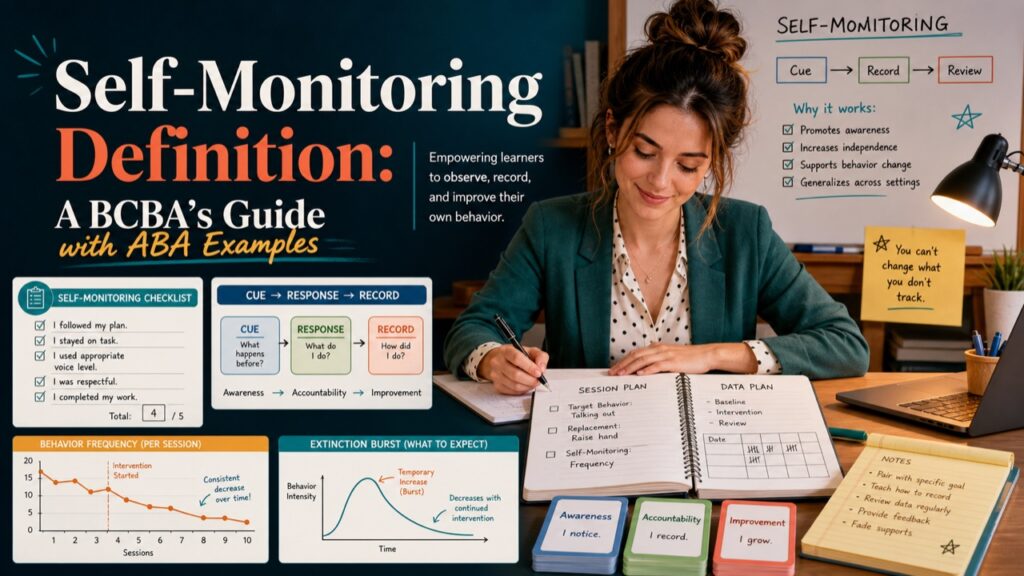
If you are preparing for the BCBA exam, you need a solid self-monitoring definition that goes beyond memorization. Self-monitoring is a versatile procedure used both as a measurement method and as an intervention. In applied behavior analysis (ABA), self-monitoring involves the client observing their own behavior and recording its occurrence. This article provides a thorough self-monitoring definition, illustrates it with real ABA examples, and explains how this concept appears on the BCBA exam. We will cover key components, differentiate it from similar techniques, and point out common traps that can trip up candidates.
Table of Contents
- Understanding Self-Monitoring in Applied Behavior Analysis
- What Is Self-Monitoring? A Clear Definition for BCBA Candidates
- Real-World ABA Examples of Self-Monitoring
- Why Self-Monitoring Matters for the BCBA Exam
- Quick Checklist: Self-Monitoring Essentials
- Summary: Mastering Self-Monitoring for the BCBA Exam
Understanding self-monitoring is not just about passing a test; it is about being able to design effective interventions that promote independence. When clients learn to self-monitor, they become active participants in their own behavior change. This skill is especially valuable for behaviors that occur in private settings or at times when a therapist is not present. The BCBA exam tests both your conceptual knowledge and your ability to apply self-monitoring in practice scenarios.
What Is Self-Monitoring? A Clear Definition for BCBA Candidates
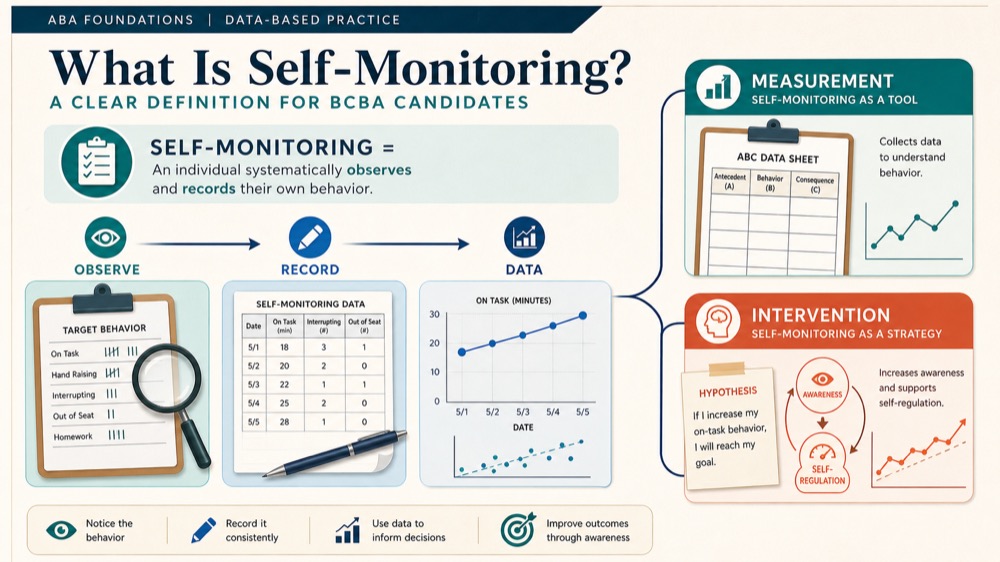
In ABA, self-monitoring is defined as a procedure in which an individual systematically observes and records their own behavior. It can serve two distinct purposes: as a measurement tool to collect data on a target behavior, or as an intervention to increase awareness and produce behavior change. For the BCBA exam, you must be able to distinguish self-monitoring from related concepts like self-evaluation and self-reinforcement. Self-evaluation involves comparing one’s performance against a criterion, while self-reinforcement is delivering a reinforcer contingent on meeting that criterion. Self-monitoring does not necessarily include evaluation or reinforcement; it can be purely observational.
When used as an intervention, self-monitoring often leads to reactivity—a change in behavior simply because it is being monitored. This effect can be harnessed therapeutically. For example, a client who tallies each instance of nail-biting may reduce the behavior due to increased awareness. However, reactivity can also confound measurement if you are not careful. The BCBA exam frequently tests your understanding of when self-monitoring is appropriate and how to interpret data obtained through this method.
Key Components of Self-Monitoring: Self-monitoring consists of two essential components: self-observation and self-recording. Self-observation means the client attends to the occurrence or non-occurrence of the target behavior. Self-recording involves documenting each occurrence using a device like a tally counter, a smartphone app, a paper log, or a wristband. For self-monitoring to be accurate, the client must be trained to discriminate the target behavior and to record it promptly. Without proper training, the data may be unreliable, and the intervention may lose its effectiveness.
Some self-monitoring procedures also include a self-reinforcement component, where the client delivers a reinforcer after meeting a preset goal. However, you should keep in mind that self-monitoring alone is distinct from self-management packages that combine multiple strategies. On the exam, if a question describes a client tracking their own behavior without any mention of evaluating or reinforcing it, the correct answer is likely self-monitoring.
Here is a quick comparison of self-monitoring with other self-management techniques:
- Self-monitoring: The client observes and records the behavior (e.g., checks off each time they bite their nails).
- Self-evaluation: The client compares their performance against a predetermined criterion (e.g., “I bit my nails three times today; my goal is zero.”).
- Self-reinforcement: The client administers a reinforcer to themselves after meeting a goal (e.g., after a nail-biting-free day, they watch a favorite show).
- Self-management: A broader term that includes self-monitoring, self-evaluation, and self-reinforcement plus environmental modifications.
Real-World ABA Examples of Self-Monitoring
To solidify your understanding, let’s examine three practical ABA examples. Each example includes the target behavior, the self-monitoring procedure, a brief ABC analysis, and the hypothesized function of the behavior. These scenarios are similar to those you might encounter on the BCBA exam or in practice.
Example 1: On-Task Behavior in a Classroom: Client: An 8-year-old child diagnosed with ADHD in a general education classroom.
Target behavior: On-task behavior (eyes on work, pencil moving, following teacher directions).
Self-monitoring procedure: The child uses a tone-based device (a MotivAider) that vibrates every five minutes. Upon feeling the vibration, the child asks themselves, “Was I on task?” and marks a “+” or “–” on a paper grid taped to the desk.
ABC analysis: Antecedent = vibration (discriminative stimulus); Behavior = self-recording on-task/off-task; Immediate consequence = teacher praise delivered later when the child shows a completed grid with many “+” marks.
Hypothesized function: Positive reinforcement in the form of teacher attention. The self-monitoring increases awareness and provides data that leads to praise.
This example is guided by the BACB Task List. The self-monitoring serves both as a measurement tool (data on on-task behavior) and as an intervention (the child becomes more aware of drifting off-task). For the BCBA exam, note that the tone-based device helps prompt self-observation, which is crucial for young children.
Example 2: Reducing Nail-Biting in an Adult: Client: A 30-year-old office worker who bites their nails when feeling stressed.
Target behavior: Nail-biting (any instance of teeth contacting nails).
Self-monitoring procedure: The client carries a small tally counter in their pocket. Each time they catch themselves biting a nail, they press the counter. At the end of the day, they record the total count in a notebook.
ABC analysis: Antecedent = feeling of stress or boredom (establishing operation), or the sight of a rough nail; Behavior = nail-biting; Immediate consequence = reduction in tension (automatic negative reinforcement) and possibly sensory stimulation (automatic positive reinforcement).
Hypothesized function: Automatic reinforcement – the behavior is maintained by the sensory consequences of biting (the feeling, the sound, the relief). Self-monitoring introduces awareness, which can reduce the behavior via reactivity.
Self-monitoring for habit disorders like nail-biting is common in ABA. The BCBA exam may ask you to identify the function and recommend self-monitoring as part of a multicomponent intervention. Remember that when the function is automatic, self-monitoring alone may not eliminate the behavior, but it can be a first step.
Example 3: Increasing Daily Exercise in a Teen: Client: A 16-year-old with obesity who struggles to meet daily physical activity goals.
Target behavior: Completing at least 30 minutes of moderate exercise per day (e.g., walking, jogging, cycling).
Self-monitoring procedure: The teen uses a smartphone app to log exercise minutes and optionally shares the log with a parent via a shared account. The app sends a reminder each evening to log.
ABC analysis: Antecedent = phone alarm (discriminative stimulus); Behavior = logging exercise minutes; Immediate consequence = parent praise and encouragement (social positive reinforcement).
Hypothesized function: Social positive reinforcement from parental attention. The self-monitoring increases accountability and provides the parent with data to praise accomplishment.
This example highlights how technology can facilitate self-monitoring. For the BCBA exam, be prepared to consider ethical issues related to privacy and data sharing. Self-monitoring should always respect the client’s dignity and choices. Additionally, if the parent praise is reinforcing, the procedure is likely to maintain the logging behavior, which in turn supports the exercise habit.
Why Self-Monitoring Matters for the BCBA Exam
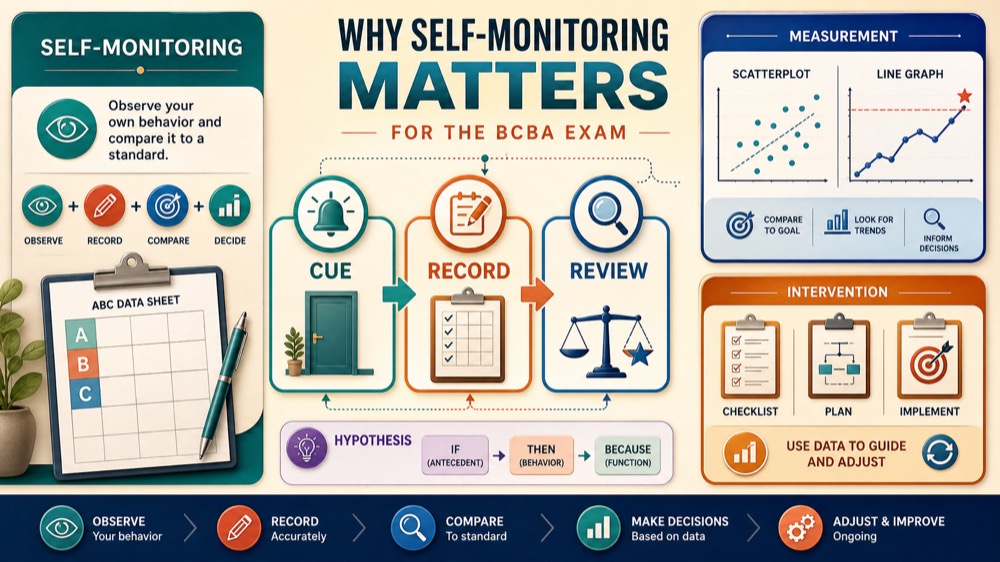
The BCBA exam includes several questions on self-monitoring, especially within the measurement and intervention sections of the Task List. You need to know the definition, when to use self-monitoring, its advantages and limitations, and how to train clients to self-monitor accurately. The exam will also test your ability to interpret self-monitoring data and to distinguish it from other data collection methods.
One key reason self-monitoring is tested is that it requires you to understand reactivity. Reactivity occurs when the process of observing and recording behavior changes the behavior itself. This can be a confound in measurement but a therapeutic mechanism in intervention. The exam may present a scenario where a client’s behavior improves simply because they started tracking it, and you must identify that as reactivity. Another common angle is the validity of self-monitored data—clients may not always record accurately, especially if the behavior is private or if they lack training. In such cases, the BCBA should conduct interobserver agreement (IOA) checks or use permanent-product measures when possible.
Common Exam Traps with Self-Monitoring: Avoid these three traps that often appear on the BCBA exam:
- Trap 1: Confusing self-monitoring with self-evaluation. Self-monitoring is only observing and recording. If the question says the client rates their performance against a goal, that’s self-evaluation. Many candidates miss this distinction.
- Trap 2: Assuming self-monitoring always causes behavior change. While reactivity is common, it is not guaranteed. The exam may describe a situation where self-monitoring does not produce change; then you need to consider adding reinforcement or choosing a different intervention.
- Trap 3: Forgetting that self-monitoring data can be invalid. Without training and checks, clients might under- or over-report. The correct answer may involve conducting IOA or using a more objective measure.
Exam Tips: How to Answer Self-Monitoring Questions: Use these strategies to boost your exam performance:
- Tip 1: Identify the purpose. Is the question about measuring behavior or changing it? If measurement, watch for threats to validity. If intervention, consider the function and whether reinforcement is needed.
- Tip 2: Look for keywords. Phrases like “client records each instance,” “self-record,” or “tracks own behavior” point to self-monitoring.
- Tip 3: Remember reactivity as a confound. If a behavior changes as soon as self-monitoring starts, consider reactivity. But also consider if the change is due to other factors like a new contingency.
Quick Checklist: Self-Monitoring Essentials
Use this checklist for last-minute review before the exam:
- [ ] Define self-monitoring: client observes and records own behavior.
- [ ] Differentiate from self-evaluation: no comparison to criterion.
- [ ] Differentiate from self-reinforcement: no delivery of reinforcer.
- [ ] Recognize dual role: measurement vs. intervention.
- [ ] Identify reactivity as a potential confound or therapeutic effect.
- [ ] Know that training is required for accurate self-recording.
- [ ] Plan to conduct IOA checks when possible.
- [ ] Consider ethical issues: privacy, dignity, client choice.
- [ ] Apply ABC analysis to understand function before implementing.
Summary: Mastering Self-Monitoring for the BCBA Exam
In this guide, we covered a comprehensive self-monitoring definition with ABA examples. You learned that self-monitoring involves self-observation and self-recording, and it can function as both measurement and intervention. We examined three examples—on-task behavior, nail-biting, and exercise—each with an ABC analysis and hypothesized function. We also highlighted common exam traps, such as confusing self-monitoring with self-evaluation, and provided test-taking tips. Finally, the quick checklist will help you review key points quickly.
To further strengthen your understanding, consider exploring our article on free BCBA mock exam practice questions for more scenario-based practice. Self-monitoring is a powerful tool that every BCBA should master. Keep studying, and remember that clear definitions and applied examples are the keys to passing the BCBA exam.
For additional authoritative information, refer to the BACB website for the Task List and ethical guidelines. Academic research on self-monitoring can be found in the Journal of Applied Behavior Analysis where studies validate its effectiveness across populations.