
What Is Time Sampling in ABA?
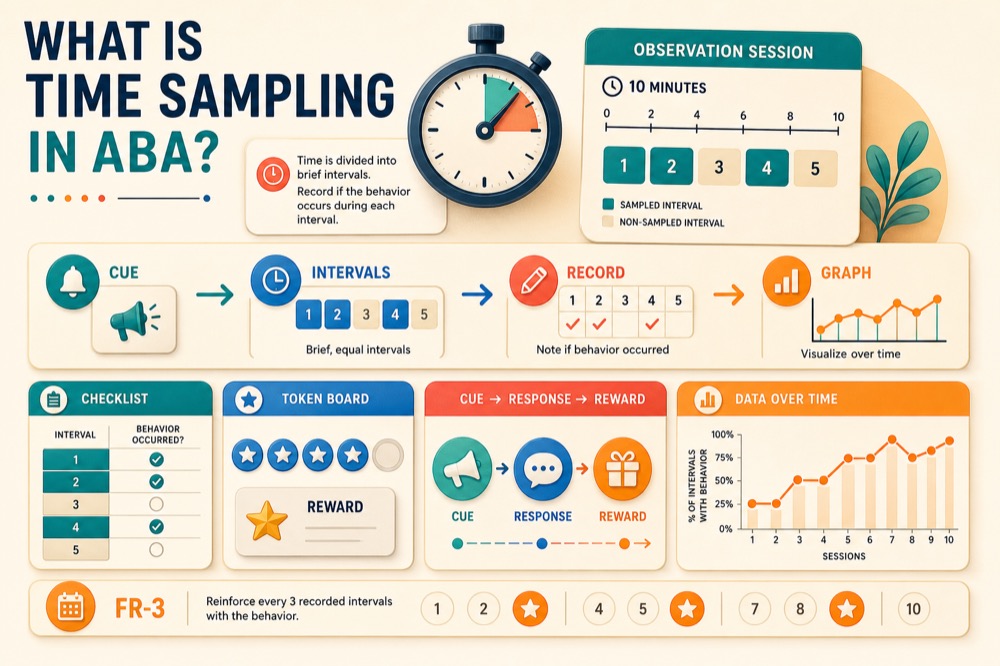
In applied behavior analysis, measuring behavior accurately is essential for evaluating interventions. Time sampling is a measurement method where you divide an observation session into brief intervals and record whether behavior occurred during each interval, rather than tracking continuously. This approach is practical for behaviors that are frequent or lengthy, and it is a core topic on the BCBA exam.
Table of Contents
- What Is Time Sampling in ABA?
- The Three Main Types of Time Sampling
- Time Sampling in Practice: Worked ABA Examples
- Exam Relevance and Common Traps
- Quick Checklist: Choosing the Right Time Sampling Method
- Summary and Next Steps for BCBA Candidates
- References
The key is that you are sampling behavior at specific moments or within short chunks of time. Time sampling is not about counting every instance; it’s about estimating occurrence. This makes it different from continuous measurement (like frequency or duration). BCBA candidates must understand when to use which type and how to interpret the data accurately.
Key Characteristics of Time Sampling: First, the total observation period is split into equal intervals (e.g., 1-minute intervals over a 10-minute session). Second, the observer records whether the target behavior occurred based on a rule: either during the entire interval, at any point, or only at the end. Third, data are reported as percentage of intervals with occurrence. This method is efficient but introduces some error—either overestimation or underestimation—depending on the type used.
The Three Main Types of Time Sampling
There are three primary interval recording methods every BCBA candidate must know: whole interval, partial interval, and momentary time sampling. Each produces different estimates of behavior, so choosing the right one depends on the behavior and the goal of measurement. Below we define each, give examples, and discuss data interpretation.
Whole Interval Recording: Whole interval recording requires the behavior to occur throughout the entire interval to be counted. For example, if on-task behavior is measured in 1-minute intervals, the student must be on-task for the whole 60 seconds. This method tends to underestimate the actual occurrence of behavior, especially for behaviors that are not continuous. It is best suited for behaviors you want to increase (e.g., staying seated, sustained attention). Data are reported as percentage of intervals where the behavior occurred for the full interval.
Partial Interval Recording: With partial interval recording, the behavior is recorded if it occurs at any time during the interval, even for a split second. For instance, if self-stimulatory hand-flapping occurs once in a 10-second interval, that interval is marked as an occurrence. This method tends to overestimate the behavior, especially for behaviors that are brief or high-rate. It is often used for behaviors you want to decrease (e.g., aggression, self-injury). The result is a percentage of intervals with at least one instance.
Momentary Time Sampling: Momentary time sampling records whether the behavior is occurring exactly at the end of the interval (or at a specific moment). For example, a teacher glances at a student at the end of each 2-minute interval to see if they are on-task. This method is less sensitive to brief behaviors and can either overestimate or underestimate depending on the behavior pattern. It is efficient and works well for continuous behaviors that are stable. However, it may miss brief episodes.
Time Sampling in Practice: Worked ABA Examples
To help you apply these methods to exam scenarios, here are three realistic examples covering different settings and functions. Each includes an ABC analysis and hypothesized function.
Example 1: Reducing Off-Task Behavior in a Classroom: A BCBA uses whole interval recording to measure on-task behavior during math lessons. The antecedent is the teacher giving instructions; the behavior is on-task (e.g., writing, looking at the board); the consequence is teacher praise. The hypothesized function is positive reinforcement (access to praise). After a token economy, on-task behavior increases from 40% to 80% of intervals. Because whole interval recording underestimates, the actual improvement may be even larger—an important exam point.
Example 2: Assessing Self-Injurious Behavior in a Clinic: A child engages in brief hand-biting when demands are placed. The BCBA uses partial interval recording with 15-second intervals. Antecedent: therapist asks to complete a task; behavior: hand-biting; consequence: therapist removes the demand. The hypothesized function is negative reinforcement (escape). Partial interval recording will overestimate the behavior, but it captures all instances, which is useful for dangerous behaviors. Data show 60% of intervals with biting, prompting a function-based intervention.
Example 3: Monitoring Stereotypic Behavior in a Group Home: A resident displays body rocking when alone. The BCBA uses momentary time sampling (30-minute intervals, observe at the end). Antecedent: being alone in the room; behavior: body rocking; consequence: sensory stimulation. The function is automatic reinforcement. Momentary time sampling is chosen because the behavior is continuous and low-rate. Data indicate rocking occurs in 30% of observations. Because momentary time sampling may underestimate, the BCBA supplements with duration recording for a full picture.
Exam Relevance and Common Traps
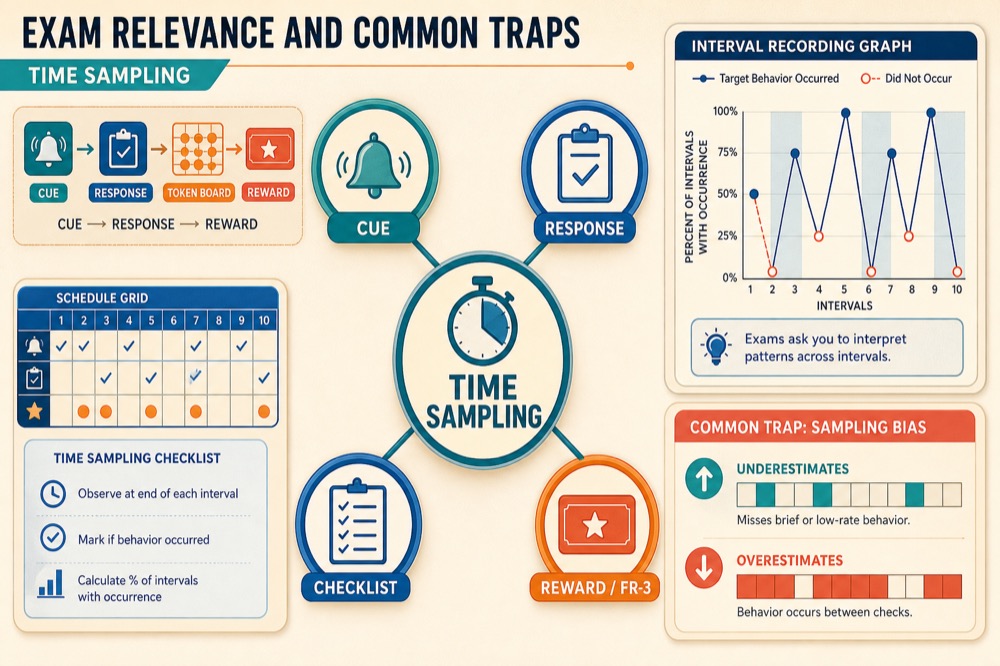
BCBA exam questions often test your ability to select the correct type of time sampling for a given behavior. You may also be asked to interpret graphed data from interval recording. Understanding the biases of each method is critical. Below are key traps to avoid.
How Time Sampling Appears on the BCBA Exam: Common question formats include:
- Scenario-based: Choose the appropriate method given a target behavior and goal (increase vs. decrease).
- Comparison: Identify which method overestimates, underestimates, or is most accurate.
- Data interpretation: Read a graph showing interval recording results and determine if the intervention is effective.
Many questions pair time sampling with other measurement methods, like frequency or duration. You may need to compare their strengths. Review the continuous measurement guide for a full comparison.
Common Traps to Avoid: Use the points below as a quick study guide.
- Confusing whole and partial interval: Remember: whole interval = behavior must last the whole interval (underestimates). Partial interval = any part counts (overestimates).
- Using partial interval for continuous behaviors: This inflates the data, making a behavior seem more frequent than it is.
- Using momentary time sampling for brief, high-rate behaviors: You may miss most occurrences, leading to severe underestimation.
- Forgetting to match method to goal: Use whole interval to measure behaviors to increase; partial interval to measure behaviors to decrease.
Quick Checklist: Choosing the Right Time Sampling Method
Use this checklist when faced with a scenario on the exam or in practice:
- Is the target behavior brief or frequent? If yes, partial interval is often best (but expect overestimation).
- Is the behavior continuous or sustained? If yes, whole interval (underestimates) or momentary time sampling (efficient) works.
- Is the goal to increase the behavior? Use whole interval recording (conservative measure).
- Is the goal to decrease the behavior? Use partial interval recording (sensitive to any occurrence).
- Need efficiency and the behavior is stable? Consider momentary time sampling.
Also remember to consider practical constraints like observer availability and the behavior’s topography. For instance, dangerous behaviors may warrant partial interval recording despite overestimation to ensure safety.
Summary and Next Steps for BCBA Candidates
Time sampling is a versatile measurement method that every behavior analyst must master. We covered whole interval, partial interval, and momentary time sampling, each with distinct advantages and biases. Use worked examples to see how ABC data and function inform your choice. For the BCBA exam, focus on selecting the correct method based on behavior characteristics and the goal of measurement. Avoid common traps by practicing scenario-based questions.
To further strengthen your measurement skills, explore our measurement methods guide and try our free BCBA mock exam questions that include time sampling scenarios. For more details on interval recording, see the interval recording guide.
As you prepare, remember that time sampling is just one of many measurement options. Always consider the dimensions of behavior (rate, duration, latency, etc.) and choose the method that gives the most useful data for decision-making. Good luck with your studies!



