
What Are Stimuli in Applied Behavior Analysis?
In everyday language, a stimulus is any event that can affect an organism. In Applied Behavior Analysis, the technical definition is more precise: a stimulus is an energy change that can influence behavior. This includes anything you can see, hear, touch, taste, or smell—but also internal changes like hunger or pain. However, what matters most in ABA is not the physical property of a stimulus but its function in relation to behavior.
Table of Contents
- What Are Stimuli in Applied Behavior Analysis?
- Types of Stimuli You Must Know for the BCBA Exam
- How Stimuli Fit into the ABC Contingency
- Common Exam Traps Involving Stimuli
- Stimuli Quick Checklist for BCBA Candidates
- Summary: Stimuli Are the Keys to Understanding Behavior
- References
BCBA candidates must understand that stimuli are classified by how they alter behavior. The same object can serve different stimulus functions depending on the context. For example, a teacher’s voice saying ‘line up’ may be a cue for a specific behavior, but on a playground, the same voice might have no effect.
Formal vs. Functional Definitions in ABA
Behavior analysts categorize stimuli based on function rather than form. A formal definition describes what a stimulus looks like (e.g., a red circle). A functional definition describes what it does (e.g., evokes a response because it signals reinforcement). For the BCBA exam, you must focus on function. Always ask: Does this stimulus evoke, abate, or alter the value of a reinforcer? That determines its class.
Types of Stimuli You Must Know for the BCBA Exam
The BCBA exam tests your ability to discriminate among several stimulus classes. Here are the key ones you need to master.
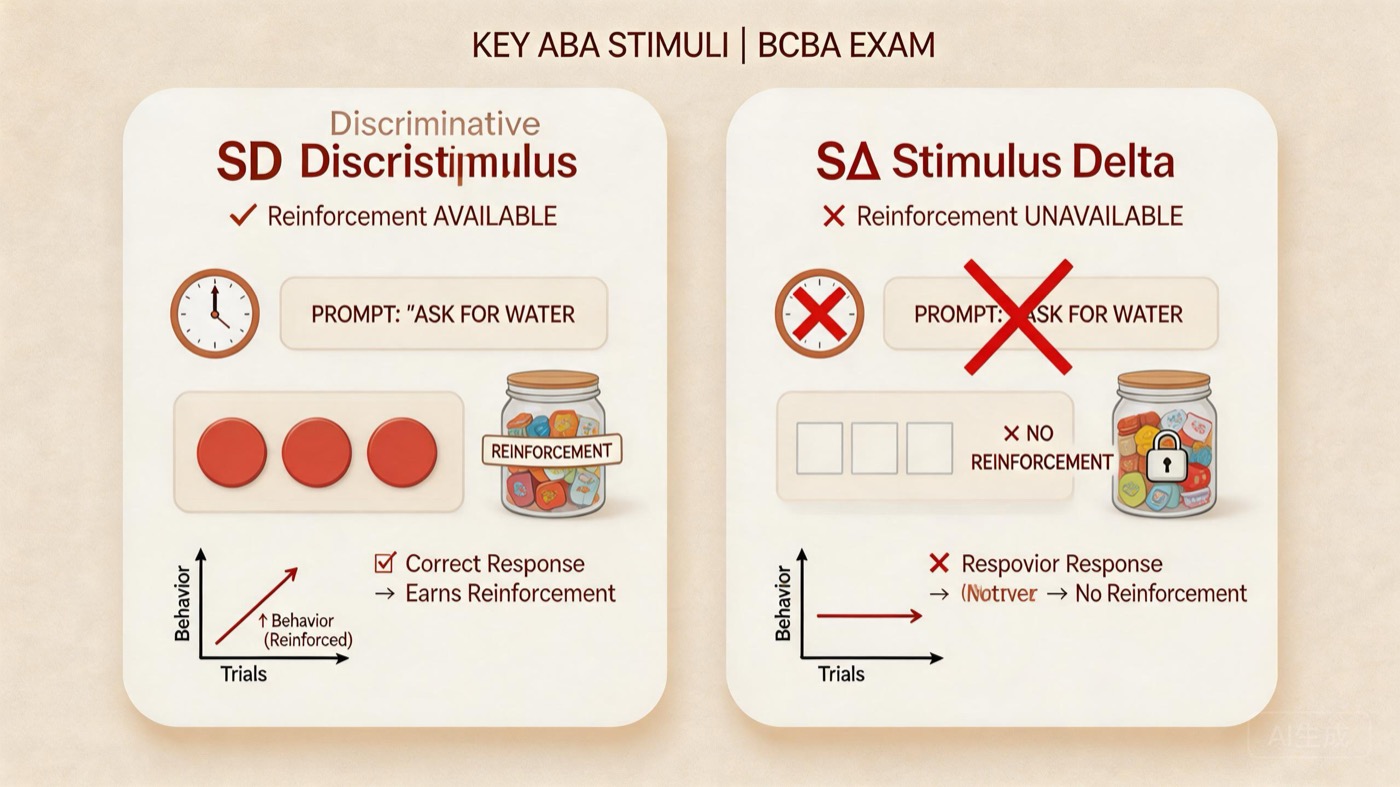
Discriminative Stimulus (SD) vs. Stimulus Delta (SΔ)
An SD is a stimulus that signals the availability of reinforcement for a particular behavior. A stimulus delta (SΔ) signals that reinforcement is not available for that behavior. Think of a green traffic light (SD: driving forward gets you moving) versus a red light (SΔ: driving forward does not get you moving—you might get a ticket). In ABA, a teacher’s instruction ‘raise your hand’ is an SD if raising a hand produces teacher attention; when the teacher is >not< looking, that stimulus is an SΔ for hand-raising.
Motivating Operations (MOs): Establishing and Abolishing Effects
Motivating operations (MOs) alter the effectiveness of a reinforcer or punisher and change the frequency of behavior that has previously produced that consequence. An establishing operation (EO) increases the value of a reinforcer (e.g., food deprivation makes food more valuable). An abolishing operation (AO) decreases its value (e.g., eating a large meal makes food less valuable). MOs are crucial in understanding why a client may be highly motivated to escape a task (EO for negative reinforcement) or indifferent to praise (AO for social reinforcement).
Stimulus Prompts and Response Prompts
Stimulus prompts are extra cues added to the environment that increase the likelihood of a correct response. They can be within-stimulus (e.g., highlighting a target letter on a keyboard) or extra-stimulus (e.g., a picture icon next to the correct button). In contrast, response prompts involve behavior from a trainer, such as modeling, verbal instructions, or physical guidance. During prompt fading, you systematically remove these prompts to transfer stimulus control to the natural SD. The BCBA exam often asks you to identify a stimulus prompt in a given scenario.
How Stimuli Fit into the ABC Contingency
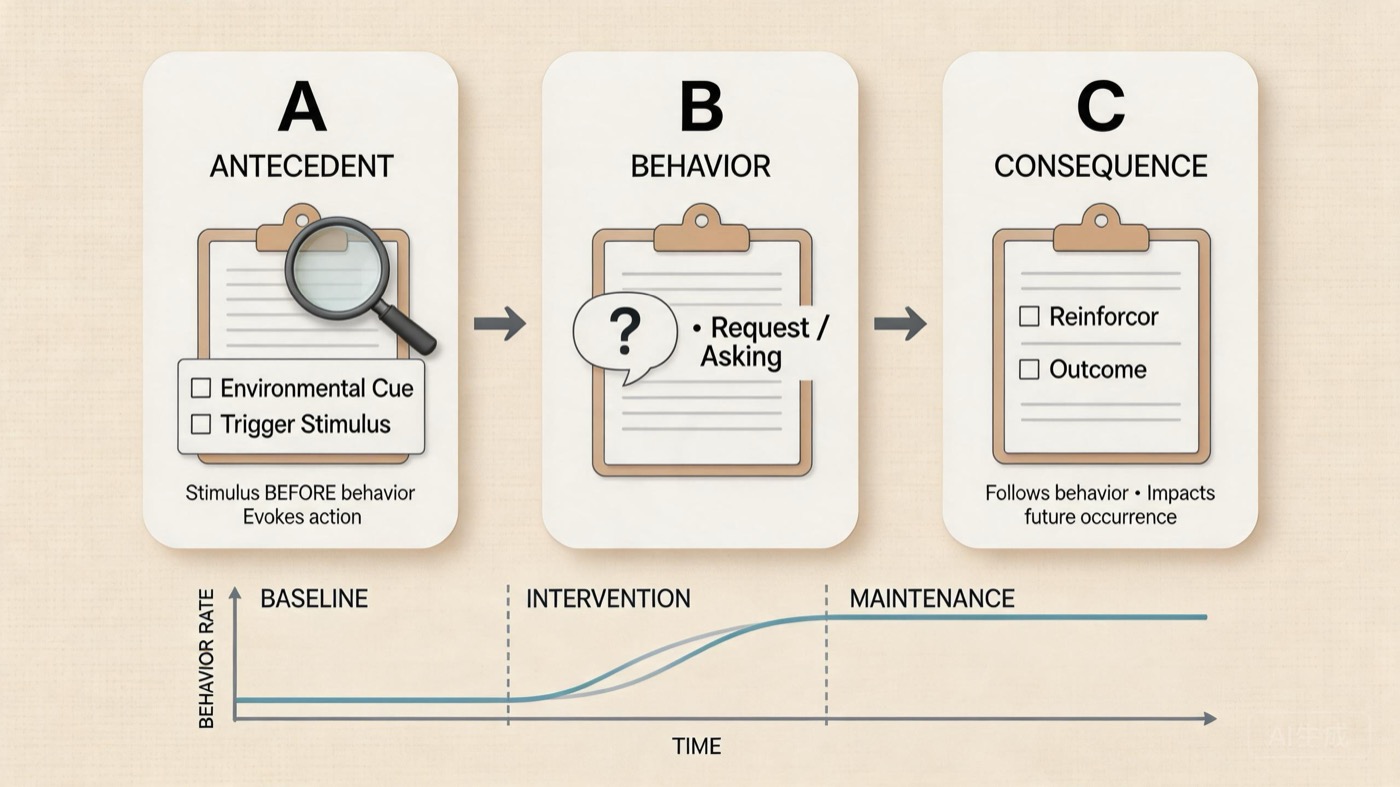
The three-term contingency (ABC) is the foundation of ABA: Antecedent → Behavior → Consequence. The antecedent is a stimulus that occurs immediately before the behavior and evokes or elicits it. Understanding antecedents is critical for functional assessment. Let’s walk through a scenario.
- Antecedent stimulus: A child sees a snack jar on the counter (visible, open).
- Behavior: The child asks, ‘Can I have a snack?’
- Consequence: The parent says, ‘Not right now.’
The behavior (asking) is evoked by the presence of the snack jar. If the jar were hidden in a cabinet, asking might not occur. The hypothesized function is access to tangible. When collecting ABC data, always note the specific antecedent stimuli present, including environmental, social, and internal events. This helps identify which stimuli are SDs, MOs, or neutral.
Common Exam Traps Involving Stimuli
Many BCBA candidates stumble on stimulus-related questions. Watch out for these pitfalls:
- Confusing SD and MO. An SD signals availability of a reinforcer; an MO changes the value of that reinforcer. E.g., a teacher’s presence is an SD for asking for help; being tired may be an MO that makes help more valuable.
- Overlooking SΔ. When a stimulus signals extinction, behavior decreases. For example, if a client tantrums when told ‘no’ and the parent ignores, the word ‘no’ becomes an SΔ for tantrum reinforcement.
- Ignoring antecedent control strategies. Exam questions may ask how to modify stimuli to reduce problem behavior (e.g., rearranging the environment, changing the SD/MO).
- Misidentifying stimulus prompts. A picture schedule is an extra-stimulus prompt; a highlighted timer is within-stimulus.
Stimuli Quick Checklist for BCBA Candidates
Use this checklist when analyzing any behavior:
- Identify the antecedent stimulus (who, what, when, where, what happened just before).
- Determine its function: Is it an SD, SΔ, or MO? (Not its form!)
- Check if the stimulus signals reinforcement (SD) or alters value (MO).
- Look for stimulus prompts that could be faded to transfer control.
- Consider how manipulating the antecedent stimulus could change behavior (e.g., remove the snack jar).
Summary: Stimuli Are the Keys to Understanding Behavior
Stimuli are the environmental events that set the stage for everything we do. By mastering the types of stimuli—discriminative stimuli, stimulus deltas, motivating operations, and prompts—you will be able to analyze behavior effectively and design interventions that work. The BCBA exam will test your ability to apply these concepts in real-world scenarios. Practice identifying stimuli in everyday interactions: What SDs are present? What MOs are at work? For more depth, check out our guide on SD vs. MO differences and the stimulus equivalence guide. To solidify your understanding, try generating your own examples using the ABC contingency every day.
References
Complete BCBA Exam Prep
Turn this topic into exam-day practice
Practice concepts in context with five full-length 6th Edition mock exams, two bonus practice exams, a 6th Edition study guide, and key-term flashcards—all in one $120 USD package.
Get the $120 All-in-One Prep Pack
Review everything included on the product page before ordering. No pass guarantee is implied.



