
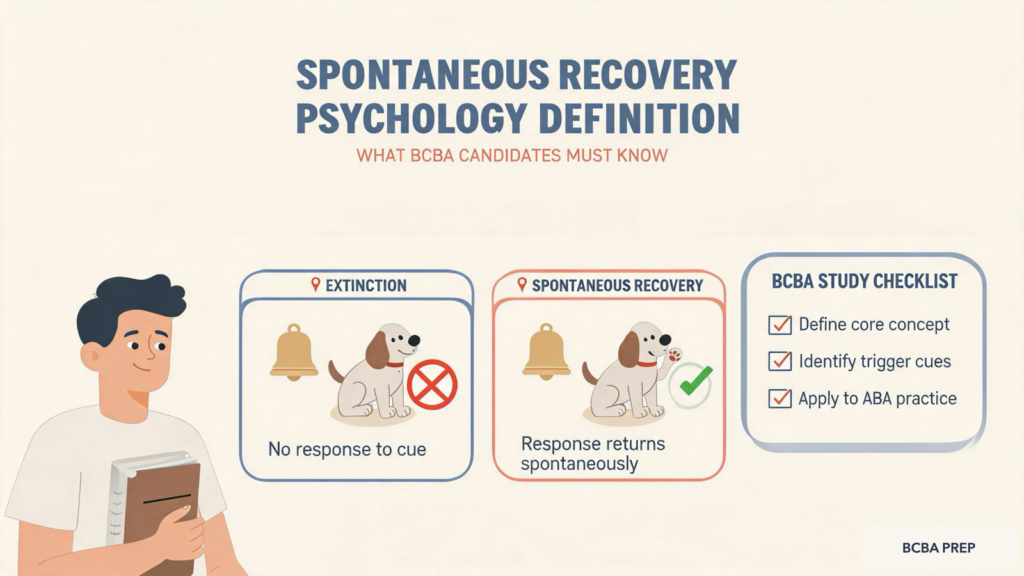
Introduction to Spontaneous Recovery in Psycho
The spontaneous recovery psychology definition refers to the reappearance of a previously extinguished behavior after a period of time without reinforcement. In applied behavior analysis (ABA), this phenomenon is crucial for BCBA candidates to understand because it can disrupt treatment fidelity and mislead practitioners into thinking a behavior has not truly been extinguished. For example, after a child’s tantrum behavior is successfully reduced through extinction, a sudden tantrum a week later might be mistaken for a failure of the intervention, when in fact it is simply spontaneous recovery.
Table of Contents
- Introduction to Spontaneous Recovery in Psycho
- Spontaneous Recovery in ABA: Worked Examples with ABC Analysis
- Exam Relevance: How Spontaneous Recovery Appears on the BCBA Exam
- Quick Checklist for Studying Spontaneous Recovery
- Summary: Key Takeaways on Spontaneous Recovery
This article provides an exam-oriented breakdown of spontaneous recovery, including real-world examples, ABC analysis, and common exam traps. By the end, you will have a clear understanding of how to identify and manage this process in both practice and test scenarios.
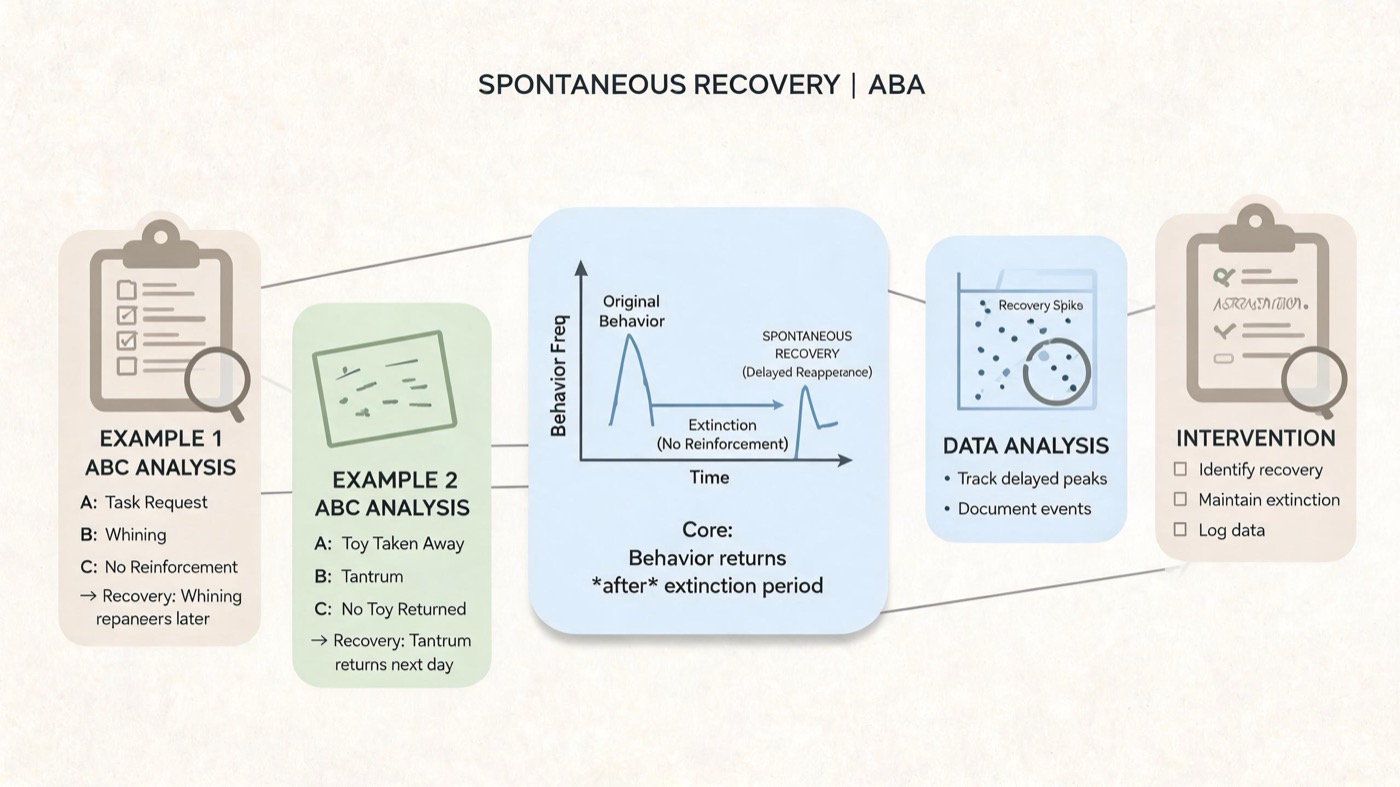
Spontaneous Recovery in ABA: Worked Examples with ABC Analysis
To apply the spontaneous recovery psychology definition to ABA, consider three examples that illustrate the typical ABC pattern. In each case, the behavior reappears after a time delay during extinction, and the key is to recognize that the behavior is weaker and temporary.
Example 1: Child’s Request for Attention
A child with autism previously used whining to gain attention. Under a successful extinction plan, caregivers ignored whining, and the behavior decreased to near zero. After a two-week holiday break, the child whined again upon returning to the therapy setting. The antecedent was the caregiver’s presence after absence; the behavior was whining; the consequence was no attention (continued extinction). The function was attention-seeking. The whining was less intense and shorter than before, illustrating that spontaneous recovery produces a weaker behavior.
Example 2: Adult’s Nail Biting
An adult client targeted nail biting for reduction using self-monitoring and competing responses. After three weeks of extinction (no reinforcement from the sensory feedback), nail biting dropped to zero. One month later, during a stressful work period, the client bit a nail. The antecedent was stress; the behavior was nail biting; the consequence was temporary relief (automatic reinforcement). The function was automatic/sensory. The behavior occurred once and did not escalate, especially when the client recommitted to extinction.
Example 3: Animal Training (Dog Sitting)
A dog trained to sit for a treat stopped sitting after the owner stopped providing reinforcement (extinction). After two days without training, the dog spontaneously sat again in the kitchen. The antecedent was the kitchen context; the behavior was sitting; the consequence was no food (extinction continued). The function was food reinforcement. The sit was slower and lacked the enthusiastic tail wag, again demonstrating a weaker response.
Exam Relevance: How Spontaneous Recovery Appears on the BCBA Exam
BCBA exam questions often test your ability to distinguish spontaneous recovery from other behavioral processes. You may be given a scenario and asked to identify the phenomenon or select the appropriate intervention. Understanding common traps will help you avoid errors.
Common Exam Traps and Misconceptions
One major trap is confusing spontaneous recovery with resurgence. Resurgence occurs when a previously extinguished behavior returns because the current behavior is placed on extinction or reinforcement conditions change, whereas spontaneous recovery happens simply after a time lapse without any change in the environment. Another trap is assuming spontaneous recovery means the behavior is fully recovered; in reality, the behavior is typically weaker and more sensitive to extinction. Trainees may also mistake spontaneous recovery for an extinction burst, which is an increase in behavior at the start of extinction, not after a delay.
Distinguishing Spontaneous Recovery from Other Processes
To help you differentiate, here is a quick comparison:
- Spontaneous Recovery: Reappearance after a time period with no reinforcement; behavior is weak and temporary.
- Extinction Burst: Increase in frequency or intensity immediately after extinction begins; occurs early.
- Resurgence: Return of a previously extinguished behavior due to a change in contingencies (e.g., new behavior placed on extinction).
- Behavioral Variability: Random fluctuations in behavior; not tied to time or contingency changes.
On the exam, look for clues: if the scenario mentions a time delay (days or weeks) with no other changes, suspect spontaneous recovery. If the scenario mentions changes in reinforcement for a current behavior, suspect resurgence.
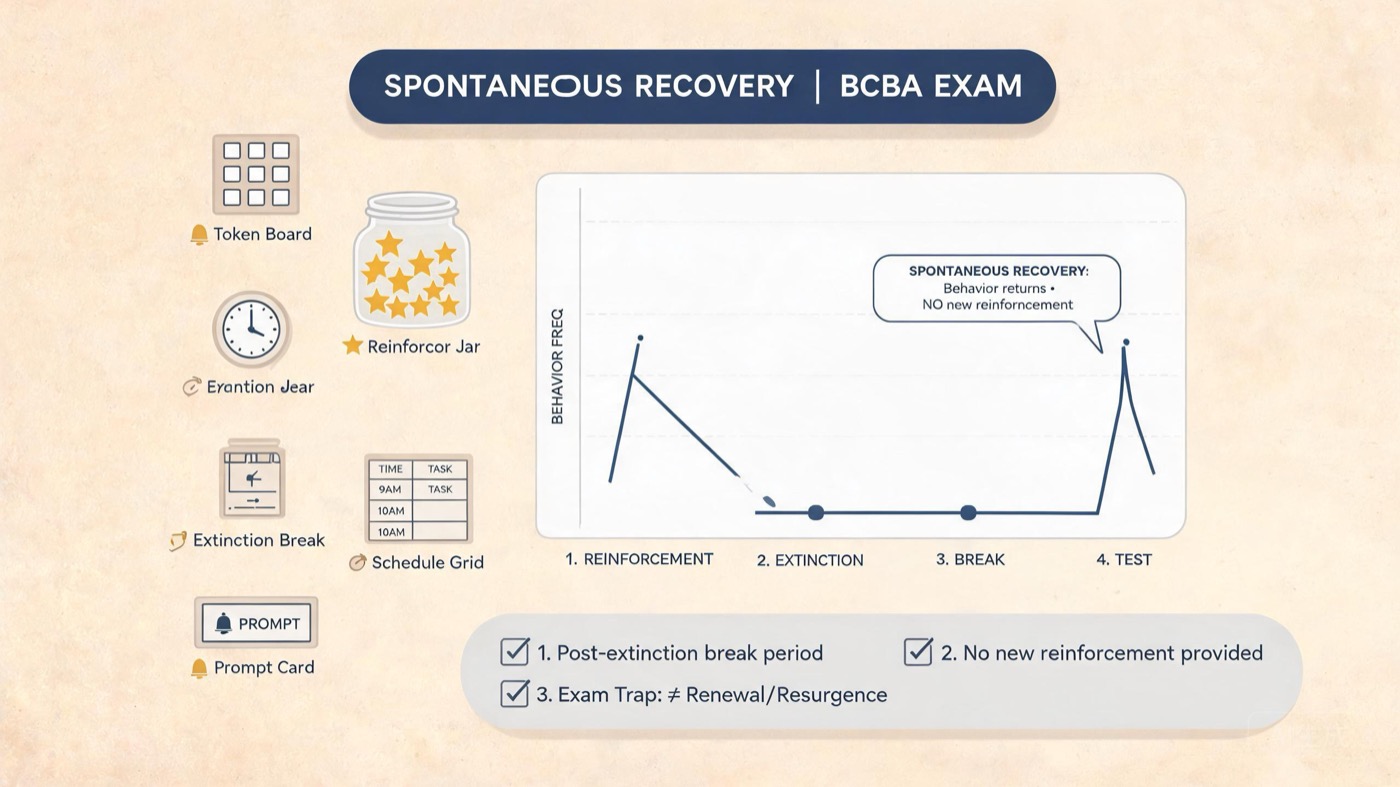
Quick Checklist for Studying Spontaneous Recovery
Use this checklist to solidify your understanding and prepare for exam questions:
- Define spontaneous recovery in your own words: reappearance of an extinguished behavior after time without reinforcement.
- Identify the three key features: time delay, weaker intensity, and temporary occurrence.
- Practice ABC analysis: write 2–3 examples and label each component.
- Contrast spontaneous recovery with extinction burst, resurgence, and variability.
- Explain to a peer: teach the concept aloud to reinforce your recall.
- Review a mock exam question on spontaneous recovery and justify your answer.
Summary: Key Takeaways on Spontaneous Recovery
The spontaneous recovery psychology definition is essential for BCBA candidates because it explains a common clinical occurrence that can derail interventions if misunderstood. Remember that spontaneous recovery is temporary, produces a weaker behavior, and requires consistent extinction to prevent reinforcement. When you see a behavior return after a break, do not panic—instead, continue the extinction plan and monitor for further occurrences. On the exam, look for time delays and unchanged contingencies to identify spontaneous recovery. For more practice, explore our extinction in ABA guide and other resources at BCBA Mock Exam. Additionally, review the BCBA exam prep guide for comprehensive study strategies.
Finally, always refer to the BACB’s Task List for official definitions and examples. You can access the BACB website at bacb.com for the most current information. Mastering spontaneous recovery will not only help you pass the exam but also improve your clinical decision-making.



