
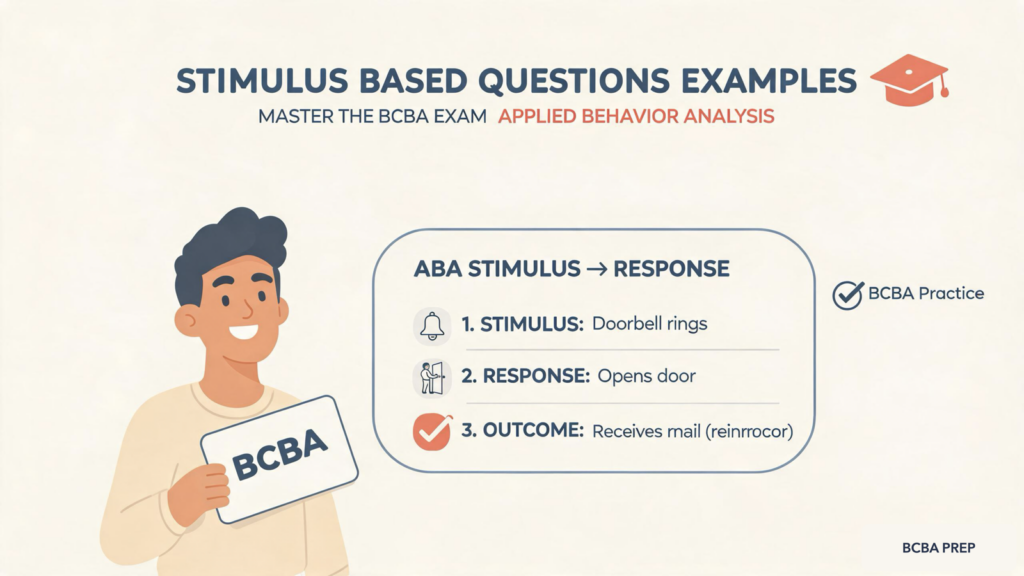
What Are Stimulus Based Questions in ABA?
Stimulus based questions present a scenario describing an antecedent, behavior, and consequence (ABC). They ask you to identify which stimulus controls the behavior or to hypothesize the function. In applied behavior analysis, these questions assess your ability to apply concepts like discriminative stimulus (SD) and stimulus delta (S-delta).
Table of Contents
- What Are Stimulus Based Questions in ABA?
- Stimulus Based Questions Examples: Worked ABA Scenarios
- Exam Relevance and Common Traps
- Quick Checklist for Solving Stimulus Based Questions
- Practice Prompts to Test Your Knowledge
Definition and Key Components
A stimulus based question typically includes a brief vignette. You must break it into ABC components: antecedent (what happens before), behavior (the action), and consequence (what follows). Then you link the antecedent to stimulus control. For example, if a child asks for a cookie after seeing a cookie jar, the cookie jar is an SD for requesting.
Why the BCBA Exam Uses Them
The BCBA exam includes many scenario-based items to test your practical reasoning. These questions align with Task List items like B-10 (stimulus control) and G-6 (function-based intervention). Mastering them helps you think like a behavior analyst in real-world settings.
Video Study: B2 Stimulus & Stimulus Class
Watch: Stimulus and Stimulus Class | 6th ed. | BCBA Exam Prep
Use this lesson as a visual study companion, then return to the definitions and examples below to apply the same concept to BCBA® exam questions.
Prefer a second pass? Open this lesson on YouTube.
Stimulus Based Questions Examples: Worked ABA Scenarios
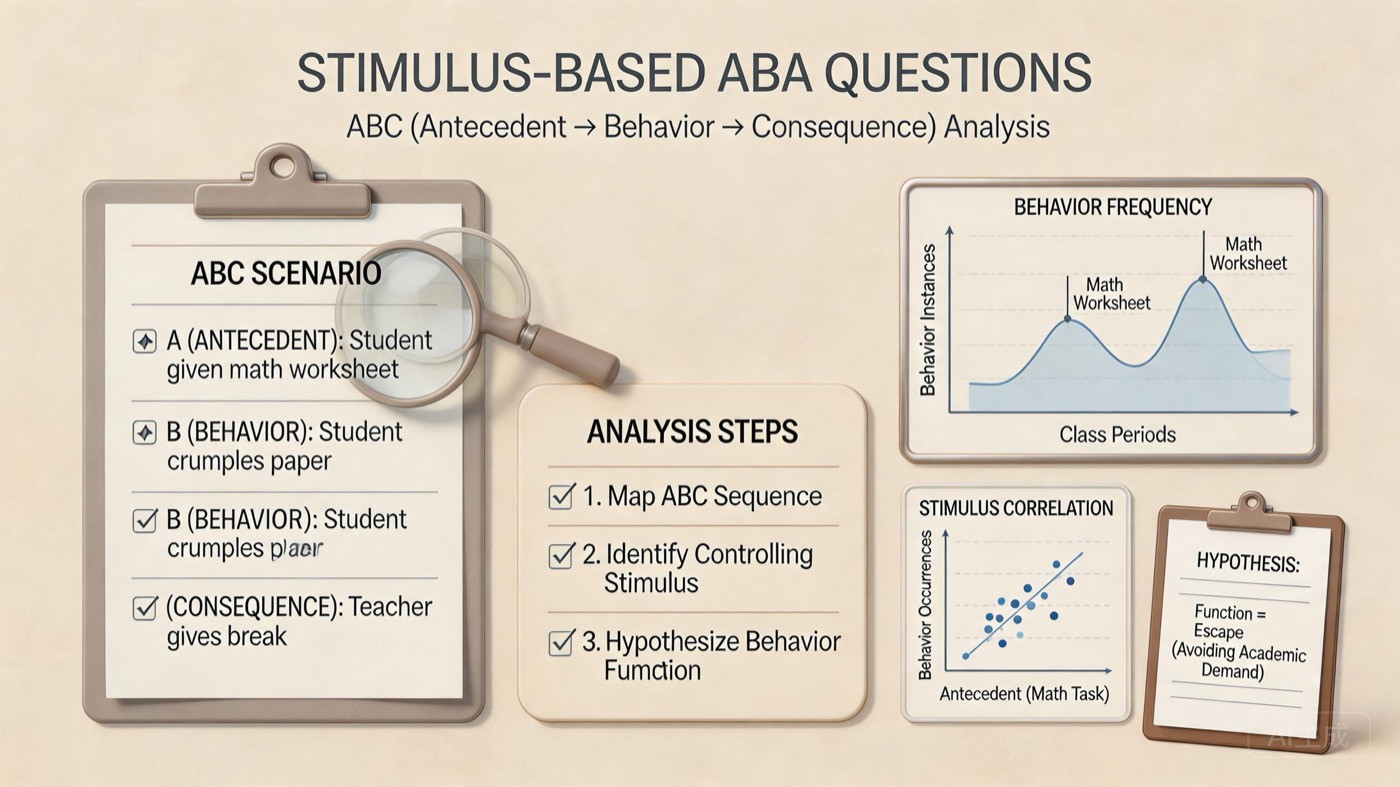
Let’s walk through three realistic examples. Each includes the ABC sequence and a hypothesized function. Practice identifying the controlling stimuli.
Example 1: Requesting a Break (Escape Function)
Scenario: A student throws a pencil when given a math worksheet. The teacher removes the worksheet and says ‘take a break.’ ABC analysis: Antecedent: math worksheet (demand). Behavior: throw pencil. Consequence: worksheet removed (escape). Hypothesized function: escape from demand. The math worksheet likely serves as an SD for problem behavior because it signals availability of escape.
Example 2: Telling a Joke (Attention Function)
Scenario: During group work, a child tells a joke; peers laugh; the teacher says ‘stop disrupting.’ ABC analysis: Antecedent: presence of peers. Behavior: joke telling. Consequence: laughter and teacher attention. Hypothesized function: attention. The peer group is an SD for joke telling, as it signals attention is available.
Example 3: Hitting When Hungry (Automatic Reinforcement)
Scenario: An infant cries and hits their head when hungry. No social consequence is provided. ABC analysis: Antecedent: hunger (establishing operation). Behavior: crying and head-hitting. Consequence: no social response, but pain may be reduced or sensory input provided. Hypothesized function: automatic reinforcement (negative: pain attenuation; positive: sensory stimulation). Here, the antecedent is a motivating operation, not a stimulus that signals reinforcement availability.
Exam Relevance and Common Traps
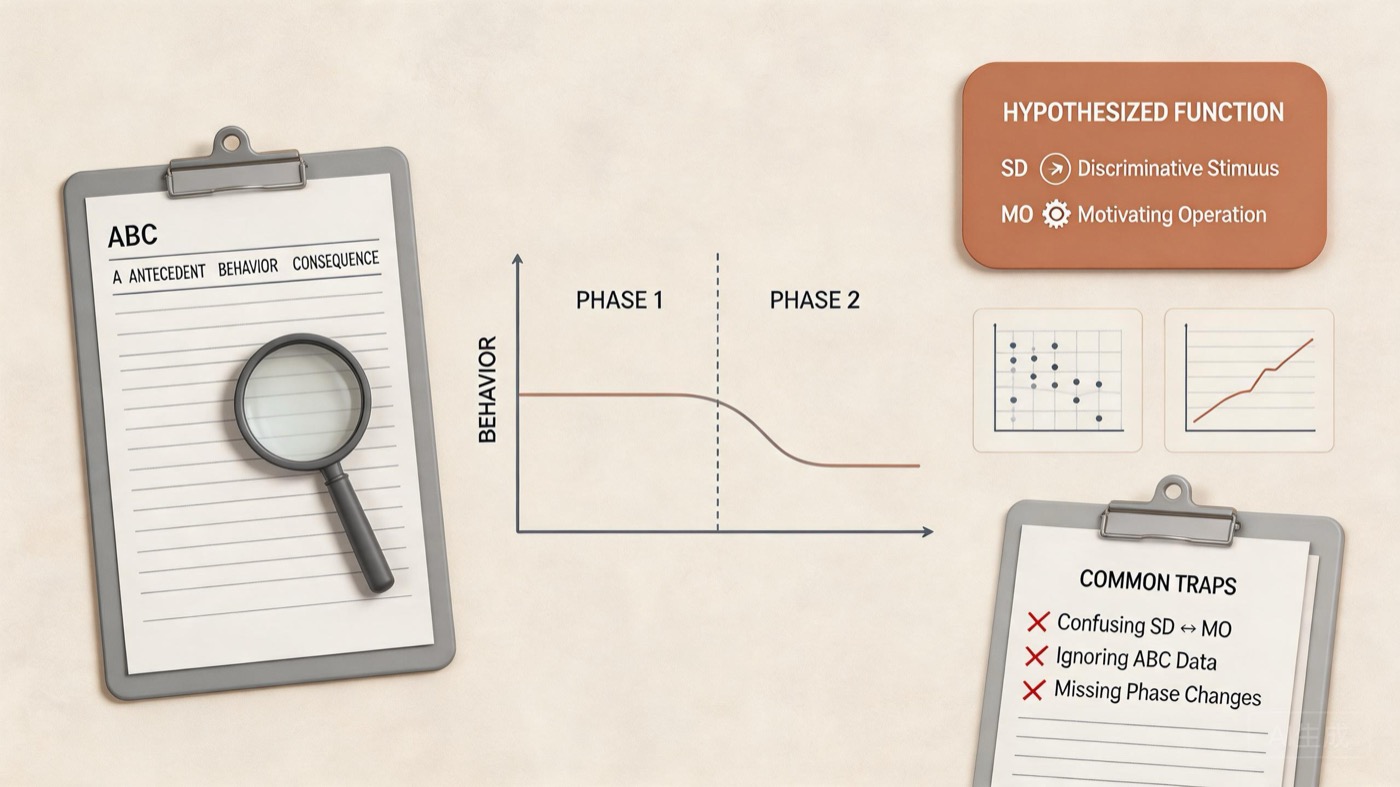
Stimulus based questions appear frequently on the BCBA exam. They test your ability to differentiate between SD and MO and to identify function from ABC data. Avoid these common pitfalls.
How These Questions Are Tested
Typical formats include multiple-choice items that ask: ‘What is the hypothesized function?’ ‘Which stimulus controls the behavior?’ or ‘How would you modify the antecedent?’ You may also see questions about stimulus class or generalization.
Top Traps to Avoid
- Confusing SD with motivating operations: SD signals availability of reinforcement; MO alters the value of that reinforcer.
- Assuming function without ABC data: Always base your answer on the scenario’s ABC sequence, not assumptions.
- Overlooking automatic reinforcement when no social consequence is present.
- Misidentifying stimulus class: Ensure stimuli share common features (e.g., all red objects).
Quick Checklist for Solving Stimulus Based Questions
Use this checklist on exam day to avoid errors.
- Identify the antecedent (what happens right before the behavior).
- Identify the behavior (observable, measurable).
- Identify the consequence (what happens after).
- Determine if the antecedent is an SD or an MO.
- Hypothesize the function: escape, attention, tangible, or automatic.
- Check if the consequence maintains the behavior.
Practice Prompts to Test Your Knowledge
Apply the checklist to these brief scenarios. Write down your ABC and function before peeking at the answer.
Prompt 1: When a parent says ‘clean up,’ a child yells. The parent stops asking. Answer: Function: escape (from demand). SD: parent’s instruction.
Prompt 2: A toddler cries in a grocery store. The parent gives a toy. The crying stops. Answer: Function: tangible (access to toy). SD: grocery store (possibly) or parent’s proximity.
Prompt 3: An adult taps their finger repeatedly when alone in a quiet room. No social consequence. Answer: Function: automatic (sensory stimulation). No clear SD; may be under automatic reinforcement.
For more resources, check out our BCBA exam study framework and official BACB website.
Next step for BCBA exam prep
Turn this topic into exam-day practice
Use this topic as a focused review, then test it in exam-style conditions with a free mock before deciding whether five full-length mocks are the right next step.
Start the Free BCBA Mock Exam
Continue with Five Full-Length Mocks — $99
Review the included materials and access details before ordering. No pass guarantee is implied.



