
What Is Overshadowing in ABA and Why It Matters for Your BCBA Exam
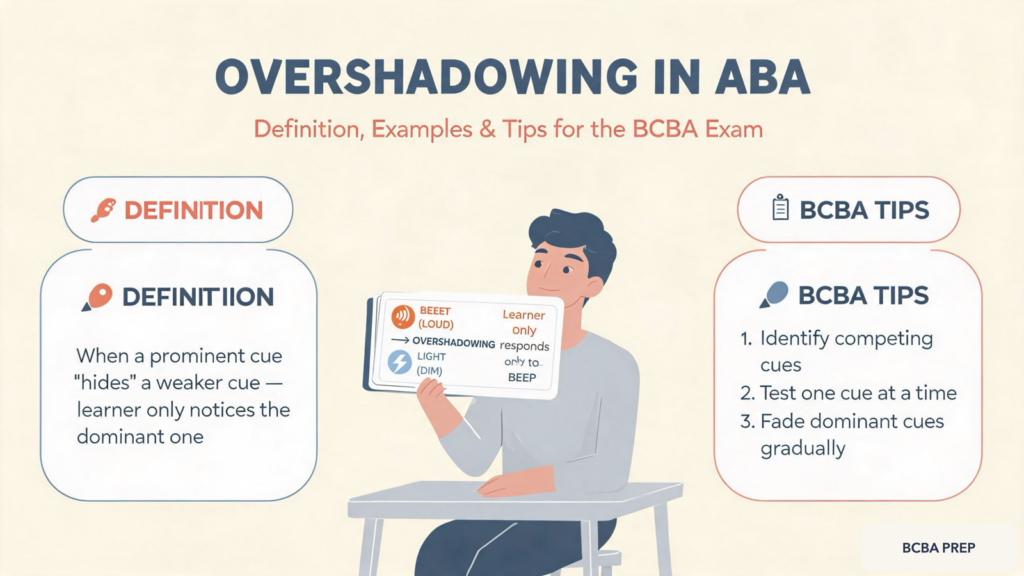
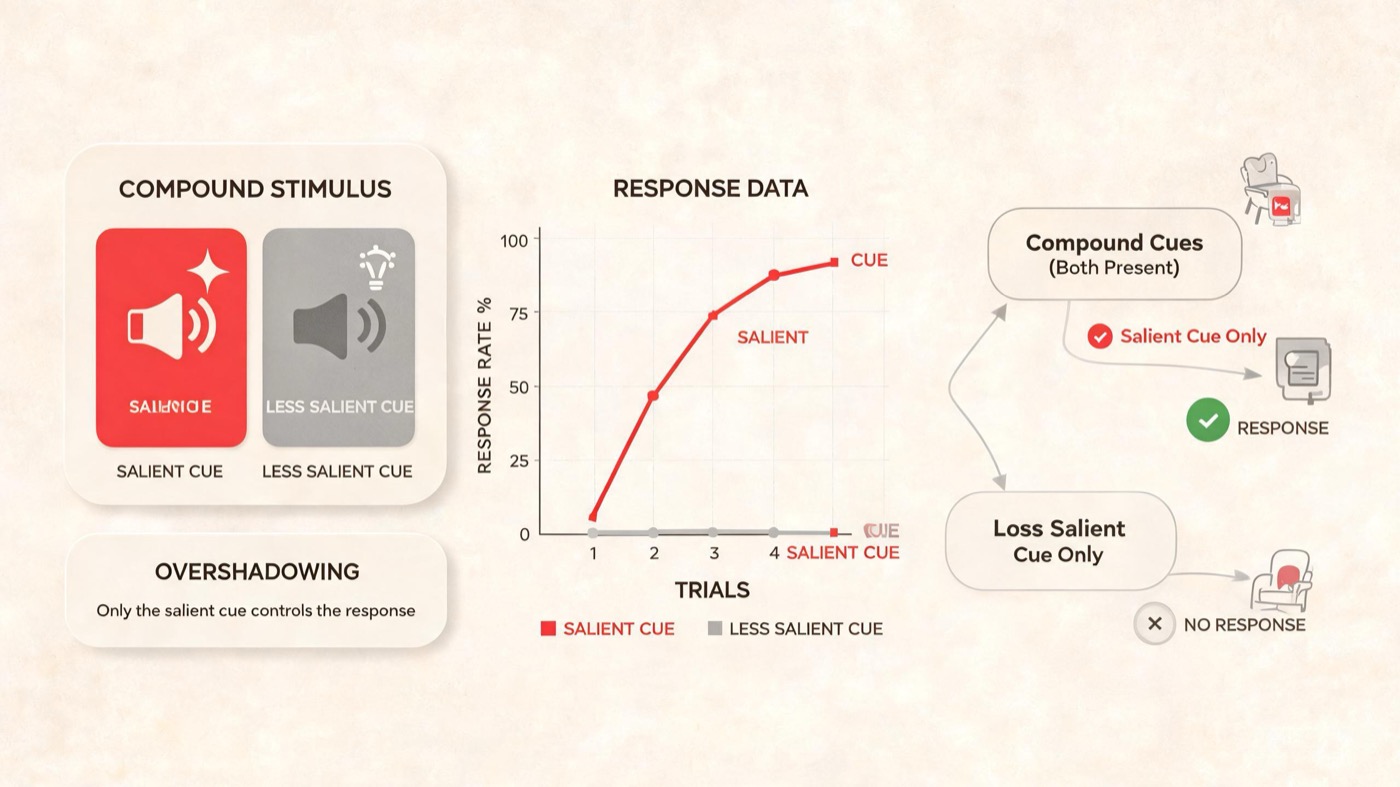
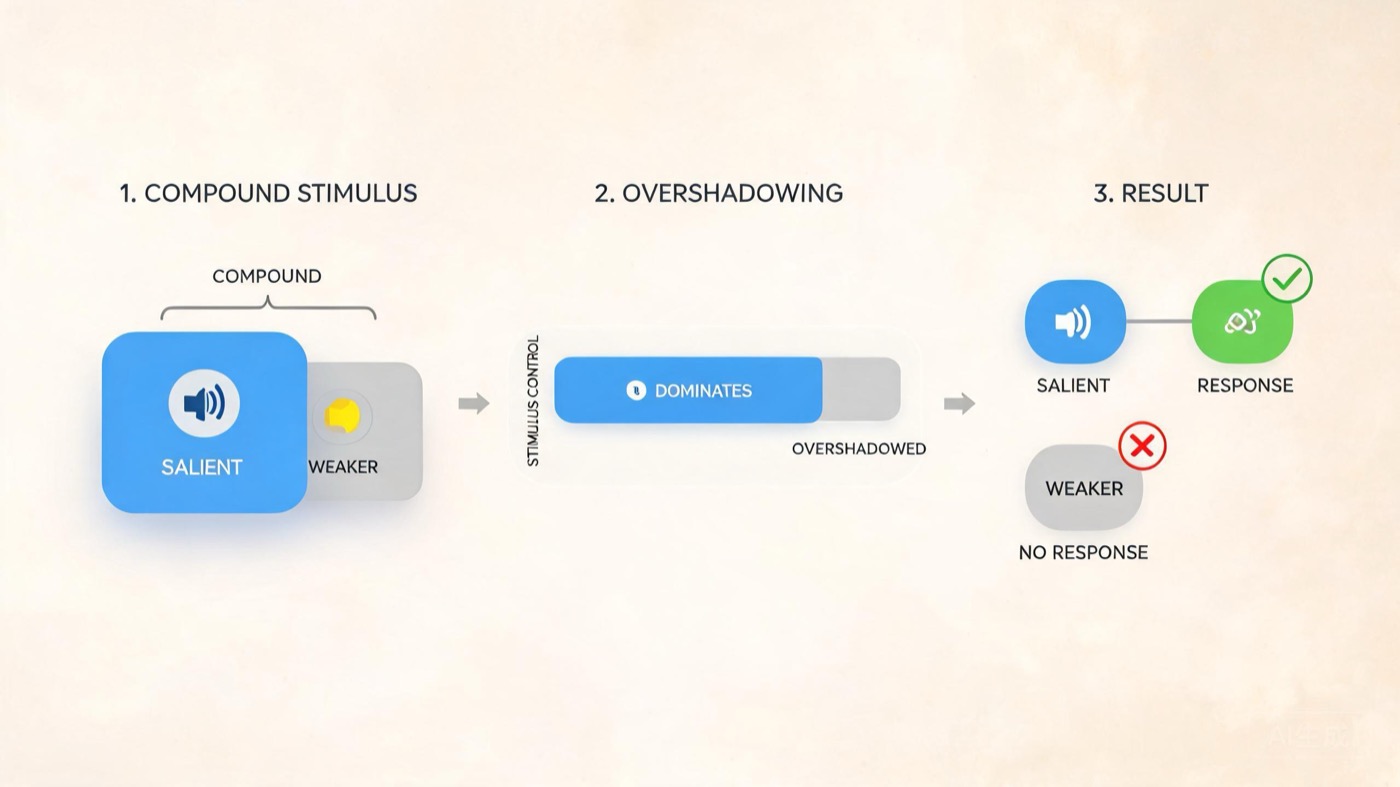
If you are studying stimulus control for the BCBA exam, you have likely encountered the term overshadowing in ABA. Overshadowing occurs when two or more stimuli are presented together as a compound, and the more salient stimulus controls the response while the other stimulus fails to acquire discriminative control. This concept is listed in the BACB Task List under stimulus control and frequently appears on the exam. Understanding overshadowing helps you design effective discrimination training and avoid common errors in behavior-analytic practice.
Table of Contents
- What Is Overshadowing in ABA and Why It Matters for Your BCBA Exam
- Defining Overshadowing in Applied Behavior Analysis
- Real-World ABA Examples of Overshadowing
- Why Overshadowing Matters for the BCBA Exam
- Quick Reference Checklist for Overshadowing
- Summary and Next Steps for Your Exam Prep
Defining Overshadowing in Applied Behavior Analysis
In technical terms, overshadowing happens when a compound stimulus is presented, and one element is more salient (noticeable) than the other. The learner's behavior comes under control of the salient element, while the less salient element never becomes a functional discriminative stimulus. For example, if a teacher presents a large red card and a small blue card together during a color discrimination task, the learner may only respond to the red card because of its size. The blue card does not evoke correct responding when presented alone.
Overshadowing vs. Blocking: A Crucial Distinction
Many BCBA exam questions test your ability to differentiate overshadowing from blocking. Use the comparison table below:
- Overshadowing: Occurs during a compound stimulus presentation when one stimulus is more salient. No prior conditioning is required. Both stimuli are new to the learner.
- Blocking: Occurs when prior conditioning with one stimulus prevents learning about a new stimulus paired with it. The learner already has a history with the blocking stimulus.
To remember: overshadowing is about salience; blocking is about learning history. On the exam, look for clues about whether each stimulus has been separately trained before the compound trial.
Real-World ABA Examples of Overshadowing
Let's examine three applied examples with ABC (antecedent-behavior-consequence) notation. Each illustrates how a more salient stimulus can overshadow a targeted discriminative stimulus.
Example 1: Classroom Discrimination Training
Antecedent: Teacher holds up a compound card displaying a large red circle (10 cm diameter) and a small blue square (2 cm side). The instruction is, 'Touch the blue shape.'
Behavior: The child touches the red circle.
Consequence: Teacher says, 'No, that's the red circle,' and provides no reinforcement.
Hypothesis: The large red circle overshadows the small blue square because of its size. The child responds to the most salient element, not the targeted shape.
To test for overshadowing, present the blue square alone. If the child then touches it correctly, overshadowing is confirmed. The solution is to equalize salience (e.g., make both shapes the same size) or teach the target stimulus in isolation first.
Example 2: Behavioral Intervention for Task Completion
Antecedent: A teacher gives a verbal instruction ('Complete your worksheet') while simultaneously showing a bright, colorful visual schedule.
Behavior: The student begins working only when the visual schedule is present. When the schedule is removed, the student stops.
Consequence: The student earns a break after finishing.
Hypothesis: The bright colors of the visual schedule overshadow the verbal instruction. The student's compliance is under control of the visual prompt, not the spoken words.
To remedy, fade the visual schedule systematically (e.g., reduce color intensity or size) so that the verbal instruction gains control.
Example 3: Language Acquisition Program
Antecedent: The therapist says the word 'ball' while holding up a large, red, inflatable ball.
Behavior: The child says 'ball' immediately.
Consequence: Therapist gives the child the ball to play with.
Hypothesis: The size and color of the ball overshadow the auditory verbal model. The child may be emitting the response under control of the visual stimulus, not the therapist's vocalization.
To test, present the verbal model alone (without the ball). If the child does not say 'ball,' overshadowing is likely. Teach the auditory stimulus in isolation and then gradually introduce the visual stimulus while maintaining control by the spoken word.
Why Overshadowing Matters for the BCBA Exam
BCBA exam questions on stimulus control often include overshadowing as a distractor. You need to identify which stimulus controls behavior and why. Here are common exam traps to avoid:
Common Exam Traps
- Assuming overshadowing only occurs with visual stimuli: Overshadowing can occur in any sensory modality (auditory, tactile, etc.). For example, a loud sound can overshadow a soft verbal cue.
- Forgetting to check salience: When a learner fails to discriminate in a compound stimulus, always ask: is one stimulus more intense, larger, brighter, or more interesting? The salience difference is the key.
- Confusing overshadowing with blocking: If the question mentions a history of reinforcement with one stimulus, it is likely blocking. If both stimuli are novel, it is overshadowing.
- Misidentifying the overshadowed stimulus: The stimulus that fails to gain control is the one that is less salient. Do not assume the targeted stimulus is the overshadowed one; it could be the salient distractor.
Practice with this sample prompt: A teacher shows a card with a small star and a large circle, says 'Touch the star,' but the child touches the circle. What is the most likely explanation? (Answer: Overshadowing by the large circle.)
Quick Reference Checklist for Overshadowing
Use this bulleted list to quickly recall key points during your BCBA exam prep:
- Definition: One element of a compound stimulus is more salient and blocks learning about the other element.
- Key contrast: Overshadowing = salience; blocking = prior learning history.
- How to identify: Present each stimulus alone. If the learner responds only to the more salient one, overshadowing is present.
- How to fix: Fade the salient stimulus, teach the target in isolation, or equalize salience (e.g., same size, color, intensity).
- Clinical implications: Always assess salience when compound stimuli are used in discrimination training. Avoid inadvertently teaching prompt dependency.
Summary and Next Steps for Your Exam Prep
Overshadowing in ABA is a fundamental concept that trainers and behavior analysts must understand to design effective interventions. On the BCBA exam, you will be asked to identify overshadowing, distinguish it from blocking, and explain how to correct it. Remember: watch for salience differences in compound stimuli, check learning history, and test by presenting stimuli separately.
For more in-depth study of stimulus control, check out our guide on stimulus control in ABA. You can also practice with free mock questions at Free BCBA Mock Exam Practice Questions. For a broader review, read about discriminative stimuli and how they relate to overshadowing. Finally, the BACB website provides official task list resources to guide your preparation.



