
Respondent learning theory explains how a stimulus can acquire the ability to elicit a response after being paired with another stimulus that already produces that response. In ABA and BCBA exam study, respondent learning is usually discussed as classical or Pavlovian conditioning. The key relation is stimulus–stimulus pairing: the learner does not have to emit a response to make the relevant stimulus appear.
Table of Contents
- What Is Respondent Learning Theory?
- How Does Respondent Conditioning Work?
- What Do NS, US, UR, CS, and CR Mean?
- How Is Respondent Learning Different From Operant Learning?
- What Are Examples in ABA?
- How Do Acquisition, Extinction, Generalization, and Discrimination Fit?
- How Does the Topic Appear on the BCBA Exam?
- What Mistakes Should You Avoid?
- Frequently Asked Questions
- Sources for Further Study
- Take the Free BCBA Mock Exam
This article explains the respondent conditioning sequence, the terms NS, US, UR, CS, and CR, the difference between respondent and operant learning, and the processes of acquisition, extinction, generalization, and discrimination. It is a study guide, not a diagnosis or an individualized treatment plan. Use the current BACB Test Content Outline and Handbook when a certification or practice decision depends on a current requirement.
What Is Respondent Learning Theory?
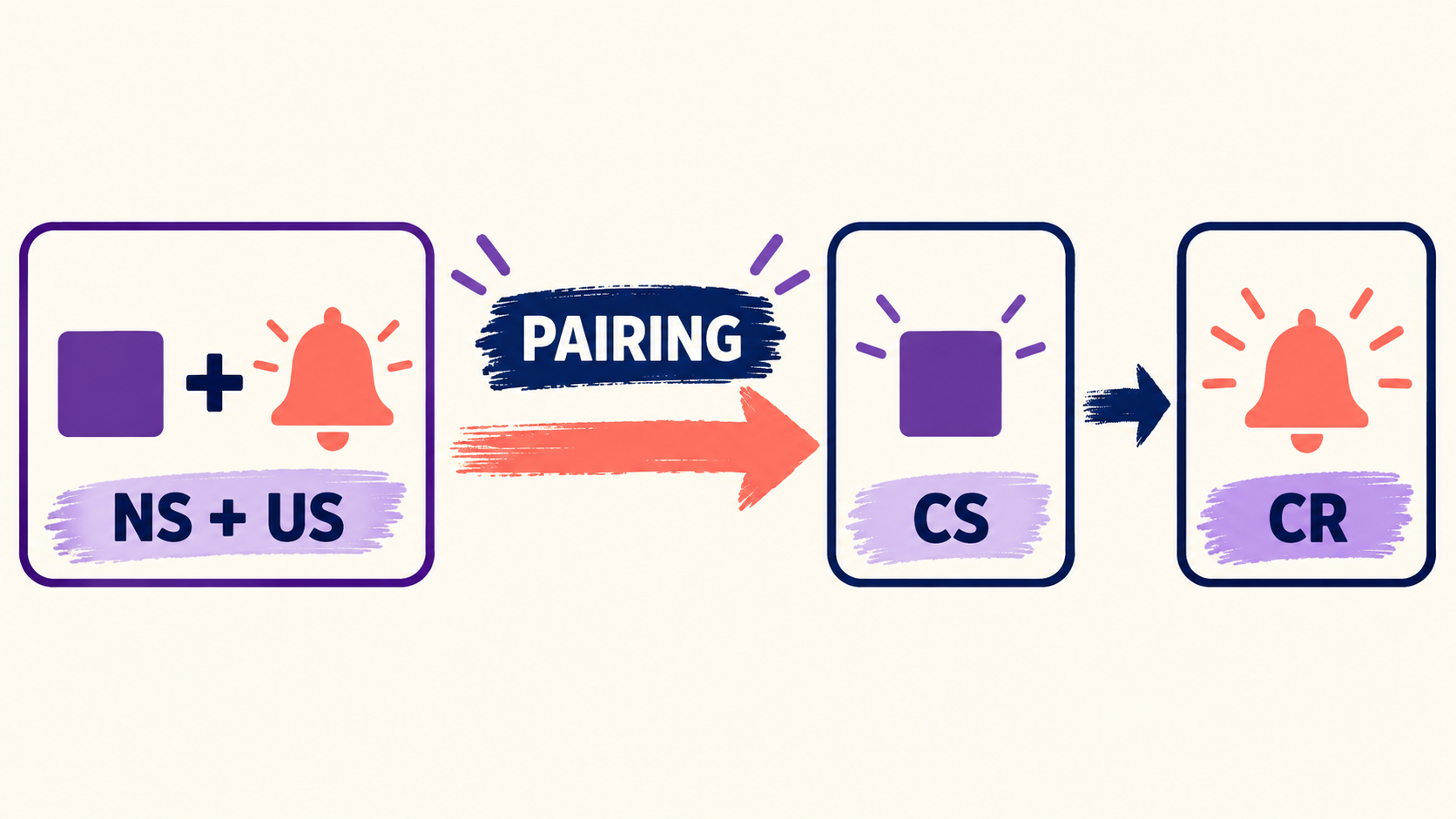
Respondent learning theory describes learning in which relations among stimuli change the probability or intensity of an elicited response. Before conditioning, an unconditioned stimulus (US) already elicits an unconditioned response (UR). A stimulus that initially has no reliable eliciting function can be paired with the US. After repeated or meaningful pairings, that formerly neutral stimulus may become a conditioned stimulus (CS) that elicits a conditioned response (CR).
A familiar example is a tone paired with food. Food can elicit salivation without prior training. If a tone repeatedly occurs before food, the tone may later elicit salivation even before food appears. The tone is now functioning as a CS, and the salivation elicited by the tone is a CR. The example is about the relation among stimuli and elicited responses, not about a consequence increasing a voluntary response.
“Respondent” does not mean that the learner is passive in every broader sense, and it does not mean that every automatic-looking behavior is respondent. For an exam question, identify whether the stem describes an eliciting stimulus and a stimulus-pairing history or a consequence that follows an emitted response. That relation usually tells you which learning process is being tested.
How Does Respondent Conditioning Work?
The sequence is easiest to learn in three stages:
- Before conditioning: the US elicits the UR. The neutral stimulus (NS) does not reliably elicit the target response.
- During conditioning: the NS is paired with the US. The timing, number of pairings, context, and predictiveness can affect learning.
- After conditioning: the NS has become a CS. The CS elicits a CR that resembles, anticipates, or differs in intensity from the original UR.
The pairing does not have to be identical in every example. A classroom bell, a clinic room, a smell, or a medical cue can acquire eliciting functions through a history with an event. The behavior analyst still needs to describe the actual stimuli and response rather than label a situation “classical conditioning” because it feels automatic.
Timing matters because the learner is sensitive to relations among events. A stimulus that reliably predicts an important event can acquire control more readily than a stimulus that appears randomly. Context can also become part of the conditioning history, which is why a response may be stronger in one room or routine than another.
What Do NS, US, UR, CS, and CR Mean?
The abbreviations are useful only when you identify the learning history. They are not labels that can be assigned by the emotional tone of a scenario.
| Term | Meaning | Question to ask |
|---|---|---|
| NS | Neutral stimulus before conditioning | Did this stimulus initially lack the target eliciting function? |
| US | Unconditioned stimulus that elicits a response without the relevant learning history | What event already produces the response? |
| UR | Unconditioned response elicited by the US | What response occurs before conditioning? |
| CS | Conditioned stimulus that acquired an eliciting function through pairing | What stimulus now predicts or signals the important event? |
| CR | Conditioned response elicited by the CS | What learned response now occurs to the CS? |
The same physical event can have different functions at different points in a learning history. A tone can be an NS before pairing and a CS after pairing. Likewise, a response can be an UR when elicited by the US and a CR when elicited by the CS. Always identify the relation and the time point before choosing a label.
How Is Respondent Learning Different From Operant Learning?
Respondent and operant processes can occur in the same environment, but the defining relations are different. Respondent behavior is elicited by an antecedent stimulus; operant behavior is emitted and its future probability is affected by consequences. A question may include an antecedent and a consequence, so do not decide based on the first stimulus you see.
| Feature | Respondent learning | Operant learning |
|---|---|---|
| Core relation | Stimulus–stimulus pairing changes what a stimulus elicits | A consequence changes the future probability of an emitted response |
| Response relation | The response is elicited by a stimulus | The response is emitted and selected by its consequences |
| Typical exam clue | Formerly neutral cue now elicits fear, salivation, arousal, or another reflexive response | The response increases or decreases after attention, access, escape, or another consequence |
For example, a learner cries when a clinic room is entered after repeated painful procedures. The room may have acquired an eliciting function through respondent conditioning. If the learner then engages in escape behavior and the demand is removed, that separate consequence may strengthen an operant response. One situation can contain both processes.
What Are Examples in ABA?
In applied behavior analysis, respondent learning may help explain why a previously neutral cue evokes an emotional or physiological response. A person may become distressed when seeing a location associated with an aversive event, relax when hearing a routine sound paired with calming experiences, or show arousal when a familiar cue predicts an important event. The example should be described carefully and without assuming a diagnosis.
A BCBA may analyze the learning history, collect information about antecedent conditions, and design a plan that reduces unnecessary exposure, teaches useful alternatives, or arranges safer new pairings when clinically appropriate. The explanation must remain individualized. A cue that is aversive for one person may be neutral or preferred for another. In a study scenario, mark each event:
- What stimulus elicited the response before the learning history?
- What neutral stimulus was paired with that event?
- What response occurred during the original event?
- What stimulus now elicits a similar response?
- Is a consequence after an emitted response also changing operant behavior?
How Do Acquisition, Extinction, Generalization, and Discrimination Fit?
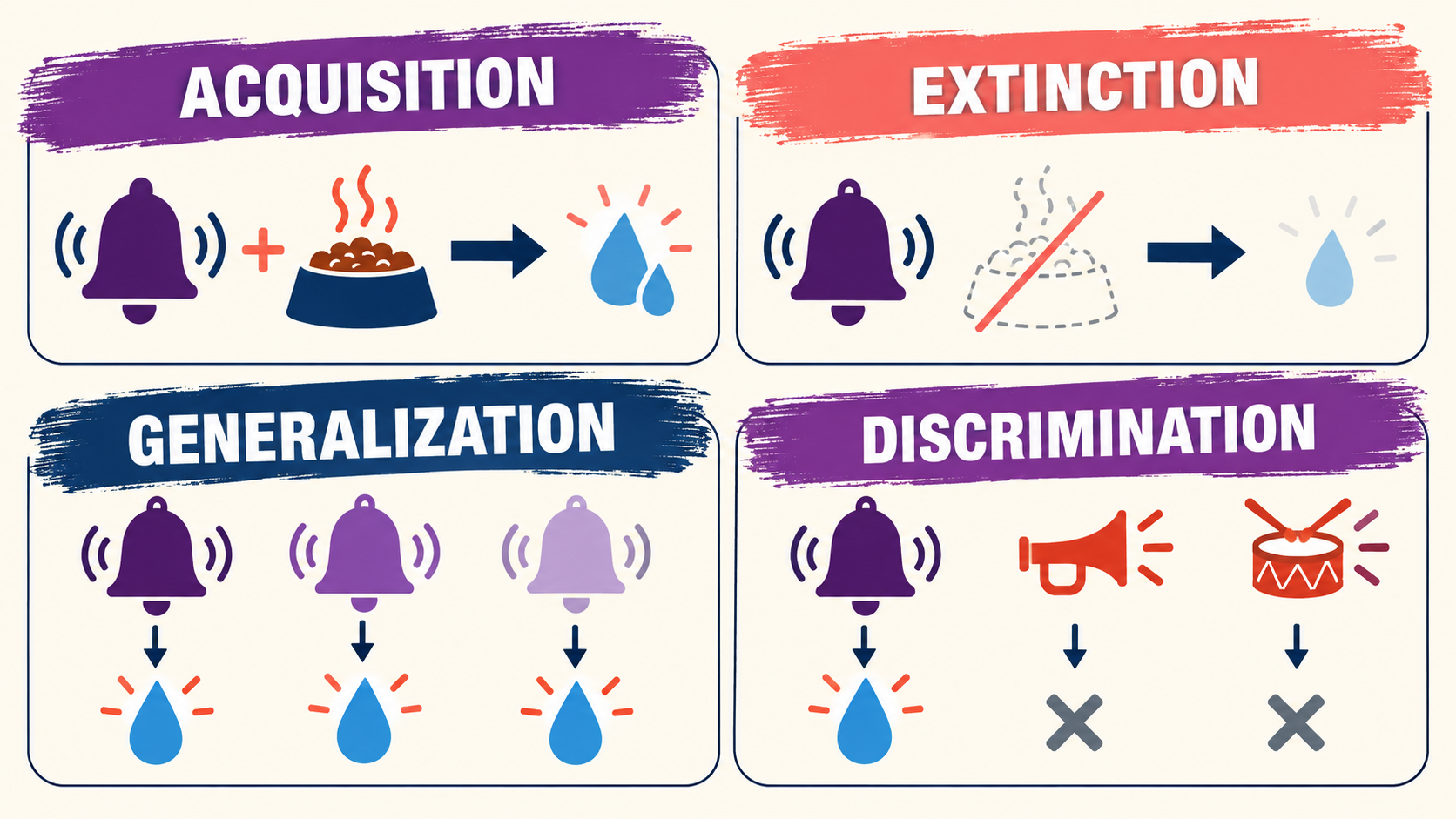
Acquisition is the development or strengthening of the conditioned relation through pairing. The CS becomes more likely to elicit the CR as the relevant learning history develops. Acquisition is not necessarily all-or-none; context, predictiveness, intensity, timing, and prior learning can affect the response.
Respondent extinction occurs when the CS is repeatedly presented without the US that maintained the conditioned relation, and the CR decreases. Extinction is not the same as erasing the learning history. A response may return in a different context or after time has passed. If a question describes withholding a consequence after an emitted operant response, identify operant extinction instead.
Generalization occurs when stimuli similar to the CS also elicit the CR. Discrimination occurs when responding becomes more selective to one stimulus or stimulus class than to other stimuli. Generalization can make a response spread across places or cues; discrimination can narrow it. The correct label depends on the pattern of responding, not on whether the response is pleasant or unpleasant.
These processes can matter clinically. A learner may respond to one therapy room but not another, or a response may spread from one medical cue to an entire routine. Data should describe which stimuli, contexts, and responses are changing. Avoid using “generalization” to mean simply that a skill is useful everywhere; specify the observed stimulus and response pattern.
How Does the Topic Appear on the BCBA Exam?
The current BCBA content outline includes identifying and distinguishing respondent and operant conditioning. Questions may test the same concept through a brief story rather than through the words “classical conditioning.” Look for the relation that explains the change.
- Underline the stimulus that elicits the response now.
- Find the stimulus that originally produced the response without training.
- Identify the pairing history that gave the neutral cue a new function.
- Check whether a consequence followed an emitted response and created a separate operant relation.
- Use the time point: before conditioning, during pairing, or after conditioning.
A common exam trap is calling a CS a reinforcer because the learner responds when the CS appears. A CS elicits a conditioned response; a reinforcer is a consequence defined by an increase in the future probability of a behavior. Another trap is calling an UR “conditioned” because the response looks emotional. The label depends on which stimulus elicits it and whether a learning history is described.
What Mistakes Should You Avoid?
- Confusing classical, respondent, and Pavlovian conditioning with three different processes; they are common names for the same broad conditioning tradition.
- Calling every automatic response respondent without identifying an eliciting stimulus.
- Calling a consequence a CS simply because it happens after behavior.
- Assuming the CR must be identical to the UR in form or intensity.
- Using respondent extinction when the stem actually describes an operant consequence being withheld.
- Ignoring context, stimulus similarity, or the timing of the pairing.
- Applying a broad theory label as if it were an individualized clinical diagnosis.
Frequently Asked Questions
What is another name for respondent learning?: Respondent learning is commonly called classical conditioning or Pavlovian conditioning. The terms refer to learning through relations among stimuli that change what a stimulus elicits. What is the difference between a US and a CS?: A US elicits a response without the relevant conditioning history. A CS acquires its eliciting function through pairing with another stimulus. The same physical event cannot be labeled correctly without knowing the learning history.
Is a conditioned response the same as an operant behavior?: Not necessarily. A conditioned response is elicited by a conditioned stimulus. An operant behavior is emitted and selected by consequences. A situation can include both a respondent response and an operant response.
What is respondent extinction?: Respondent extinction is the repeated presentation of the CS without the US, followed by a decrease in the CR. The decrease does not prove that the original learning history has been erased or that a response can never return.
How can I practice this topic for the BCBA exam?: Practice labeling the stimulus–response history before choosing an answer. Then compare respondent conditioning with operant reinforcement, punishment, and extinction. The free BCBA mock exam can provide study practice, but it is not official BACB content or a guarantee of passing.
Sources for Further Study
- BACB BCBA Handbook — current certification handbook and basic-principles content context.
- BACB Test Content Outlines — current BCBA content-outline resources.
- OpenStax Psychology: Classical Conditioning — accessible overview of the respondent conditioning sequence.
- APA Dictionary of Psychology: Classical Conditioning — terminology reference.
Take the Free BCBA Mock Exam
If you want a low-pressure way to check your recall, use the free practice resource below. Take the Free BCBA Mock Exam



