
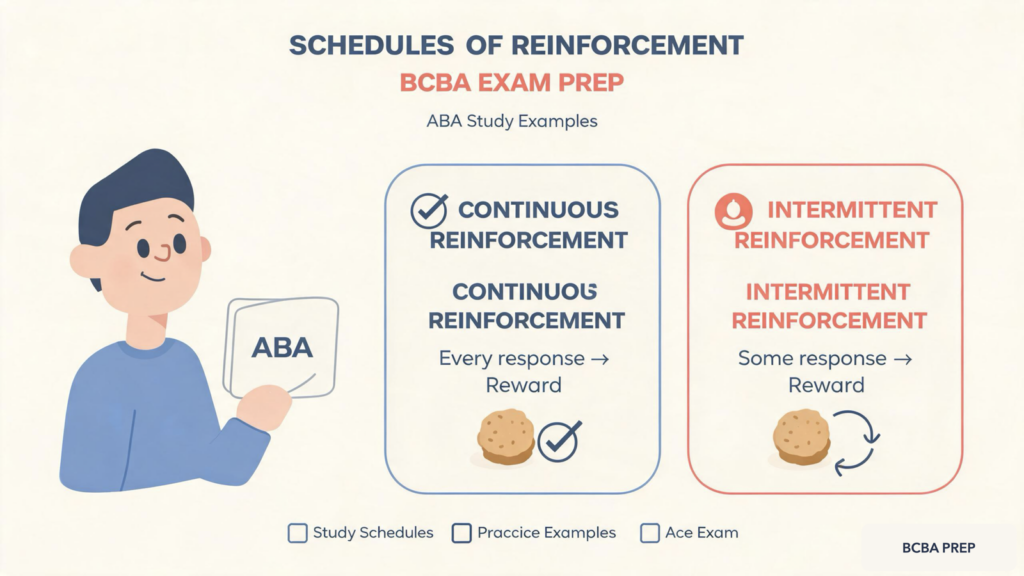
Understanding Schedules of Reinforcement in Behavior
Every BCBA candidate must know how schedules of reinforcement influence behavior. A schedule of reinforcement specifies which responses are followed by a reinforcer. The four basic schedules demand thorough understanding and the ability to recognize real-life examples.
Practice this concept
Table of Contents
- Understanding Schedules of Reinforcement in Behavior
- Fixed Ratio (FR) Schedule with ABA Examples
- Variable Ratio (VR) Schedule: Real-Life Clinical Application
- Fixed Interval (FI) Schedule and the Scalloped Pattern
- Variable Interval (VI) Schedule: Why Steady but Low Response?
- Comparing the Four Schedules for the BCBA Exam
- Summary and Next Steps for Exam Prep
As you prepare for the exam, linking each schedule to a practical example solidifies your memory. Below, we break down each schedule with clear ABA scenarios and highlight common exam traps.
The Four Basic Schedules
The four schedules are fixed ratio (FR), variable ratio (VR), fixed interval (FI), and variable interval (VI). Ratio schedules depend on the number of responses; interval schedules depend on the passage of time. Each produces a distinct pattern of responding.
Fixed Ratio (FR) Schedule with ABA Examples
An FR schedule delivers reinforcement after a fixed number of responses. For example, FR 5 means every fifth response earns a reinforcer. This schedule generates a high response rate followed by a post-reinforcement pause.
Example: A student must complete five math problems before receiving a break. The student works quickly through the problems, then pauses after receiving the break before starting the next set. In a clinical setting, a child earns a token after every third correct imitation trial.
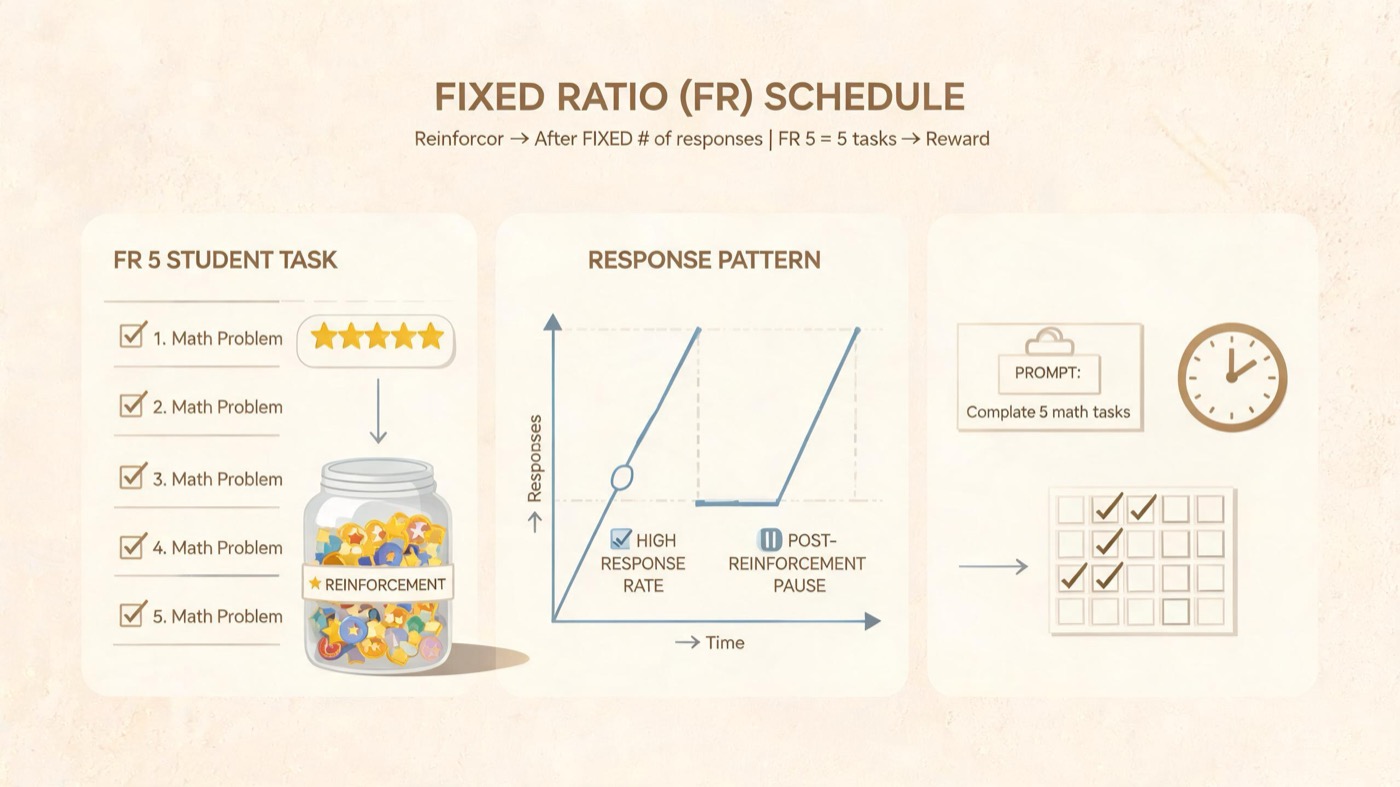
On the exam, be ready to identify the post-reinforcement pause in cumulative records. The pause is longer after larger ratio requirements. Common trap: confusing the pause with satiation — recall it is a characteristic of ratio strain, not deprivation.
Variable Ratio (VR) Schedule: Real-Life Clinical Application
VR schedules deliver reinforcement after an average number of responses, but the exact number varies unpredictably. This produces a high, steady rate with little to no post-reinforcement pause. Slot machines are a classic example — the player never knows how many pulls until the next win.
In ABA, a therapist might reinforce a client’s requesting behavior after an average of 3 attempts (VR 3). Sometimes after 2, sometimes after 5. The client continues asking consistently because the next request could be reinforced. This schedule is resistant to extinction and creates persistent behavior.
Exam trap: Do not assume VR schedules always have a post-reinforcement pause. In VR, the pause is nearly absent because the next response could be the one that pays off. Another trap: confusing VR with variable interval — remember ratio is based on responses, not time.
Fixed Interval (FI) Schedule and the Scalloped Pattern
An FI schedule provides reinforcement for the first response after a fixed time period. The classic pattern is a scalloped curve — low responding early in the interval, increasing as the end of the interval approaches.
Example: A child receives access to a preferred toy after a 5-minute timer rings, but only if they ask appropriately at that moment. Early in the interval, the child engages in other activities. As the timer nears 5 minutes, the frequency of requests increases. In human behavior, checking email before a scheduled meeting is an FI pattern: little checking early, rapid checking as the meeting time nears.
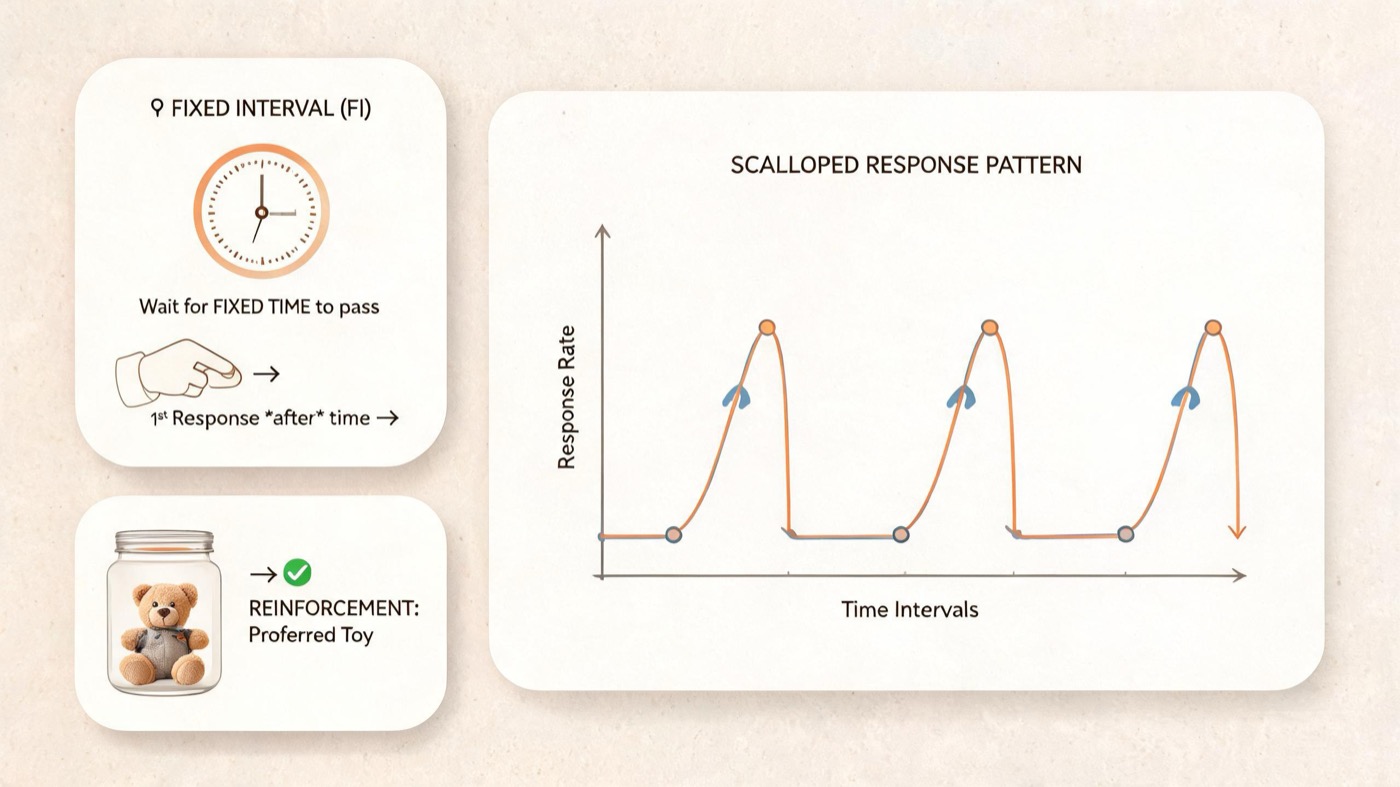
Exam relevance: The scalloped pattern is unique to FI schedules. Be cautious not to confuse it with the break-and-run pattern of FR. FI schedules also produce a post-reinforcement pause right after the reinforcer, but the pause is often followed by acceleration.
Variable Interval (VI) Schedule: Why Steady but Low Response?
A VI schedule delivers reinforcement for the first response after an average, unpredictable time interval. The result is a low to moderate, steady response rate with no predictable pauses. Because the timing of reinforcement is unknown, the learner responds consistently.
Example: A teacher gives pop quizzes on an average of every 10 school days. Students study (respond) at a steady rate because they never know when the next quiz will occur. In ABA therapy, a therapist may check in on a client’s on-task behavior and provide praise after variable intervals (e.g., VI 5 minutes). The client remains on-task at a consistent level because the next check could happen at any moment.
Key point: VI schedules produce extinction-resistant behavior but typically at lower rates than ratio schedules. Exam trap: VI and VR both produce steady responding, but VI response rates are lower because time constraints limit the maximum number of responses.
Comparing the Four Schedules for the BCBA Exam
To pass the BCBA exam, you must quickly distinguish between schedules based on response patterns and common features. The table below summarizes key differences:
- FR: High rate, post-reinforcement pause, ratio strain possible
- VR: High steady rate, minimal pause, resistant to extinction
- FI: Scalloped pattern, low early, high late, post-reinforcement pause
- VI: Low steady rate, no pause, moderate resistance to extinction
Common Exam Traps to Avoid
Examiners love to test subtle distinctions. Watch out for these common traps:
- Confusing FI scalloped with FR break-and-run — look for the acceleration near the end of the interval
- Assuming VR always has a pause — it does not; that is FR’s trademark
- Mixing up VI and VR — both are variable, but one is time-based (VI), the other response-based (VR)
- Forgetting that post-reinforcement pause length correlates with ratio size for FR, not with interval length for FI
Quick Reference Checklist
Use this checklist when analyzing scenario questions:
- Is reinforcement based on number of responses or time? Ratio or interval.
- Is the requirement fixed or variable? Predictable or unpredictable.
- What is the response rate: high, low, steady, or accelerating?
- Is there a pause after reinforcement? Usually present in FR and FI, absent in VR and minimal in VI.
- Does the pattern show a scallop? That indicates FI.
For more on compound schedules, see our guide on compound schedules of reinforcement.
Summary and Next Steps for Exam Prep
Mastering schedules of reinforcement examples is critical for the BCBA exam. Remember the four basic types and their unique patterns. Practice with real-life scenarios until you can instantly identify the schedule from the description. Use our quick checklist to systematically analyze exam questions.
For additional practice, visit the BACB website for task list details and review of basic behavior principles. Continue studying with our BCBA exam prep resources and take mock exams to test your knowledge.
Complete BCBA Exam Prep
Turn this topic into exam-day practice
Practice concepts in context with five full-length 6th Edition mock exams, two bonus practice exams, a 6th Edition study guide, and key-term flashcards—all in one $120 USD package.
Get the $120 All-in-One Prep Pack
Review everything included on the product page before ordering. No pass guarantee is implied.



