
What Is the BCBA Task List?
The task list BCBA is the official document published by the Behavior Analyst Certification Board (BACB) that outlines the knowledge and skills every Board Certified Behavior Analyst must master. It serves as the blueprint for the BCBA exam and for graduate coursework accreditation. Understanding this document is essential for effective BCBA exam preparation.
Table of Contents
- What Is the BCBA Task List?
- Content Areas of the BCBA Task List (5th Edition)
- Real-World Example: Applying Task List Items
- Common Exam Traps and How to Avoid Them
- Quick Study Checklist for the BCBA Task List
- Final Summary and Next Steps
- References
History and Evolution of the Task List
The BACB updates the task list periodically to reflect advances in the science and practice of applied behavior analysis. The 5th Edition replaced the 4th Edition in 2020 and introduced a clearer organization of content areas (A–I), refined definitions of key concepts, and a stronger emphasis on ethics and supervision. Candidates should focus exclusively on the 5th Edition for current exam requirements.
For a deeper look at the 6th Edition transition, visit our guide to the BACB task list 6th edition.
Content Areas of the BCBA Task List (5th Edition)
The task list is divided into nine content areas (A–I). Each area has a specific number of items that are sampled on the exam. Below is a summary of each domain with key subpoints you must know.
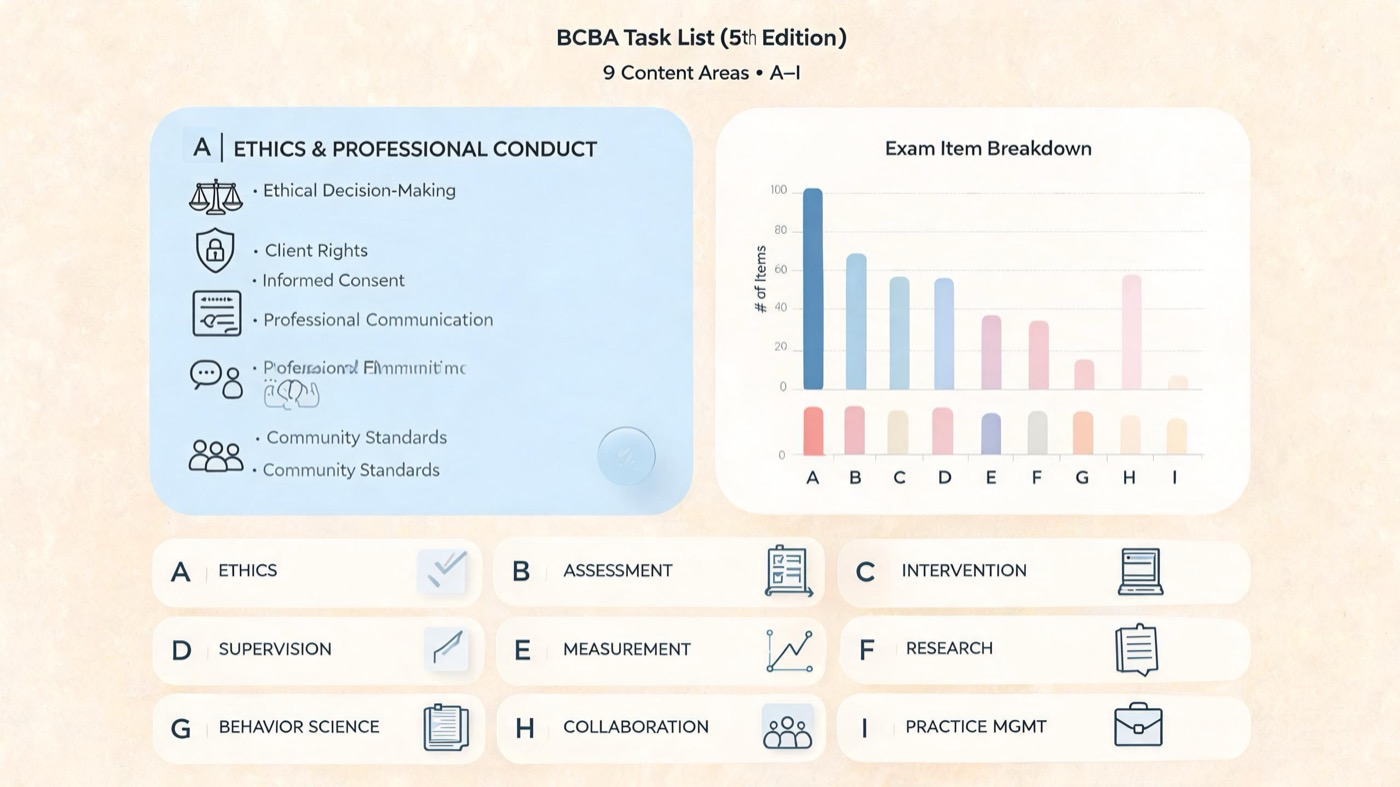
A: Ethics and Professional Conduct
This area covers the BACB Ethics Code, including ethical decision-making, client rights, and professional boundaries. Expect questions that require you to identify ethical violations and apply the code to real-world scenarios.
B: Concepts and Principles
Master the basic principles: reinforcement (positive/negative), punishment, extinction, and stimulus control. These are the building blocks of all behavior-change procedures.
C: Measurement, Data Display, and Interpretation
Topics include operational definitions, data collection methods (continuous vs. discontinuous), graphing (line graphs, bar graphs), and visual analysis. Interobserver agreement (IOA) is a frequently tested concept.
D: Experimental Design
Focus on single-subject designs (ABAB, multiple baseline, alternating treatments, changing criterion). Understand threats to internal validity and how to control for them.
E: Behavior Assessment
Cover indirect assessments (interviews, checklists), descriptive assessments (ABC data collection), and functional analysis (FA). Know the differences and when to use each.
F: Behavior-Change Procedures
This large area includes differential reinforcement (DRA, DRO, DRI, DRL, DRH), prompting and prompt fading, chaining, shaping, extinction, and generalization programming. Treatment integrity is also assessed here.
G: Implementation and Management
Focus on treatment fidelity, data-based decision making, and systems-level support. Understand how to monitor progress and make adjustments.
H: Personnel Supervision and Management
Learn about supervision responsibilities, performance feedback, training methods (e.g., Behavioral Skills Training), and ethical considerations in supervision.
Real-World Example: Applying Task List Items
To see how task list items connect in practice, consider the following scenarios.
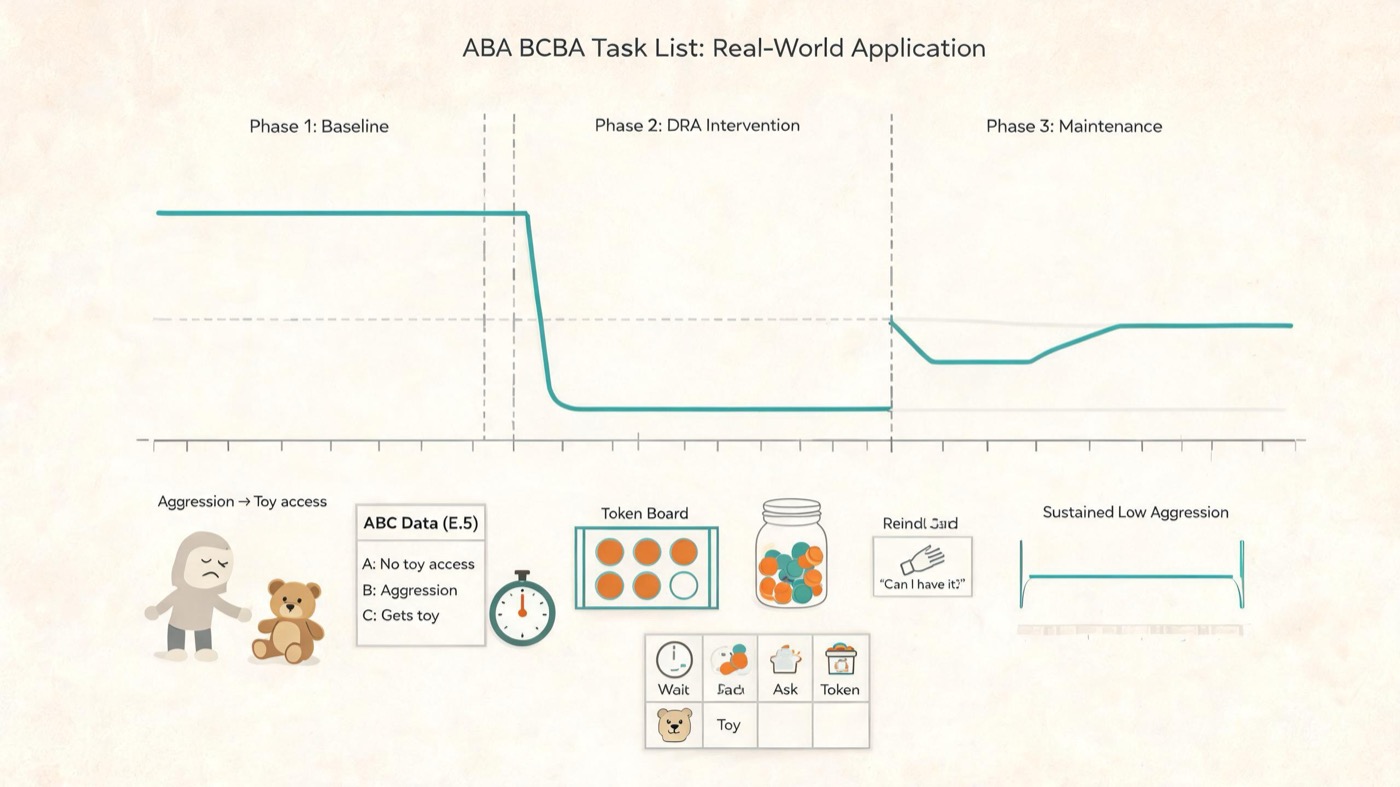
Example 1: Functional Assessment and Intervention (Task E.5 & F.6)
A client engages in aggression. You collect ABC data (E.5) and identify that aggression is maintained by access to tangibles. You then implement a differential reinforcement of alternative behavior (DRA) procedure (F.6) that teaches the client to request the item appropriately. This example integrates assessment and intervention seamlessly.
Example 2: Ethical Decision-Making (Task A.1 & H.5)
A supervisee reports that a client’s family is requesting a punishment procedure without prior functional assessment. Using the BACB Code (A.1), you guide the supervisee to refuse and instead conduct an appropriate assessment. As a supervisor (H.5), you provide immediate corrective feedback and document the discussion. This shows how ethics and supervision intertwine.
Common Exam Traps and How to Avoid Them
Candidates often lose points on the BCBA exam due to subtle misunderstandings of task list items. Here are frequent pitfalls:
- Confusing negative reinforcement with punishment: Remember that negative reinforcement increases behavior (removal of an aversive stimulus), while punishment decreases behavior.
- Misidentifying functional analysis conditions: Know that the alone condition tests automatic reinforcement; the escape condition tests negative reinforcement.
- Overlooking treatment integrity: Many questions ask you to identify whether an intervention was implemented as designed. Treatment fidelity is a separate concept from effectiveness.
- Forgetting the functions of behavior: Common functions are escape, attention, access to tangibles, and automatic reinforcement. Always refer back to these when selecting interventions.
- Ignoring ethical obligations: Even when the clinical answer seems clear, the correct choice often involves an ethical step (e.g., obtaining consent, maintaining confidentiality).
To practice with exam-style questions, try our free BCBA mock exam.
Quick Study Checklist for the BCBA Task List
Use this checklist to track your progress through each content area. Check off items as you master them.
- ___ Ethics (A): Review BACB Code; practice ethical scenarios.
- ___ Concepts (B): Define reinforcement, punishment, extinction, stimulus control with examples.
- ___ Measurement (C): Identify data collection methods; interpret graphs.
- ___ Experimental Design (D): Describe single-subject designs; identify threats to validity.
- ___ Assessment (E): Differentiate indirect, descriptive, and functional analysis.
- ___ Procedures (F): List differential reinforcement types; explain chaining and prompting.
- ___ Implementation (G): Monitor treatment fidelity; adjust based on data.
- ___ Supervision (H): Apply supervision skills; provide feedback ethically.
Final Summary and Next Steps
The task list BCBA is your roadmap to passing the exam and becoming a competent practitioner. Focus on mastering each content area, practice applying concepts to real-world cases, and review common traps. Consistent study using mock exams and flashcards will solidify your knowledge. For more comprehensive prep, explore our BCBA exam prep guide. Next steps: schedule your exam, join a study group, and take advantage of free resources.
References
Next step for BCBA exam prep
Build a focused BCBA exam practice plan
Start with five full-length 6th Edition mocks, then add the complete prep system only if you need the study guide and flashcards.
See Five Full-Length BCBA Mocks — $99See the All-in-One Prep Pack — $120
Review the included materials and access details before ordering. No pass guarantee is implied.



