
What Are Reinforcer Assessments?
Reinforcer assessments are a specific form of preference assessment that go beyond simply identifying what an individual likes. They directly test whether a stimulus functions as a reinforcer by measuring its effect on a target behavior. This distinction is critical for designing effective behavior-change programs and is a frequent topic on the BCBA exam.
Table of Contents
- What Are Reinforcer Assessments?
- Common Types of Reinforcer Assessments
- Worked ABA Examples with ABC and Hypothesized Function
- Exam Relevance and Common Traps
- Quick Checklist for Reinforcer Assessments
- Summary
- References
Definition and Purpose
A reinforcer assessment involves delivering a stimulus contingent on a specific behavior and observing whether the behavior increases over time. If the behavior increases, the stimulus is confirmed as a reinforcer. The purpose is to validate that preferred items or activities actually strengthen behavior under current conditions, accounting for motivating operations (deprivation and satiation).
How They Differ From Preference Assessments
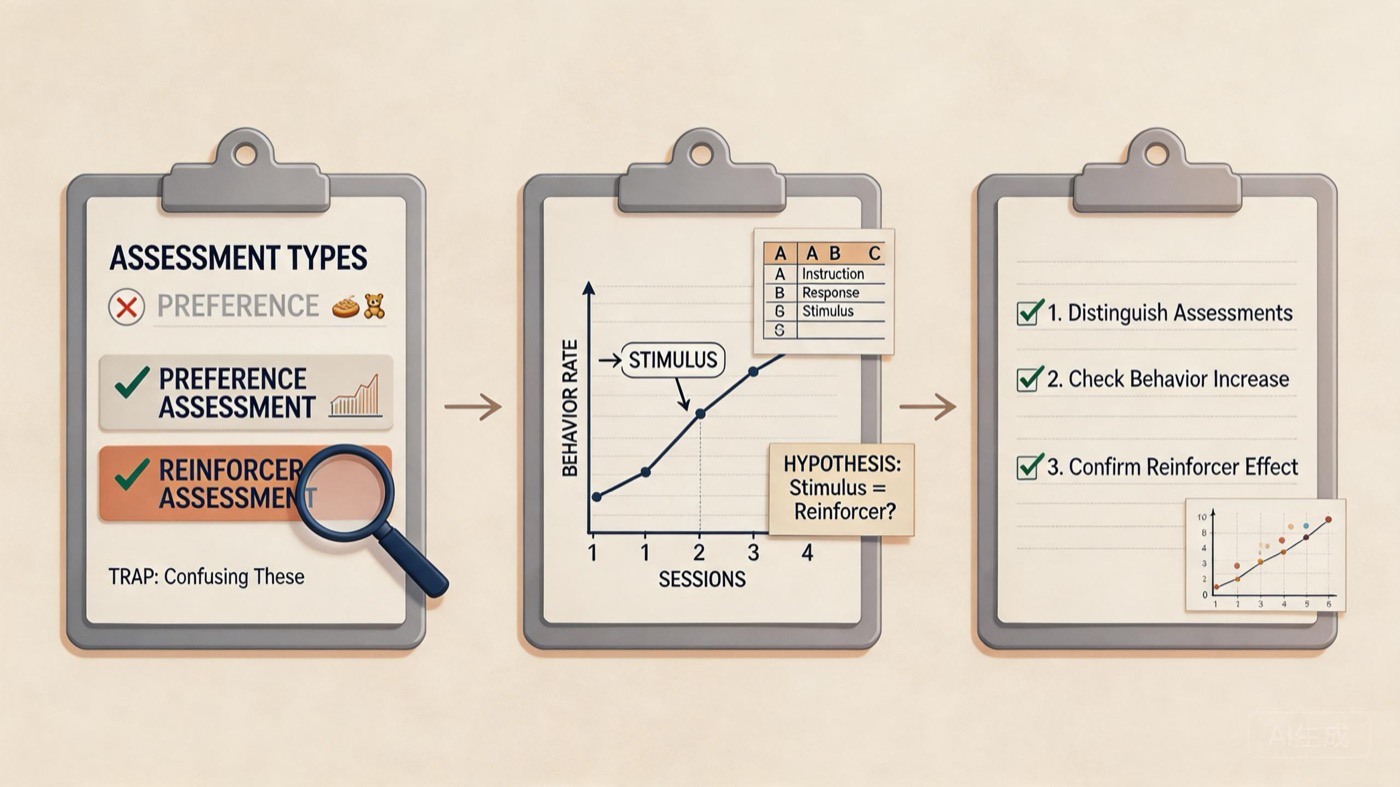
Preference assessments identify which stimuli an individual chooses or interacts with most, but they do not confirm that those stimuli will function as reinforcers. For example, a child may always select a toy car during a preference assessment, but if the toy car does not increase compliant behavior when delivered contingently, it is not a reinforcer. Reinforcer assessments provide direct evidence of reinforcing effectiveness, making them an essential step in ABA practice. For a deeper look at preference assessments, see our guide on preference assessments for the BCBA exam.
Common Types of Reinforcer Assessments
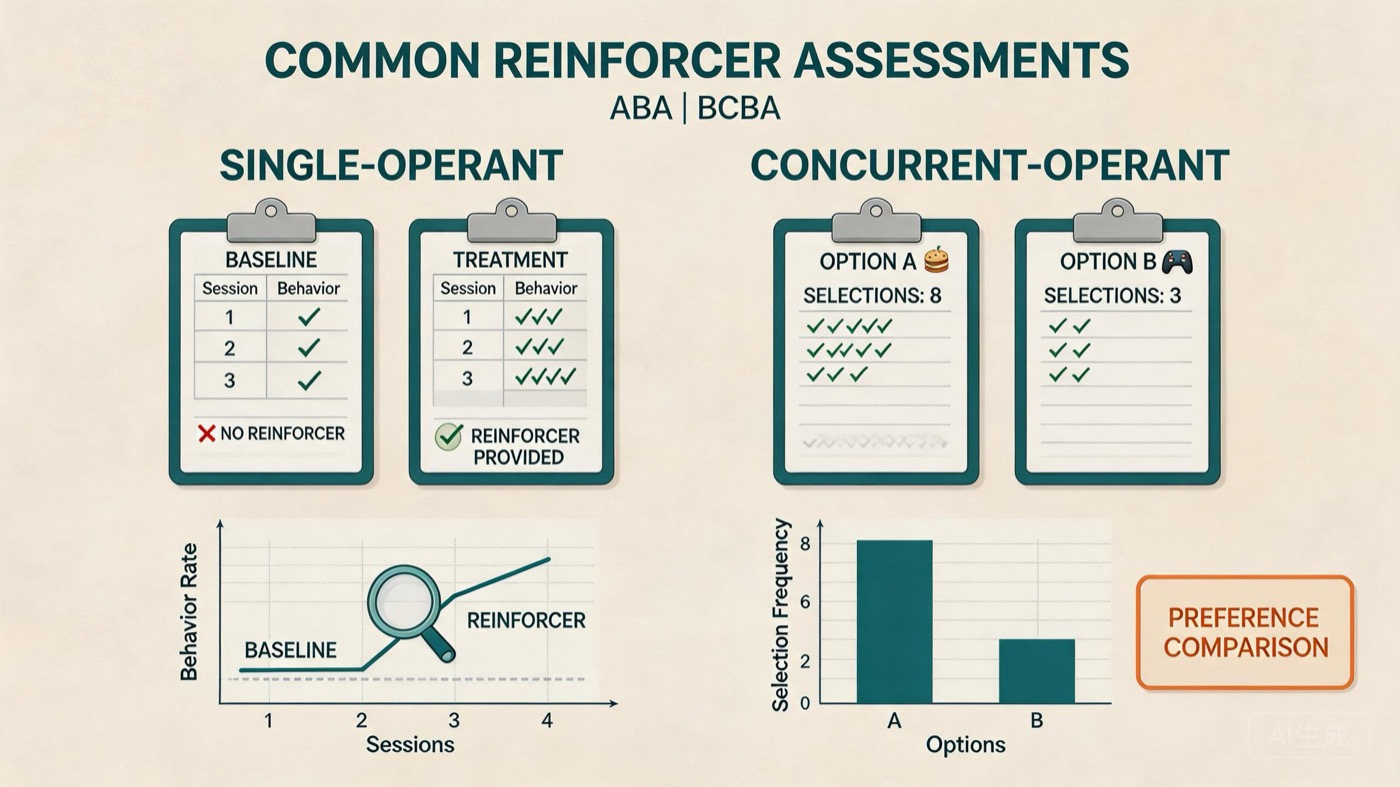
Two widely used methods in ABA are the single-operant and concurrent-operant reinforcer assessments. Each answers different questions about reinforcing value.
Single-Operant Reinforcer Assessment
In a single-operant arrangement, one target behavior is measured under two conditions: a baseline phase (without the potential reinforcer) and a test phase (where the stimulus is delivered contingently). The behavior is compared across phases. If the behavior increases during the test phase, the stimulus is a reinforcer.
- Example: A teacher measures on-task behavior during math. In baseline, on-task is low. Then, access to a preferred puzzle is given after every 5 minutes of on-task behavior. On-task increases. The puzzle is a reinforcer.
- Exam tip: Look for contrived versus natural reinforcers; single-operant assessments often test contrived reinforcers.
Concurrent-Operant Reinforcer Assessment
In a concurrent-operant arrangement, two or more response options are available, each leading to a different stimulus. The individual’s choice indicates the relative reinforcing effectiveness of each stimulus. This method directly compares reinforcer strength.
- Example: A teenager can either work on a worksheet (access to video game) or clean a room (access to snack). If the teen consistently chooses the worksheet, video game access is a more potent reinforcer for that context.
- Exam tip: Concurrent assessments reveal preference hierarchies and are useful when multiple potential reinforcers are available.
Worked ABA Examples with ABC and Hypothesized Function
Example 1: Tangible Function
Client: Child with ASD. ABC: Antecedent: therapist presents a non-preferred task. Behavior: crying. Consequence: access to iPad. Hypothesis: Positive reinforcement (access to tangible item). To confirm, conduct a reinforcer assessment: measure crying during task when iPad is delivered contingent on task completion versus no iPad. If crying decreases and task completion increases when iPad is delivered, the iPad is a reinforcer.
Example 2: Escape Function
Client: Teen with intellectual disability. ABC: Antecedent: demands given. Behavior: aggression. Consequence: removal of demands. Hypothesis: Negative reinforcement (escape). Reinforcer assessment: measure aggression when a break is given contingent on compliance versus no break. If aggression decreases and compliance increases when a break is provided, the break functions as a reinforcer.
Example 3: Automatic Reinforcement
Client: Adult with stereotypic behavior. ABC: Antecedent: alone time. Behavior: hand-flapping. Consequence: sensory stimulation. Hypothesis: Automatic positive reinforcement. Reinforcer assessment: provide an alternative source of sensory input (e.g., vibration) contingent on an alternative behavior (e.g., pressing a button). If button-pressing increases, the vibration is a reinforcer. This helps differentiate automatic from socially mediated reinforcement.
Exam Relevance and Common Traps
The BCBA exam often tests your ability to distinguish between assessment types and interpret data from reinforcer assessments. Scenario-based questions require you to identify whether a stimulus is a reinforcer based on behavioral change.
How It Appears on the Exam
- Identify the type of assessment described in a vignette (e.g., single-operant vs. concurrent).
- Interpret data: Given a graph with baseline and intervention phases, determine if the stimulus is a reinforcer.
- Decide next steps: If a preferred item does not increase behavior, the examiner should conduct a reinforcer assessment instead of assuming it is effective.
Common Traps and How to Avoid Them
Trap 1: Confusing preference assessments with reinforcer assessments. Solution: Remember that only reinforcer assessments show a functional effect on behavior. A preference assessment only indicates choice, not reinforcing efficacy.
Trap 2: Forgetting to consider motivating operations. Solution: Always check if the individual is in a state of deprivation or satiation; reinforcer value changes with context. For more on MOs, see motivating operations explained.
Trap 3: Overlooking the need for baseline data. Without a baseline, you cannot confirm behavior change. Always compare to a no-reinforcer condition.
Quick Checklist for Reinforcer Assessments
Use this checklist as a study aid to ensure you cover every step when evaluating a potential reinforcer in practice or on the exam.
- Step 1: Identify potential reinforcers using a preference assessment.
- Step 2: Choose a target behavior that is easy to measure and relevant.
- Step 3: Collect baseline data on the behavior without the potential reinforcer.
- Step 4: Deliver the stimulus contingent on the target behavior during the test phase.
- Step 5: Measure the behavior and compare it to baseline.
- Step 6: If behavior increases, the stimulus is a reinforcer; if not, reassess or modify conditions.
- Step 7: Document results and consider repeating with other stimuli to build a reinforcer menu.
Summary
Reinforcer assessments are a specific form of preference assessment that confirm whether a stimulus actually reinforces behavior. They differ from preference assessments by providing direct evidence of behavioral change. Understanding the types—single-operant and concurrent-operant—along with practical examples and common exam traps, will strengthen your BCBA exam preparation. Always pair reinforcer assessments with consideration of motivating operations and baseline data. For more on related assessment strategies, explore our functional behavior assessment guide. To deepen your understanding of reinforcement principles, consult the BACB’s Ethical Compliance Code and resources like Cooper, Heron, & Heward’s Applied Behavior Analysis (2nd ed.).
References
Complete BCBA Exam Prep
Turn this topic into exam-day practice
Practice concepts in context with five full-length 6th Edition mock exams, two bonus practice exams, a 6th Edition study guide, and key-term flashcards—all in one $120 USD package.
Get the $120 All-in-One Prep Pack
Review everything included on the product page before ordering. No pass guarantee is implied.



