
How Reinforcement Is Tested on the BCBA Exam
BCBA reinforcement practice questions usually test whether you can identify the contingency, name the right procedure, and avoid common distractors under time pressure. On exam day, you are rarely asked to recite a definition in isolation. Instead, you are given a short scenario and expected to spot whether reinforcement is positive or negative, socially mediated or automatic, or part of a larger intervention package.
That is why this page is built as a question bank, not a generic explainer. Use the scenarios below to practice reading the behavior, the consequence, and the behavior change before you commit to an answer.
Table of Contents
- How Reinforcement Is Tested on the BCBA Exam
- BCBA Reinforcement Practice Questions
- Common Reinforcement Traps on the BCBA Exam
- Quick Review Checklist
- Take the Free BCBA Mock Exam
- FAQ About BCBA Reinforcement Practice Questions
BCBA Reinforcement Practice Questions
Each item below uses the same structure you will need on the real exam: read the scenario, identify the reinforcing consequence, and rule out tempting distractors.
Question 1: Positive Reinforcement
Scenario: A BCBA works with a 6-year-old who refuses to complete math worksheets. The BCBA implements a token system where the child earns a token for every five problems completed correctly. Tokens are exchanged for 5 minutes of iPad time. The child’s worksheet completion increases to 80% of assigned tasks.
What type of reinforcement is being used?
- A. Negative reinforcement
- B. Positive reinforcement
- C. Automatic reinforcement
- D. Differential reinforcement of alternative behavior
Correct Answer: B. Positive reinforcement
Why This Answer Is Correct: The learner completes the worksheet and then gains access to a preferred outcome through tokens and iPad time. A stimulus is added after the behavior, and the behavior increases. That matches positive reinforcement.
Why the Other Options Are Wrong:
- A is wrong because nothing aversive is removed after the worksheet behavior.
- C is wrong because the consequence is delivered socially by the BCBA, not produced by the behavior itself.
- D is wrong because this scenario does not describe extinction for a competing problem behavior or reinforcement of a clearly defined alternative response class.
Exam Trap: Candidates often see a token system and over-label it as DRA. Tokens are just the delivery system. First classify the contingency itself.
Question 2: Negative Reinforcement
Scenario: A teenager with autism often cries when given a chore list. His mother removes one chore from the list each time he cries. Over time, the crying increases when chore lists are presented.
What is the reinforcing consequence?
- A. Addition of chore removal
- B. Removal of chore removal
- C. Removal of the chore list
- D. Addition of the chore list
Correct Answer: C. Removal of the chore list
Why This Answer Is Correct: The crying produces escape from a demand. Something aversive is removed, and the crying increases, so the behavior is maintained by negative reinforcement.
Why the Other Options Are Wrong:
- A is wrong because the logic is phrased as a double negative and does not describe the actual contingency clearly.
- B is wrong because removing the removal would effectively restore or increase the demand.
- D is wrong because adding the chore list would not explain why crying increased as an escape response.
Exam Trap: The word negative does not mean punishment. Always ask first: did the behavior go up or down?
Question 3: Schedules of Reinforcement
Scenario: A student earns a sticker after every third correct answer during math drills. The student shows a long pause after receiving each sticker, then resumes responding quickly.
Which schedule best describes this pattern?
- A. Fixed interval
- B. Variable ratio
- C. Fixed ratio
- D. Variable interval
Correct Answer: C. Fixed ratio
Why This Answer Is Correct: Reinforcement occurs after a fixed number of responses, specifically every three correct answers. That is an FR 3 schedule, and the post-reinforcement pause fits the expected pattern.
Why the Other Options Are Wrong:
- A is wrong because fixed interval schedules depend on time, not response count.
- B is wrong because variable ratio schedules usually produce high, steady responding with less predictable pausing.
- D is wrong because variable interval schedules also depend on time, not every third response.
Exam Trap: When you see a pause, do not stop there. Check whether the contingency is based on responses or time.
Question 4: Differential Reinforcement
Scenario: A child engages in hand-flapping for 10 seconds at a time, about 5 times per hour. The BCBA wants to reduce hand-flapping frequency without eliminating it entirely. She provides a token each time the child has less than 3 episodes of hand-flapping in a 30-minute period. The frequency drops to 2 times per hour.
What procedure is being implemented?
- A. DRA
- B. DRO
- C. DRL
- D. DRH
Correct Answer: C. DRL
Why This Answer Is Correct: The target is not complete elimination. The BCBA is reinforcing a lower rate of the response than baseline, which is exactly the goal of differential reinforcement of low rates.
Why the Other Options Are Wrong:
- A is wrong because no alternative response is specified as the reinforced behavior.
- B is wrong because DRO would require zero occurrences during the interval.
- D is wrong because DRH is used when you want the response to occur more often, not less often.
Exam Trap: DRO vs. DRL is a classic exam confusion point. If some responding is still allowed, think DRL before DRO.
Question 5: Automatic vs. Social Reinforcement
Scenario: A 4-year-old with no language skills frequently spins in circles for several minutes at a time. This occurs most often when alone and no one interacts with him. The behavior is not followed by any social consequence. Spinning persists despite no attention or escape from demands.
What type of reinforcement maintains this behavior?
- A. Socially mediated positive reinforcement
- B. Socially mediated negative reinforcement
- C. Automatic positive reinforcement
- D. Automatic negative reinforcement
Correct Answer: C. Automatic positive reinforcement
Why This Answer Is Correct: The behavior itself produces sensory stimulation, and no other person is needed to deliver the consequence. Because stimulation is added and the response persists, this is automatic positive reinforcement.
Why the Other Options Are Wrong:
- A is wrong because no social agent is presenting a reinforcer.
- B is wrong because no demand or aversive event is being removed by another person.
- D is wrong because the case describes gaining stimulation, not escaping or reducing stimulation.
Exam Trap: If the behavior persists when the learner is alone, you should immediately test the idea of automatic reinforcement before assuming a social function.
Common Reinforcement Traps on the BCBA Exam
These are the mistakes that make reinforcement items feel harder than they actually are.
- Positive vs. negative: both increase behavior. The difference is add versus remove.
- Reinforcement vs. reward: a preferred item is only a reinforcer if behavior actually increases.
- Automatic vs. social: if no one delivers the consequence, suspect automatic reinforcement.
- DRO vs. DRL: zero occurrences points to DRO; lower but non-zero responding points to DRL.
- Schedule confusion: always ask whether the contingency is based on time or responses.
For a related concept review, see our guide on automatic reinforcement.
Quick Review Checklist
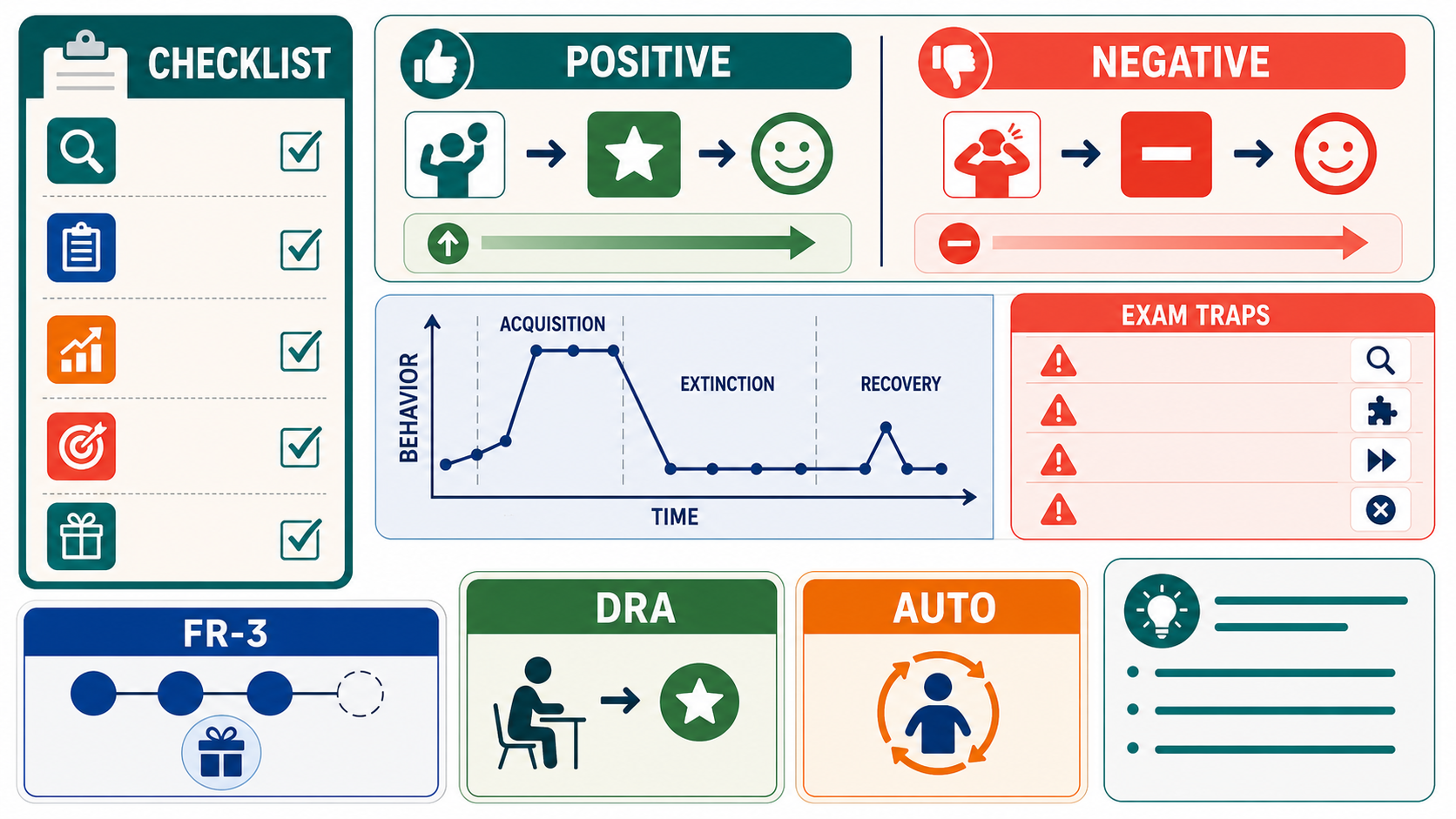
- Find the target behavior before you label the contingency.
- Find the immediate consequence and decide whether something was added or removed.
- Check the behavior change: if it increased, you are in reinforcement territory.
- Ask who delivered the consequence: another person or the behavior itself.
- Check the schedule cue: response-based or time-based.
- Check whether the intervention allows zero or low rates when differential reinforcement is involved.
Complete BCBA Exam Prep
Turn this topic into exam-day practice
Practice concepts in context with five full-length 6th Edition mock exams, two bonus practice exams, a 6th Edition study guide, and key-term flashcards—all in one $120 USD package.
Get the $120 All-in-One Prep Pack
Review everything included on the product page before ordering. No pass guarantee is implied.
Take the Free BCBA Mock Exam
If you want more reinforcement practice questions with explanations, the next step is to test your speed and accuracy on a longer set. Our free mock exam gives you more scenario-based items and helps you see which concepts still need work.
You can also review our BCBA exam prep guide if you want a broader study plan around reinforcement, stimulus control, and behavior-change procedures.
FAQ About BCBA Reinforcement Practice Questions
Q: How many reinforcement questions are on the BCBA exam?
A: The BACB does not publish an exact reinforcement count, but reinforcement concepts appear frequently because they connect to behavior-change procedures, schedules, function, and treatment selection.
Q: Are these questions meant to match the real exam style?
A: Yes. The goal is to mirror the short, scenario-based decision making that BCBA candidates usually face on exam day.
Q: What is the most common reinforcement mistake?
A: Mixing up negative reinforcement with punishment and overlooking whether the behavior increased or decreased.
Q: How should I study reinforcement more efficiently?
A: Practice classifying the behavior, the consequence, and the change in behavior in that order. That sequence reduces most reinforcement errors.
Q: Where can I get more BCBA-style questions?
A: Start with the free BCBA mock exam, then use targeted review pages like this one to tighten weak spots.



