
A practical guide to measuring response effort, changing the environment around a response, and choosing the right BCBA exam answer without confusing effort with motivation or punishment. If you are studying response effort aba, start with one precise idea: response effort is how much work a person must do to emit a response. That work can involve distance, force, physical or mental steps, time-consuming actions, or the number of separate behaviors required. In applied behavior analysis, changing that effort can change which response is more likely to occur.
Table of Contents
- What Is Response Effort ABA?
- Why Response Effort Changes Behavior
- How BCBAs Manipulate Response Effort
- Response Effort Examples
- Measurement and Ethical Safeguards
- How to Solve a Response-Effort Exam Question
- Use BCBA Practice to Test the Concept
- Frequently Asked Questions
- Quick Review Checklist
- Take the Free BCBA Mock Exam
The concept is useful because it turns a vague question—“Why will the learner not do this?”—into an environmental question: “What does this response require compared with the available alternatives?” A good analysis does not blame the learner. It defines the response, checks the function and context, changes one practical variable, and measures what happens next.
Study boundary: Response effort is an environmental variable. It is not a label for laziness, compliance, or willingness. In practice, changes must also respect consent or assent when applicable, client dignity, safety, social validity, and current professional requirements.
What Is Response Effort ABA?
Response effort is the amount of physical or behavioral work required to perform a response. A useful operational description includes at least three dimensions:
- Distance: how far the person must move to access materials, a communication device, a person, or a reinforcer.
- Force or pressure: how much force is needed to open, press, lift, carry, manipulate, or complete something.
- Number of actions: how many discrete steps, selections, responses, or transitions are required before the outcome is available.
For example, requesting a break with one available button may require less response effort than walking across a room, finding a card, handing it to an adult, and waiting for a response. The response topographies are different, but the key analytic question is how much work each option requires in that context.
Response effort is not the same as response cost. Response effort describes the work needed to perform a response. Response cost is a procedure in which a person loses a reinforcer or conditioned reinforcer after a behavior. A learner may experience high effort without losing anything, and response cost may occur after a low-effort response. Keep those definitions separate on the BCBA exam.
Why Response Effort Changes Behavior
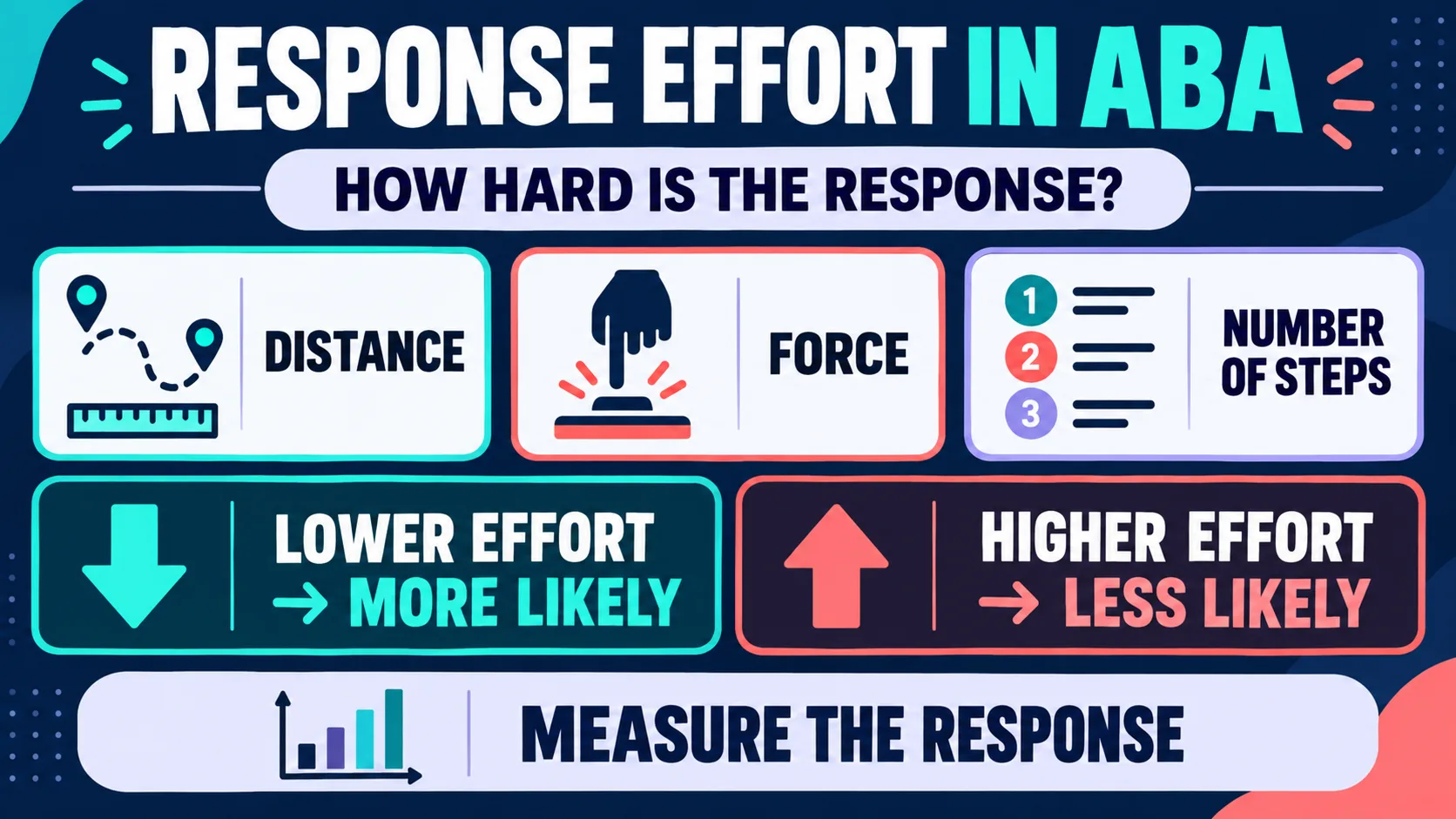
When two responses produce similar outcomes, the lower-effort option may become more competitive. If a desired response is difficult and a competing response is easy, the competing response may occur more often even when the learner has the skill to perform the desired response. Conversely, reducing the effort of a useful response can make it easier for reinforcement to contact that response.
This is not a mechanical rule that predicts every behavior. Preference, deprivation, delay, quality of reinforcement, stimulus control, skill fluency, pain, communication access, and history all matter. Response effort is one variable in a functional arrangement. The analyst should avoid saying “high effort always decreases behavior” or “low effort always increases behavior.” Instead, test the relation in the relevant context.
Research on response-effort manipulations has examined ways to increase desirable behavior or reduce problematic behavior. A peer-reviewed review of response-effort research summarizes applied examples and measurement concerns. For a BCBA candidate, the exam-relevant takeaway is not a universal formula. It is the ability to identify what the response requires, predict how a change might alter choice or persistence, and use data to check whether the prediction was correct.
How BCBAs Manipulate Response Effort
A response-effort manipulation changes the environment so that a response becomes easier or harder. In many cases, the most humane first move is to lower the effort of a safe, functional, socially valid response rather than adding an aversive consequence to a problem behavior.
| Goal | Possible effort change | What to measure |
|---|---|---|
| Increase functional communication | Place the communication option within reach, reduce unnecessary steps, or provide an accessible response form. | Independent requests, latency, successful access, and competing problem behavior. |
| Increase task engagement | Break a long task into smaller responses, prepare materials, clarify the next step, or reduce unnecessary motor demands. | Initiation, completed steps, accuracy, prompt level, and escape-maintained behavior. |
| Reduce an unsafe competing response | After assessment and safety review, remove easy access or add a safe response requirement while keeping an effective alternative available. | Rate and severity of the unsafe response, access to the alternative, and side effects. |
Notice the order in the table. The analyst first makes the goal response practical and measurable. If an intervention only makes a problem response harder but does not teach or make an effective alternative available, the arrangement may increase frustration, delay, or risk. A response-effort change should fit the function and the learner’s communication and skill repertoire.
Response Effort Examples
Example 1: A break request versus escape behavior: A learner is given a difficult worksheet. The break card is stored in a binder across the room, while pushing the worksheet away immediately delays the task. The break card has high response effort, and the problem response has low immediate effort. A reasonable first hypothesis is not that the learner “does not know how to request.” The analyst should check whether the card is available, whether the learner can use it independently, whether the request has a reliable outcome, and whether the task is appropriately matched to skill.
Possible changes include placing an accessible communication option nearby, teaching the response with appropriate prompting, honoring the request according to the plan, and gradually building task tolerance. Measure independent requests, latency, task engagement, and problem behavior. Do not assume that moving the card alone proves why behavior changed.
Example 2: Multi-step classroom routines: A student rarely begins an assignment, but the assignment requires opening a platform, finding the correct file, reading several instructions, locating materials, and entering a response. The academic answer may be easy; the response chain is not. A task analysis, visual checklist, prepared materials, or a shorter first step may lower effort without lowering the learning objective. Compare initiation and independent completion before and after the change.
Example 3: Choosing between two reinforcer options: Imagine that one reinforcer requires a spoken request, while another requires navigating four screens on a device. If the learner consistently chooses the first option, the pattern may reflect response effort rather than a stable preference. Offer accessible choices, measure selection and consumption, and avoid interpreting one choice as a permanent preference without checking effort, delay, and quality.
Measurement and Ethical Safeguards
Response effort is most useful when it is observable and measurable. Define the target response and the effort manipulation before making a conclusion. When the question involves certification or exam boundaries, cross-check the current BACB Handbook rather than relying on an old study guide. Depending on the case, collect:
- latency from the instruction or opportunity to response initiation;
- number of steps completed and independent steps in a chain;
- frequency, duration, or percentage of opportunities with the target response;
- prompt level, errors, and treatment-integrity data;
- access to reinforcement, delay, and the quality or preference value of the outcome; and
- problem behavior, distress signals, refusal, or other indicators that the arrangement is not acceptable.
Use the least intrusive effective arrangement consistent with safety and the behavior-change goal. Ask whether the effort change is necessary, whether the client and stakeholders view the goal as meaningful, and whether the procedure is feasible in the real setting. If a change lowers effort but does not improve the target response, inspect skill, reinforcement, clarity, competing contingencies, and implementation fidelity before simply increasing demands.
Ethical practice also means avoiding language that turns effort into a moral judgment. “The response requires six motor steps” is useful. “The learner is unmotivated” is incomplete. A precise description supports better assessment, respectful communication, and a more defensible intervention decision.
How to Solve a Response-Effort Exam Question
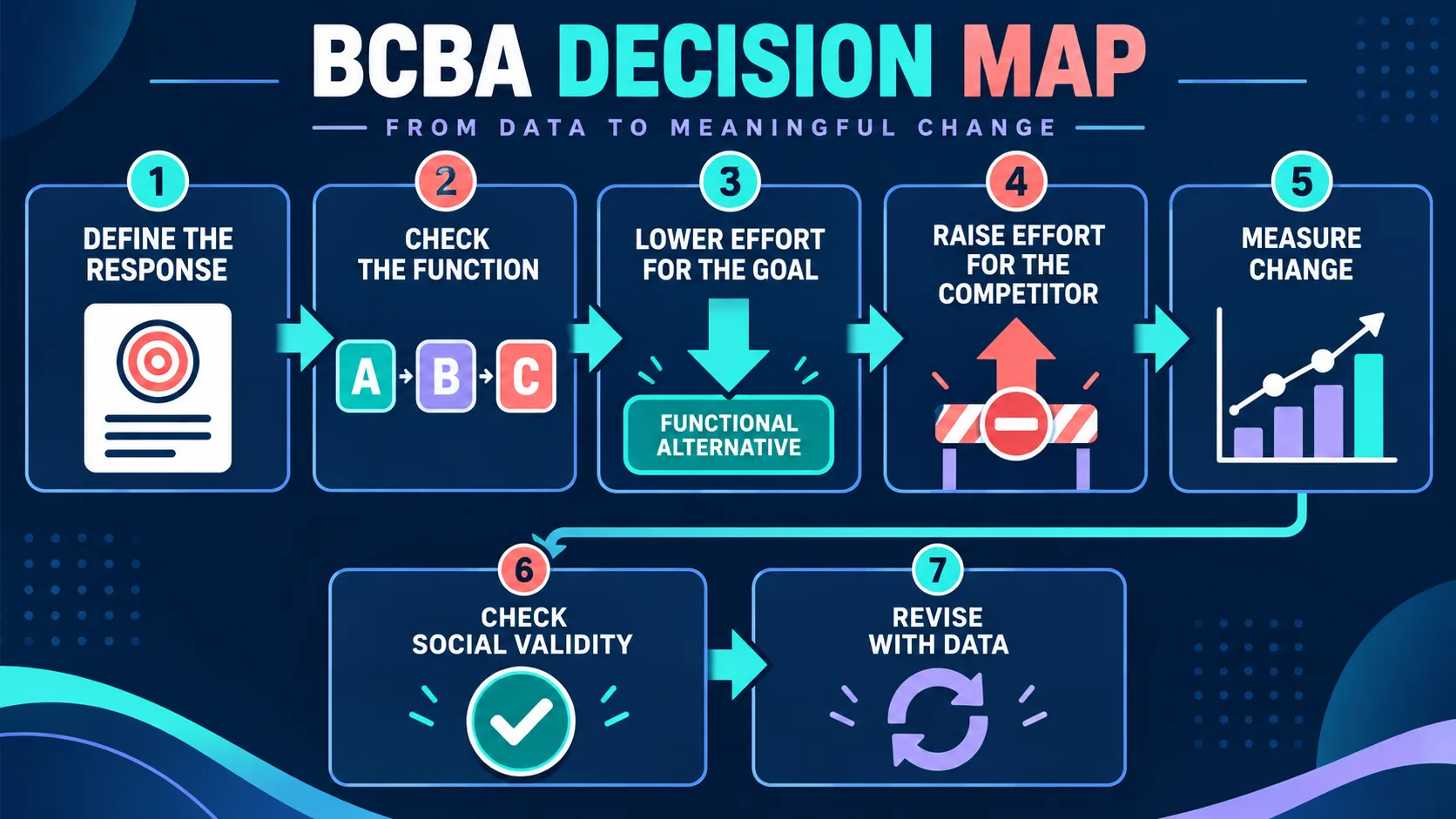
When a scenario includes response effort, use this sequence:
- Define the response. What exactly must the person do? Count steps, distance, force, and any required transitions.
- Identify the competing options. What other response produces attention, escape, access, or sensory change? Compare the effort and delay for each option.
- Check the function. An effort manipulation is not a replacement for functional assessment. Ask what consequence is maintaining the response.
- Choose the goal-consistent direction. Lower effort for the functional alternative when the goal is to increase it; consider increasing effort for an unsafe or ineffective competing response only with a safe, effective alternative and appropriate safeguards.
- Measure and revise. Select data that can show whether the change worked and whether it created side effects.
Common traps include choosing response cost when the stem asks about effort, assuming every difficult task should simply be made easier, and increasing effort for problem behavior without teaching communication or another replacement. Also watch for an answer that changes several variables at once. The best option usually identifies the response, manipulates the relevant environmental requirement, and preserves data-based evaluation.
Use BCBA Practice to Test the Concept
Response-effort questions reward careful reading more than memorizing a slogan. Practice identifying the exact response, its alternatives, the relevant consequence, and the direction of the manipulation. Then explain why the answer fits the function and what data you would collect. For a structured set of scenario questions, try the Free BCBA Mock Exam. Use the result to find reasoning gaps; it is a study signal, not a guarantee of exam performance.
Frequently Asked Questions
What is response effort in ABA?: Response effort is the physical or behavioral work required to emit a response. It can include distance, force, number of steps, or other observable requirements. A BCBA can sometimes change the effort of a response to affect its competition with other responses.
Is response effort the same as task difficulty?: They overlap but are not identical. Task difficulty may involve skill, complexity, discrimination, or cognitive demands. Response effort focuses on the work required to perform the response. A task can be conceptually difficult but physically easy, or conceptually simple but require many actions.
Is increasing response effort punishment?: Not automatically. Increasing effort changes a response requirement; punishment is defined by its effect on future behavior after a consequence. A response-effort manipulation should still be evaluated for side effects and ethical acceptability, but the terms should not be treated as synonyms.
What should I measure after changing response effort?: Measure the target response and meaningful competing responses, along with latency, prompts, errors, reinforcement access, treatment integrity, and signs of distress when relevant. Choose measures that can show both effectiveness and acceptability.
Bottom line: Response effort in ABA is a way to analyze what the environment asks a person to do. Define the response, compare alternatives, change the relevant requirement carefully, and let data—not assumptions about motivation—guide the next decision.
Quick Review Checklist
Use this final checklist to turn response effort aba into exam-ready reasoning. The goal is not to memorize a label in isolation; it is to identify the relevant evidence and explain why the best answer fits the scenario. Key ideas to review:
- State the central definition or decision point for response effort aba in your own words.
- Identify the detail that makes response effort aba different from its closest related ABA term.
- Separate the observable facts in a scenario from assumptions that are not supported by the facts.
- Write one example and one nonexample so you can recognize the concept in a new setting.
Exam application checks:
- Ask what the question is actually requesting before comparing the answer choices.
- Mark the antecedent, response, consequence, or other evidence that supports the selected answer.
- Look for a distractor that describes a related process but does not answer the specific question.
Final self-check:
- Explain how you would verify the interpretation with clear observations or data.
- Change one detail in the scenario and decide whether your answer should change.
- Give a one-sentence rationale that a supervisor or study partner could evaluate.
Take the Free BCBA Mock Exam
When you are ready to apply the idea, use the free practice resource below for additional feedback. Take the Free BCBA Mock Exam



