

A practical guide to the Student Analyst ABA role: what the title usually means, how supervised fieldwork fits, and which questions to ask before counting on a job or program. If you are searching for student analyst aba opportunities, the first thing to know is that “Student Analyst” is usually an employer or training-program title, not a standalone BACB credential. A company may use it for a graduate student who is receiving structured experience and supervision while working toward BCBA or BCaBA eligibility. Another company may use the same title for a senior behavior technician or clinical apprentice. The title alone does not prove that a role meets your certification pathway.
Table of Contents
- Student Analyst ABA: What the Role Means
- What Student Analysts May Do
- Work Hours Versus Qualifying Fieldwork
- How to Evaluate Supervision
- A Fieldwork Due-Diligence Checklist
- How the Role Builds BCBA Readiness
- Frequently Asked Questions
- Quick Review Checklist
- Take the Free BCBA Mock Exam
The useful question is not simply, “Can I get this job?” It is, “What will I actually do, who will supervise me, how will my activities be documented, and which current requirements determine whether the experience is useful for my pathway?” Treat the position as a learning and fieldwork arrangement that needs verification.
Important: BACB requirements, fieldwork standards, state rules, employer policies, and university expectations can change. Read the current BACB Handbook and confirm the details with your program and supervisor. Do not assume that every paid ABA hour is automatically qualifying fieldwork.
Student Analyst ABA: What the Role Means
A Student Analyst role generally sits between entry-level implementation and fully independent analyst responsibility. You may be enrolled in a graduate ABA program, working as an RBT or behavior assistant, or completing supervised experience under a BCBA. The position can provide access to cases, feedback, indirect activities, and a professional development structure that is difficult to create alone.
But the title has no single universal job description. Read the actual offer, supervision agreement, training plan, and fieldwork documentation process. In one organization, a Student Analyst may mostly deliver direct services. In another, the student may assist with data review, program writing, assessment preparation, staff training, and case discussions. Both can be legitimate employment arrangements; they are not automatically identical fieldwork arrangements. Keep three labels separate:
- Employee or trainee title: what the organization calls your job.
- Supervisee relationship: who is responsible for your supervision, feedback, and records.
- BACB pathway: the current education, experience, application, and examination requirements that determine eligibility.
What Student Analysts May Do
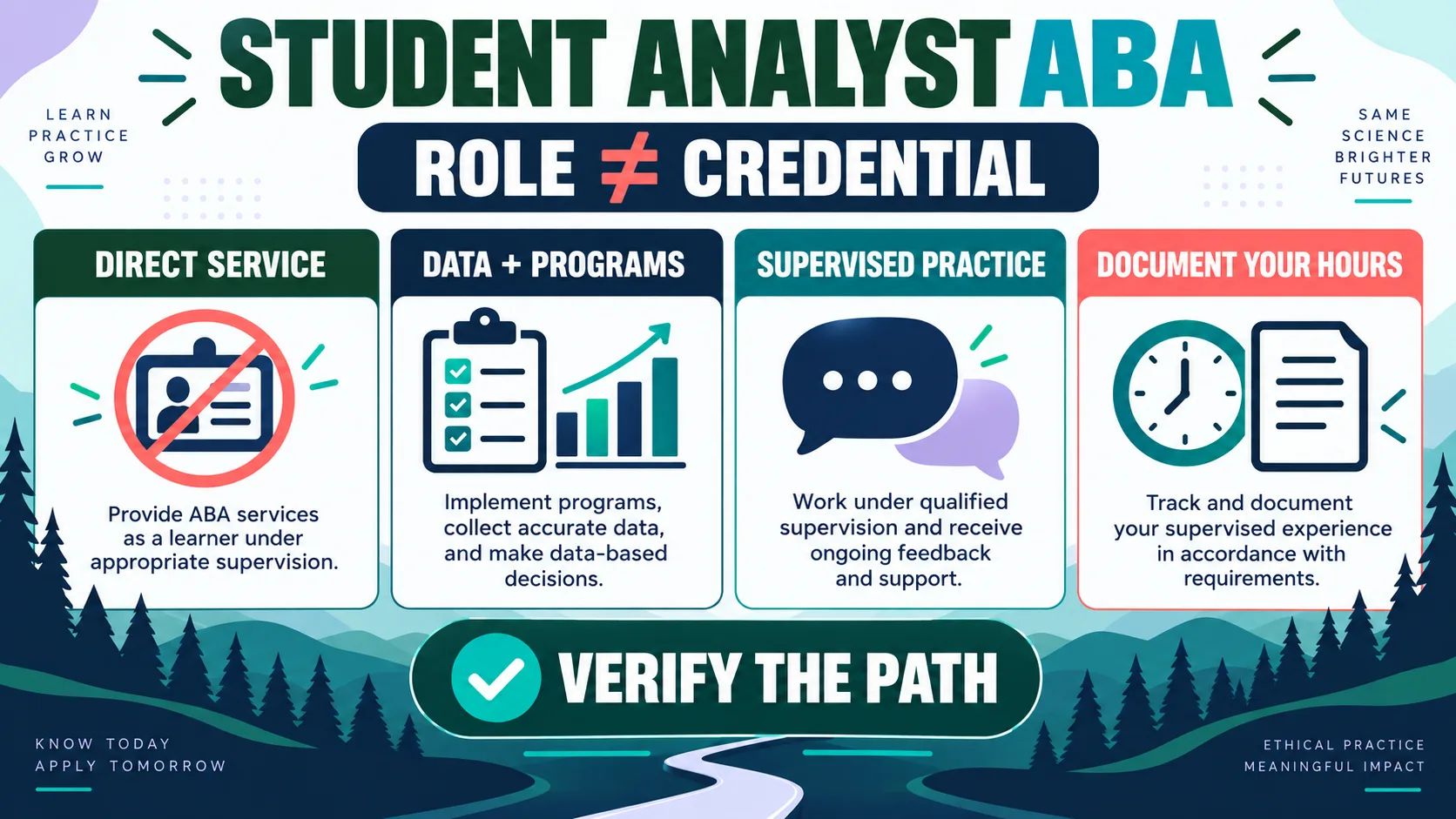
The work depends on setting, training stage, client needs, and supervisor capacity. Common activities may include:
- Direct implementation: follow an approved teaching or behavior-support protocol, collect objective data, communicate concerns, and protect client dignity and safety.
- Observation and data review: observe sessions, check graphs, identify patterns for discussion, and learn how a BCBA connects measurement to a clinical decision.
- Program support: prepare materials, help organize skill-acquisition data, draft questions for a case meeting, or practice writing measurable goals under review.
- Assessment exposure: assist with record review, interviews, preference-assessment preparation, or observation when the supervisor assigns and reviews the work.
- Training and feedback: participate in supervision meetings, role-play procedures, receive performance feedback, and practice explaining a behavioral rationale.
These activities should match your competence and role boundaries. A Student Analyst should not present as a BCBA, independently diagnose, change a treatment plan without authorization, or make promises to families beyond the assigned scope. Strong programs make escalation easy: you should know whom to contact when a safety, consent, data-quality, or ethical question appears.
Work Hours Versus Qualifying Fieldwork
One of the most important distinctions in a Student Analyst ABA search is the difference between being busy and receiving qualifying experience. A shift may include useful learning but still fail to meet the current documentation, supervision, activity, or pathway requirements that apply to your situation. The answer depends on the current BACB rules, your route, your supervisor’s qualifications, and your program or employer process.
| Activity you may see | Why it can be useful | What to verify before counting it |
|---|---|---|
| Direct ABA implementation | Builds fluency with procedures, measurement, communication, and client-centered implementation. | Whether it is restricted or unrestricted under the current pathway, who observes it, and how it is documented. |
| Data analysis or program writing | Develops assessment, graphing, decision-making, and written clinical reasoning skills. | Whether the work is client-specific, reviewed by the supervisor, and linked to approved responsibilities rather than generic administration. |
| Staff or caregiver training | Practices behavioral skills training, feedback, generalization, and professional communication. | Your role, the client-specific purpose, supervisor observation, consent, and the record showing what was taught and reviewed. |
| Team meetings or case review | Shows how behavior analysts integrate data, context, family priorities, and ethical constraints. | Whether attendance is active behavior-analytic work or only general staff time, and how supervision/feedback is recorded. |
Do not chase an hour total while ignoring learning quality. A good fieldwork plan connects activities to competencies, provides observation and feedback, protects confidentiality, and creates records that another reviewer can understand. Ask your graduate program whether it requires a particular tracker or approval before the experience begins.
How to Evaluate Supervision
A Student Analyst program is only as strong as its supervision system. The current BACB supervision and training resources should be the starting point for checking role expectations. Your supervisor should be able to explain their credential status, training, availability, observation process, feedback schedule, documentation, and escalation path. Ask specific questions rather than accepting “you will get supervision” as an answer:
- Who is the responsible supervisor, and how do I verify that person’s current status?
- How often will I receive direct observation, written feedback, and performance-based coaching?
- Which activities are direct service, which are client-specific indirect work, and which are administrative?
- Who signs or reviews my records, and what happens if the supervisor leaves?
- How are consent, privacy, safety, cultural variables, assent when applicable, and client preferences handled?
- What happens if my university requirements and the employer’s tracking system disagree?
Good supervision is not just a monthly signature. It should help you observe, practice, receive feedback, make corrections, and gradually perform more complex skills within your competence. If you are never observed, cannot ask questions, or are pressured to sign records that do not reflect your work, treat that as a serious quality concern.
A Fieldwork Due-Diligence Checklist
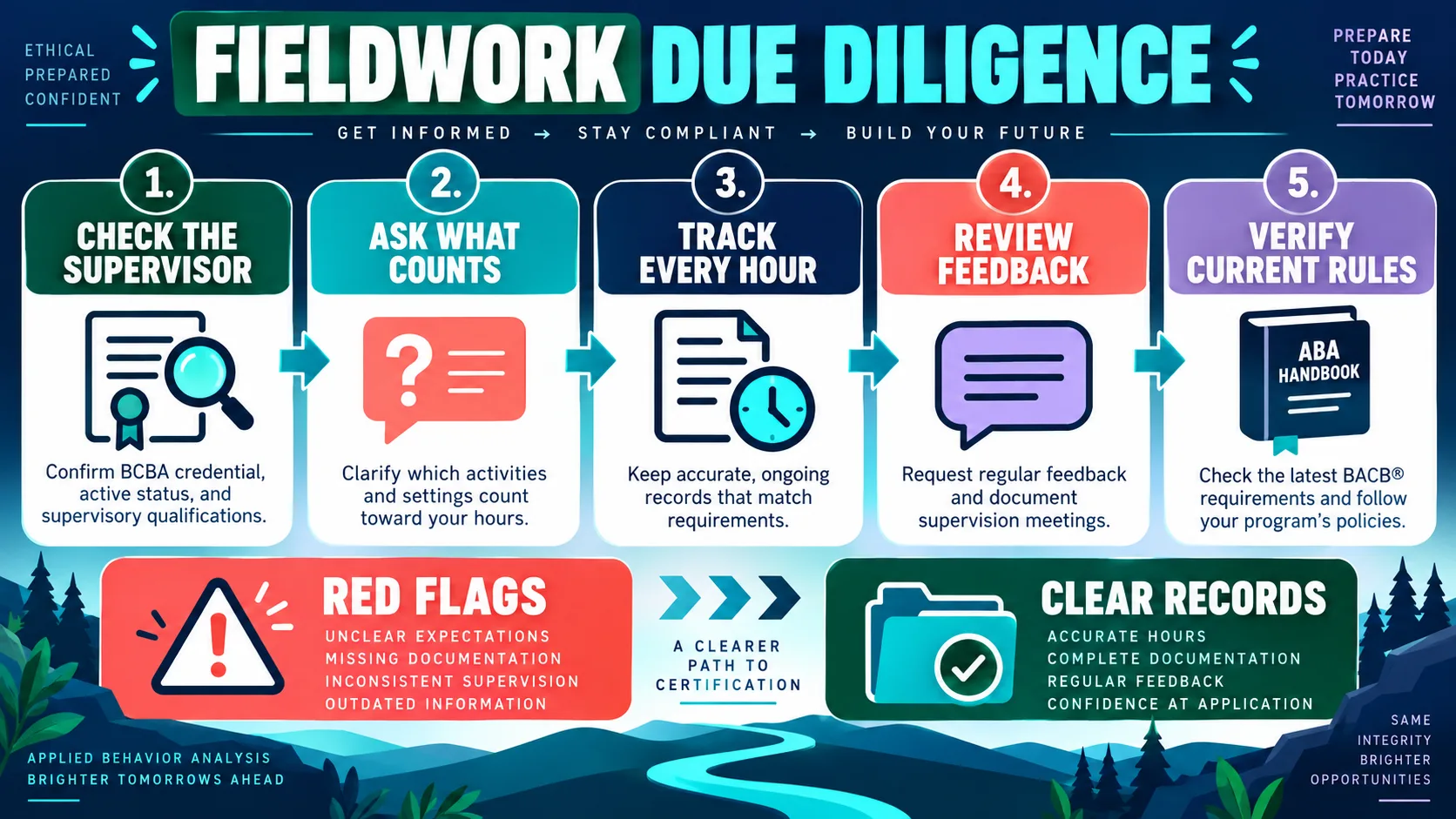
Before accepting a Student Analyst position, save the job description and ask for a written explanation of the learning structure. Then use this checklist:
- Check the supervisor. Confirm the person’s role, current credential status, training, and availability. Use official verification tools when the pathway requires it.
- Ask what counts. Request examples of direct, indirect, unrestricted, restricted, administrative, and non-countable activities as they apply to your current route. Do not rely on labels alone.
- Track every hour. Record date, client-specific activity, setting, supervisor interaction, feedback, and any required signatures while the details are fresh.
- Review feedback. Ask how your supervisor will evaluate competency, how corrections are documented, and how you can request additional support.
- Verify current rules. Recheck the BACB Handbook, current transition materials, state rules, and your university’s requirements before making a long-term assumption.
Red flags include vague promises that every hour counts, no written supervision plan, unexplained unpaid work, pressure to perform outside your competence, a tracker that cannot separate clients or activities, and a supervisor who cannot explain how records are reviewed. A lower-paying role with clear supervision and honest documentation may be more valuable than a higher-paying role with no usable learning structure.
How the Role Builds BCBA Readiness
A Student Analyst role can make exam concepts more concrete. When you graph a client’s data, review a prompting error, or discuss why a plan did not work, connect that experience to the underlying task-list skill. Keep a study log that links a real, de-identified learning activity to concepts such as measurement, assessment, intervention, generalization, treatment integrity, supervision, and ethics.
Do not let experience replace systematic study. A job may expose you to a narrow population or procedure, while the BCBA exam covers a wider range of concepts and scenario decisions. After a shift, write down what you observed, what evidence supported the decision, what alternative you considered, and what you still need to learn. This turns work experience into deliberate practice. When you want to test the academic side, use the Free BCBA Mock Exam for scenario practice. Treat the result as a study signal, not a certification prediction.
Frequently Asked Questions
What is a Student Analyst in ABA?: It is usually an employer or training-program title for a person developing behavior-analytic skills under supervision, often while enrolled in graduate coursework. The title is not itself a BACB certification and does not prove that every activity counts toward a pathway.
Is a Student Analyst the same as an RBT?: Not necessarily. An RBT is a formal BACB credential with its own requirements and role boundaries. A Student Analyst may also hold an RBT credential, but the titles describe different things: one is a certification, while the other is commonly a job or training title.
Do Student Analyst hours count toward BCBA fieldwork?: Some activities may be useful or qualifying, but you must verify them against the current BACB pathway, supervisor qualifications, documentation rules, university expectations, and employer process. Never assume that a paid shift or a job title automatically makes hours count.
What should I ask before accepting a Student Analyst job?: Ask who supervises you, how often you are observed, which activities you will perform, how records are kept, what happens when the supervisor is unavailable, and how the role aligns with your current education and experience route. Request the answers in writing.
Bottom line: A Student Analyst ABA role can be a valuable bridge between coursework and professional competence when supervision, activities, feedback, and records are clear. Evaluate the structure—not just the title—and verify every important assumption against current official requirements.
Quick Review Checklist
Use this final checklist to turn student analyst aba into exam-ready reasoning. The goal is not to memorize a label in isolation; it is to identify the relevant evidence and explain why the best answer fits the scenario. Key ideas to review:
- State the central definition or decision point for student analyst aba in your own words.
- Identify the detail that makes student analyst aba different from its closest related ABA term.
- Separate the observable facts in a scenario from assumptions that are not supported by the facts.
- Write one example and one nonexample so you can recognize the concept in a new setting.
Exam application checks:
- Ask what the question is actually requesting before comparing the answer choices.
- Mark the antecedent, response, consequence, or other evidence that supports the selected answer.
- Look for a distractor that describes a related process but does not answer the specific question.
Final self-check:
- Explain how you would verify the interpretation with clear observations or data.
- Change one detail in the scenario and decide whether your answer should change.
- Give a one-sentence rationale that a supervisor or study partner could evaluate.
Take the Free BCBA Mock Exam
When you are ready to apply the idea, use the free practice resource below for additional feedback. Take the Free BCBA Mock Exam



