

A balanced career-fit guide for readers weighing meaningful work, graduate school, supervised fieldwork, cost, supervision, documentation, and the real day-to-day BCBA role. If you are asking should i become a bcba, the honest answer is: it can be an excellent fit if you want data-driven work, professional responsibility, and long-term involvement in behavior change. It may be a poor fit if you expect a quick credential, mostly hands-on therapy, or a predictable job with little documentation and little responsibility for other people’s work.
Table of Contents
- Should I Become a BCBA? The Short Answer
- What the BCBA Work Really Includes
- Career Fit and Trade-Offs
- The Investment You Are Choosing
- A Five-Step Decision Roadmap
- Use BCBA Practice as a Low-Risk Test
- Frequently Asked Questions
- Quick Review Checklist
- Take the Free BCBA Mock Exam
The right decision is not based on salary alone. Before committing to graduate education, compare the work itself with your values, skills, resources, timeline, tolerance for ambiguity, and willingness to supervise and keep learning. The Behavior Analyst Certification Board’s BCBA resources describe the credential and pathway; they do not promise that the career is right for every candidate. Important: Requirements, job markets, state licenses, program costs, and employer expectations change. Use current BACB materials, your state rules, and actual local job postings when making a personal decision.
Should I Become a BCBA? The Short Answer
Consider becoming a BCBA if most of these statements sound true:
- You want to use observation, measurement, and data to make professional decisions.
- You are interested in teaching skills and changing environmental conditions, not only in talking about problems.
- You can accept that supervision, documentation, meetings, and program revision are major parts of the job.
- You are prepared for graduate-level education, supervised fieldwork, a certification exam, and ongoing maintenance.
- You can work respectfully with clients, families, technicians, teachers, and other professionals whose priorities may differ.
Think carefully before committing if your main reason is a quick salary increase, if you strongly dislike writing and data review, or if you want a role that is almost entirely direct service. Some BCBAs do spend meaningful time with clients, but the credential also carries responsibility for assessment, intervention design, supervision, ethical decisions, and the quality of services delivered by a team.
What the BCBA Work Really Includes
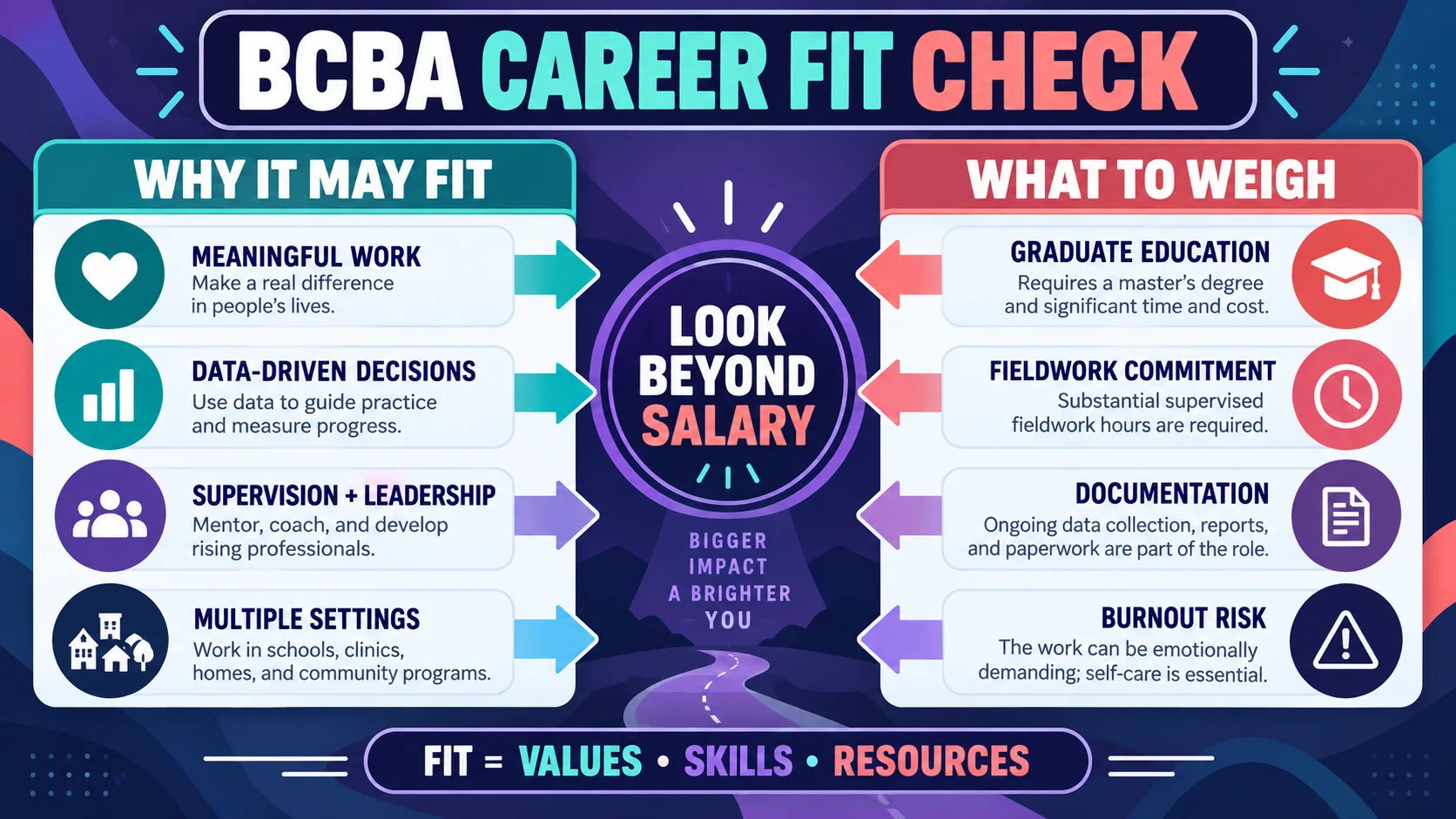
A BCBA’s week varies by setting, population, caseload, employer, and state rules. Still, the work usually combines several responsibilities:
- Assessment and observation: define behavior, interview stakeholders, observe relevant contexts, review records, and select measurements that answer the clinical question.
- Program design: translate assessment findings into measurable goals, teaching procedures, environmental supports, and data-collection plans.
- Data-based decisions: inspect graphs and session notes, evaluate treatment effects, and change a program when the evidence or client needs call for it.
- Supervision and training: coach RBTs, BCaBAs, caregivers, teachers, or trainees; model procedures; give feedback; and monitor implementation fidelity.
- Communication and documentation: write notes and reports, attend meetings, explain decisions in plain language, coordinate with other professionals, and respond to payer or organizational requirements.
This mix is one reason two BCBAs can describe very different jobs. A school-based analyst may spend more time in classrooms and team meetings. A home-based analyst may travel and coach caregivers. A clinic BCBA may supervise multiple technicians during a day. A consultant or organizational behavior management practitioner may work mostly with staff systems rather than direct clinical sessions.
Ask a potential employer for a realistic sample week. Find out the caseload, billable expectations, supervision load, travel, documentation time, crisis responsibilities, support for new BCBAs, and how decisions are made when data and business pressure conflict.
Career Fit and Trade-Offs
There is no universal “best” BCBA profile. The question is whether the role’s demands match your strengths and resources. Use this comparison before treating a job advertisement or salary number as a reason to enroll.
| Possible fit | What to weigh honestly |
|---|---|
| Meaningful, measurable work You want to help people learn skills or experience safer, more functional routines. | Progress can be uneven. You may need to explain slow or mixed data, revise plans, and tolerate uncertainty without promising a quick result. |
| Data and problem solving You enjoy operational definitions, graphs, measurement, and testing whether a plan works. | Data work includes imperfect records, missing sessions, fidelity problems, and decisions that are less tidy than textbook examples. |
| Supervision and leadership You want to coach others and build consistent implementation. | You are responsible for feedback, boundaries, training, documentation, and difficult conversations—not just your own client contact. |
| Several possible settings You value options across clinics, schools, homes, community programs, consulting, or organizational work. | Your options still depend on local licensure, competence, employer model, payer rules, and the population you are trained to serve. |
| Professional independence You want increasing responsibility for assessment and treatment decisions. | Independence brings accountability. You must recognize limits, seek consultation, follow ethics, and maintain competence. |
Burnout risk deserves a direct conversation. Emotional intensity, high caseloads, travel, productivity expectations, staff turnover, and paperwork can accumulate. A good employer provides supervision, realistic caseloads, training, and a way to raise ethical concerns. Ask how the organization protects quality when schedules are full.
The Investment You Are Choosing
Becoming a BCBA is a multi-stage commitment, not a single exam purchase. The current BACB pathway can involve graduate education, behavior-analytic coursework, supervised fieldwork, application review, examination, and ongoing maintenance. The exact route and transition rules must be checked in the current BCBA Handbook and the official 2027 requirements guidance. Calculate more than tuition:
- program tuition, books, technology, application fees, exam fees, and travel;
- the time needed for coursework and supervised fieldwork;
- income you may give up if your schedule changes;
- transportation, childcare, or relocation costs;
- the cost of retaking an exam or changing programs if the first plan does not work; and
- ongoing continuing education, renewal, supervision, and professional-development obligations.
Do not use a national salary headline as your personal return-on-investment calculation. Compare current job postings in the locations where you could realistically work, then ask whether the role’s caseload, schedule, benefits, and supervision support match the advertised pay. The BACB’s employment-demand materials are useful context, but demand does not guarantee a particular salary, employer, state license, or work setting.
A Five-Step Decision Roadmap
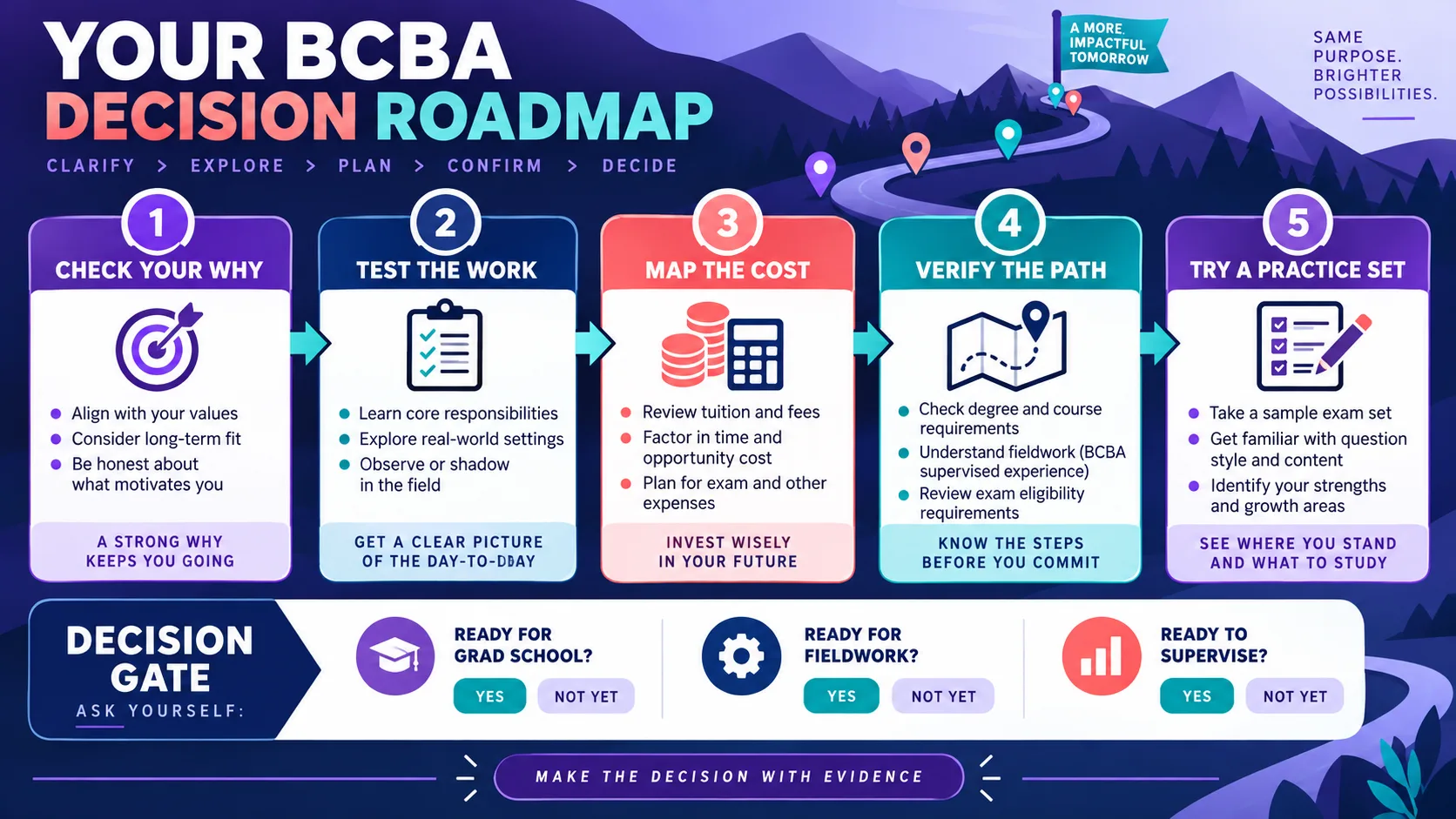
Use this sequence before paying a deposit or applying to a program:
- Check your why. Write what attracts you: data, teaching, leadership, advocacy, schedule flexibility, a population, or career change. Then write what you do not want to do. A clear “why” is more useful than a vague promise of job security.
- Test the work. Read a BCBA note, observe a session if permitted, interview a BCBA in two different settings, or work in an entry-level role. Ask how much time goes to direct service, supervision, graphs, meetings, and paperwork.
- Map the cost. Build a personal budget for tuition, fieldwork, exam preparation, transportation, time, and emergency savings. Compare at least two programs using current official tuition and pathway information.
- Verify the path. Check the current BACB Handbook, 2027 transition page, state licensure requirements, fieldwork availability, supervisor qualifications, and the program’s documentation process. Do not rely only on an enrollment counselor’s summary.
- Try a practice set. Sample the actual thinking style: measurement, ethics, assessment, intervention, graphs, and scenario decisions. Notice whether you enjoy explaining why an answer fits the data, not only whether you can memorize a definition.
The decision gate is simple: are you ready for graduate school, ready to arrange supervised fieldwork, and ready to supervise or lead others eventually? “Not yet” is useful information. It may mean you need experience, savings, a different program, or a clearer work setting—not that the goal is impossible.
Use BCBA Practice as a Low-Risk Test
A practice exam cannot tell you whether a career will make you happy, but it can reveal whether the subject matter and decision style interest you. Try questions from multiple domains and review the rationale. Pay attention to how you respond to uncertainty, competing ethical duties, measurement choices, and data that do not support the first plan.
When you want a structured sample, the Free BCBA Mock Exam can help you test the academic side of the decision. Treat the result as a study signal, not a promise about certification or career success.
Frequently Asked Questions
Is becoming a BCBA worth it?: It can be worth it when the work fits your values and you can realistically manage graduate education, fieldwork, supervision, documentation, and ongoing learning. The return depends on your program cost, location, employer, role, and goals—not on a universal salary promise.
Is BCBA work mostly direct therapy?: Not necessarily. BCBAs may observe and work directly with clients, but they also assess behavior, write programs, analyze data, train caregivers, supervise staff, attend meetings, and document services. Ask each employer for its actual role expectations.
Can I decide after trying ABA work first?: Yes. Observing or working in an entry-level ABA, education, or support role can help you test the setting and responsibilities before committing to a graduate program. Protect confidentiality and follow the organization’s rules when observing services.
Will the 2027 BACB changes affect my decision?: They may affect your education, coursework, fieldwork, application timing, or maintenance planning. Read the current BACB transition materials and ask programs how they document the applicable pathway. Do not assume that the date you begin a course alone determines which rule applies.
What is the first practical step?: Interview two practicing BCBAs in different settings, read the current BACB Handbook, and build a personal cost-and-time plan. Then take a small practice set and compare the work to your reasons for entering the field.
Bottom line: Become a BCBA because the work, responsibilities, and evidence-based decision style fit you—not because a headline makes the career sound easy. Test the day-to-day reality, verify the current pathway, calculate the full investment, and make the decision with evidence.
Quick Review Checklist
Use this final checklist to turn should i become a bcba into exam-ready reasoning. The goal is not to memorize a label in isolation; it is to identify the relevant evidence and explain why the best answer fits the scenario. Key ideas to review:
- State the central definition or decision point for should i become a bcba in your own words.
- Identify the detail that makes should i become a bcba different from its closest related ABA term.
- Separate the observable facts in a scenario from assumptions that are not supported by the facts.
- Write one example and one nonexample so you can recognize the concept in a new setting.
Exam application checks:
- Ask what the question is actually requesting before comparing the answer choices.
- Mark the antecedent, response, consequence, or other evidence that supports the selected answer.
- Look for a distractor that describes a related process but does not answer the specific question.
Final self-check:
- Explain how you would verify the interpretation with clear observations or data.
- Change one detail in the scenario and decide whether your answer should change.
- Give a one-sentence rationale that a supervisor or study partner could evaluate.
Take the Free BCBA Mock Exam
When you are ready to apply the idea, use the free practice resource below for additional feedback. Take the Free BCBA Mock Exam



