
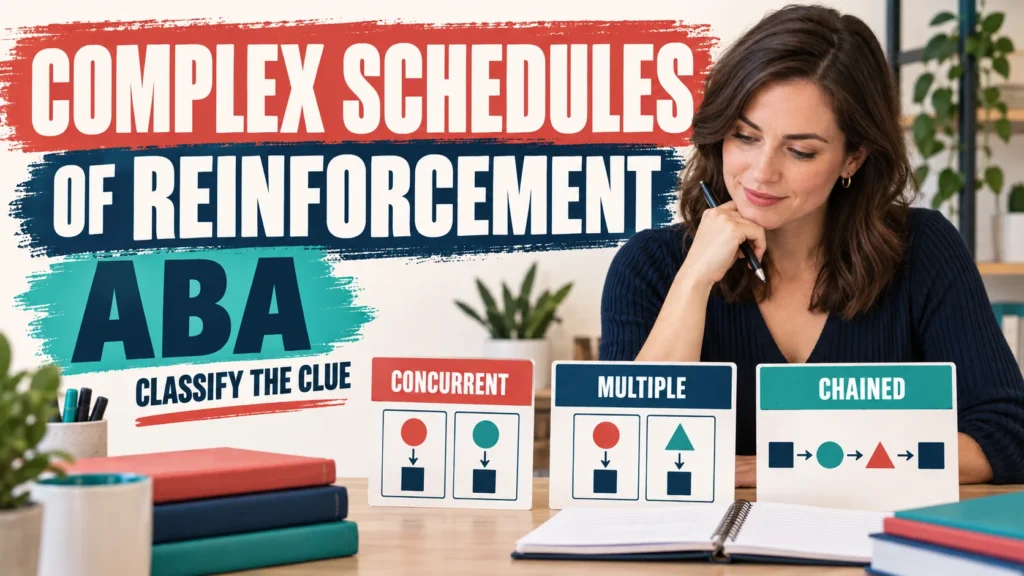
If you are studying complex schedules of reinforcement ABA, do not start by memorizing seven abbreviations. Start by asking four questions: Are the schedules available at the same time or one after another? Are the components signaled? Must links occur in a specific order? Does reinforcement follow either requirement or both requirements? Those questions usually reveal the schedule family before the label does.
Table of Contents
- What are complex schedules of reinforcement ABA?
- The four-question classification framework
- Complex schedule comparison table
- The schedule families that cause the most confusion
- How to identify a complex schedule from a vignette
- Scenario checks and common traps
- Design and evaluation cautions
- Exam review and practice
- FAQ
- Sources and scope
- Quick Review Checklist
- Take the Free BCBA Mock Exam
Complex schedules combine two or more basic reinforcement schedules—such as fixed-ratio, variable-ratio, fixed-interval, or variable-interval arrangements—into a larger contingency. The same basic ingredients can produce very different procedures depending on how they are arranged. This guide is a classification and exam-review tool; it does not replace the current BACB materials, supervision, assessment, client preferences, or data-based clinical decision making.
The current BCBA Test Content Outline is the official exam reference. It addresses reinforcement procedures, discriminative stimuli, chaining, schedule thinning, and evaluation. Textbooks may use slightly different examples or groupings, so read the facts in a question carefully instead of selecting an answer because one abbreviation looks familiar.
What are complex schedules of reinforcement ABA?
A complex, or compound, schedule joins multiple schedule components into one reinforcement arrangement. The components may be available simultaneously, alternate across time, occur in a sequence, or impose more than one requirement on the same opportunity. The important feature is not that the schedule sounds complicated; it is that more than one basic contingency is operating in a defined relationship. Examples include simultaneous choice, signaled or unsignaled alternation, ordered links, and either-or or both-and requirements. The arrangement determines whether the best label is concurrent, multiple, chained, conjunctive, or another type.
A useful study sentence is: classify the arrangement before you classify the schedule value. First identify what is happening between components. Then identify whether each component is FR, VR, FI, VI, or another schedule. Reversing that order is a common reason learners confuse a mixed schedule with a multiple schedule or a tandem schedule with a chained schedule.
The four-question classification framework
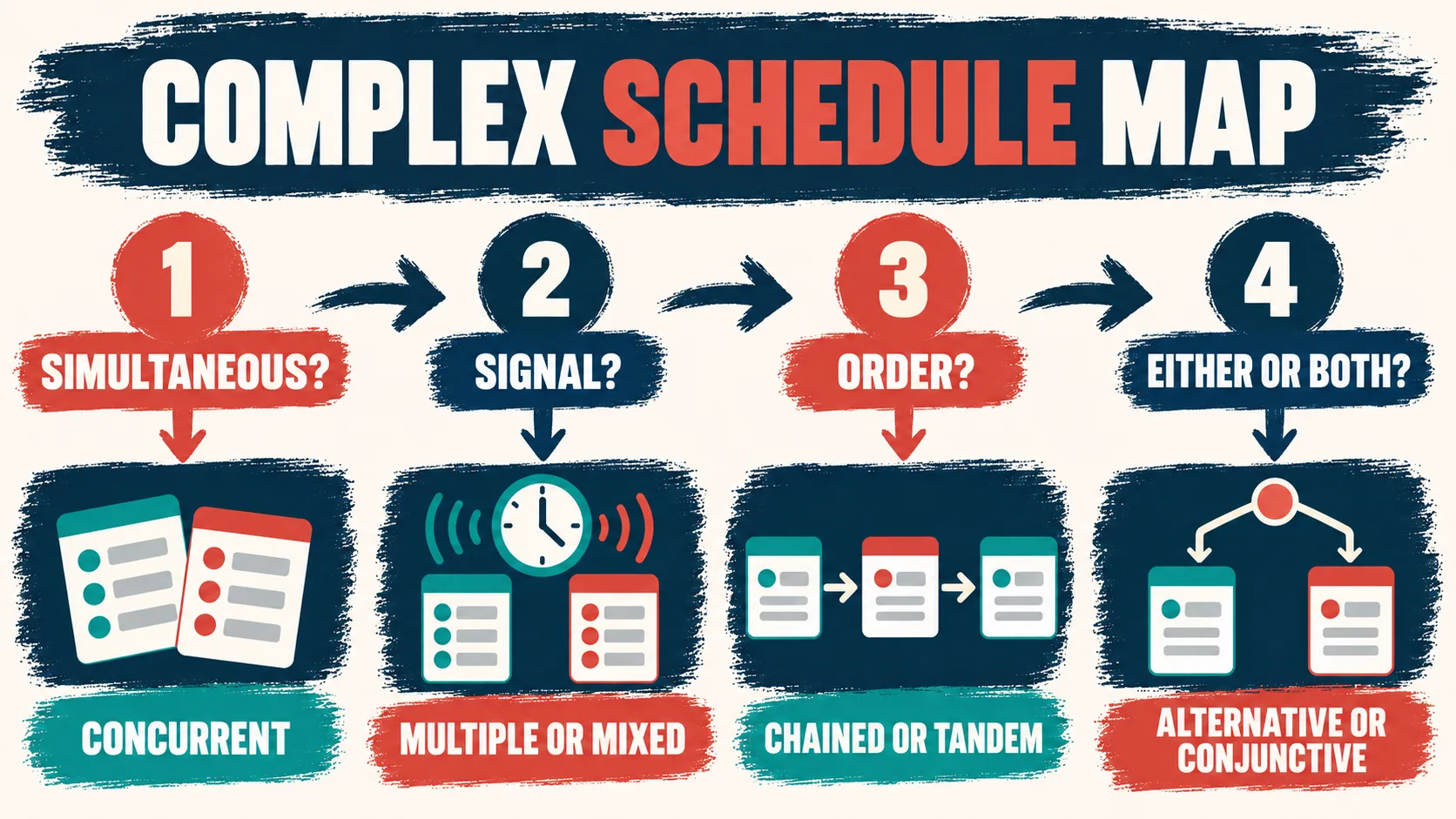
Use this sequence when a BCBA-style question describes a complex schedule:
- Ask whether options are simultaneous. If two or more response options have independent schedules available at the same time, begin with the concurrent family. If the components occur one after another, move to the signaling and sequence questions.
- Look for a signal. A stimulus such as a color, card, sound, or screen cue can indicate which component is active. Successive signaled components point toward a multiple or chained arrangement; successive unsignaled components point toward a mixed or tandem arrangement.
- Check the order requirement. In a chain, completing one link produces access to the next link and the links must be completed in a specified sequence. A tandem arrangement also has successive requirements, but the component changes are not signaled by distinctive stimuli.
- Ask whether either or both requirements are needed. If reinforcement follows when either of two requirements is completed, think alternative. If both requirements must be completed before reinforcement, think conjunctive. Then verify the exact facts and terminology used by the source or textbook.
This framework keeps four dimensions separate: simultaneity, signaling, sequence, and completion rule. A single vignette can include more than one dimension. For instance, a concurrent-chain arrangement combines simultaneous choice in an initial link with successive signaled links later. Do not force every question into one isolated word when the description clearly contains a nested arrangement.
Complex schedule comparison table
The table below is a memory aid, not a replacement for the definitions in your course text or official exam materials.
| Schedule family | Arrangement clue | Fast distinction |
|---|---|---|
| Concurrent | Two or more schedules are available simultaneously, usually for different response options. | Choice is available now; the question is often how responding is allocated across options. |
| Multiple | Successive components alternate and each component is correlated with a distinctive signal. | Same general response class may continue, but the signal tells you which schedule is active. |
| Mixed | Successive components alternate without a distinctive signal for the active component. | It resembles multiple, but the component change is unsignaled. |
| Chained | Successive links occur in a required order, with stimuli correlated with the links. | Each completed link leads to the next; the final link produces the terminal reinforcer. |
| Tandem | Successive requirements must be completed in order, but link changes are not signaled by distinctive stimuli. | It resembles chained, minus the distinctive link signals. |
| Alternative | Two requirements are combined and reinforcement follows when either one is met. | Either-or completion rule; check whether one component can end the opportunity. |
| Conjunctive | Two requirements are combined and both must be met before reinforcement. | Both-and completion rule; one satisfied component is not enough. |
FR, VR, FI, and VI describe the basic components; the family name describes how those components are combined. For example, concurrent VI schedules describe simultaneous options and their component values, while multiple FR/FI schedules alternate under signals.
The schedule families that cause the most confusion
Concurrent versus concurrent-chain: In a concurrent schedule, two or more options are available at the same time, and each option has its own schedule. A person, animal, or client may allocate responding between the options. In a concurrent-chain procedure, the initial choice leads to later links, and the later links may be signaled and sequential. The word “choice” alone is not enough; ask whether the choice is the whole arrangement or the first link of a sequence.
Multiple versus mixed: Both use successive components, but multiple schedules have signals that correlate with the component in effect. Mixed schedules do not provide a distinctive signal for the current component. A red card that reliably means one contingency and a green card that reliably means another is the clue for multiple. If the same contingencies alternate while the learner cannot tell which one is active from a distinctive signal, the description is mixed.
Chained versus tandem: Both involve successive links and a required order. In a chained schedule, stimuli correlated with the links help signal the progression. In a tandem schedule, the links are completed in sequence without distinctive component signals. In either case, the consequence after an early link may function as a conditioned reinforcer or transition event rather than the final reinforcer for the whole chain.
Alternative versus conjunctive: These labels describe the completion rule. Alternative means that either requirement can be satisfied first to produce reinforcement. Conjunctive means that both requirements must be satisfied. Do not infer alternative merely because two schedules are listed; the question must say or imply that either criterion is sufficient. Likewise, “both” is the decisive clue for conjunctive. Study resources may group compound schedules differently. Translate the vignette into plain language first, then match the label used by the answer choices.
How to identify a complex schedule from a vignette
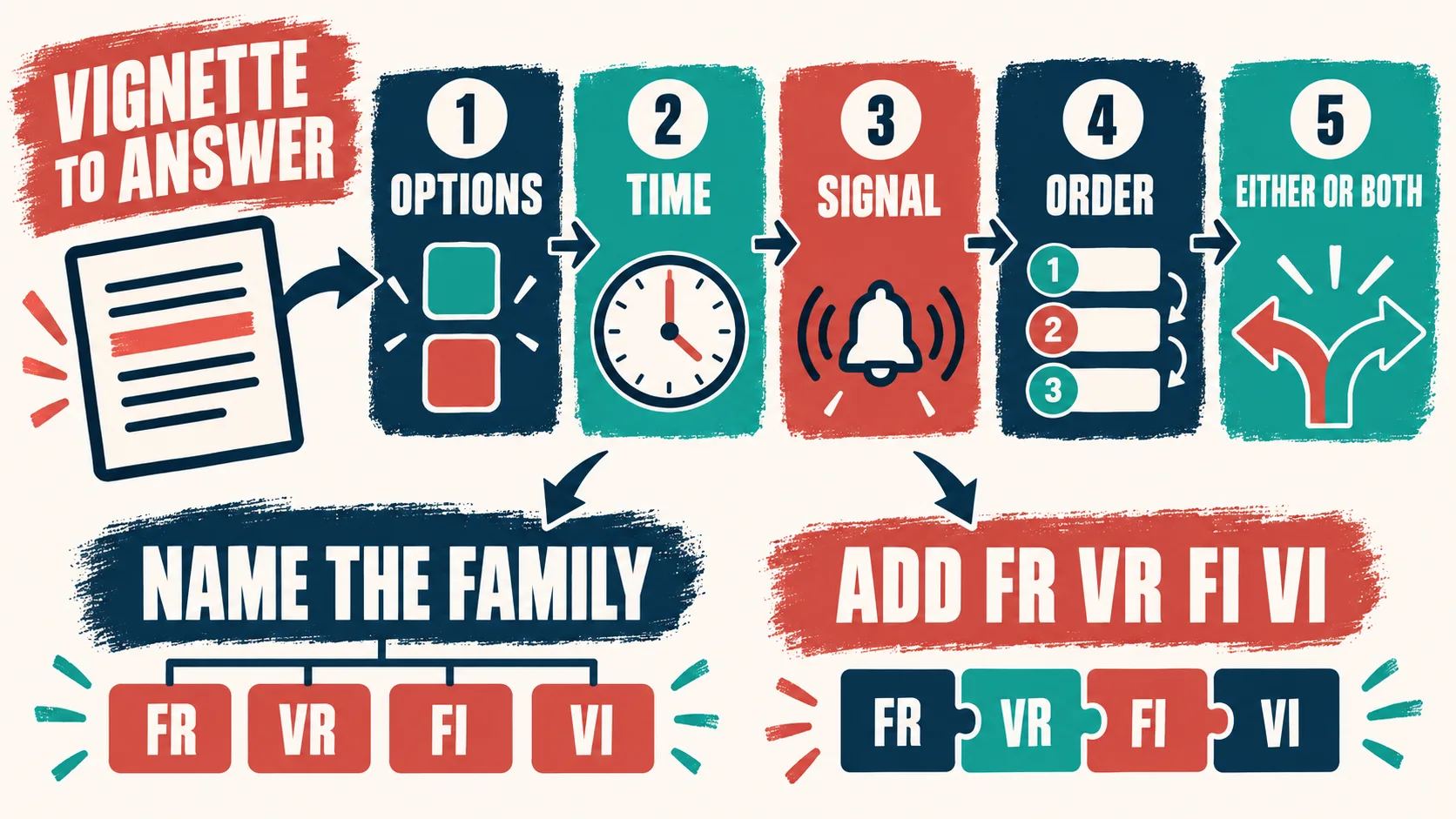
Use this five-step algorithm before looking at the answer choices:
- Underline the response options. Are there two or more responses that can contact reinforcement independently right now? If yes, investigate concurrent wording first.
- Circle time words. “At the same time,” “then,” “after,” “next,” and “in sequence” tell you whether the components are simultaneous or successive.
- Box the stimulus words. “Red card,” “tone,” “signaled,” or “stimulus correlated with the link” supports a signaled arrangement. The absence of a signal can be equally important.
- Mark the logic word. “Either” points toward alternative; “both” points toward conjunctive. If neither appears, do not invent a completion rule.
- Name the basic schedules last. Only after the arrangement is clear should you label a component FR, VR, FI, VI, or another schedule.
Then test your answer with a counterfactual: What single fact would make the label change? If removing the color signal would turn multiple into mixed, the signal is doing the diagnostic work. If removing the required order would turn a chain into a simultaneous choice arrangement, sequence is doing the diagnostic work. This counterfactual method is more reliable than memorizing a list without noticing which feature matters.
Scenario checks and common traps
These short examples show how to apply the framework. They are study scenarios, not individualized treatment recommendations.
| Vignette clue | Best first classification | Why |
|---|---|---|
| Two response buttons are available at once; each has a separate VI schedule. | Concurrent | The defining clue is simultaneous access to independent options, not the VI values. |
| A colored card changes after reinforcement and signals which schedule is active. | Multiple | Successive components are signaled; the color is not decoration. |
| A learner completes FR 3, then FI 20 seconds, in order; no link signal is described. | Tandem | There is a sequence, but no distinctive stimulus marks the link change. |
| Reinforcement is delivered after a ratio requirement or an interval requirement, whichever is completed first. | Alternative | “Whichever first” is the either-or completion rule. |
| Both the response count and the elapsed time must be satisfied before reinforcement. | Conjunctive | The response and time requirements operate as a both-and rule. |
Common traps include treating every successive schedule as chained or every choice arrangement as concurrent. “Either” describes an alternative completion rule; it does not prove that separate options were available simultaneously. Alternative and concurrent describe different dimensions.
Design and evaluation cautions
A schedule label is not a complete intervention plan. In practice, consider function, client preferences, response effort, competing reinforcement, safety, cultural and contextual fit, treatment integrity, and socially meaningful outcomes. The current BCBA outline emphasizes contextual fit, procedural integrity, effectiveness, and data-based modification.
Research on schedule thinning and multiple or chained arrangements can inform questions, but one study does not guarantee the same outcome for a particular client. If a schedule changes, define the response and consequence, measure outcomes, monitor unwanted effects, and consult when risk, consent, communication access, or meaningful choice is affected. For study purposes: classify the arrangement, identify the controlling stimulus, describe the completion rule, then evaluate the result.
Exam review and practice
Before selecting an answer, rewrite the vignette in one line: “Two options at once,” “successive and signaled,” “successive and unsignaled,” “ordered links,” “either criterion,” or “both criteria.” Then add the basic schedule values. This produces an answer rationale that can survive distractors with familiar abbreviations.
- Concurrent: options are available simultaneously.
- Multiple: successive components are signaled.
- Mixed: successive components are not distinctly signaled.
- Chained: signaled links occur in a required sequence.
- Tandem: ordered links occur without distinctive link signals.
- Alternative: either requirement can produce reinforcement.
- Conjunctive: both requirements must be met.
For focused practice, use the Free BCBA Mock Exam to test whether you can classify the arrangement before choosing the component schedule. Treat the practice result as a study signal, then return to the current BACB outline and your approved course materials for exact exam scope.
FAQ
Are complex schedules and compound schedules the same thing?
Many study resources use the terms as near-synonyms for combining basic schedules. Terminology can vary, so follow your course or question stem and focus on the described arrangement. What is the fastest way to tell multiple from mixed?
Look for a distinctive signal correlated with the active component. Signal present points toward multiple; no signal points toward mixed. What is the fastest way to tell chained from tandem?
Both use ordered links. Chained schedules signal the links; tandem schedules do not use distinctive link signals. Does “either” always mean concurrent?
No. “Either” usually identifies an alternative completion rule. Concurrent asks whether separate options are available simultaneously. Can I choose a schedule for a client from this article?
No. A real program requires assessment, client-informed goals, contextual fit, supervision, consent, data collection, and ongoing evaluation.
Sources and scope
Use the official BCBA Test Content Outline (6th ed.) and BACB BCBA resource hub for current exam information. Research context includes studies on multiple and concurrent schedules, multiple versus mixed schedules, multiple versus chained schedules, and schedule thinning. These sources provide study context, not individualized clinical advice. For targeted review, use our complex schedules of reinforcement aba practice questions to apply the concept in exam-style scenarios.
Quick Review Checklist
Use this final checklist to turn complex schedules of reinforcement aba into exam-ready reasoning. The goal is not to memorize a label in isolation; it is to identify the relevant evidence and explain why the best answer fits the scenario. Key ideas to review:
- State the central definition or decision point for complex schedules of reinforcement aba in your own words.
- Identify the detail that makes complex schedules of reinforcement aba different from its closest related ABA term.
- Separate the observable facts in a scenario from assumptions that are not supported by the facts.
- Write one example and one nonexample so you can recognize the concept in a new setting.
Exam application checks:
- Ask what the question is actually requesting before comparing the answer choices.
- Mark the antecedent, response, consequence, or other evidence that supports the selected answer.
- Look for a distractor that describes a related process but does not answer the specific question.
Final self-check:
- Explain how you would verify the interpretation with clear observations or data.
- Change one detail in the scenario and decide whether your answer should change.
- Give a one-sentence rationale that a supervisor or study partner could evaluate.
Take the Free BCBA Mock Exam
When you are ready to apply the idea, use the free practice resource below for additional feedback. Take the Free BCBA Mock Exam



