
A practical guide to probe trials in ABA: test independent performance, check generalization or maintenance, and let the data determine the next teaching decision. When someone searches for a probing ABA definition, they usually need more than a dictionary sentence. In a behavior-analytic teaching program, a probe is a planned opportunity to sample what a learner can do under specified conditions, often without the prompts, teaching, or feedback used during instruction. The result helps the team decide whether to continue teaching, program for generalization, or schedule a maintenance check.
Table of Contents
- Probing ABA Definition: What a Probe Trial Tests
- Connect Probing to the Current BCBA Scope
- Probe Trial vs. Teaching Trial
- Design a Probe That Answers One Question
- Use Probes for Generalization and Maintenance
- Read Probe Data Without Guessing
- Do Not Mix Probe, Baseline, and Design Terms
- Choose the Next Step From the Probe
- Common Probe-Data Mistakes
- Use a Quick BCBA Exam Routine
- Practice Probe Decisions
- Frequently Asked Questions
- Quick Review Checklist
- Take the Free BCBA Mock Exam
A probe is not a “trick” trial and it is not a universal percentage rule. The target response, materials, setting, prompting rule, scoring method, mastery criterion, and next action should be defined in the program. This article explains the reasoning pattern so BCBA candidates can distinguish a probe from a teaching trial and interpret the data without overclaiming.
Important boundary: Probe procedures must fit the learner, skill, safety needs, consent, treatment plan, and supervising clinician’s judgment. Do not remove needed support or run a novel probe solely because a study guide describes the concept.
Probing ABA Definition: What a Probe Trial Tests
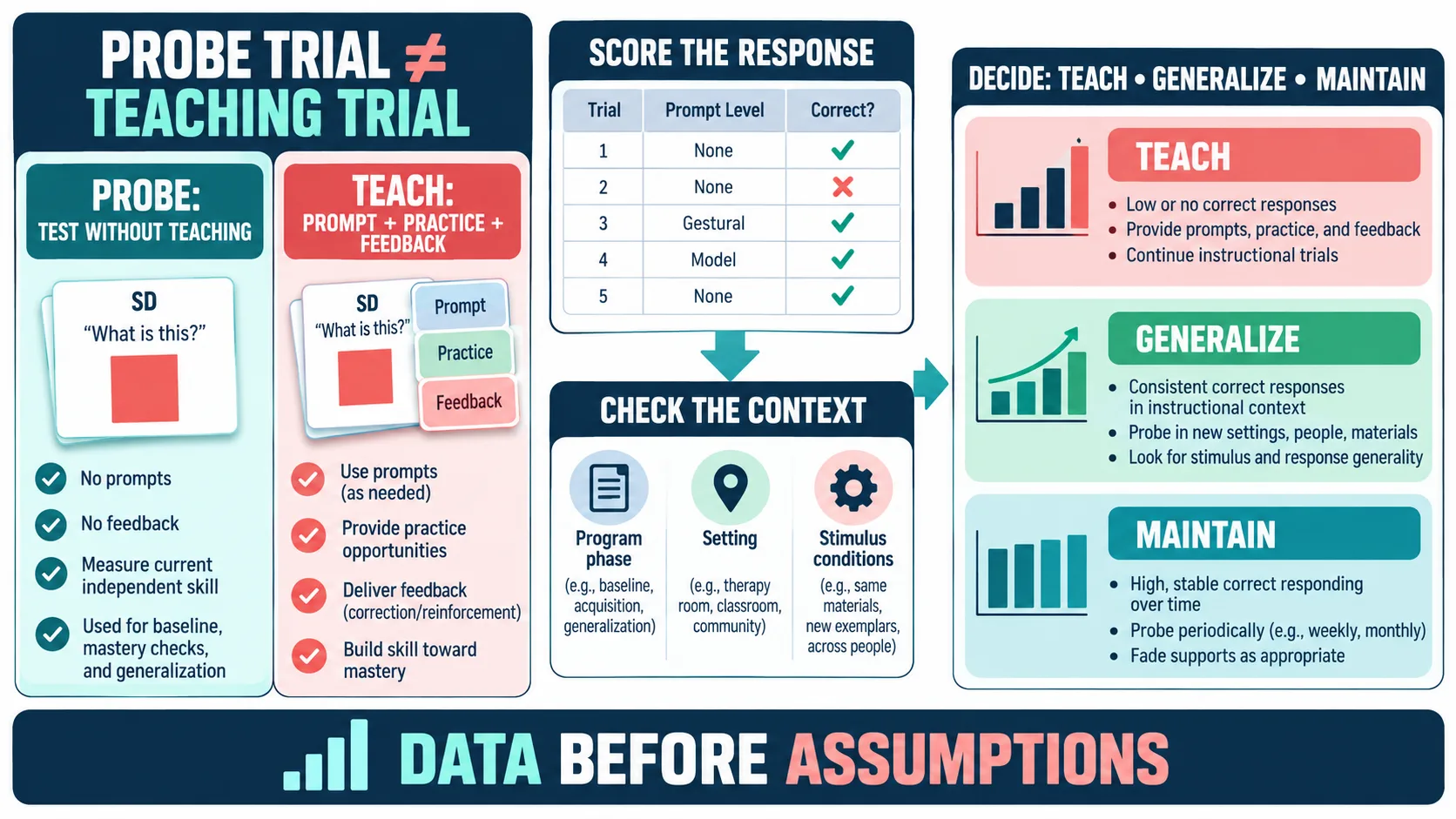
A probe trial is a planned assessment opportunity used to sample performance under defined conditions. The learner receives the relevant instruction or opportunity, the response is observed and scored, and the program specifies what support is or is not available. In many teaching contexts, the probe is arranged so the score reflects independent responding rather than performance after a prompt or corrective teaching sequence. Question: “What can the learner do under this condition before I add more teaching?” That question can be asked at several points:
- Before instruction, to establish whether the target response is already present.
- During instruction, to check whether a skill is transferring beyond the exact teaching arrangement.
- After mastery, to check whether performance persists over time without active teaching.
- After a programming change, to see whether the intended condition was tested and whether the next step is justified.
A probe therefore describes a measurement arrangement, not a single brand-name curriculum. The definition becomes useful only when the team states the behavior, opportunity, context, prompt rule, scoring rule, and decision linked to the result.
Connect Probing to the Current BCBA Scope
The current BCBA Test Content Outline connects probe reasoning to broader skills such as implementing procedures that promote stimulus and response generalization, promoting maintenance, evaluating client progress and procedural integrity, and making data-based decisions. The outline is the scope reference; it does not prescribe one universal probe schedule for every learner or target.
| Probe question | What must be defined | Decision it can inform |
|---|---|---|
| Is the response already present? | Target definition, opportunity, materials, and independent-response rule. | Whether to begin instruction, adjust the target, or collect more baseline information. |
| Does the skill transfer? | Which person, place, material, instruction, or response form is new. | Whether to generalize the program or return to targeted teaching. |
| Does the skill persist? | When active teaching ended, what conditions remained, and how performance is scored. | Whether to continue maintenance checks or modify supports. |
Probe Trial vs. Teaching Trial
The quickest way to understand probing is to compare its function with an instructional trial. A teaching trial is arranged to build or strengthen a response. A probe is arranged to sample the response under the stated conditions. The same target and instruction may appear in both, but the support and the decision purpose differ.
| Feature | Probe trial | Teaching trial |
|---|---|---|
| Purpose | Sample current performance or transfer. | Establish, strengthen, or refine a skill. |
| Prompt rule | Usually no programmed prompt unless the written protocol says otherwise; score the response as defined. | Prompts, prompt fading, correction, and reinforcement may be arranged to support learning. |
| Feedback | Avoid adding teaching feedback that would contaminate the sample, unless the plan specifies it. | Deliver the programmed consequence or feedback that supports the instructional objective. |
| Output | Data used to choose teaching, generalization, maintenance, or more assessment. | Practice opportunities and data about acquisition under teaching conditions. |
Design a Probe That Answers One Question
Before running a probe, write the question in one sentence. “Can the learner name the item?” is incomplete if the team does not specify which item, who presents it, what counts as correct, how long the response may take, and whether a prompt is allowed. A useful probe plan contains:
- Target: an observable response and a clear scoring rule.
- Opportunity: the instruction, materials, and relevant stimulus arrangement.
- Context: the person, place, time, task, and dimension being tested.
- Support rule: whether prompts, error correction, reinforcement, or breaks are available during the sample.
- Recording method: trial-by-trial accuracy, latency, duration, independence, or another measure that fits the target.
- Decision rule: what will happen if performance is strong, weak, variable, or unclear.
Keep the probe sensitive to the question. If you change the materials, instructor, setting, instruction, and scoring rule at the same time, a low score does not tell you which dimension failed to transfer. A well-defined sample makes the next teaching decision more precise.
Use Probes for Generalization and Maintenance
Generalization and maintenance are related but different reasons to probe. A generalization probe asks whether a skill occurs with a new person, place, material, instruction, or response form. A maintenance probe asks whether a skill persists after active teaching has been reduced or stopped. Both require a stated context and an independent-response rule.
For a generalization probe, identify the dimension that is new. If the learner was taught to request a break with one clinician using one card, a new-partner or home-setting probe samples transfer rather than repeating the exact clinic teaching arrangement. If performance is weak, the result does not mean the learner “does not know” the skill in every context; it indicates which programmed variation needs attention.
Read Probe Data Without Guessing
A probe score is a sample, not a complete description of the learner’s repertoire. Interpret it alongside the number of opportunities, the exact context, the response definition, implementation fidelity, and any events that could affect performance. A single low score may justify a closer look; it does not automatically justify rewriting the entire program.
| Probe result | Questions before acting | Possible next move |
|---|---|---|
| Strong independent responding | Was the new condition actually untrained, and was the response measured consistently? | Test additional relevant variations or move the mastered target into an appropriate maintenance plan. |
| Weak or absent responding | Was the instruction clear, was the opportunity valid, and did the new dimension change the response requirement? | Return to targeted teaching or program the missing generalization feature, then re-probe. |
| Variable performance | Are opportunities, materials, motivation, latency, or observer scoring changing across trials? | Clarify measurement and context before choosing a new intervention or declaring mastery. |
| Uninterpretable sample | Was the probe implemented as written, and are there enough valid opportunities to answer the question? | Repair the probe or collect a better sample before making a program decision. |
Do Not Mix Probe, Baseline, and Design Terms
Keep the terms separate: a probe is a planned sample of performance; baseline names measurement before a phase or intervention; and a multiple-probe design is an experimental arrangement using intermittent measurement across behaviors, settings, or participants. A probe can occur during baseline, generalization, or maintenance, but the terms answer different questions.
Choose the Next Step From the Probe
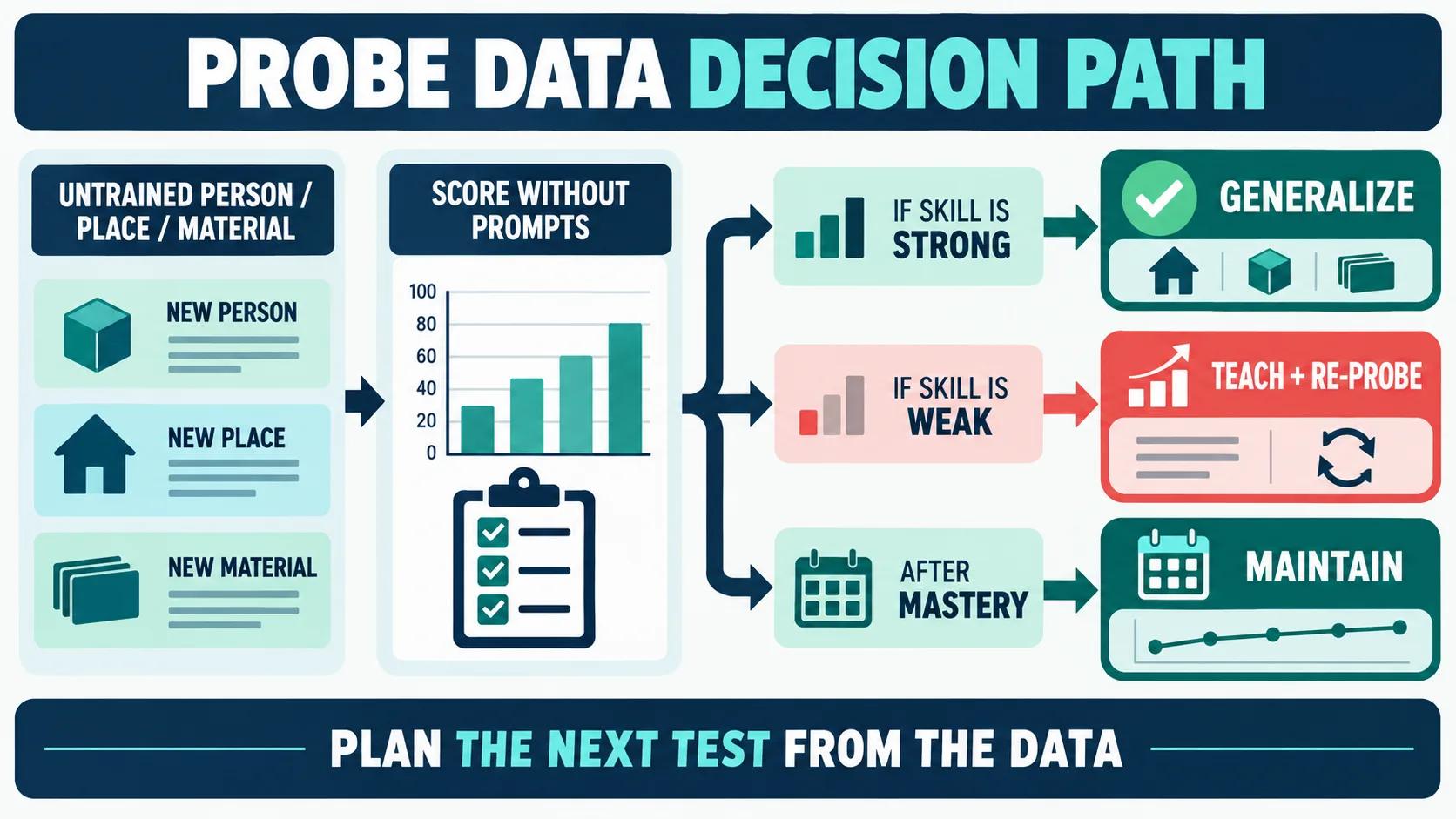
Once the score is recorded, make the next action explicit. A useful decision note has four lines: what was tested, what the learner did independently, what condition may explain the result, and what will be changed or checked next.
- If the skill is strong in the new condition: test another clinically relevant variation or schedule maintenance, depending on the program.
- If the skill is weak only in the new condition: identify the missing generalization dimension and teach it deliberately rather than labeling the whole skill mastered or failed.
- If the skill is weak everywhere: review acquisition criteria, instruction, prompting, reinforcement, response effort, and measurement before changing the target.
- If the result is unclear: repair the probe and collect a valid sample; uncertainty is a reason to improve the measurement, not to invent a conclusion.
Common Probe-Data Mistakes
- Prompting before scoring: If the question is independent performance, a prompt changes what the probe is measuring.
- Calling a new teaching example a generalization test: The team must specify what was untrained and how it differs from the teaching arrangement.
- Using a mastery percentage as a universal law: Criteria should be tied to the target, learner, context, and written program.
- Ignoring invalid opportunities: A missing material, unclear instruction, or implementation error can make a trial uninterpretable.
- Making a global conclusion from a narrow sample: A strong response with one new card does not automatically demonstrate transfer across every person, place, or material.
Use a Quick BCBA Exam Routine
When a question uses the word “probe,” scan for five clues:
- What is being sampled? Identify the target response and the exact opportunity.
- What support is present? Look for prompts, feedback, correction, reinforcement, or an explicit absence of them.
- What dimension changed? Is the test about a new person, setting, material, time, response form, or persistence after teaching?
- What is scored? Check independence, accuracy, latency, duration, or another defined measure.
- What decision follows? Choose teaching, generalization programming, maintenance, or better measurement only when the result supports it.
In a multiple-choice item, eliminate answers that confuse the purpose of a probe with the outcome of a teaching trial. If the learner receives prompts and feedback before the response is scored, the item may be describing instruction rather than an independent probe.
Practice Probe Decisions
Practice by writing a short probe note for each missed question: “Target,” “new condition,” “support rule,” “score,” and “next decision.” This format forces you to separate what was tested from what you hope the learner can do. It also makes it easier to notice when a scenario gives too little information for a confident answer.
Use the Free BCBA Mock Exam for timed practice. After each item, explain whether the evidence supports acquisition, generalization, maintenance, or only a better probe. The score is study feedback, not a certification decision or a substitute for supervision.
Frequently Asked Questions
What is the definition of probing in ABA?: Probing in ABA is a planned opportunity to sample a learner’s performance under specified conditions. The response is observed and scored according to a written rule, often without the teaching prompts or feedback used during instruction. The data inform the next teaching, generalization, or maintenance decision.
Is a probe trial the same as a teaching trial?: No. A teaching trial is arranged to build or strengthen a response and may include prompts, practice, feedback, and reinforcement. A probe trial samples what the learner can do under the stated conditions so the team can evaluate independent performance or transfer.
What is a generalization probe?: A generalization probe tests a learned response with a defined new dimension, such as a person, place, material, instruction, or response form. The new dimension should be named; a vague “different situation” does not tell the team what actually transferred.
What is a maintenance probe?: A maintenance probe checks whether a skill persists after active teaching has been reduced or stopped. The program should define when the check occurs, what independent performance means, and what action follows if performance weakens.
Bottom line: A probe in ABA is a carefully defined sample, not a surprise test and not a universal percentage rule. Separate probe trials from teaching trials, name the new or persistent condition, score independent performance, and let the data determine whether the next step is teaching, generalization, maintenance, or a better measurement plan.
Quick Review Checklist
Use this final checklist to turn probing aba definition into exam-ready reasoning. The goal is not to memorize a label in isolation; it is to identify the relevant evidence and explain why the best answer fits the scenario. Key ideas to review:
- State the central definition or decision point for probing aba definition in your own words.
- Identify the detail that makes probing aba definition different from its closest related ABA term.
- Separate the observable facts in a scenario from assumptions that are not supported by the facts.
- Write one example and one nonexample so you can recognize the concept in a new setting.
Exam application checks:
- Ask what the question is actually requesting before comparing the answer choices.
- Mark the antecedent, response, consequence, or other evidence that supports the selected answer.
- Look for a distractor that describes a related process but does not answer the specific question.
Final self-check:
- Explain how you would verify the interpretation with clear observations or data.
- Change one detail in the scenario and decide whether your answer should change.
- Give a one-sentence rationale that a supervisor or study partner could evaluate.
Take the Free BCBA Mock Exam
When you are ready to apply the idea, use the free practice resource below for additional feedback. Take the Free BCBA Mock Exam



