
A practical ABA ethical codes guide for BCBA exam scenarios: identify the risk, connect the facts to the right standard, choose the safest next action, and document what happens next. When someone searches for ABA ethical codes, they may be looking for a list of rules. That is useful, but it is not enough for a scenario question. The harder task is deciding what to do when a client, caregiver, supervisee, employer, funder, and behavior analyst have competing interests. A strong answer starts with the facts, identifies the possible risk of harm, connects the situation to the applicable code and law, and selects a defensible next step.
Table of Contents
- ABA Ethical Codes: Start With the Ethical Question
- What the BACB Ethics Code Is For
- Identify the Client, Stakeholders, and Risk
- Map the Facts to Code, Law, and Competence
- Compare Possible Actions Before Choosing
- Document, Consult, Act, and Follow Up
- Apply ABA Ethical Codes to Common Scenarios
- Code, Context, and Action: A Fast Exam Workflow
- Common Ethical-Code Mistakes
- Practice Ethical Decisions
- Frequently Asked Questions
- Quick Review Checklist
- Take the Free BCBA Mock Exam
Scope note: Use the official code as the authority. In practice, protect affected people, follow law and policy, consult appropriately, and document the decision; on an exam, match the facts and sequence rather than choosing the option that merely sounds strict.
ABA Ethical Codes: Start With the Ethical Question
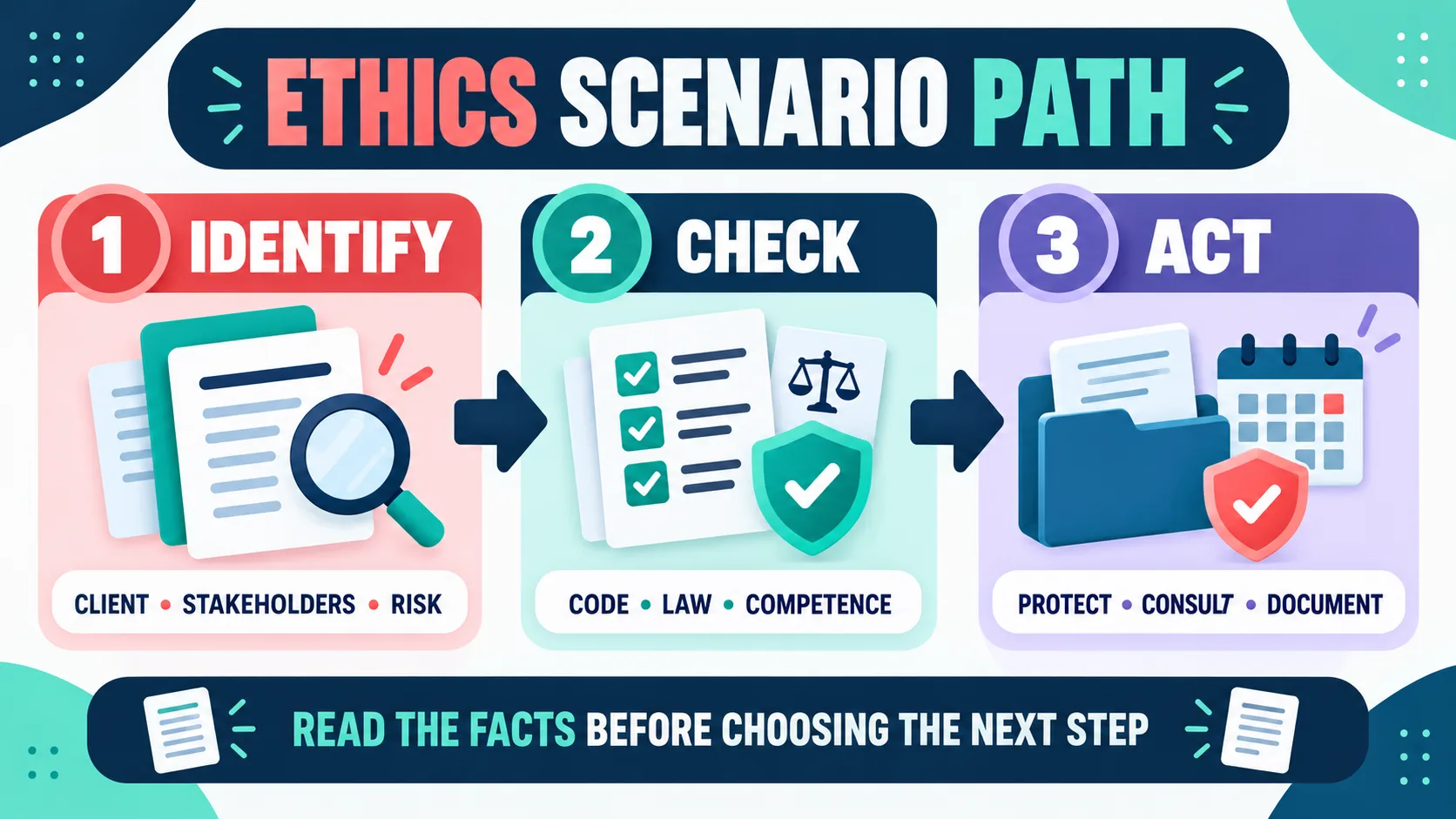
Do not begin an ethics question by guessing a code number. Begin by stating the problem in neutral language: What happened, who may be affected, and what risk needs to be reduced? This prevents a common error in which a test taker reacts to one emotionally loaded detail but misses the professional responsibility that controls the decision.
A useful first sentence is: “The immediate issue is ___, and the potential harm is ___.” For example, the issue may be that a supervisor is being asked to approve a service outside the team’s competence. The potential harm may be ineffective or unsafe care, not simply an uncomfortable disagreement with an employer. Once the risk is clear, the relevant ethical standard becomes easier to locate.
What the BACB Ethics Code Is For
The BACB describes its ethics requirements as a foundation for protecting consumers, applicants, and certificants. The code is not a shortcut that makes every dilemma simple. It gives standards that must be interpreted with the facts, law, licensure rules, service agreements, and the analyst’s competence.
For BCBA exam preparation, separate the ethical requirement, the legal or regulatory requirement, and the practice decision. They may overlap, but they are not interchangeable. “Ask the employer” may be incomplete when the request creates immediate risk, while “report immediately” may be premature when the stem first requires fact-checking, protection, or an internal procedure. Choose the option that matches the urgency and sequence in the stem.
The official Ethics Code for Behavior Analysts includes a systematic decision process: define the issue and possible harm, identify people involved, gather facts, identify standards, consult, compare actions, select a response, document it, and evaluate the outcome. Treat that sequence as a reasoning scaffold rather than a memorization contest.
Identify the Client, Stakeholders, and Risk
Many ethics scenarios name several people. A parent, technician, supervisor, administrator, or funder is not automatically the client. Write the roles down and ask whose welfare, rights, privacy, or access each action may affect.
| Role in the scenario | Questions to ask | Common trap |
|---|---|---|
| Client or service recipient | What benefit, risk, preference, right, or access issue could result? | Treating convenience for the team as the primary outcome. |
| Caregiver or representative | What consent, assent, preference, or communication responsibility is relevant? | Assuming a representative’s request overrides the client’s welfare or rights. |
| Supervisee or technician | Is training, feedback, oversight, or protection from an unsafe assignment needed? | Blaming the supervisee without checking the supervisor’s system. |
| Employer, payer, or colleague | What obligation applies, and does the request conflict with client protection or competence? | Assuming authority or payment automatically determines the ethical answer. |
Classify the risk as safety, ineffective care, privacy, conflict, competence, boundaries, representation, discrimination, or supervision. This is a routing step, not the final answer.
Map the Facts to Code, Law, and Competence
After identifying the risk, map the scenario instead of searching for a slogan. Ask, “Which responsibility is implicated?” For example, a request to use a treatment outside the BCBA’s training raises competence and client-welfare questions. A request to share a client video publicly raises consent, confidentiality, and representation questions. A supervisor who never reviews data raises supervision and service-quality questions. Use the following map:
- Code: locate the current standard or core principle that addresses the behavior.
- Law and policy: check whether a state rule, reporting requirement, court order, payer rule, or organizational process adds a duty.
- Competence: determine whether the people implementing or supervising the service have the education, training, experience, and oversight needed.
- Client voice and data: consider assent, preferences, cultural responsiveness, client goals, assessment, progress data, procedural integrity, and relevant evidence.
Do not invent a standard that the stem does not support. The best exam answer usually names an action that obtains the missing information, protects the client, or corrects the practice. It is rarely the most dramatic action simply because the scenario sounds uncomfortable.
Compare Possible Actions Before Choosing
Ethical reasoning improves when you compare at least two realistic actions. For each option, ask: Does it reduce the risk now? Is it within the analyst’s competence and authority? Does it respect the client and relevant stakeholders? Does it follow the code, law, and policy? Can the team explain, document, and evaluate it?
| Possible action | Strength | What to verify |
|---|---|---|
| Protect first | Addresses immediate risk to the client or others. | Whether the action is necessary, proportionate, authorized, and safe. |
| Consult | Adds expertise and reduces the chance of a biased or uninformed decision. | Whether consultation is timely and protects confidentiality. |
| Document and communicate | Creates a clear record of facts, action, responsibility, and follow-up. | Whether the record is objective, secure, accurate, and shared only as permitted. |
| Report or escalate | Moves a serious or unresolved concern to the appropriate authority. | The applicable reporting path, deadline, evidence, and immediate safety plan. |
“Consult” is not the same as handing responsibility to another person. The BCBA remains responsible for making a competent decision within the role. Likewise, “document” is not a substitute for acting when someone is at risk. On a scenario question, combine the steps that the facts require and place them in the correct order.
Document, Consult, Act, and Follow Up
Documentation should make the reasoning visible without turning the record into a personal argument. Record relevant dates, people, observations, reports, decisions, actions, and due dates. Protect confidentiality and separate observed facts from interpretations. If a concern came from a second-hand report, follow up to determine what is verified and what remains uncertain. A practical note can use five headings:
- Concern: the neutral description of the possible ethical problem.
- Risk: who could be harmed and how urgent the risk is.
- Standard: the relevant code, law, policy, competence limit, or client-rights issue.
- Action: what was done, by whom, when, and why.
- Follow-up: how the outcome will be evaluated and what happens if the risk remains.
This structure is valuable on the exam because it distinguishes a complete response from a vague intention. “Talk to someone” becomes stronger when the answer specifies who should be consulted, what information must be protected, what immediate risk is addressed, and how the result will be evaluated.
Apply ABA Ethical Codes to Common Scenarios
Scenario 1: A requested service exceeds competence. An employer asks a BCBA to supervise a service outside the BCBA’s training. Identify the client risk, disclose the competence limit, seek qualified consultation or training, and protect continuity of care. If the organization insists on unsafe practice, follow the applicable escalation process.
Scenario 2: A caregiver wants a public testimonial with client details. Clarify what would be shared, who can authorize it, whether assent is relevant, and whether the content could identify the client. A signed form does not make every public use automatically ethical; privacy, client welfare, and accurate representation still matter.
Scenario 3: A technician reports a possible implementation problem. Check the data and implementation, protect the client if the concern is immediate, provide feedback and supervision, and document the review. If an intervention produces no meaningful progress, also review measurement, fidelity, preferences, social validity, evidence, and risk before changing or defending the plan.
Code, Context, and Action: A Fast Exam Workflow
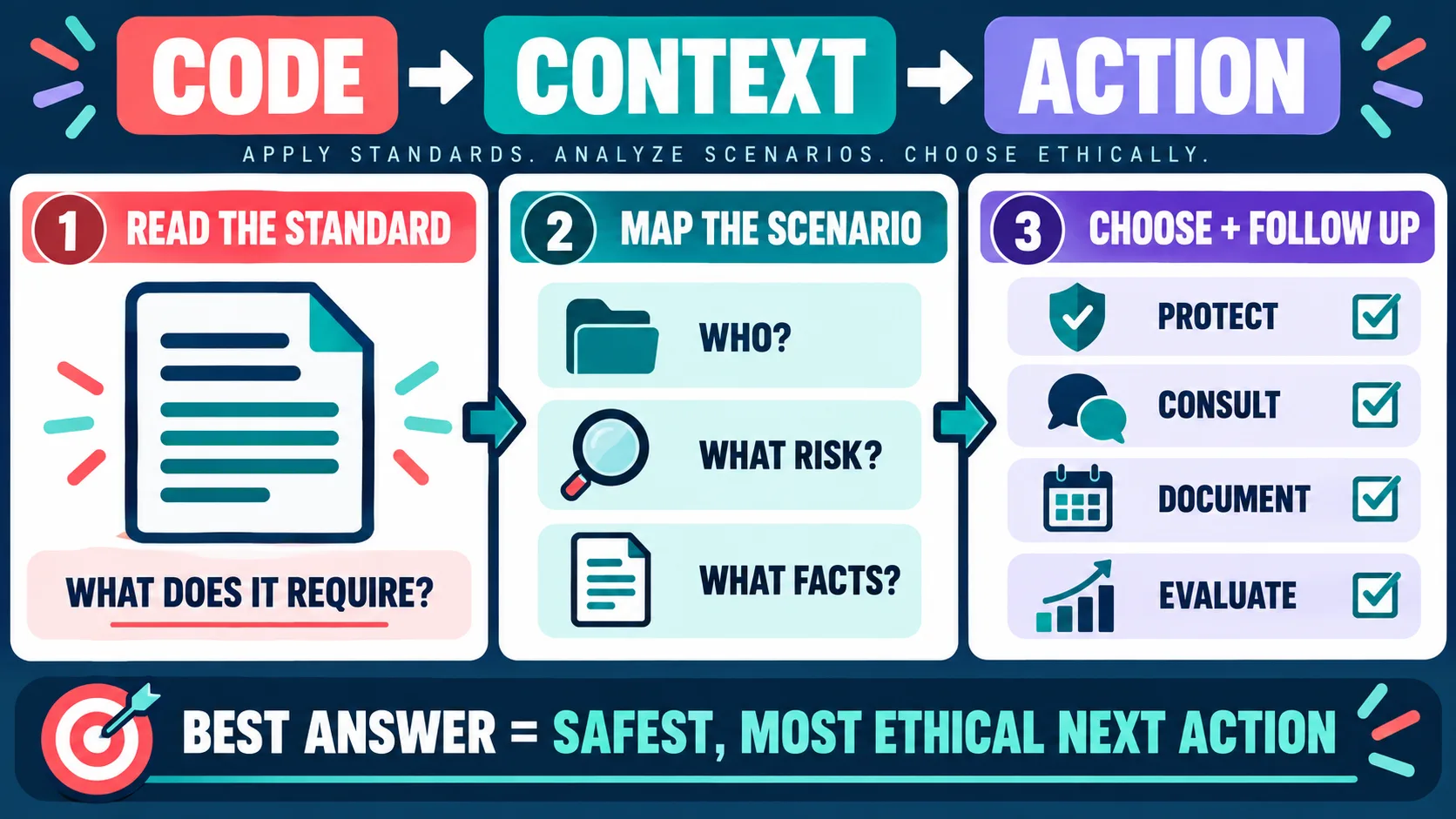
Use this three-pass routine when time is limited:
- Read the standard: What responsibility or principle is implicated? Do not decide from the most emotional sentence alone.
- Map the context: Who is affected, what facts are verified, what risk is present, what authority or competence limit applies, and what information is missing?
- Choose and follow up: Select the action that best protects the client and reduces the ethical concern, then look for consultation, documentation, communication, escalation, and outcome evaluation when the stem requires them.
If two options both sound reasonable, prefer the one that is more immediate when there is immediate risk, more evidence-based when the data are available, more respectful of client rights and preferences, and more complete about follow-up. The phrase “first,” “best,” or “next” matters. The answer may not be the final resolution; it may be the next action that makes a safe resolution possible.
Common Ethical-Code Mistakes
- Memorizing labels without applying facts: A code title does not tell you the order of action in every scenario.
- Confusing authority with permission: An employer, payer, or caregiver request does not automatically override client welfare, competence, privacy, or law.
- Choosing the most dramatic response: Reporting or ending services may be necessary in some cases, but the stem may first require protection, verification, consultation, or internal escalation.
- Ignoring assent and client voice: A technically efficient plan can still fail to respect the person receiving services.
- Writing a biased record: Document observable facts, sources, actions, and outcomes rather than motives you cannot verify.
- Treating consultation as delegation: Seek qualified input, but keep track of your own professional responsibility and follow-up.
Practice Ethical Decisions
After each missed ethics question, write four lines: risk, relevant responsibility, next action, and follow-up. Then explain why each distractor is weaker. This is more useful than rereading a long list because it rehearses the exact task that scenario questions demand: applying the code to facts while preserving the sequence of action.
Use the Free BCBA Mock Exam for timed practice. When reviewing an item, do not only record whether your answer was right. Mark the role of the client, the ethical risk, the missing fact, the relevant responsibility, and the next step. That review turns an ethics score into a repeatable decision skill.
Frequently Asked Questions
What are ABA ethical codes?: ABA ethical codes are professional standards that guide behavior analysts’ responsibilities to clients, stakeholders, supervisees, the profession, and the public. Use the current BACB Ethics Code for Behavior Analysts as the primary source, then apply it to the facts, law, competence, client rights, and risk in the scenario.
What should I study first in the BACB Ethics Code?: Start with the core responsibilities and decision-making process, then apply them to competence, confidentiality, supervision, client welfare, boundaries, public statements, and conflicts of interest. The goal is to choose a safe, ethical, well-sequenced action.
What is the best way to answer a BCBA ethics scenario?: Identify the client and stakeholders, define potential harm, separate facts from assumptions, locate the relevant duty, and compare actions. Choose the option that best protects the client in the order required by the stem, including consultation, documentation, reporting, and follow-up when appropriate.
Do I need to memorize every ABA ethics code number?: Know the organization and meaning of the current code, but do not rely on numbers alone. Scenario questions test recognition, interpretation, and next-action selection. Verify current language against official BACB resources. Bottom line: Read the facts, identify the risk, map the correct responsibility, choose the safest next action, document it, and evaluate the outcome.
Quick Review Checklist
Use this final checklist to turn aba ethical codes into exam-ready reasoning. The goal is not to memorize a label in isolation; it is to identify the relevant evidence and explain why the best answer fits the scenario. Key ideas to review:
- State the central definition or decision point for aba ethical codes in your own words.
- Identify the detail that makes aba ethical codes different from its closest related ABA term.
- Separate the observable facts in a scenario from assumptions that are not supported by the facts.
- Write one example and one nonexample so you can recognize the concept in a new setting.
Exam application checks:
- Ask what the question is actually requesting before comparing the answer choices.
- Mark the antecedent, response, consequence, or other evidence that supports the selected answer.
- Look for a distractor that describes a related process but does not answer the specific question.
Final self-check:
- Explain how you would verify the interpretation with clear observations or data.
- Change one detail in the scenario and decide whether your answer should change.
- Give a one-sentence rationale that a supervisor or study partner could evaluate.
Take the Free BCBA Mock Exam
When you are ready to apply the idea, use the free practice resource below for additional feedback. Take the Free BCBA Mock Exam



