
A scenario-first guide to the three scientific goals of behavior analysis: description, prediction, and control. If you search for the goals of behavior analysis as a science, the short answer is description, prediction, and control. The exam-level skill, however, is not merely naming the three words. You must match the strength of a claim to the evidence in the scenario: What was observed? What pattern was found? Was a variable systematically changed, and did behavior change in a reliable relation to that change?
Table of Contents
- Goals of Behavior Analysis as a Science: What This Keyword Is Really Asking
- Use the Current BCBA Scope
- Description: What Happened?
- Prediction: What Pattern Should We Expect?
- Control: What Changed Because of the Variable?
- Compare the Three Goals by Evidence
- Match a Scenario to the Strongest Claim
- Common BCBA Exam Traps
- Use a 30-Second Answer Routine
- Keep the Scientific Goal Inside Professional Boundaries
- Turn the Concept Into Practice
- Frequently Asked Questions
- Quick Review Checklist
- Take the Free BCBA Mock Exam
This guide is built as a decision tool. It uses brief examples, evidence checks, and common traps so you can tell whether a vignette shows description, prediction, control, or only a tempting overstatement. It is a study resource, not a substitute for the current BACB BCBA Test Content Outline, coursework, supervision, or professional judgment.
Important boundary: “Control” in a scientific sense means demonstrating a functional relation through appropriate systematic analysis. It does not mean controlling a person, guaranteeing an outcome, or ignoring client choice. Always interpret the term within the research design, client-welfare, and ethical context described.
Goals of Behavior Analysis as a Science: What This Keyword Is Really Asking
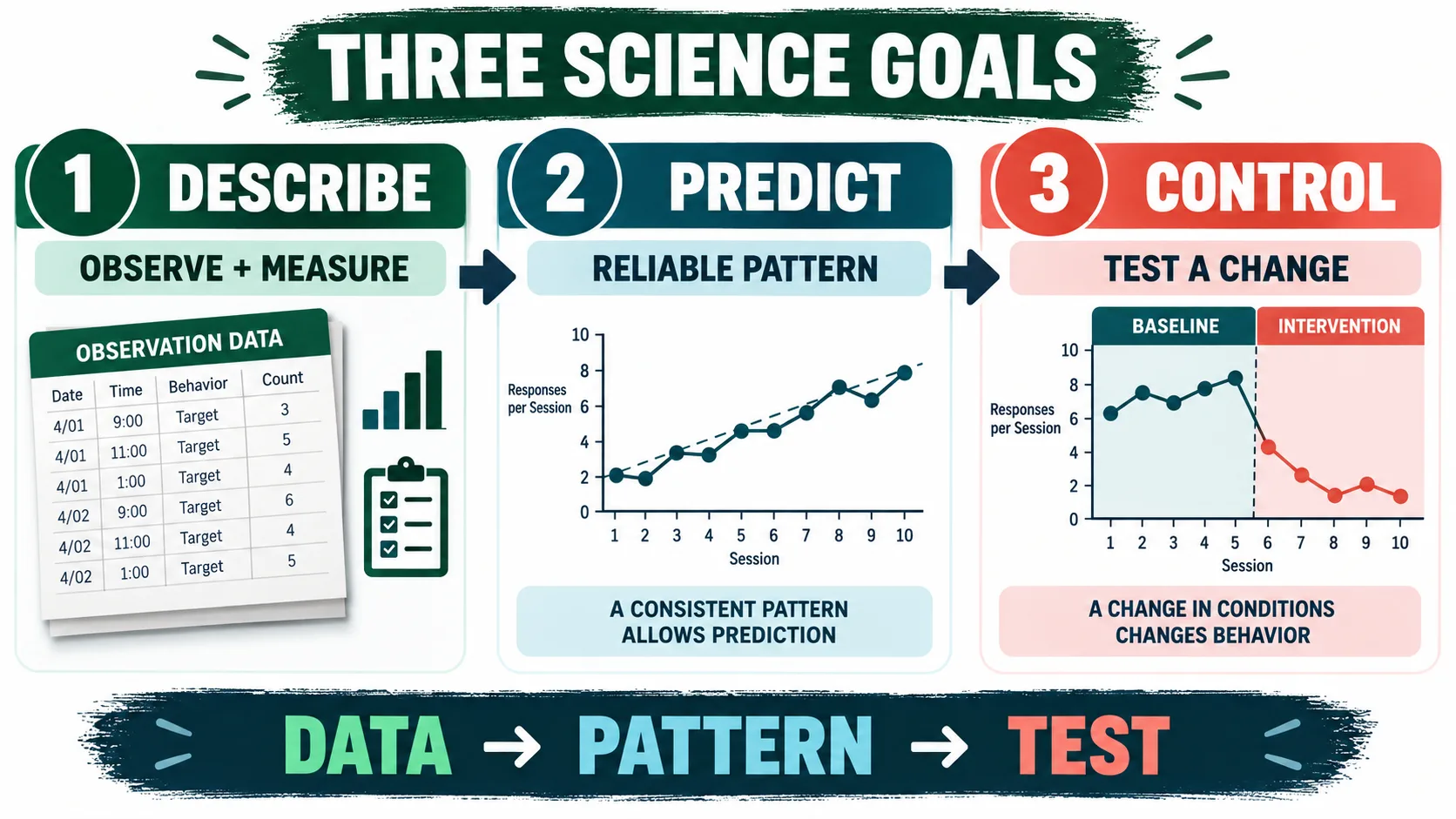
The three goals describe increasingly strong ways of knowing about behavior. They are connected, but they are not interchangeable:
- Description organizes direct observations into an objective account of what happened.
- Prediction identifies a reliable relation between events so that behavior can be anticipated under similar conditions.
- Control demonstrates that systematically changing an environmental variable produces a reliable change in behavior, usually through an appropriate experimental arrangement.
Think of the difference as a claim-evidence ladder. A graph or narrative may describe behavior without explaining why it occurred. A repeated pattern may support prediction without proving that one variable caused the behavior. A replicated change that tracks a planned manipulation provides stronger evidence for control. The ladder is useful for exam reasoning because the wrong answer often claims more certainty than the scenario supports.
Use the Current BCBA Scope
The BACB’s current outline places this topic in Domain A, Behaviorism and Philosophical Foundations, as the task “identify the goals of behavior analysis as a science.” The outline names description, prediction, and control. It is the appropriate boundary for an exam article; a third-party study page should not silently expand the task into a different claim.
| Goal | Evidence in the scenario | What you may claim |
|---|---|---|
| Description | Objective observation, measurement, classification, or a clear summary of events. | This is what the behavior looked like, how often it occurred, or what events were observed with it. |
| Prediction | A consistent correlation or repeated relation between behavior and environmental events. | Under similar conditions, this behavior is likely to occur or change in a similar pattern. |
| Control | Systematic manipulation, appropriate comparison, and repeated behavior change that corresponds to the manipulation. | The manipulated variable is functionally related to the behavior change, within the limits of the design and context. |
Description: What Happened?
Description is the foundation of objective scientific communication. The analyst collects facts about an event, defines the behavior clearly, and organizes observations so they can be examined. A descriptive statement stays close to the data. It does not need to identify a cause.
Words such as “unmotivated,” “defiant,” or “seeking attention” may be interpretations rather than descriptions unless the question defines how they were measured. On an exam, choose the descriptive answer when the scenario gives observations but no reliable pattern or systematic test. Do not leap from one event to a functional conclusion.
Prediction: What Pattern Should We Expect?
Prediction is supported when observations show a consistent relation between behavior and surrounding events. The analyst is no longer only saying what happened; the analyst can anticipate behavior when the relevant conditions recur. Prediction can be based on a reliable correlation. It does not, by itself, prove that one variable caused the behavior.
A common trap is treating “the behavior happened after the event” as prediction. One sequence can be descriptive. Prediction requires a reliable pattern, not merely a plausible story. Another trap is calling a correlation control. If no variable was systematically manipulated and compared, the evidence may support prediction but not experimental control.
Control: What Changed Because of the Variable?
Control is the strongest of the three scientific goals because it requires evidence that changing an environmental variable produces a corresponding change in behavior. The question is not whether behavior improved after an intervention in a general sense. The question is whether the design supports a functional relation between the manipulated variable and the behavior.
Control is also not the same as coercion or total predictability. Scientific control means arranging and testing variables to understand their functional relation. In applied work, the analysis remains bounded by client welfare, informed consent, social validity, least-restrictive considerations where relevant, competence, and the limits of the design.
Compare the Three Goals by Evidence
When an item gives you several answer choices, compare the evidence rather than matching on a familiar word. The table below shows what each claim can and cannot establish.
| If the item gives you… | Most defensible goal | Do not overclaim |
|---|---|---|
| A clear operational definition and a measured account of behavior. | Description | The definition does not prove a cause or a reliable future pattern. |
| Repeated observations showing behavior is associated with a condition. | Prediction | An association alone does not demonstrate that the condition caused the behavior. |
| A planned manipulation, comparison, and replicated behavior change tied to that manipulation. | Control | The conclusion is still limited by the design, fidelity, measurement, context, and ethical boundaries. |
The words “cause,” “demonstrates,” and “functional relation” should make you look for experimental evidence. The words “associated with,” “likely,” or “under similar conditions” usually point toward prediction. A statement that simply reports the count, duration, or topography is usually descriptive.
Match a Scenario to the Strongest Claim
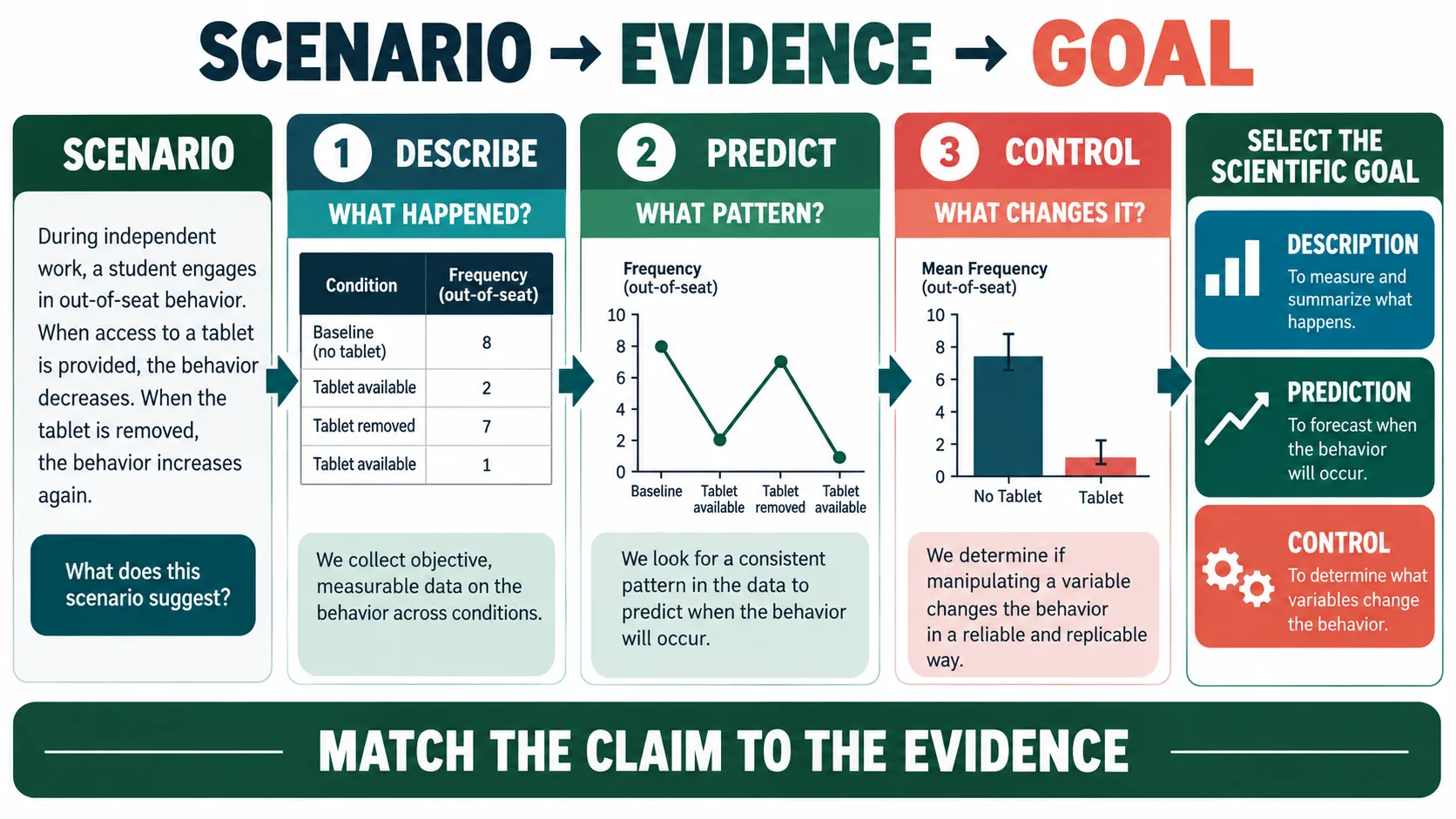
Use the following four-step scan when a vignette feels wordy. First identify the behavior and how it was measured. Then locate the repeated pattern, if any. Finally look for an actual manipulation and a design feature that rules out plausible alternatives.
| Scenario clue | Reasoning move | Likely answer |
|---|---|---|
| “The analyst counted each instance and recorded duration during a specified observation.” | Stay with the directly observed facts. | Description |
| “Across several observations, the response is more likely when a particular event is present.” | Ask whether the relation is reliable but merely correlational. | Prediction |
| “The analyst systematically changes the event and the response changes in a replicated pattern.” | Look for a demonstrated functional relation, not just improvement. | Control |
| “The behavior improved after a new program was started, with no comparison or replication.” | Name the outcome cautiously and note that alternative explanations remain. | Not enough evidence for scientific control. |
Common BCBA Exam Traps
The same distinctions appear in different wording. Watch for these traps:
- Prediction is not control. A reliable correlation lets you anticipate behavior, but it does not show that changing the correlated event caused the change.
- Control is not “the behavior got better.” Improvement may reflect maturation, history, measurement drift, a concurrent event, or another variable unless the design addresses those alternatives.
- Description is not interpretation. “The learner is avoiding work” is not the same as recording what happened before and after the response.
- One dramatic data point is not a pattern. Look for repeated observations, stable measurement, and the conditions under which the relation occurs.
- Scientific control is not a license to ignore values. In applied behavior analysis, social importance, client welfare, consent, competence, and practical acceptability remain relevant.
When two options both sound scientifically reasonable, select the one that makes the smallest claim supported by the facts. Then ask what additional data or design feature would be needed to move from description to prediction or from prediction to control.
Use a 30-Second Answer Routine
For a timed question, use this sequence:
- Underline the behavior: Identify the response and its measurement dimension.
- Circle the evidence verb: Is the item describing, associating, forecasting, manipulating, or demonstrating?
- Check the conditions: Are there repeated observations, a comparison, a planned manipulation, or replication?
- Limit the claim: Choose the lowest level of scientific certainty that fully fits the evidence.
- Eliminate the trap: Explain why a stronger or weaker label does not fit.
For example, if a vignette says that a learner’s behavior occurs more often when attention is unavailable across repeated observations, the pattern may support prediction. If it then says the analyst arranged attention and no-attention conditions in a systematic analysis and the behavior changed in correspondence with those conditions, the evidence moves toward control. If it only says a treatment was started and behavior later decreased, do not automatically claim control.
Keep the Scientific Goal Inside Professional Boundaries
The goals of behavior analysis as a science help organize evidence; they do not replace ethical decision-making. The BACB ethics resources should be consulted when a question involves competence, informed consent, confidentiality, records, supervision, risk, or conflicts. A scientifically interesting manipulation may still be inappropriate if it is outside competence, poorly justified, not consented to, or inconsistent with client welfare.
In practice, write the claim and its limit together: “The data show a relation under these conditions; they do not yet establish ___.” This protects against overpromising to a family, treating a hypothesis as a diagnosis, or presenting a single outcome as proof. It also mirrors the reasoning expected in well-designed exam questions.
Turn the Concept Into Practice
After learning the definitions, practice classifying short vignettes. For each item, record four answers: the goal, the evidence phrase, the missing evidence, and the reason the closest distractor is wrong. That four-part review is more useful than tracking only whether you selected the correct letter.
Use the Free BCBA Mock Exam for a timed check. When you miss an item, return to the claim-evidence ladder and ask whether you confused an association with a functional relation, or an outcome with experimental control. The score is study feedback, not a certification decision.
Frequently Asked Questions
What are the goals of behavior analysis as a science?: The goals are description, prediction, and control. Description objectively records behavior and relevant events. Prediction identifies reliable relations that allow behavior to be anticipated under similar conditions. Control demonstrates a functional relation when systematic manipulation produces a reliable behavior change within an appropriate design.
Is prediction the same as control in behavior analysis?: No. Prediction can be supported by a reliable correlation between events. Control requires stronger evidence that changing an environmental variable produces the behavior change. A prediction may guide a test, but it does not automatically establish causation.
What is an example of description?: Counting the number of out-of-seat responses during a defined observation period and reporting the duration of each response is descriptive. It tells you what occurred and how it was measured without claiming why it occurred.
What is an example of control?: If an analyst systematically manipulates an environmental variable, measures behavior across appropriate comparison conditions, and observes a replicated change that corresponds to the manipulation, the study may demonstrate experimental control. The exact conclusion depends on the design, fidelity, measurement, and context.
Bottom line: To answer questions about the goals of behavior analysis as a science, match the claim to the evidence. Describe what was observed, predict when a reliable pattern supports anticipation, and reserve control for a demonstrated functional relation. That discipline keeps your answer precise—and keeps scientific reasoning connected to ethical applied practice. For targeted review, use our goals of behavior analysis as a science practice questions to apply the concept in exam-style scenarios.
Quick Review Checklist
Use this final checklist to turn goals of behavior analysis as a science into exam-ready reasoning. The goal is not to memorize a label in isolation; it is to identify the relevant evidence and explain why the best answer fits the scenario. Key ideas to review:
- State the central definition or decision point for goals of behavior analysis as a science in your own words.
- Identify the detail that makes goals of behavior analysis as a science different from its closest related ABA term.
- Separate the observable facts in a scenario from assumptions that are not supported by the facts.
- Write one example and one nonexample so you can recognize the concept in a new setting.
Exam application checks:
- Ask what the question is actually requesting before comparing the answer choices.
- Mark the antecedent, response, consequence, or other evidence that supports the selected answer.
- Look for a distractor that describes a related process but does not answer the specific question.
Final self-check:
- Explain how you would verify the interpretation with clear observations or data.
- Change one detail in the scenario and decide whether your answer should change.
- Give a one-sentence rationale that a supervisor or study partner could evaluate.
Take the Free BCBA Mock Exam
When you are ready to apply the idea, use the free practice resource below for additional feedback. Take the Free BCBA Mock Exam



