

Defining Private Events in Radical Behaviorism
When you sit for the BCBA exam, you will encounter questions that reference private events—thoughts, feelings, and bodily sensations that only the individual can directly observe. In radical behaviorism, these events are not dismissed or treated as unobservable mysteries. Instead, they are considered behavior that follows the same principles as public behavior. This is a key distinction from earlier behaviorist viewpoints, and understanding it will help you answer exam items accurately.
Table of Contents
- Defining Private Events in Radical Behaviorism
- Why Private Events Matter in Applied Behavior Analysis
- Worked Examples: Private Events in Practice
- Exam Relevance and Common Traps
- Quick Checklist for Exam Day
- Summary
- Take the Free BCBA Mock Exam
- References
Radical behaviorism, as articulated by B.F. Skinner, holds that a complete science of behavior must include all events that influence behavior, regardless of whether they are publicly observable. Private events are included because they are part of the causal chain of behavior. For example, a student might feel a sudden itch (private event) and then scratch their arm (public behavior). Both are legitimate subjects for analysis. The exam will often test your ability to recognize that private events are not a separate category but simply behavior occurring within the skin.
To deepen your understanding, consider that private events can serve as antecedents, behaviors, or consequences. For instance, a thought like “I’m going to fail” can act as a discriminative stimulus for avoidance behavior. Similarly, a feeling of relief can serve as a reinforcing consequence. This functional perspective is what makes radical behaviorism a robust framework for applied work. If you are new to this concept, you might find it helpful to review how methodological behaviorism differs in its treatment of internal events. What Are Private Events?: Private events are stimuli or responses that are accessible only to the person experiencing them. Common examples include:
- Feelings of anxiety before a presentation
- Visual images that appear in one’s mind
- Sensations of pain from an injury
- Internal self-talk or verbal reasoning
These events are not considered metaphoric or fictional; they are real biological occurrences. In radical behaviorism, they are analyzed just like any other behavior—by identifying their function and the variables that control them. This is why the BCBA exam may ask you to identify private events in a clinical scenario or to select an intervention that addresses them indirectly.
Radical vs. Methodological Behaviorism: Methodological behaviorism, which dominated early behaviorism, restricted science to events that could be observed and verified by multiple people. Private events were excluded because they were seen as untestable. Radical behaviorism rejects this exclusion. Skinner argued that a science of behavior must account for all behavior, including private events, and that the same principles of operant and respondent conditioning apply. This is known as behavioral continuity. The exam often tests this distinction with paired statements, so be prepared to differentiate the two approaches.
For a practical comparison, consider this: a methodological behaviorist might say, “We cannot study anger because we cannot observe it.” A radical behaviorist would respond, “We can study the conditions under which anger is reported and the effects it has on behavior.” This shift in perspective is crucial for applied work, as it allows behavior analysts to address private events functionally without resorting to mentalistic explanations.
Why Private Events Matter in Applied Behavior Analysis
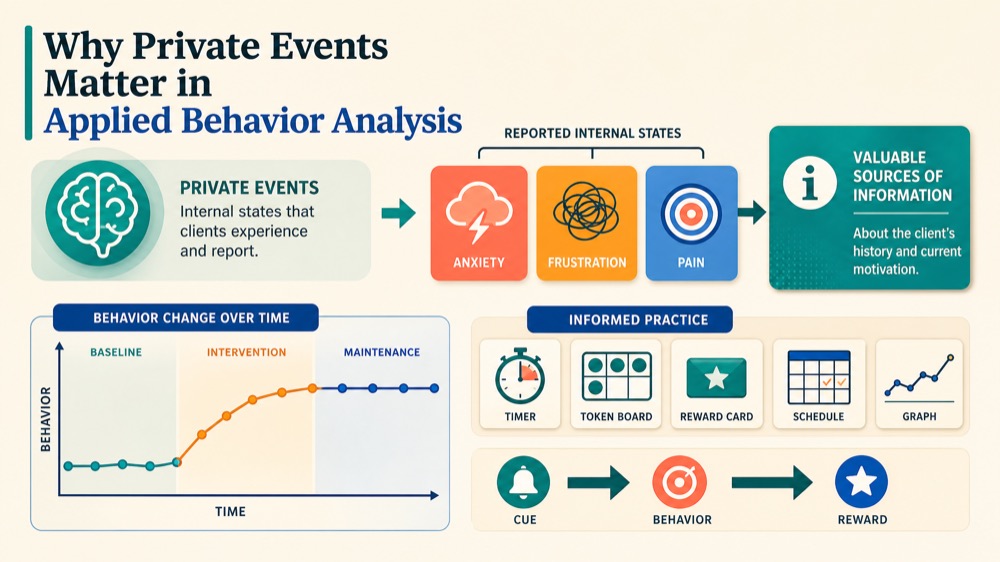
In daily practice, behavior analysts encounter clients who report internal states such as anxiety, frustration, or pain. These reports are valuable sources of information about the client’s history and current motivation. Radical behaviorism provides a framework for treating these reports as behavior, not as hidden causes. This means that when a client says, “I feel sick,” the behavior analyst might examine what antecedent conditions evoke that verbal report and what consequences maintain it.
Private events also play a role in assessment and intervention. In functional analysis, the target behavior might be a private event, such as a negative thought or a somatic sensation. Although you cannot directly observe the private event, you can observe its public correlates and manipulate environmental variables to infer its function. This is an essential skill for the exam, as scenario-based questions may ask you to hypothesize the function of a private event based on antecedents and consequences.
For example, suppose a teenager reports feeling “panicked” before social events. A behavior analyst might notice that the teen’s parent responds with reassurance and allows the teen to stay home. Here, the private event (panicked feeling) is an antecedent for avoidance behavior, and the consequence is access to parental attention and escape from the social setting. This analysis leads to an intervention that targets the environmental contingencies, not the feeling itself.
Understanding private events is also tied to broader philosophical questions about the goals of behavior analysis. If you want to explore how description, prediction, and control apply to private events, you can read our guide on identifying the goals of behavior analysis.
Worked Examples: Private Events in Practice
To solidify your understanding, let’s walk through three concrete examples that illustrate how private events function in an ABC analysis. These examples mirror the kind of clinical reasoning you will need, both on the exam and in real supervisory situations. Each example breaks down the antecedent, behavior, and consequence, and then offers a hypothesized function. Pay close attention to how the private event is treated as a behavior, not as a hidden cause.
Example 1: Anxiety as a Private Event: Scenario: A graduate student has an upcoming exam (antecedent). She thinks, “I’m going to fail,” and feels a tightness in her chest—both private events. She then calls a friend (behavior). The friend listens and offers reassurance (consequence). This interaction may be maintained by access to social comfort, which is a form of positive reinforcement. In the exam, you might be asked to identify the function of the private event or the behavior.
This example shows that private events can serve as motivating operations or discriminative stimuli. The feeling of anxiety may increase the value of social comfort, making the friend’s response more reinforcing. This is a classic pattern seen in clinical settings.
Example 2: Pain as a Private Event: Scenario: A child with a headache (private event) complains to her mother. The mother gives her attention and a massage (consequence). Over time, the child may learn that complaining about pain leads to attention. The function here may be attention-seeking, not pain relief. This is a critical example because it shows that reported pain can be influenced by social contingencies. On the exam, you might be asked to design an intervention that provides attention for alternative behaviors, such as the child asking for a break or using a relaxation technique.
It is important to note that this analysis does not deny the reality of pain; rather, it recognizes that pain reports are behavior that can be shaped by consequences. This perspective is a hallmark of radical behaviorism and is frequently tested in questions about functional assessment.
Example 3: Thoughts as Private Events: Scenario: An adult with depression often says to herself, “I’m worthless.” This thought (private event) is followed by a feeling of hopelessness and then avoiding social events (behavior). The avoidance leads to a temporary reduction in distress, which is negative reinforcement. The function is likely escape from uncomfortable social situations. In this case, the private event serves as an abolishing operation, making social interaction less reinforcing.
Interventions might include cognitive restructuring from a CBT perspective, but from a behavior analytic view, you would focus on establishing new discriminative stimuli and reinforcing approach behaviors. This example underscores how private events can be integrated into a behavior analytic case conceptualization.
Exam Relevance and Common Traps
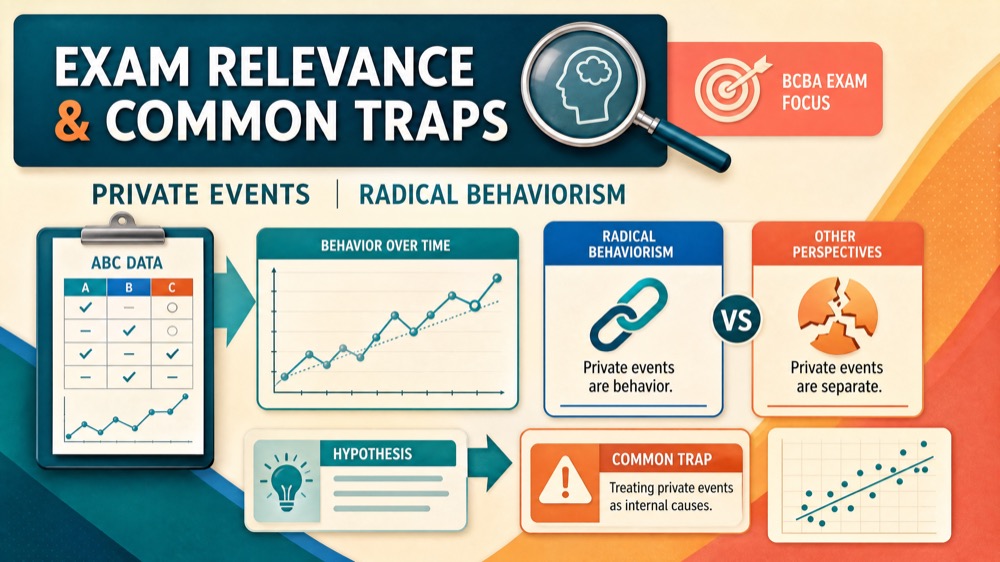
The BCBA exam often includes items that test your understanding of philosophical foundations. Private events are a frequent topic, especially in questions that contrast radical behaviorism with other perspectives. You will need to know the key terms and recognize common misconceptions. Below is a list of terms that you should define and distinguish clearly. You may also find it useful to review our guide on radical behaviorism for additional depth. Key Terms to Know: Use the points below as a quick study guide.
- Private event: An event accessible only to the individual experiencing it, such as a thought or a sensation.
- Covert behavior: Behavior that occurs within the skin, not observable by others.
- Behavioral continuity: The assumption that private events follow the same behavioral laws as public events.
- Radical behaviorism: Skinner’s philosophy that includes private events in the science of behavior.
Understanding these terms will help you navigate exam questions that use precise language. Common Exam Traps: Here are three traps that candidates often fall into, along with explanations of why they are incorrect.
- Trap 1: Confusing radical behaviorism with methodological behaviorism. Remember that methodological behaviorism excludes private events, while radical behaviorism includes them. If an answer option says “private events are not subject to scientific analysis,” it is inconsistent with radical behaviorism.
- Trap 2: Thinking private events are not behavior. Some candidates believe that only observable actions count as behavior. In radical behaviorism, thoughts and feelings are behaviors, even if they are internal.
- Trap 3: Ignoring the function of private events in ABC analysis. When you are given a scenario, always consider how private events serve as antecedents or consequences. For example, a private event might be a motivating operation that alters the value of a reinforcer.
Being aware of these traps can save you valuable points on exam day.
Quick Checklist for Exam Day
Use this checklist as a final review before your exam. It captures the essential points about private events in radical behaviorism.
- Define private events and provide examples (thoughts, feelings, sensations).
- Contrast radical behaviorism with methodological behaviorism.
- Explain behavioral continuity and why it matters.
- Identify private events in a given ABC scenario.
- Hypothesize the function of a private event based on consequences.
- Recognize that private events are not mental causes but behaviors to be analyzed.
If you can complete this checklist confidently, you are in good shape for the relevant exam items.
Summary
Private events in radical behaviorism are a core concept that you must master for the BCBA exam. They are defined as behaviors or stimuli accessible only to the individual, and they are treated as legitimate subjects of scientific study. The key distinction is that radical behaviorism includes private events, whereas methodological behaviorism does not.
In practice, private events can be analyzed using the same functional approach as any other behavior. By identifying antecedents and consequences, you can determine their function and design interventions that target environmental variables. Common exam traps include confusing the two behaviorisms, denying that private events are behavior, and overlooking their role in ABC analyses. We hope this guide has clarified the concept and its application. For more in-depth study, consider reviewing our article on methodological behaviorism to see the contrast in detail. Good luck with your preparation!
Take the Free BCBA Mock Exam
Ready for more practice? Use the free mock exam to keep testing your accuracy with realistic BCBA-style items. Take the Free BCBA Mock Exam
References
Next step for BCBA exam prep
Turn this topic into exam-day practice
Use this topic as a focused review, then test it in exam-style conditions with a free mock before deciding whether five full-length mocks are the right next step.
Start the Free BCBA Mock Exam
Continue with Five Full-Length Mocks — $99
Review the included materials and access details before ordering. No pass guarantee is implied.



