

Defining ‘Trainee’ in Applied Behavior Analysis
In everyday language, a trainee is anyone learning a new skill. However, in Applied Behavior Analysis, the term carries a specific professional meaning tied to the BACB supervision framework. A trainee is an individual who has completed the required coursework but is still accruing supervised fieldwork hours to become a Board Certified Behavior Analyst (BCBA) or Board Certified Assistant Behavior Analyst (BCaBA). This status is defined by the Behavior Analyst Certification Board (BACB) and involves strict supervision requirements.
Table of Contents
- Defining ‘Trainee’ in Applied Behavior Analysis
- Real-World ABA Examples and Hypothesized Functions
- Exam Relevance of the Term ‘Trainee’
- Quick-Reference Checklist for Trainees
- Summary and Key Takeaways
The term ‘trainee’ emphasizes that the person is not yet independent. They must work under the guidance of a qualified supervisor, typically a BCBA, who oversees their clinical activities. This is different from a ‘supervisee,’ which can refer to any professional receiving supervision, including certified staff. A trainee is always a supervisee, but not every supervisee is a trainee. Understanding this distinction is crucial for the BCBA exam.
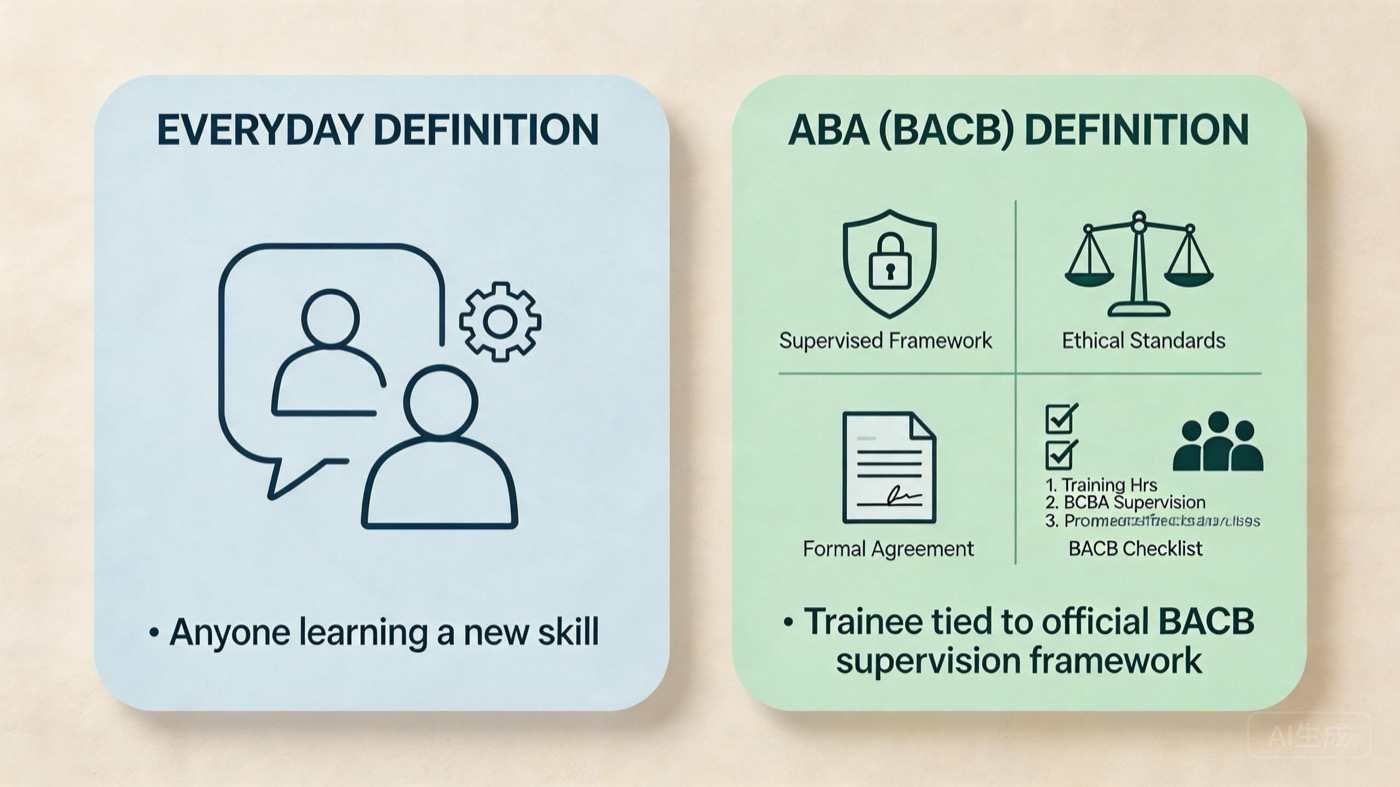
Generic vs. ABA-Specific Meaning
A generic dictionary might define a trainee as ‘a person undergoing training.’ In ABA, the definition is more precise. According to the BACB, a trainee is someone enrolled in a verified course sequence or equivalent and simultaneously completing supervised fieldwork. This status comes with specific responsibilities: the trainee must accrue a minimum number of hours, meet monthly supervision requirements, and document their progress using BACB-approved forms.
On the BCBA exam, questions may test whether you can differentiate a trainee from a fully certified BCBA. For example, a trainee cannot independently design behavior intervention plans or supervise others without a supervising BCBA. They must work within the scope of their training and under active supervision. The exam often presents scenarios where you must identify ethical violations related to trainee independence.
Real-World ABA Examples and Hypothesized Functions
Seeing the term ‘trainee’ in action helps solidify its meaning. Below are three examples that incorporate ABC data (antecedent-behavior-consequence) and hypothesized functions, as commonly tested on the BCBA exam.
Example 1: Trainee Implements a DTT Program
A trainee is running a discrete trial training (DTT) session with a client. The antecedent is the trainee presenting a discriminative stimulus (‘Point to the dog’). The behavior is the client pointing to the correct picture. The consequence is the trainee delivering a token. However, the trainee’s behavior of following the protocol correctly is maintained by supervisor approval (attention-maintained). If the supervisor is present, the trainee runs trials accurately; when the supervisor leaves, the trainee becomes less precise. This suggests the trainee’s adherence is under social positive reinforcement.
Example 2: Trainee Collects Data During Naturalistic Teaching
During a natural environment teaching session, the trainee is tasked with collecting trial-by-trial data. The antecedent is the client initiating a request for a preferred toy. The trainee records the response on a data sheet. The hypothesized function of the trainee’s data collection behavior is escape from supervisor feedback. If the trainee collects data accurately, the supervisor provides less corrective feedback (negative reinforcement). If data is missing, the supervisor gives more feedback, which the trainee finds aversive.
Example 3: Trainee Receives Feedback from Supervisor
After a session, the supervisor provides corrective feedback on the trainee’s prompting hierarchy. The trainee listens, nods, but does not change the behavior in the next session. The ABC: antecedent – supervisor’s feedback; behavior – verbal acknowledgment without change; consequence – supervisor ends the conversation. The hypothesized function for the trainee’s lack of behavior change is automatic negative reinforcement – avoiding the discomfort of changing a familiar routine. This highlights how trainee behavior can be maintained by non-social consequences.
Exam Relevance of the Term ‘Trainee’
The BCBA exam includes questions about supervision, ethical responsibilities, and professional conduct. The term ‘trainee’ appears in several domains, particularly in supervision and management. You must know the BACB’s supervision standards, including the minimum supervision hours, the qualifications of supervisors, and the activities that count toward fieldwork.
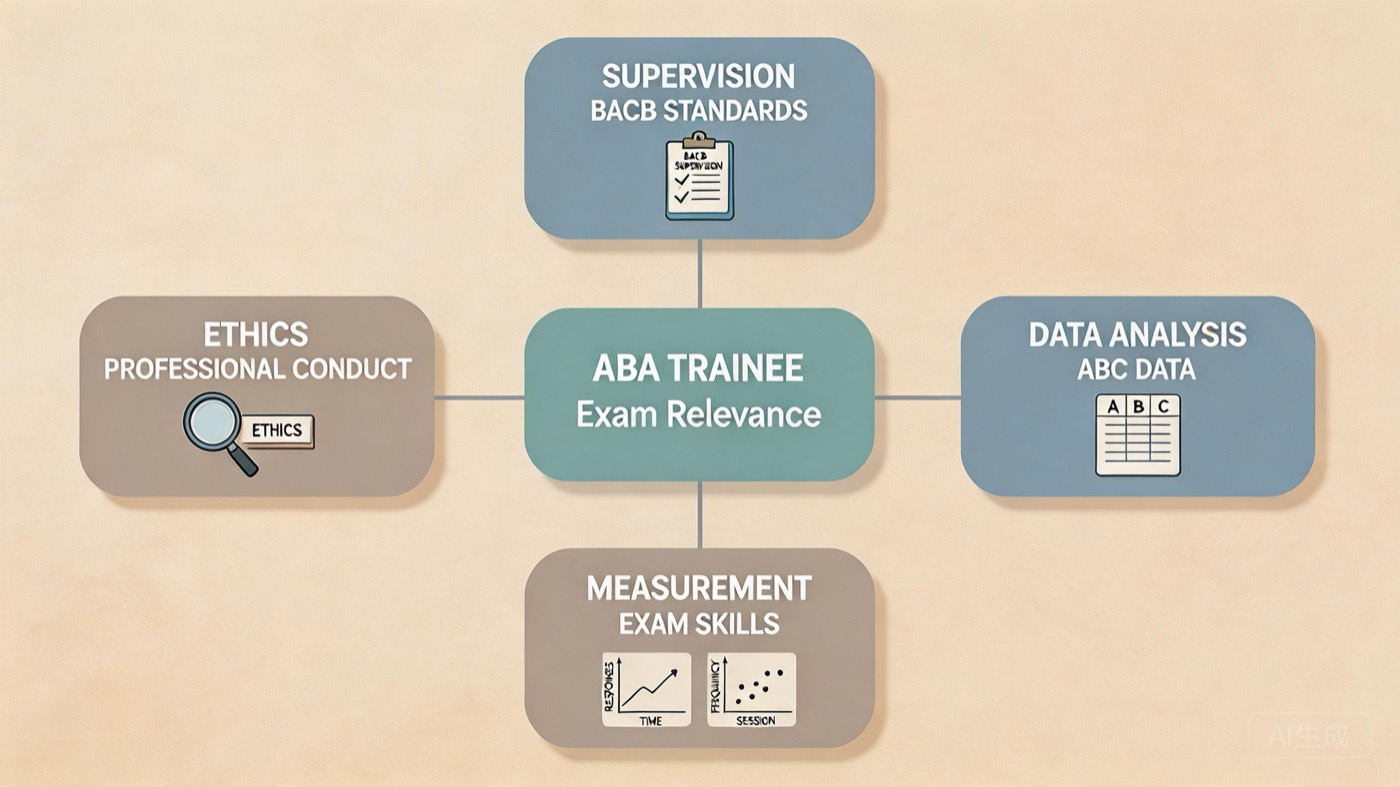
Common Traps on the BCBA Exam
Test-takers often misinterpret trainee roles. Here are common pitfalls:
- Confusing trainee with supervisee: All trainees are supervisees, but not all supervisees are trainees. Certified BCBAs may also receive supervision (e.g., for professional development), but they are not considered trainees.
- Assuming trainee independence: A trainee cannot practice independently. The exam may describe a scenario where a trainee creates a behavior plan without supervisor approval – this is an ethical violation.
- Ignoring supervisor responsibilities: The supervisor must ensure the trainee’s competence and sign off on hours. If a trainee behaves unethically, the supervisor shares responsibility.
- Miscounting supervision hours: The BACB requires a certain percentage of supervision to be individual (one-on-one). Group supervision has limits. Know the exact numbers for the 6th Edition Task List.
For a deeper dive into supervision standards, check out our guide on BCBA 6th Edition Exam Blueprint Weighting.
Sample Exam-Style Questions
1. A BCBA trainee is assigned to design a behavior intervention plan for a new client. The supervising BCBA has not reviewed the plan. Which ethical principle is most clearly violated? A) Client dignity B) Responsibility to supervisees C) Competence D) Informed consent. (Answer: B – the supervisor must oversee trainee work.)
2. A trainee accrues 1500 hours of fieldwork, but only 3% is individual supervision. Which BACB requirement is not met? A) Minimum total hours B) Minimum individual supervision percentage C) Supervisor qualifications D) Trainee documentation. (Answer: B – individual supervision must be at least 5% of total hours for the 6th Edition.)
3. During a supervision session, a trainee disagrees with the supervisor’s recommendation. What should the trainee do? A) Follow the supervisor anyway B) Document the disagreement and discuss further C) Implement own plan D) Quit the supervision. (Answer: B – professional collaboration is key.)
Quick-Reference Checklist for Trainees
Use this checklist for last-minute exam review. It covers essential trainee responsibilities and supervision requirements.
- Enroll in a verified course sequence or equivalent as per BACB standards.
- Secure a qualified supervisor – must be a BCBA with active certification.
- Track fieldwork hours using BACB-approved forms (monthly and final verification).
- Ensure supervision meets content requirements: at least 5% individual, 10% total (including group).
- Follow ethical guidelines – a trainee must not misrepresent credentials.
- Document all supervision contacts – date, duration, content, and signatures.
- Seek feedback actively and implement changes to demonstrate professional growth.
For more exam prep resources, visit our BCBA Exam Prep 2025 page.
Summary and Key Takeaways
The meaning of trainee in ABA is defined by the BACB’s supervision framework. A trainee is a supervised professional accruing fieldwork hours toward certification. On the BCBA exam, you must understand the distinctions between trainee and supervisee, the supervisor’s responsibilities, and the ethical boundaries of trainee practice. The real-world examples illustrate how trainee behavior can be analyzed similarly to client behavior – using ABC and function hypotheses. Finally, the checklist provides a quick review of key requirements. Master these concepts to avoid common exam mistakes and to prepare for real-world supervision scenarios.
For additional study, review the BACB supervision requirements directly.
Complete BCBA Exam Prep
Turn this topic into exam-day practice
Practice concepts in context with five full-length 6th Edition mock exams, two bonus practice exams, a 6th Edition study guide, and key-term flashcards—all in one $120 USD package.
Get the $120 All-in-One Prep Pack
Review everything included on the product page before ordering. No pass guarantee is implied.



