

Introduction: Why Deprivation and Satiation Matter for BCBA
Understanding motivating operations is fundamental to applied behavior analysis, and among these, deprivation and satiation stand out as two sides of the same coin. For BCBA candidates, grasping how these states influence behavior is not just theoretical—it’s a practical necessity for designing effective interventions. When a client is deprived of a preferred item, that item becomes more potent as a reinforcer; when they are satiated, the same item loses its power. This dynamic directly impacts everything from session planning to data interpretation.
Table of Contents
- Introduction: Why Deprivation and Satiation Matter for BCBA
- Defining Deprivation: The Engine of Motivation
- Defining Satiation: When Motivation Drops
- Deprivation and Satiation Together: The Motivating Operations Dynamic
- BCBA Exam Relevance: Traps, Tips, and Practice Prompts
- Quick Checklist: Deprivation and Satiation Essentials
- Final Takeaways and Additional Resources
- Quick Review Checklist
- Take the Free BCBA Mock Exam
- References
In this guide, we break down deprivation and satiation ABA concepts with clear definitions, real-world examples, and exam-focused insights. By the end, you’ll be able to identify these operations in scenarios, anticipate common traps, and apply this knowledge to raise your exam score.
What Are Motivating Operations?: Let’s start with the umbrella term. Motivating operations (MOs) are environmental events that alter the value of a stimulus as a reinforcer or punisher. They have two key effects: they change the effectiveness of a consequence, and they alter the current frequency of behavior that has previously produced that consequence. There are two types: establishing operations (EOs), which increase reinforcer value, and abolishing operations (AOs), which decrease it. Deprivation typically acts as an EO, while satiation acts as an AO. For the BCBA exam, you need to recognize these operations in everyday clinical scenarios and explain their effects on behavior.
Defining Deprivation: The Engine of Motivation
Deprivation occurs when an individual has gone without a particular reinforcer for a period of time. This condition temporarily increases the value of that reinforcer, making it more effective at strengthening behavior. For instance, if a child hasn’t had access to their favorite iPad game all day, the iPad becomes a high-value reinforcer, leading to increased attempts to earn it. From a behavioral perspective, deprivation is an establishing operation (EO) because it establishes the effectiveness of the reinforcer and evokes behavior that has yielded it in the past.
In practice, BCBAs use deprivation intentionally to boost motivation. However, they must balance this with ethical considerations, ensuring that basic needs (like food, water, comfort) are never withheld. For exam questions, remember that deprivation is not just about physical needs; it applies to any stimulus, including attention, activities, or tokens. The key is that the individual has experienced a period without it, and as a result, the value of that stimulus rises.
How Deprivation Impacts Reinforcer Effectiveness: The impact of deprivation is both immediate and conditional. It immediately increases the value of the reinforcer, and this change leads to an increased frequency of behavior that has historically produced that reinforcer. For example, a student who hasn’t had a chance to play with building blocks for several days will likely engage in more on-task behavior when the completion of work is followed by access to blocks. The establishing effect is clear: the block play is now a stronger reinforcer.
In addition, deprivation can influence response allocation. When deprived of one reinforcer, the individual may allocate more behavior toward obtaining it, even if other reinforcers are available. This is important for BCBA practice, as it suggests that to maximize motivation, you should consider what the client hasn’t had access to recently. For the exam, you might be asked to identify the EO in a scenario: the missing access is the deprivation, and the increase in behavior is the result.
Real-World ABA Example: Deprivation in Action: Let’s walk through a brief ABC analysis to see deprivation in action. Setting: a preschool classroom, just after lunch. Antecedent: the teacher tells the child, ‘If you put away your toys, you can play with the sensory bin (which the child hasn’t used since yesterday).’ Behavior: the child quickly cleans up. Consequence: the teacher gives access to the sensory bin, and the child plays enthusiastically. The hypothesized function is access to a tangible reinforcer, and the deprivation from yesterday’s lack of access increased the value of the bin, making the clean-up behavior more likely. This example highlights how deprivation can be manipulated to improve compliance.
Defining Satiation: When Motivation Drops
Satiation is the opposite state: the individual has had an overabundance of a reinforcer, leading to a decrease in its value. This makes the reinforcer less effective at strengthening behavior. For example, if a child has been given unlimited access to stickers all day, stickers may no longer serve as a motivating reward. Satiation acts as an abolishing operation (AO), reducing the effectiveness of that stimulus and decreasing the frequency of behavior that produces it.
In therapy, satiation can quietly sabotage intervention integrity. A clinician might notice a drop in responding and incorrectly assume the intervention is failing, when in fact the reinforcer has simply lost its power due to satiation. Recognizing this is crucial for data-based decision-making. For the BCBA exam, you’ll often see scenarios where a client becomes disengaged during a session; one possible explanation is satiation with the current reinforcer.
How Satiation Affects Intervention Integrity: Satiation can have a direct impact on the integrity of an intervention. When a reinforcer is satiated, the client may show reduced motivation to engage in the target behavior, leading to a plateau or decrease in performance. This is especially problematic in dense reinforcement schedules, where the client receives the same reinforcer frequently. The discriminative stimulus (SD) may still be present, but the consequence is no longer valuable, so the behavior extinguishes or falls to lower levels.
To maintain intervention integrity, BCBAs must monitor for satiation and plan accordingly. This might involve rotating reinforcers, using varied reinforcement, or implementing brief periods of deprivation. For example, if using edible reinforcers, it’s wise to limit the client’s access outside of sessions. This ensures that the edible remains effective when needed. On the exam, questions may ask you to explain a decrease in behavior; remember that satiation is a plausible, and often overlooked, reason.
Real-World ABA Example: Satiation in a Classroom: Here’s an ABC example illustrating satiation. Setting: a self-contained classroom for students with autism. Antecedent: the paraprofessional gives a student access to a tablet (which he has had all morning) and asks him to complete a math worksheet. Behavior: the student engages in low rates of on-task behavior and frequently looks at the tablet. Consequence: the paraprofessional prompts and redirects, but the student continues to wander. The hypothesized function could be access to the tablet, but since the student has been satiated on the tablet, it no longer functions as a reinforcer, so the instruction produces little behavior. The solution would be to restrict tablet access before sessions, creating a state of deprivation to increase its value.
Deprivation and Satiation Together: The Motivating Operations Dynamic
Deprivation and satiation are not static; they operate along a continuum and fluctuate continually based on the individual’s history with the reinforcer. A client may be deprived of a certain item in the morning but satiated by the afternoon. As a BCBA, you must understand that the same reinforcer can have different values at different times, and this dynamic directly influences training and intervention outcomes. Therefore, ongoing assessment of motivating operations is essential.
The dynamic nature of these operations means that effective intervention planning involves implementing strategies to control the level of deprivation or satiation. For example, you might schedule intense teaching sessions shortly after a period of deprivation, or you might intersperse easy tasks with access to a variety of reinforcers to avoid satiation. Recognizing when to apply each concept is a mark of a skilled practitioner—and a common exam theme.
Fluctuations in Motivating Operations: Motivating operations are transient; they change based on recent events. This is especially important in a clinical setting, where a client’s motivation can shift over the course of a single session. For instance, a child may be highly motivated by a toy car at the start of a session, but after playing with it for a few minutes, the car’s value decreases. The astute behavior analyst will respond by rotating reinforcers or introducing a brief time-out from the toy to re-establish its value through mild deprivation.
On the exam, you’ll be tested on your ability to identify when an MO changes. A scenario might describe a child who requests a break after working for a while; here, the break becomes more valuable as the child becomes satiated on work tasks. Alternatively, the value of a snack might increase after lunch time has passed, making it an EO for requesting. Always consider the recent history with the stimulus to determine whether deprivation or satiation applies.
Practical Applications for BCBA Practice: In applied practice, manipulating deprivation and satiation can be a powerful tool. For example, in a token economy, you might allow clients to earn tokens throughout the day, but they can only exchange tokens during a specific ‘store’ time. This creates a period of deprivation from the back-up reinforcers, increasing the value of tokens. Conversely, if you notice that a client is no longer motivated by tokens because they have a surplus, you might adjust the exchange rate or introduce novel items to renew interest.
Another strategy is to use preference assessments to identify current reinforcers, but also to track access times. If a client chooses the same item repeatedly, you might limit access to that item for a while to boost its effectiveness. In supervision, you can train behavior technicians to notice signs of satiation, such as slow responding or checking out, and to switch to an alternative reinforcer. This practical knowledge not only helps in interventions but also directly corresponds to exam scenarios that ask for the best course of action.
BCBA Exam Relevance: Traps, Tips, and Practice Prompts
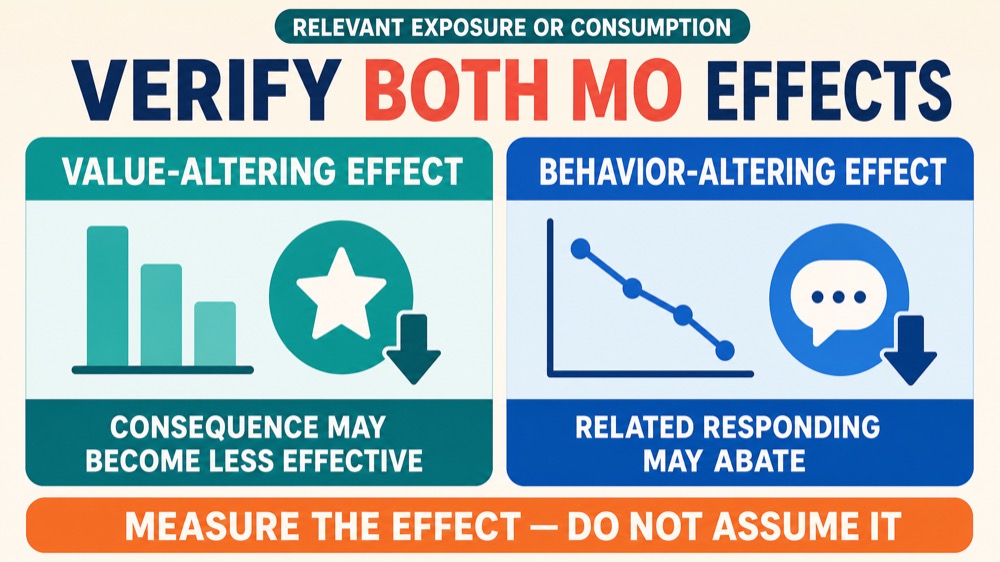
The BCBA exam frequently includes questions on motivating operations, and deprivation and satiation are prime targets. Questions often present a scenario and ask you to identify whether an EO or AO is in effect, or to predict the effect on behavior. A common trap is confusing the two: students might misidentify satiation as deprivation when a behavior decreases, not considering that the reinforcer has lost its value. Another trap is overlooking the role of MOs altogether, attributing a behavior decrease to extinction when it’s actually due to satiation.
To succeed, practice reading scenarios carefully and identifying the relevant variables. Remember that motivating operations alter both the value of the consequence and the current frequency of behavior. Use this two-part definition as a checklist. Also, be aware that the exam may present multiple-choice options that include both correct and plausible but incorrect MO terms; knowing the precise definitions is crucial. Common Exam Traps: Here are specific pitfalls to avoid on the exam:
- Overlooking MOs: Assuming behavior changes are due to reinforcement or punishment alone, ignoring the role of motivating operations.
- Confusing EO and AO: Mixing up establishing operations (deprivation) with abolishing operations (satiation).
- Static view: Thinking motivation is constant; in reality, MOs fluctuate over time and context.
- Overgeneralizing: Assuming deprivation applies only to primary reinforcers like food and water, when it also applies to secondary reinforcers like attention or tokens.
Scenario-Based Practice Prompts: Test yourself with these short scenarios. Answers are provided below, but cover them first. Scenario 1: A student typically enjoys completing puzzles. However, after a weekend of puzzle play, the student shows little interest in puzzles during Monday’s session and completes fewer puzzles. What is this an example of?
Scenario 2: A client hasn’t had access to his favorite music for a week. When the therapist offers a music break as a reinforcer for task completion, the client responds quickly and accurately. Which motivating operation is at play? Answers: Scenario 1 is satiation—the reinforcer’s value decreased due to excess access. Scenario 2 is deprivation—the reinforcer’s value increased due to lack of access.
Quick Checklist: Deprivation and Satiation Essentials
Use this checklist for rapid revision before the exam. Each point encapsulates a core concept you should be able to articulate.
- Definition: Deprivation = limited access increases reinforcer value (EO). Satiation = excess access decreases reinforcer value (AO).
- Effects: Both alter the effectiveness of a consequence and the frequency of behavior.
- Example: Restricting a child’s access to a tablet increases its reinforcing value; allowing unlimited access decreases it.
- Assessment: Conduct ongoing preference assessments and track access to avoid satiation.
- Intervention: Rotate reinforcers, control access, and use interspersed reinforcement to maintain motivation.
- Supervision: Train RBTs to recognize signs of satiation and adjust accordingly.
- Ethics: Never deprive clients of basic needs (food, water, sleep); deprivation applies to discretionary reinforcers.
Final Takeaways and Additional Resources
Mastering deprivation and satiation is more than memorizing definitions; it’s about understanding how these concepts drive behavior change. These motivating operations are foundational to effective intervention and appear throughout the BCBA exam. Keep in mind that deprivation often increases motivation, while satiation decreases it, and that both states are dynamic and require ongoing monitoring.
To deepen your understanding, explore related concepts like reinforcement schedules and preference assessments, which often interact with MOs. Practice with mock questions to fine-tune your ability to identify MOs in scenarios. For more exam prep, check out our guide on automatic reinforcement and our comprehensive reinforcement and extinction principles guide. Also, the BACB provides a detailed task list that outlines the standards for these concepts. Consistent review and application will boost your confidence and performance on exam day.
Quick Review Checklist
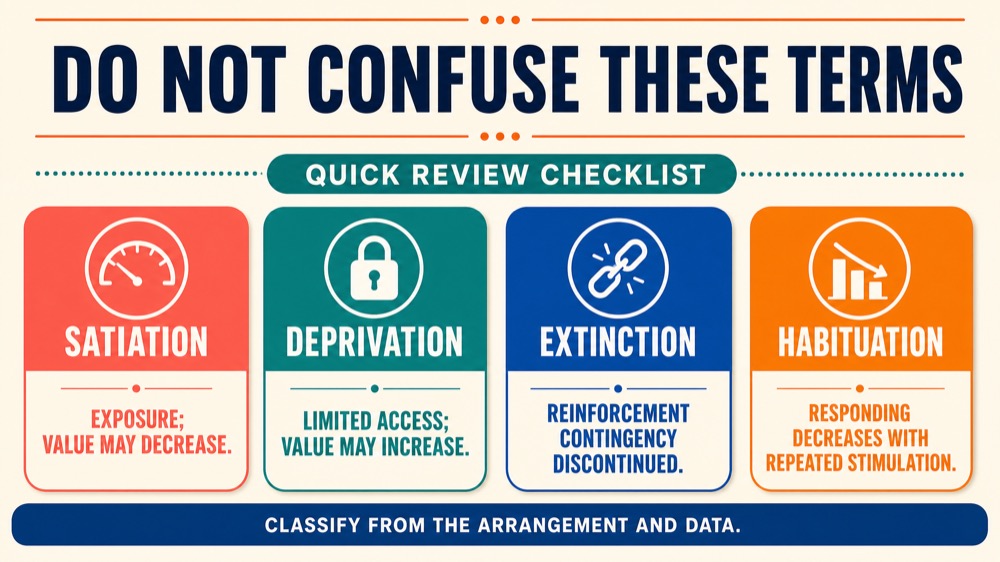
Use this final checklist to turn deprivation and satiation ABA into exam-ready reasoning. The goal is not to memorize a label in isolation; it is to identify the relevant evidence and explain why the best answer fits the scenario. Key ideas to review:
- State the central definition or decision point for deprivation and satiation ABA in your own words.
- Identify the detail that makes deprivation and satiation ABA different from its closest related ABA term.
- Separate the observable facts in a scenario from assumptions that are not supported by the facts.
- Write one example and one nonexample so you can recognize the concept in a new setting.
Exam application checks:
- Ask what the question is actually requesting before comparing the answer choices.
- Mark the antecedent, response, consequence, or other evidence that supports the selected answer.
- Look for a distractor that describes a related process but does not answer the specific question.
Final self-check:
- Explain how you would verify the interpretation with clear observations or data.
- Change one detail in the scenario and decide whether your answer should change.
- Give a one-sentence rationale that a supervisor or study partner could evaluate.
Take the Free BCBA Mock Exam
Ready for more practice? Use the free mock exam to keep testing your accuracy with realistic BCBA-style items. Take the Free BCBA Mock Exam



