
Introduction: Why Mastering Independent and D
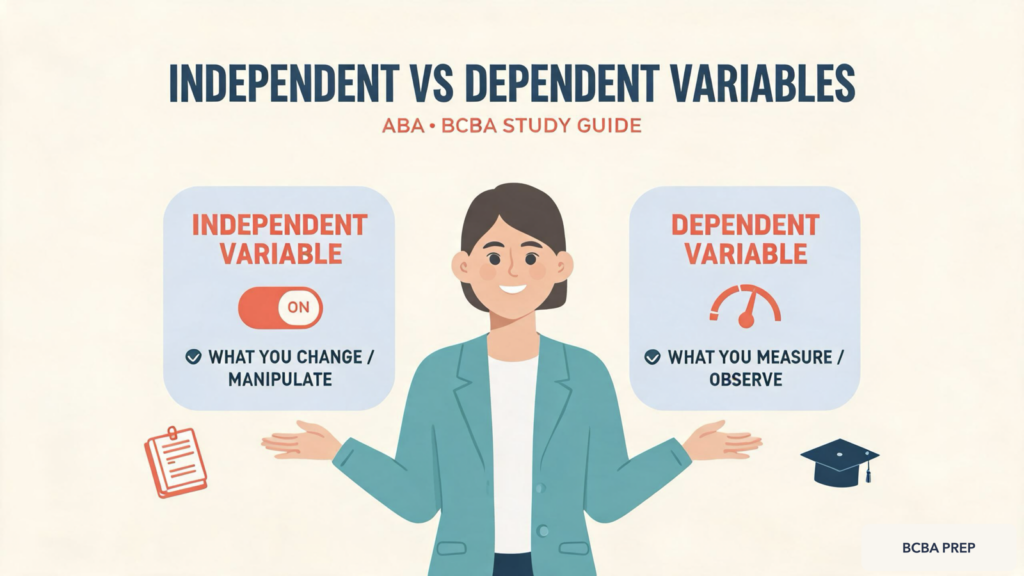
One of the most fundamental concepts tested on the BCBA exam is the relationship between the independent variable and the dependent variable. These terms appear in nearly every scenario-based question, and confusing them can cost you points. In applied behavior analysis, the independent variable is the intervention you manipulate; the dependent variable is the target behavior you measure. Getting this distinction right is essential for demonstrating experimental control and understanding functional relationships. In this guide, you’ll learn clear definitions, practical ABA examples, and common exam traps to help you ace this topic.
Table of Contents
- Introduction: Why Mastering Independent and D
- Core Differences Between Independent and Dependent Variables in ABA
- ABA Examples of Independent and Dependent Variables (ABC Format)
- Exam Relevance and Common Traps
- Quick Checklist: Distinguishing IV from DV
- Summary
- How to Study independent variable and dependent variable for BCBA-Style Questions
- How to Study independent variable and dependent variable for BCBA-Style Questions
- Take the Free BCBA Mock Exam
- References
What Is an Independent Variable in ABA?: The independent variable (IV) in ABA is the intervention or treatment that the practitioner systematically manipulates. It is what you change to see if it affects behavior. For example, if you implement a token economy to increase on-task behavior, the token system is the independent variable. The IV must be clearly defined and implemented with fidelity to establish a functional relationship.
What Is a Dependent Variable in ABA?: The dependent variable (DV) is the target behavior being measured. It is the behavior you expect to change as a result of the intervention. Using the same example, the percentage of intervals with on-task behavior is the dependent variable. The DV must be operationally defined and measured reliably to detect change over time.
Core Differences Between Independent and Dependent Variables in ABA
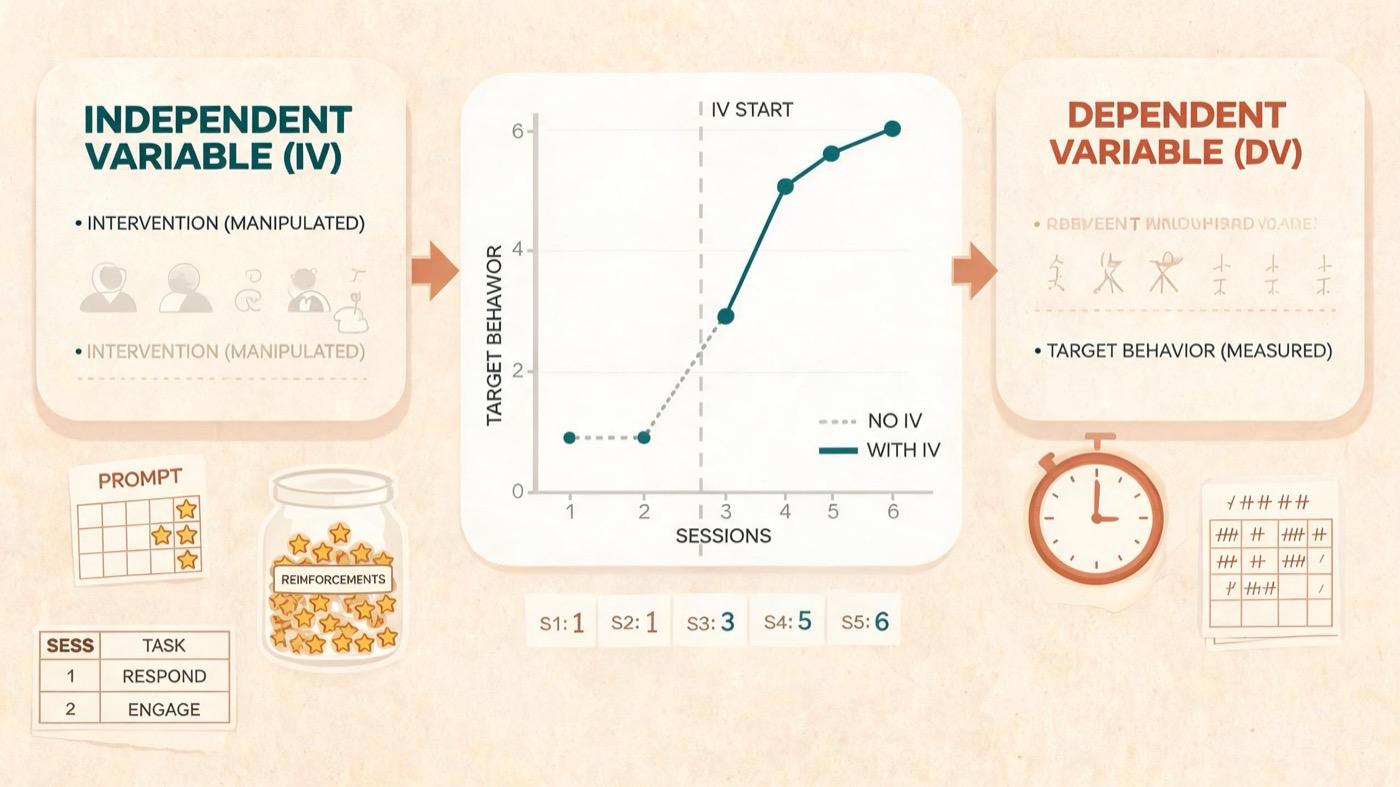
The Functional Relationship: Intervention and Behavior: The core of ABA science lies in demonstrating a functional relationship between the independent variable (intervention) and the dependent variable (behavior). When the IV is manipulated and the DV changes predictably, you have evidence that the intervention caused the behavior change. This cause-and-effect logic is what distinguishes ABA from purely descriptive approaches. Unlike other fields where variables may be correlated, ABA emphasizes experimental control through systematic manipulation.
How Variables Are Used in Single-Subject Designs: Single-subject designs, such as reversal (ABAB) and multiple baseline designs, rely on clear identification of the IV and DV. In an ABAB design, the IV is the presence or absence of the intervention, and the DV is the behavior measured across phases. A multiple baseline design introduces the IV across different behaviors, settings, or participants at staggered times. Being able to identify the IV and DV in a design is a common exam requirement.
ABA Examples of Independent and Dependent Variables (ABC Format)
The ABC (Antecedent-Behavior-Consequence) framework helps contextualize variables. Below are three exam-ready examples showing the IV and DV alongside hypothesized functions. Example 1: Noncontingent Reinforcement for Aggression: Use the points below as a quick study guide.
- Independent variable: Delivery of attention on a fixed-time schedule (noncontingent reinforcement).
- Dependent variable: Frequency of aggression per session.
- Antecedent: Demand presented; Behavior: hitting; Consequence: escape from demand; Function: escape from demands.
- Outcome: NCR provides attention regardless of behavior, reducing the motivation to aggress for attention or escape.
Example 2: Differential Reinforcement of Alternative Behavior for Off-Task: Use the points below as a quick study guide.
- Independent variable: DRA procedure (reinforce on-task behavior, ignore off-task).
- Dependent variable: Percentage of intervals with on-task behavior.
- Antecedent: Task demand; Behavior: off-task; Consequence: escape; Function: escape.
- Outcome: On-task behavior increases as it produces reinforcement, while off-task is placed on extinction.
Example 3: Self-Monitoring for Tics: Use the points below as a quick study guide.
- Independent variable: Self-monitoring training (e.g., recording each tic).
- Dependent variable: Frequency of motor tics per hour.
- Antecedent: Boredom or internal sensations; Behavior: tic; Consequence: sensory feedback; Function: automatic reinforcement.
- Outcome: Self-monitoring increases awareness and may reduce tic frequency.
Exam Relevance and Common Traps
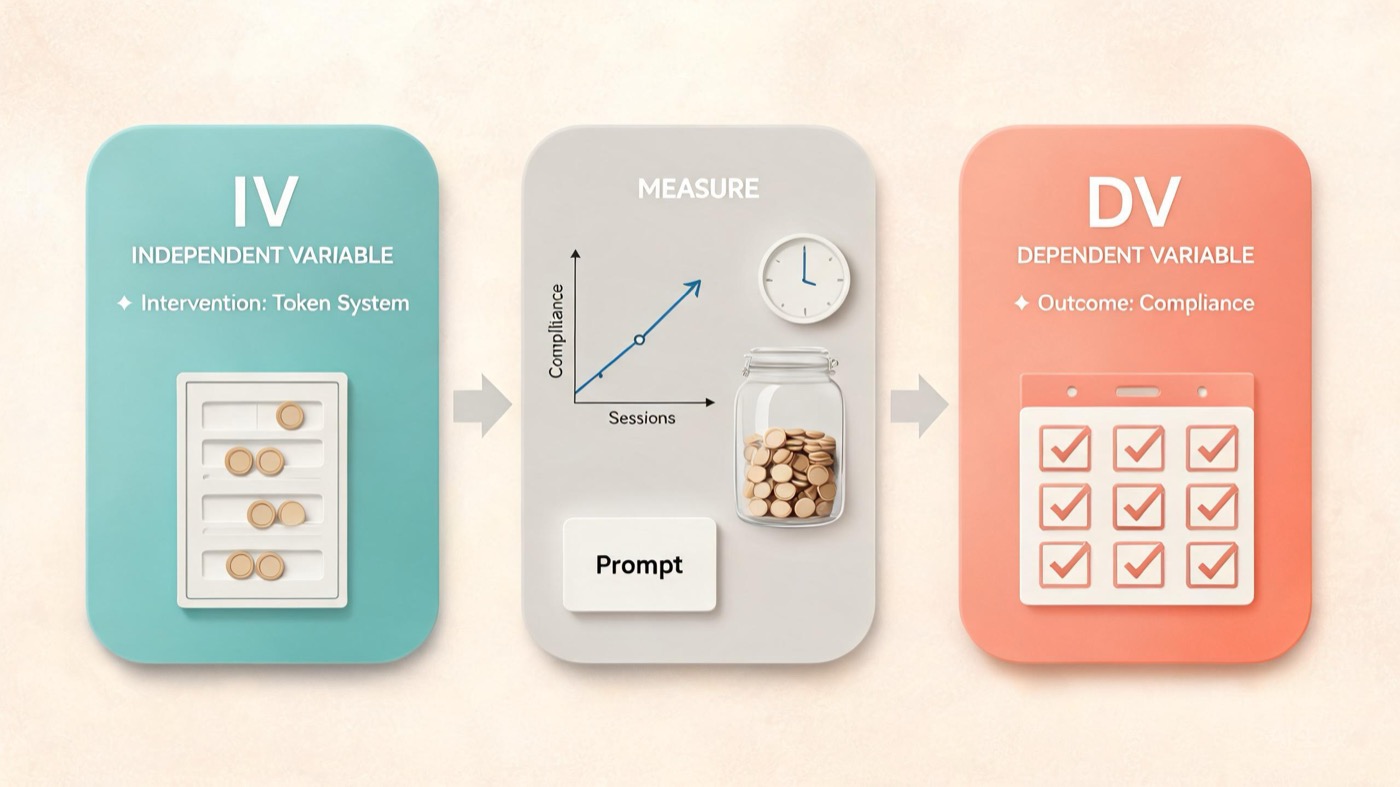
How the BCBA Exam Tests Variable Identification: BCBA exam questions often present a vignette describing a study or intervention. You must select which option represents the IV and which the DV. For example: “A therapist implements a token system (IV) to increase compliance (DV).” Questions may ask you to identify the IV from a list of components or to choose the correct DV measurement. Practice with scenario-based items to build fluency. Common Mistakes to Avoid: Use the points below as a quick study guide.
- Confusing confounding variables: A confound is an unplanned variable that changes along with the IV, not the DV itself. For example, if you run NCR but also change the seating arrangement, seating is a confound.
- Confusing IV with reinforcement: The IV is the entire intervention, not a specific reinforcer. The token system is the IV; tokens are a component.
- Failing to specify measurement of DV: The DV must have a clear measurement dimension (rate, duration, percentage). Vague wording like “compliance” is not a measurable DV.
- Misidentifying the DV in a multi-component intervention: If the IV has several parts, the DV is the behavior you track, not a part of the intervention.
Quick Checklist: Distinguishing IV from DV
- Ask: “What is being manipulated by the practitioner?” That is the IV.
- Ask: “What behavior is being measured to see if it changes?” That is the DV.
- Remember: The IV is the cause; the DV is the effect.
- In a graph, the IV is usually on the x-axis (phases), and the DV is on the y-axis (behavior measure).
- Operationally define both before starting an intervention.
- Check if the DV is socially significant and measurable.
Summary
Mastering the independent variable versus dependent variable is critical for BCBA exam success. The independent variable is the intervention you manipulate; the dependent variable is the behavior you measure. Use clear operational definitions, practice with real examples, and avoid common traps like confounding variables. For more practice, see our BCBA mock exams and additional variable identification resources. A solid grasp of this concept will prepare you for scenario-based questions and help you design effective behavior-change programs.
How to Study independent variable and dependent variable for BCBA-Style Questions
When you review independent variable and dependent variable, do not stop at the definition. The exam usually tests whether you can apply the concept inside a short scenario, separate it from similar terms, and choose the most behaviorally precise answer. A strong study routine should connect the term to observable behavior, environmental context, measurement, and likely consequences.
- Define the response: identify exactly what the learner or client does, not just the broad skill area.
- Find the context: note the antecedent, setting, materials, people, or condition that makes the concept relevant.
- Check the consequence: ask what changes after the response and whether that change supports the answer choice.
- Compare close terms: write one sentence explaining why the best answer is not a related but different ABA concept.
For practice, turn each example into a quick discrimination exercise. Ask, “What would make this answer wrong?” and then change one detail in the scenario. This builds flexible exam reasoning instead of memorizing a single phrase.
How to Study independent variable and dependent variable for BCBA-Style Questions
When you review independent variable and dependent variable, do not stop at the definition. The exam usually tests whether you can apply the concept inside a short scenario, separate it from similar terms, and choose the most behaviorally precise answer. A strong study routine should connect the term to observable behavior, environmental context, measurement, and likely consequences.
- Define the response: identify exactly what the learner or client does, not just the broad skill area.
- Find the context: note the antecedent, setting, materials, people, or condition that makes the concept relevant.
- Check the consequence: ask what changes after the response and whether that change supports the answer choice.
- Compare close terms: write one sentence explaining why the best answer is not a related but different ABA concept.
For practice, turn each example into a quick discrimination exercise. Ask, “What would make this answer wrong?” and then change one detail in the scenario. This builds flexible exam reasoning instead of memorizing a single phrase.
Take the Free BCBA Mock Exam
Ready for more practice? Use the free mock exam to keep testing your accuracy with realistic BCBA-style items. Take the Free BCBA Mock Exam



