

What Is Non Contingent Reinforcement? A Straightforward Definition
Non contingent reinforcement (NCR) is a procedure in which a reinforcer is delivered on a fixed or variable time schedule, completely independent of the learner’s behavior. In other words, the individual receives the reinforcing stimulus whether they engage in the target behavior or not. This breaks the typical contingency between behavior and reinforcement, which is why it is called “non contingent.”
Table of Contents
- What Is Non Contingent Reinforcement? A Straightforward Definition
- How NCR Reduces Problem Behavior: The Mechanism Explained
- Real-World NCR Examples with ABC and Hypothesized Function
- NCR vs. Other Behavioral Interventions: DRA, DRO, and Extinction
- BCBA Exam Relevance: How NCR Is Tested and Common Traps
- Quick Checklist for Applying NCR in Practice and Exam Questions
- Final Summary: What You Need to Remember About NCR
- Quick Review Checklist
- Take the Free BCBA Mock Exam
- References
To understand NCR, it helps to clarify two key terms. A contingency is the relationship between a behavior and its consequence. When reinforcement is contingent, the behavior must occur to produce the reinforcer. When it is non contingent, the delivery is based on time, not on what the person does. This distinction matters for the BCBA exam because many questions hinge on recognizing whether a procedure is truly non contingent or whether it includes other components.
Key Terms You'll Need to Know: Before you apply NCR, you should be comfortable with a few related concepts. Reinforcement is any stimulus that increases the future probability of a behavior when delivered contingent on that behavior. In NCR, reinforcement is delivered without that contingency, so its effect is different. You also need to understand schedule of reinforcement, which describes how often and under what conditions reinforcers are delivered. NCR typically uses a time-based schedule, such as fixed-time (FT) or variable-time (VT), rather than a response-based schedule.
Finally, note that NCR is often combined with extinction. In that case, the reinforcer is still delivered on schedule, but the problem behavior no longer produces it. This combination is common in research and practice. Many BCBA exam questions will expect you to identify the components of an NCR intervention, so keep this in mind.
How NCR Reduces Problem Behavior: The Mechanism Explained
NCR works primarily by reducing the motivation for the problem behavior. When a reinforcer is freely available on a time-based schedule, the individual is less likely to engage in behavior that previously obtained that reinforcer. For example, if a child receives attention every 2 minutes, they have less reason to scream to get attention. This process is tied to the concept of abolishing operations (AOs), which decrease the momentary effectiveness of a reinforcer.
In practice, NCR is a proactive strategy. It prevents the problem behavior from occurring by reducing the establishing operation. This is different from reactive strategies that only address behavior after it happens. Because NCR does not require the learner to emit a specific response, it can be easier to implement consistently than other interventions, especially during initial stages of behavior change.
The Role of Satiation and Abolishing Operations: Satiation occurs when the individual has received enough of a reinforcer that it loses its value temporarily. NCR leverages this by delivering the reinforcer frequently enough to keep the individual in a state of relative satiation for that specific reinforcer. The abolishing operation makes the reinforcer less potent, which in turn weakens the behavior-reinforcer relationship. This is why NCR is particularly effective for behaviors maintained by attention, escape, or access to tangibles.
For example, if a student’s disruptive behavior is maintained by teacher attention, providing attention on a fixed-time schedule (e.g., every 3 minutes) will make teacher attention less valuable. As a result, the student is less motivated to engage in disruptive behavior to get it. The same logic applies to escape-maintained behavior: providing regular breaks can reduce the motivation to escape demands. Understanding this mechanism helps you predict why NCR works and how to adjust parameters.
Real-World NCR Examples with ABC and Hypothesized Function
Seeing NCR in action is the best way to solidify your understanding. Below are three practical examples that show how to apply NCR across different settings and functions. Each example includes an ABC analysis: antecedent, behavior, consequence. Remember that in NCR, the consequence (reinforcer) is delivered regardless of behavior, but we can still describe the typical behavior-consequence relationship that was maintaining the problem behavior before NCR.
Example 1: Attention-Seeking Behavior in a Classroom: Setting: A 7-year-old student frequently calls out during independent work. Hypothesized function: Attention from the teacher. ABC before NCR: Antecedent – independent work; Behavior – calling out; Consequence – teacher reprimands (attention). NCR procedure: The teacher provides positive attention (e.g., praise, thumbs up) every 5 minutes on a fixed-time schedule, regardless of behavior. She also ignores (extinction) any calling out. Outcome: The student’s motivation for attention decreases, and calling out reduces.
Example 2: Escape-Motivated Behavior During Therapy: Setting: A 10-year-old with autism frequently elopes during therapy sessions. Hypothesized function: Escape from demands. ABC before NCR: Antecedent – therapist presents task; Behavior – elopement; Consequence – therapist stops task (escape). NCR procedure: The therapist provides a 2-minute break every 10 minutes on a variable-time schedule, regardless of behavior. Demands are resumed after the break. Outcome: The child is less motivated to escape because breaks are guaranteed. Over time, the schedule is thinned to 15 and then 20 minutes.
Example 3: Tangible-Seeking Behavior in a Clinic: Setting: A 4-year-old frequently tantrums when a preferred toy is removed. Hypothesized function: Access to tangible item. ABC before NCR: Antecedent – toy removed; Behavior – tantrum; Consequence – caregiver gives toy back (access). NCR procedure: The clinician gives the child access to the toy for 30 seconds every 2 minutes on a fixed-time schedule, regardless of behavior. The toy is removed after 30 seconds, then returned again at the next interval. Outcome: Tantrums decrease as the child learns the toy will be available regularly.
NCR vs. Other Behavioral Interventions: DRA, DRO, and Extinction
One of the most common sources of confusion on the BCBA exam is differentiating NCR from other interventions that also involve reinforcement. NCR is often compared to differential reinforcement of alternative behavior (DRA) and differential reinforcement of other behavior (DRO). Knowing the key differences will help you answer scenario-based questions accurately.
Difference Between NCR and DRA: In DRA, you reinforce an alternative, desired behavior that serves the same function as the problem behavior. For example, you might teach a student to raise their hand to get attention, and only reinforce hand-raising. In NCR, you deliver the reinforcer on a time schedule, with no requirement for any specific alternative behavior. The key difference is that NCR is independent of behavior, while DRA is dependent on the occurrence of the alternative response.
Difference Between NCR and DRO: DRO involves delivering reinforcement only if the problem behavior does not occur during a specific interval. For instance, you might give a child a token at the end of a 2-minute interval only if they did not engage in the target behavior during that time. In NCR, the reinforcer is delivered at the end of the interval regardless of whether the behavior occurred. Thus, NCR always delivers the reinforcer, whereas DRO withholds it if the target behavior appears.
Additionally, NCR is sometimes combined with extinction, but they are not the same thing. Extinction involves withholding the reinforcer that previously maintained the behavior. In NCR plus extinction, you continue to deliver the reinforcer on schedule, but you stop reinforcing the problem behavior. This distinction is crucial because many exam questions ask you to identify whether a procedure uses extinction, NCR, or both.
BCBA Exam Relevance: How NCR Is Tested and Common Traps
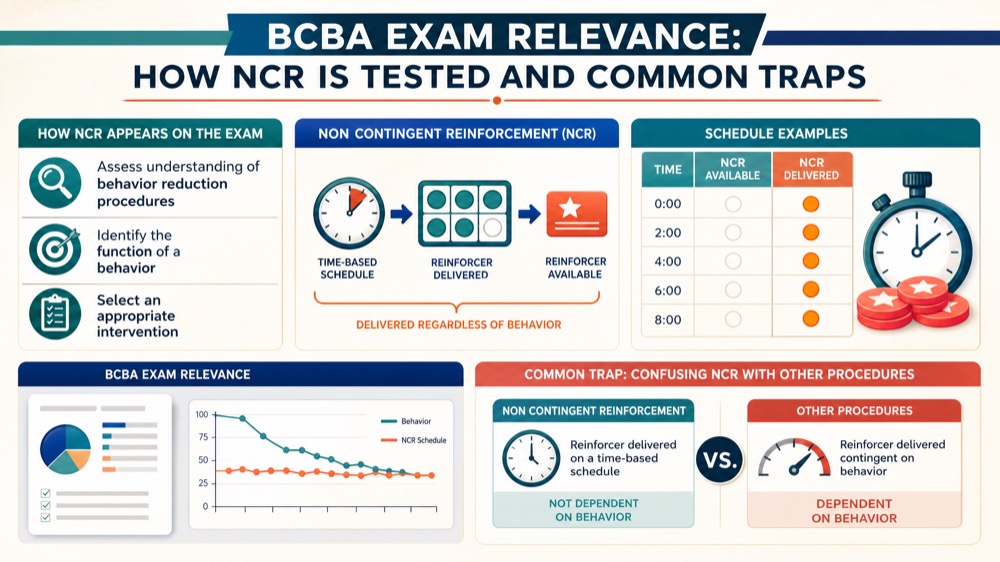
NCR appears on the BCBA exam primarily in questions that assess your understanding of behavior reduction procedures and schedules of reinforcement. You may be asked to identify the function of a behavior, select an appropriate intervention, or describe the components of a treatment package. The exam also tests your ability to differentiate NCR from related concepts such as extinction, DRA, and DRO.
One common trap is confusing NCR with extinction. Remember that extinction withholds reinforcement, while NCR provides it on a non-contingent basis. Another trap is overlooking the schedule parameter. If a question says “reinforcement is delivered every 2 minutes,” that is a fixed-time schedule; if it says “on average every 2 minutes,” it is a variable-time schedule. Being precise about these details can make the difference between a correct and incorrect answer.
Common Exam Traps: Confusing NCR with Extinction: Many students mistakenly think NCR is a form of extinction because both often reduce problem behavior. However, the mechanisms are different. Extinction stops the delivery of the reinforcer after the behavior, while NCR delivers the reinforcer on a time schedule. In some cases, NCR is implemented without extinction, and the problem behavior may still be reinforced occasionally. In practice, NCR is often paired with extinction to maximize effectiveness, but they are distinct procedures.
Schedule Thinning and Practical Considerations: When implementing NCR, you rarely start with a very dense schedule and continue indefinitely. Over time, you will need to thin the schedule to make the intervention more practical and to reduce reliance on frequent reinforcer delivery. Schedule thinning involves gradually increasing the time between reinforcer deliveries. For example, you might start with reinforcement every 2 minutes, then increase to every 5 minutes, then every 10 minutes, and so on. This process should be based on data showing low rates of problem behavior.
Another practical consideration is the choice of reinforcer. The reinforcer must be highly preferred and should match the hypothesized function of the problem behavior. If the behavior is maintained by attention, use attention as the NCR reinforcer. If it is maintained by escape, provide breaks. Using a non-functional reinforcer will not be as effective. Also, monitor the client’s response to NCR; if problem behavior persists, you may need to adjust the schedule or reassess the function.
Quick Checklist for Applying NCR in Practice and Exam Questions
Whether you are implementing NCR in a clinical setting or analyzing an exam scenario, having a clear checklist can keep you on track. The following lists summarize the essential steps and key points to remember. Implementation Checklist
- Identify the function of the problem behavior through FBA or functional analysis.
- Select a reinforcer that matches the function (e.g., attention, escape, tangible).
- Choose an initial schedule (usually a dense schedule, such as every 2–5 minutes).
- Plan for extinction of the problem behavior, if appropriate, while continuing NCR.
- Monitor the behavior and adjust the schedule based on data.
- Thin the schedule gradually to make NCR more practical over time.
Exam Question Checklist
- Look for “free” reinforcement delivered on a time-based schedule, regardless of behavior.
- Check the schedule type: fixed-time (FT) or variable-time (VT).
- Differentiate from DRA/DRO by asking: Is the reinforcer contingent on any behavior?
- Consider the function of the behavior and whether the reinforcer matches it.
- Watch for extinction components – NCR and extinction can be used together, but they are not the same.
Final Summary: What You Need to Remember About NCR
Non contingent reinforcement is a valuable tool in the behavior analyst’s toolbox. It delivers reinforcers on a time-based schedule, independent of behavior, which reduces motivation and helps prevent problem behavior. Understanding the mechanism, differences from DRA/DRO, and practical implementation details will serve you well on the BCBA exam and in your professional practice.
Keep these key points in mind: NCR is not extinction, it requires a functional reinforcer, and schedule thinning is essential. When you see a scenario where a reinforcer is delivered “on a fixed-time schedule,” recognize it as NCR. If you can clearly explain why it works and how to apply it, you are ready to tackle any NCR question. For more exam prep, check out our guide on reinforcement and extinction and schedules of reinforcement.
Quick Review Checklist
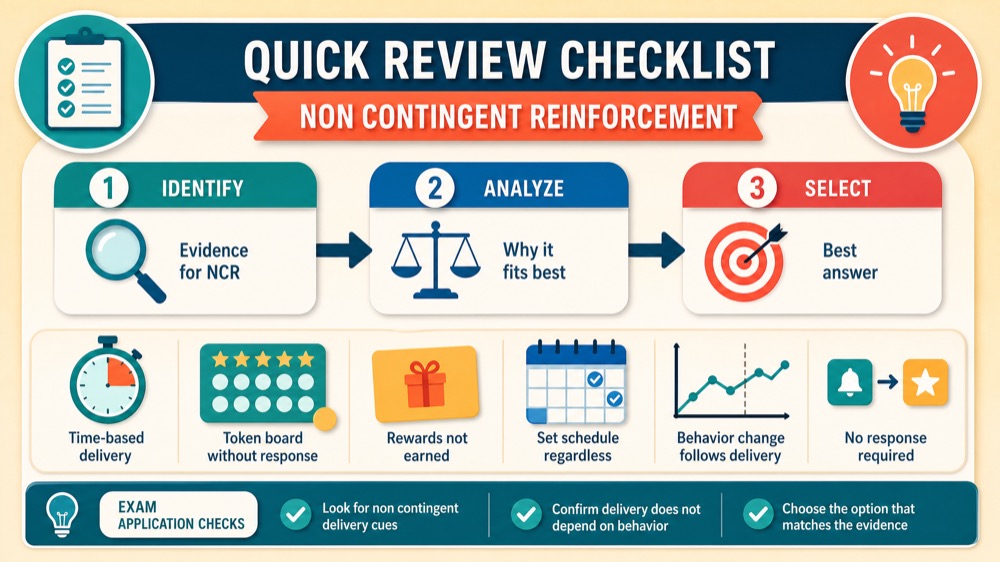
Use this final checklist to turn non contingent reinforcement into exam-ready reasoning. The goal is not to memorize a label in isolation; it is to identify the relevant evidence and explain why the best answer fits the scenario. Key ideas to review:
- State the central definition or decision point for non contingent reinforcement in your own words.
- Identify the detail that makes non contingent reinforcement different from its closest related ABA term.
- Separate the observable facts in a scenario from assumptions that are not supported by the facts.
- Write one example and one nonexample so you can recognize the concept in a new setting.
Exam application checks:
- Ask what the question is actually requesting before comparing the answer choices.
- Mark the antecedent, response, consequence, or other evidence that supports the selected answer.
- Look for a distractor that describes a related process but does not answer the specific question.
Final self-check:
- Explain how you would verify the interpretation with clear observations or data.
- Change one detail in the scenario and decide whether your answer should change.
- Give a one-sentence rationale that a supervisor or study partner could evaluate.
Take the Free BCBA Mock Exam
Ready for more practice? Use the free mock exam to keep testing your accuracy with realistic BCBA-style items. Take the Free BCBA Mock Exam



