
Understanding Punishment in ABA
If you are preparing for the BCBA exam, mastering the difference between positive punishment vs negative punishment is essential. Both are core concepts on the BACB Task List, and exam questions often test your ability to identify which type of punishment is operating in a given scenario. This guide breaks down each type with clear definitions, practical examples, and common traps to watch for.
Practice this concept
Table of Contents
- Understanding Punishment in ABA
- Defining Punishment in ABA
- Positive Punishment: Adding an Aversive Stimulus
- Negative Punishment: Removing a Desired Stimulus
- Positive vs Negative Punishment: Key Differences
- Exam Relevance and Common Traps
- Quick Checklist for Test Day
- Summary
- References
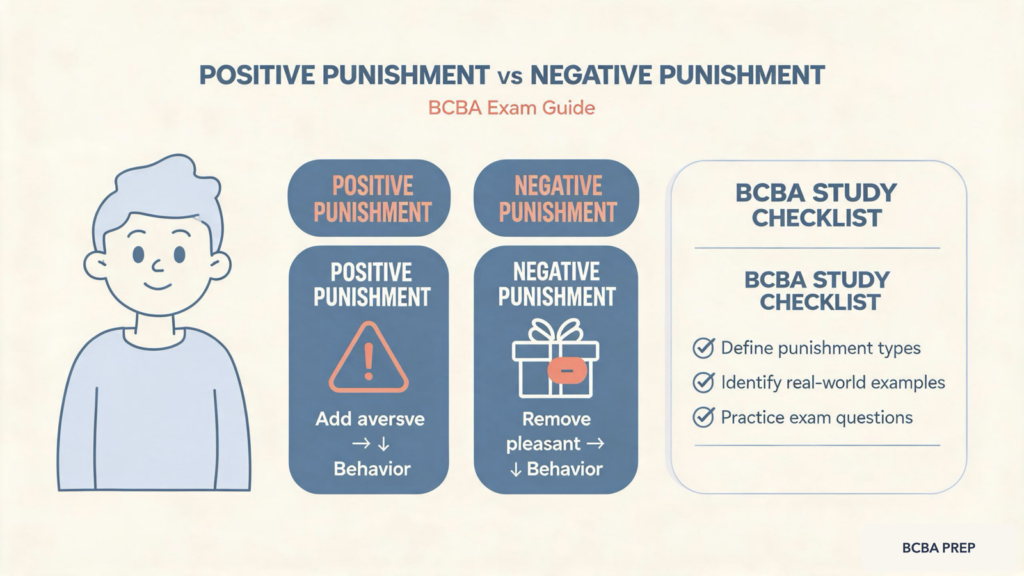
Punishment in ABA is defined by its effect on behavior: it reduces the future probability of a behavior. It is not about being punitive; it is simply a functional relation. There are two types: positive punishment (adding an aversive stimulus) and negative punishment (removing a desired stimulus). The key to telling them apart lies in whether something is added or removed after the behavior.
Defining Punishment in ABA
According to Cooper, Heron, and Heward, punishment is a consequence that decreases the future frequency of a behavior. It only qualifies as punishment if the behavior actually decreases. This is a functional definition, not a topographical one. A consequence that seems aversive to you may not punish the behavior; you must see the data.
How Punishment Differs from Reinforcement
- Reinforcement increases behavior; punishment decreases behavior.
- Both are defined by their effect, not by the stimulus itself.
- Extinction stops reinforcement for a previously reinforced behavior; it is not punishment because no stimulus is added or removed (only withheld).
Positive Punishment: Adding an Aversive Stimulus
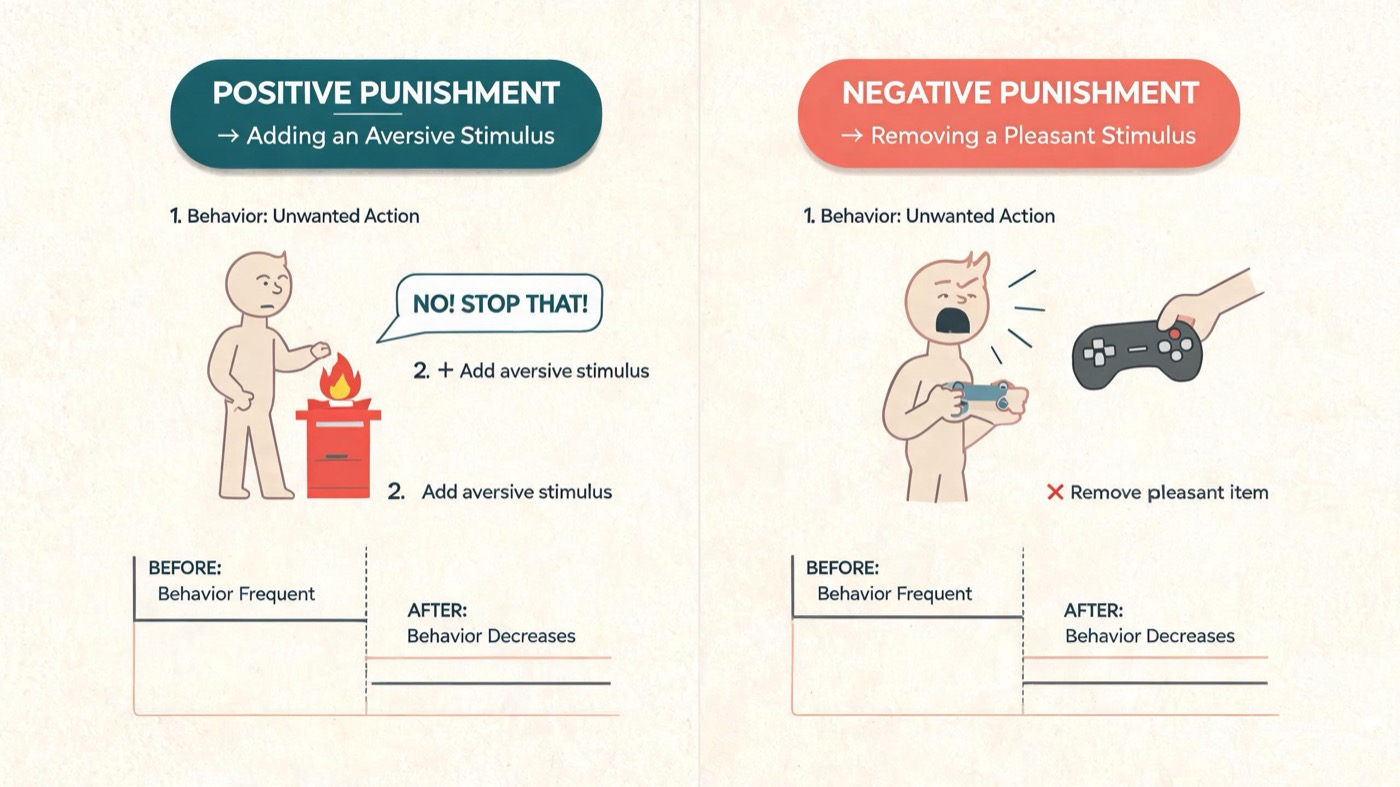
Positive punishment occurs when a behavior is followed by the presentation of an aversive stimulus, resulting in a decrease in that behavior. The word positive simply means adding something. Examples include a reprimand, a spank, or adding extra chores.
ABA Example of Positive Punishment
Consider a child who whines for a toy at the store. The parent yells at the child, and the whining decreases in the future. The ABC is:
- Antecedent: Child sees toy and whines.
- Behavior: Child whines.
- Consequence: Parent yells (aversive stimulus is added).
- Effect: Whining decreases in similar situations.
Note that if the yelling actually increased whining, it would be positive reinforcement (attention added). Always check the effect on behavior. Another common example: a client makes a loud noise, and the therapist applies a gentle response blocking (adding physical contact). If the loud noise decreases, it is positive punishment.
Negative Punishment: Removing a Desired Stimulus
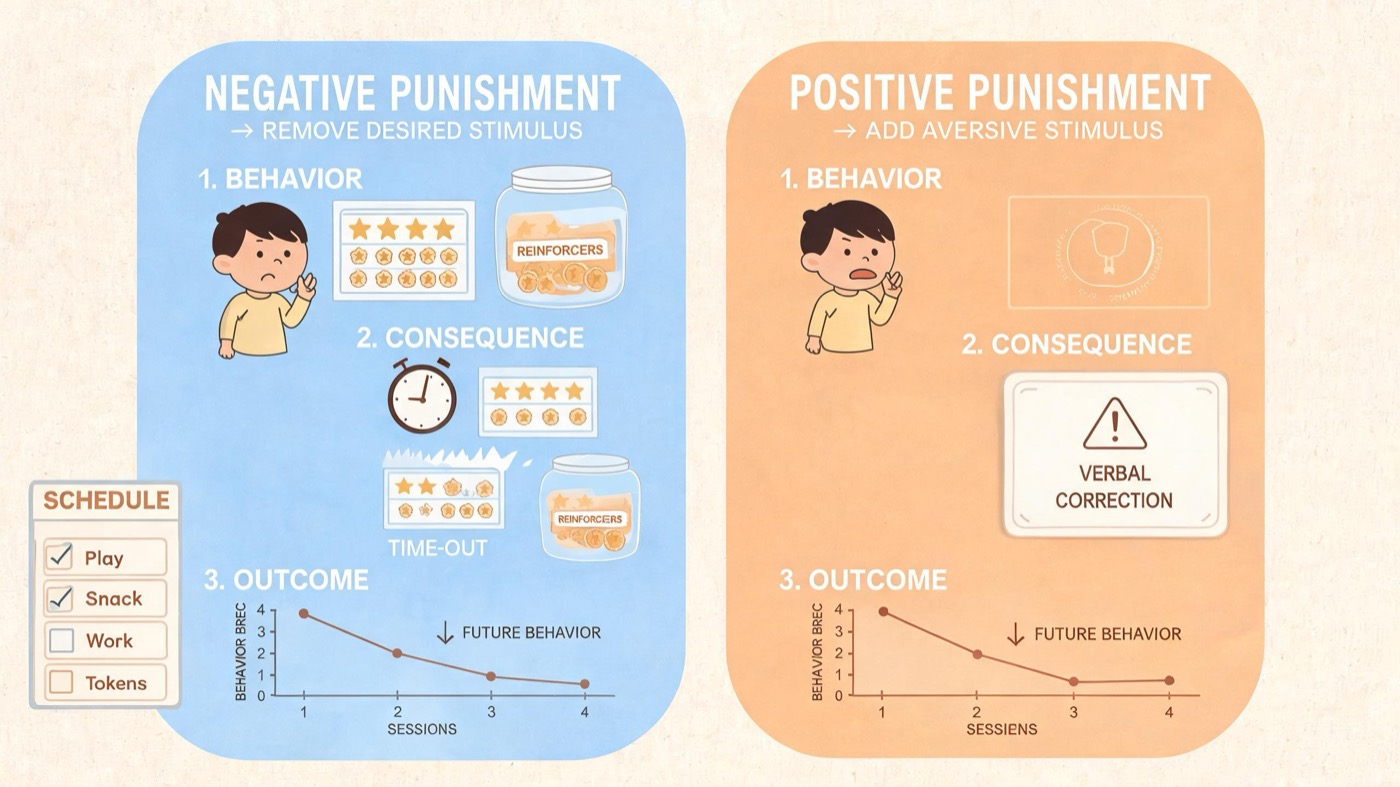
Negative punishment involves removing a desired stimulus after a behavior, which reduces the future occurrence of that behavior. The word negative means removing something. Common forms include time-out (removing access to reinforcement) and response cost (removing tokens or privileges).
ABA Example of Negative Punishment
A child hits a sibling while playing. The parent immediately removes the child’s favorite toy for 5 minutes (time-out from positive reinforcement). The hitting decreases over time. The ABC is:
- Antecedent: Child is playing with toy near sibling.
- Behavior: Child hits sibling.
- Consequence: Toy removed (desired stimulus removed).
- Effect: Hitting decreases.
Another example: a student does not complete homework, so the teacher deducts 5 minutes of recess (response cost). If homework completion increases, this is not punishment; it is negative reinforcement (avoiding loss of recess). Always confirm behavior reduction, not increase.
Positive vs Negative Punishment: Key Differences
The critical distinction is whether a stimulus is added (positive punishment) or removed (negative punishment). Table below summarizes:
- Positive punishment: Add aversive stimulus → behavior decreases.
- Negative punishment: Remove desired stimulus → behavior decreases.
- Both require the behavior to actually decrease.
How to Tell Them Apart on Exam Questions
When you read a vignette, ask: What changed in the environment after the behavior? If something new appeared (e.g., parent yelled, added chore), it is positive punishment. If something was taken away (e.g., removed toy, lost token), it is negative punishment. Be careful not to confuse negative punishment with negative reinforcement (which increases behavior). For example, turning off an alarm (removing aversive) increases the behavior of pressing the snooze button — that is negative reinforcement, not punishment.
Exam Relevance and Common Traps
The BCBA exam frequently includes questions that ask you to identify the contingency. Here are traps to avoid:
Misidentifying Punishment Contingencies
- Trap 1: Confusing negative punishment with extinction. Extinction does not remove a stimulus that was already present; it simply withholds reinforcement. Example: ignoring a child’s whine (no stimulus added/removed).
- Trap 2: Thinking ‘positive’ means good and ‘negative’ means bad. In ABA, positive just means adding, negative means removing.
- Trap 3: Ignoring the effect on behavior. A consequence is only punishment if behavior decreases. If the behavior does not change or increases, it is not punishment.
- Trap 4: Mislabeling negative reinforcement as negative punishment. Remember: reinforcement increases behavior; punishment decreases it.
Quick Checklist for Test Day
- Identify the target behavior.
- Note what happened right after the behavior.
- Determine if something was added (positive) or removed (negative).
- Check the effect: did the behavior decrease? If yes, it is punishment.
- Verify it is not negative reinforcement (behavior increases) or extinction (nothing removed).
Summary
Understanding the difference between positive and negative punishment is critical for BCBA success. Remember: positive punishment adds an aversive stimulus, while negative punishment removes a desired stimulus. Both reduce behavior. Practice applying these concepts with real scenarios and watch out for common exam traps. For additional practice, take our free BCBA mock exam.



