
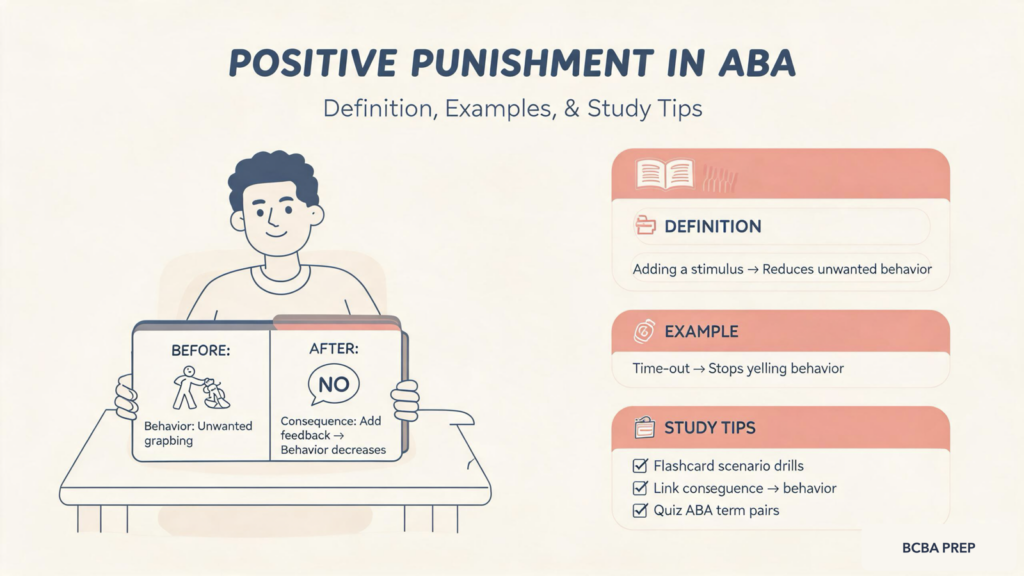
What Is Positive Punishment? A Clear Definition for BCBA Candidates
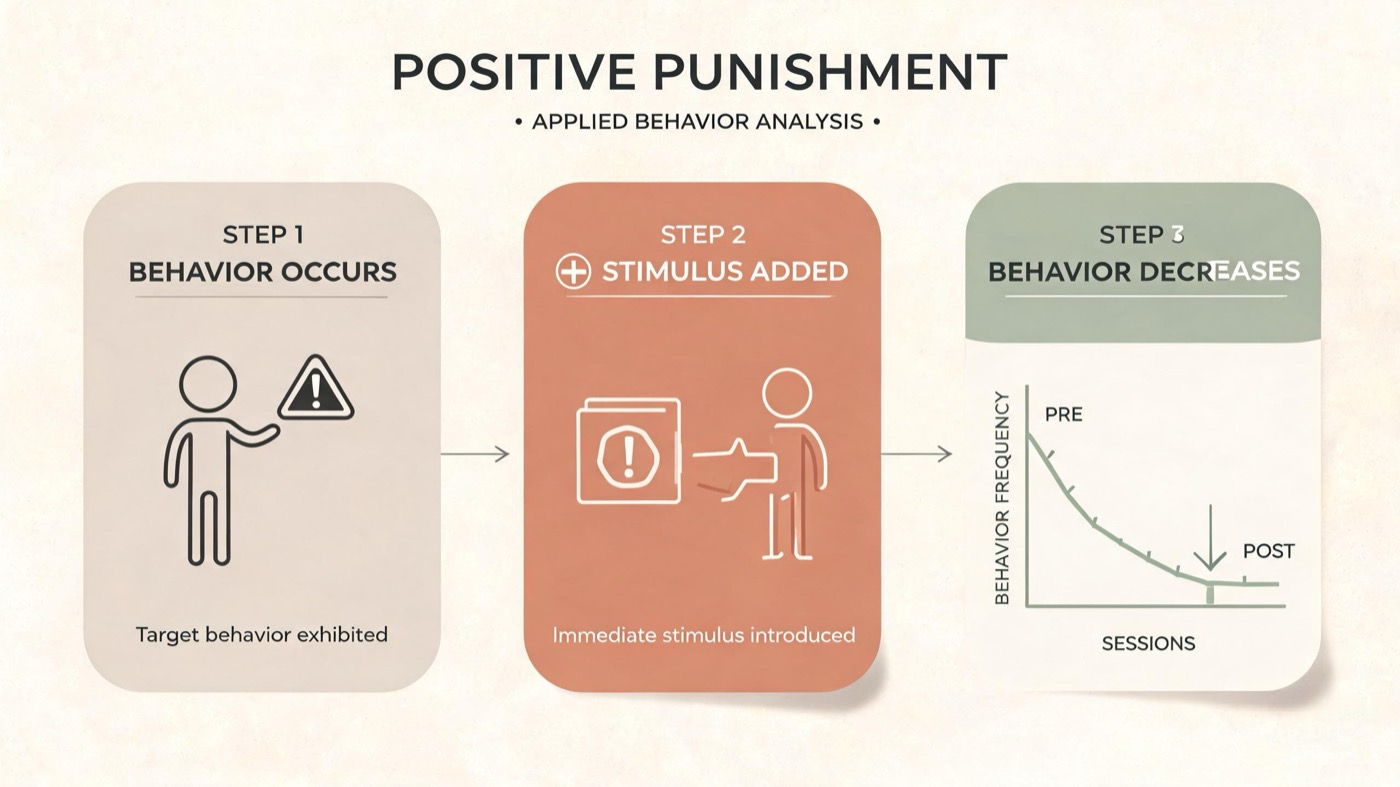
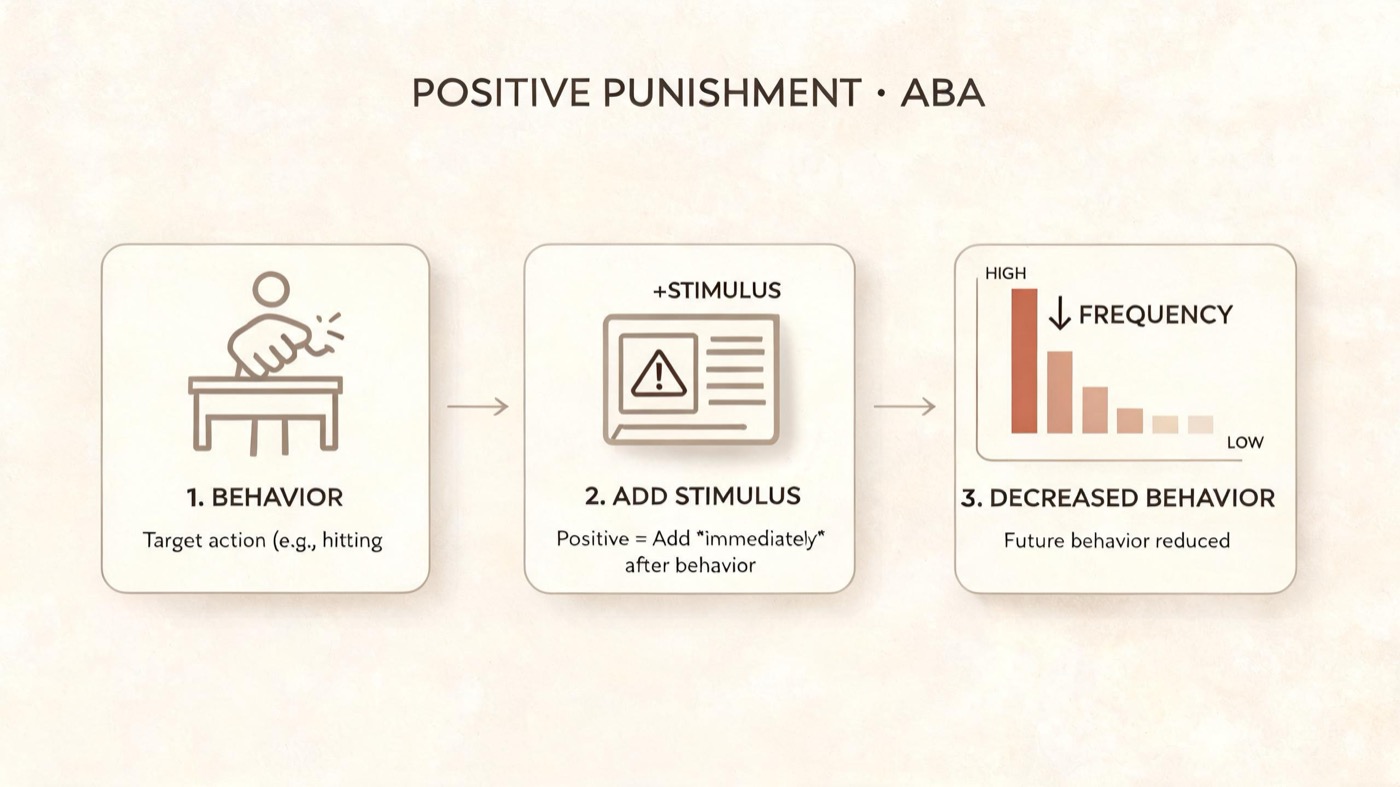
In applied behavior analysis, positive punishment is a behavior-change procedure in which a stimulus is added immediately after a behavior, resulting in a decrease in the future frequency of that behavior. The term ‘positive’ refers to the addition of a stimulus, not to the idea that it is good or pleasant. For BCBA candidates, understanding this definition precisely is critical because many exam questions hinge on discriminating between punishment and reinforcement, and between positive and negative procedures.
Table of Contents
- What Is Positive Punishment? A Clear Definition for BCBA Candidates
- Positive Punishment vs. Negative Punishment: Key Differences
- ABA Examples of Positive Punishment with ABC Analysis
- Exam Relevance and Common Traps
- Quick Checklist for Positive Punishment
- Summary: Mastering Positive Punishment for the BCBA Exam
For example, if a child touches a hot stove (behavior) and feels pain (added stimulus), the child is less likely to touch the stove again. That is positive punishment. The added stimulus (pain) suppresses the behavior. It is important to note that positive punishment is sometimes called type 1 punishment in the literature. The key is that something is presented following the behavior, and the behavior decreases.
On the BCBA exam, you may be asked to identify positive punishment from a vignette. Look for language indicating that a consequence was added (e.g., ‘gave a reprimand,’ ‘provided a cold spray,’ ‘presented a loud noise’) and that the behavior decreased. If the behavior increases, it is reinforcement. Always check the effect on the behavior first.
Positive Punishment vs. Negative Punishment: Key Differences
Both positive and negative punishment aim to decrease behavior, but they differ in how the consequence is applied. Positive punishment involves adding an aversive stimulus, while negative punishment involves removing a reinforcing stimulus. This distinction is a common source of confusion on the BCBA exam.
Comparing Positive and Negative Punishment
- Positive punishment: Add something undesirable → behavior decreases. Example: A teacher reprimands a student for talking out of turn.
- Negative punishment: Remove something desirable → behavior decreases. Example: A child loses screen time for yelling.
- Memory aid: Think of the sign (+ or -) as the operation on the environment: + means add, – means remove.
- Common exam question: ‘Which procedure is being used?’ Look for whether a stimulus was presented (positive) or withdrawn (negative).
Common Misconceptions in Exam Questions
One major trap is confusing positive punishment with negative reinforcement. Both involve aversive stimuli, but their effects are opposite. Negative reinforcement increases behavior by removing an aversive stimulus after the behavior occurs. For example, taking aspirin to remove a headache is negative reinforcement (behavior of taking aspirin increases). Positive punishment, however, decreases behavior. Another common mix-up is between positive punishment and extinction. Extinction involves withholding reinforcement, not adding an aversive stimulus. Always ask: ‘Is a stimulus being added? Is the behavior decreasing?’ If yes, it is positive punishment.
ABA Examples of Positive Punishment with ABC Analysis
Understanding positive punishment through concrete ABC (Antecedent-Behavior-Consequence) examples can solidify your ability to identify and apply the concept. Here are two realistic scenarios with hypothesized functions.
Example 1: Child Touching a Hot Stove
Antecedent: Stove burner is red and hot; parent says ‘Don’t touch.’
Behavior: Child touches the burner.
Consequence: Child feels immediate pain (burn) – an aversive stimulus is added.
Hypothesized function: Sensory? The pain is naturally punishing. The behavior likely decreases after one or two occurrences. This is a classic example of positive punishment occurring without deliberate intervention.
Example 2: Student Talks Out of Turn
Antecedent: Teacher is delivering a lesson; peer is speaking.
Behavior: Student interrupts loudly.
Consequence: Teacher gives a stern verbal reprimand (e.g., ‘Stop interrupting!’).
Hypothesized function: Attention? The reprimand may serve as positive punishment if it decreases future interruptions. However, if the student finds the reprimand reinforcing (odd as it may sound), the behavior might increase. BCBA exam questions often test this nuance: the same consequence can function differently for different individuals.
Example 3: Dog Jumps on Visitors
Antecedent: Doorbell rings; visitor enters.
Behavior: Dog jumps up on visitor.
Consequence: Owner sprays dog with a quick burst of water from a spray bottle (aversive stimulus added).
Hypothesized function: Positive punishment via presentation of an aversive stimulus. The jumping behavior should decrease over time if the spray is consistently applied.
Exam Relevance and Common Traps
The BCBA exam frequently tests your ability to identify positive punishment in vignettes and to distinguish it from other procedures. Understanding common traps can save you points.
How the BCBA Exam Tests Positive Punishment
- Identify the procedure: You may be given an ABC description and asked which behavior-change procedure is being used. Look for ‘added consequence’ and ‘decrease in behavior.’
- Distinguish from extinction: Extinction involves no consequence (withholding reinforcement), while positive punishment involves presenting an aversive stimulus.
- Consider automatic reinforcement: Some behaviors are maintained by automatic reinforcement (e.g., sensory stimulation). Punishment may still be effective, but ethical considerations are paramount.
- Ethical use: The BACB ethics code requires that punishment be used only after reinforcement-based procedures have failed and with proper safeguards. Be aware of this when answering ethical scenario questions.
Avoiding Traps: Positive Punishment vs. Negative Reinforcement
The most common trap is confusing positive punishment with negative reinforcement. Both involve aversive stimuli, but the effect on behavior is opposite. Use this checklist:
- Is the behavior increasing? → Likely reinforcement (positive or negative).
- Is the behavior decreasing? → Likely punishment (positive or negative).
- What is the consequence? Added stimulus (positive) or removed stimulus (negative)?
Quick Checklist for Positive Punishment
Use this scannable checklist to review key points before your exam:
- ☐ Definition: A stimulus is added after a behavior, and the behavior decreases.
- ☐ Memory aid: Positive = add; punishment = decrease.
- ☐ Distinguish from negative punishment: Negative = remove a reinforcer.
- ☐ Distinguish from negative reinforcement: Reinforcement = increase; punishment = decrease.
- ☐ Distinguish from extinction: Extinction = no consequence; punishment = aversive consequence.
- ☐ Ethical caution: Use only after reinforcement-based strategies, with informed consent, and monitor for side effects (e.g., aggression, escape behaviors).
- ☐ Exam tip: Always check the behavior trend (increase or decrease) before deciding on the procedure.
Summary: Mastering Positive Punishment for the BCBA Exam
Positive punishment is a core concept in ABA that you must understand thoroughly for the BCBA exam. Remember: positive means adding a stimulus, punishment means decreasing behavior. Use the ABC analysis to identify positive punishment in vignettes: look for an added consequence that suppresses behavior. Distinguish it clearly from negative punishment, negative reinforcement, and extinction. Practice with mock exam questions to solidify your skills. For more practice, explore our free BCBA mock exam practice questions and review our guide on punishment in ABA ethics and side effects. Also check the official BACB Ethics Code for ethical guidelines on punishment procedures.
Complete BCBA Exam Prep
Turn this topic into exam-day practice
Practice concepts in context with five full-length 6th Edition mock exams, two bonus practice exams, a 6th Edition study guide, and key-term flashcards—all in one $120 USD package.
Get the $120 All-in-One Prep Pack
Review everything included on the product page before ordering. No pass guarantee is implied.



