
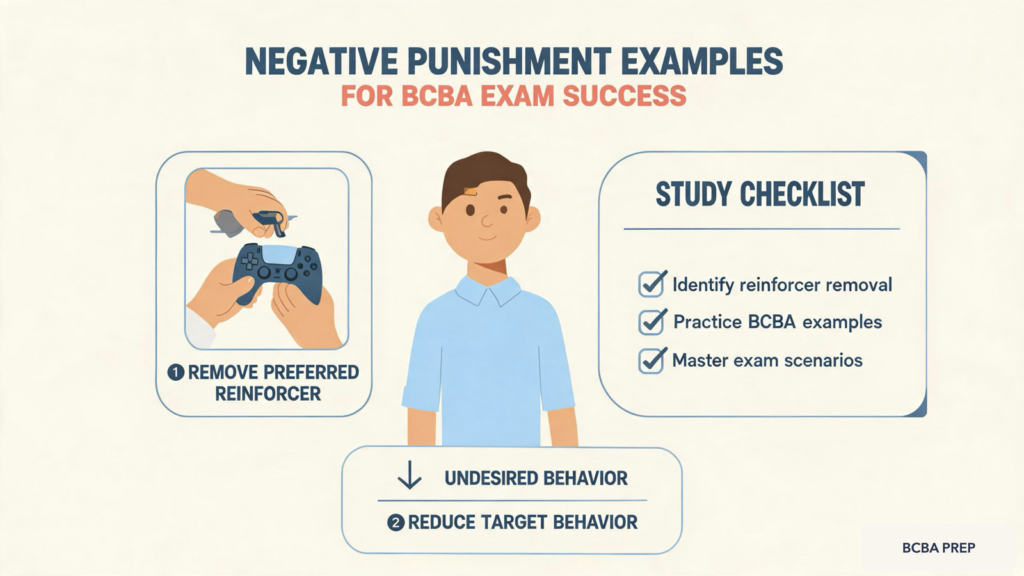
What Is Negative Punishment? Definition and Key Features
Negative punishment is a behavioral procedure in which a reinforcing stimulus is removed immediately after a behavior occurs, resulting in a decrease in the future frequency of that behavior. The key is that something the individual values is taken away contingent on the problem behavior. This contrasts with positive punishment, where an aversive stimulus is added. Understanding the distinction is critical for the BCBA exam.
Table of Contents
- What Is Negative Punishment? Definition and Key Features
- Negative Punishment Examples in ABA (With ABC Analysis)
- Exam Relevance: How Negative Punishment Questions Appear on the BCBA
- Negative Punishment Quick Checklist for Exam Day
- Summary: Key Takeaways for Negative Punishment
- References
Negative Punishment vs. Extinction: A Common Exam Mistake
Many candidates confuse negative punishment with extinction. In negative punishment, a reinforcer is removed as a consequence of the behavior. In extinction, the reinforcer that previously maintained the behavior is discontinued, but no other stimulus is removed. For example, ignoring a child’s tantrum (extinction) is different from removing a preferred toy after a tantrum (negative punishment). Always check whether the consequence involves removing a known reinforcer contingent on the behavior. Another nuance: if the consequence involves removing the individual from the reinforcing environment (e.g., time-out from all sources of reinforcement), that is negative punishment if the environment itself was reinforcing. In contrast, extinction might involve withholding the specific reinforcer that was maintaining the behavior (e.g., not giving attention for a tantrum). A quick way to differentiate on the exam is to ask: “Was a stimulus removed (negative punishment) or was the usual reinforcer simply not delivered (extinction)?” This distinction frequently appears in scenario questions, so ensure you can spot the difference.
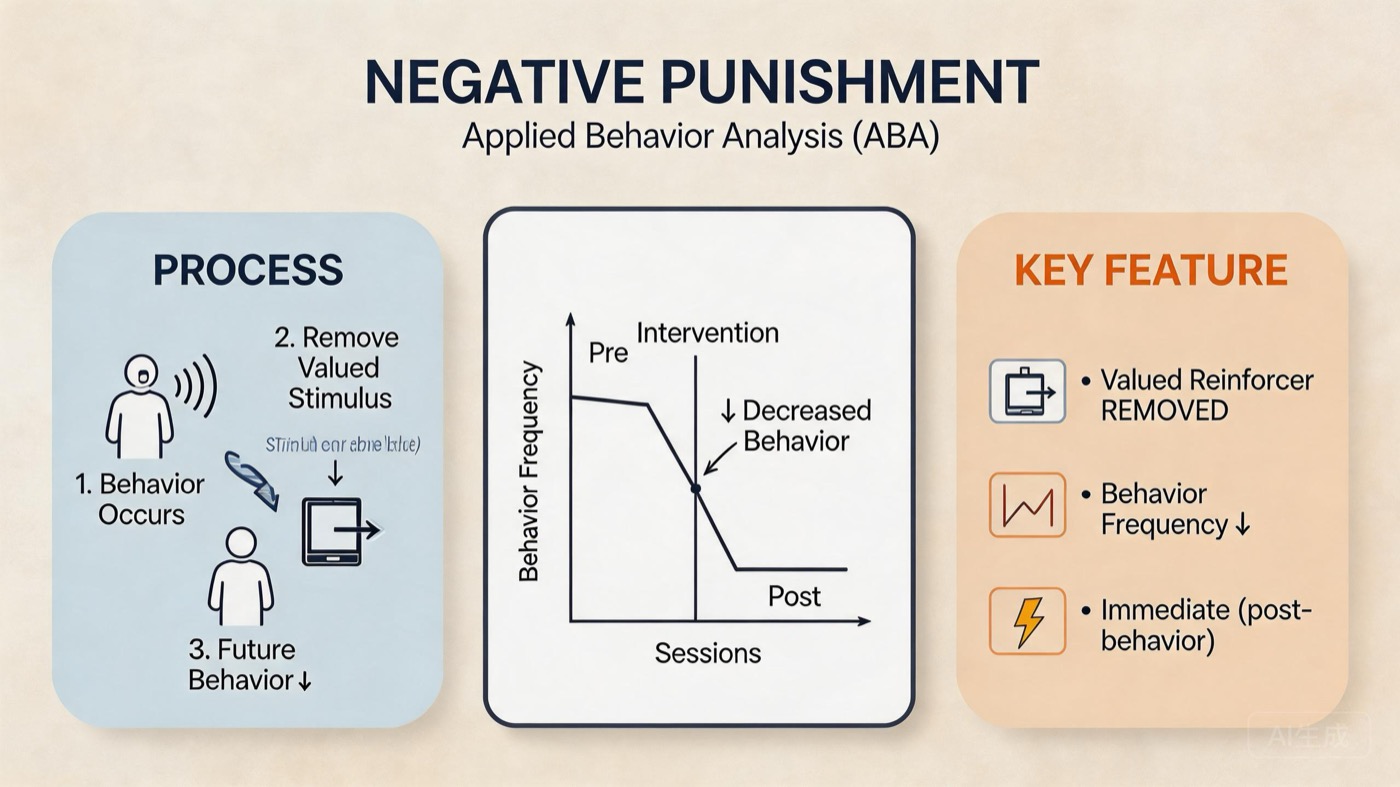
Negative Punishment Examples in ABA (With ABC Analysis)
Let’s examine three practical examples using the ABC (Antecedent-Behavior-Consequence) framework. Each example includes a hypothesized function to help you think like a BCBA. Understanding the function is crucial because the effectiveness of negative punishment depends on whether the removed stimulus actually serves as a reinforcer for that individual. For example, if a child loves blocks, removing blocks after hitting will likely punish hitting. But if blocks are neutral, removing them may have no effect.
Example 1: Time-Out from Preferred Activity
- Antecedent: Child is playing with blocks; peer joins.
- Behavior: Child hits peer.
- Consequence: Teacher removes access to blocks for 2 minutes (time-out).
- Hypothesized function: The hitting may have been maintained by attention; the consequence (removing toys) does not address the attention function directly but does function as a punisher if the child finds block play reinforcing. Over time, hitting decreases.
Example 2: Response Cost – Loss of Tokens
- Antecedent: Classroom instruction; student given task demands.
- Behavior: Student talks out without permission.
- Consequence: Student loses one token from their token board (response cost).
- Hypothesized function: The talking out may serve to escape task demands. Losing tokens (a conditioned reinforcer) punishes the talking-out behavior, leading to a reduction. Note that response cost is a form of negative punishment because the removal of the token (a reinforcer) is contingent on the behavior. On the exam, response cost is often paired with token economies, so watch for scenarios where tokens are subtracted.
Example 3: Loss of Privileges for Aggression
- Antecedent: Parent asks teenager to do chores.
- Behavior: Teenager swears at parent.
- Consequence: Parent removes video game privileges for the evening.
- Hypothesized function: The swearing may function to avoid chores. Losing video game time (a high-preference reinforcer) reduces future swearing. This example highlights the importance of identifying individualized reinforcers: if the teenager does not value video games, removal would not be punishing. Always consider the individual’s preference hierarchy.
For more practice with punishment procedures, check out our detailed guide on negative punishment in ABA.
Exam Relevance: How Negative Punishment Questions Appear on the BCBA
On the BCBA exam, you will see scenario-based questions asking you to identify the procedure (e.g., negative punishment, positive punishment, extinction) or to determine the function of the behavior. Common traps include confusing negative punishment with extinction or forgetting that the removed stimulus must be a reinforcer. For more exam strategies, read our BCBA exam prep guide.
Common Exam Traps to Avoid
- Confusing negative punishment with extinction – remember: removal of a reinforcer vs. discontinuation of reinforcement.
- Forgetting that the removed stimulus must be a reinforcer for the individual – if it is not valued, no punishment occurs.
- Overlooking the function of the behavior – the same procedure can have different effects depending on the function. For instance, removing a task may actually reinforce escape-maintained behavior if the task was aversive.
- Assuming time-out and response cost are identical – time-out removes access to reinforcing environment; response cost removes earned tokens or privileges. Both are negative punishment but differ in implementation.
Practice Prompts for Self-Testing
- A teacher removes a student’s free time after he yells. Identify the procedure. (Answer: Negative punishment – removal of free time contingent on yelling.)
- Is removing a non-preferred activity punishment? Why or why not? (Answer: No, because the stimulus removed is not a reinforcer; it may actually increase the behavior if the activity is aversive.)
- What is the hypothesized function in a response-cost scenario where a client loses tokens for self-injury? (Answer: The self-injury may be maintained by escape from demands; losing tokens reduces that behavior if tokens are a powerful reinforcer.)
- A child whines and a parent stops giving attention. Is this negative punishment or extinction? (Answer: Extinction, because attention was the reinforcer maintaining whining and it is now withheld, not removed.)
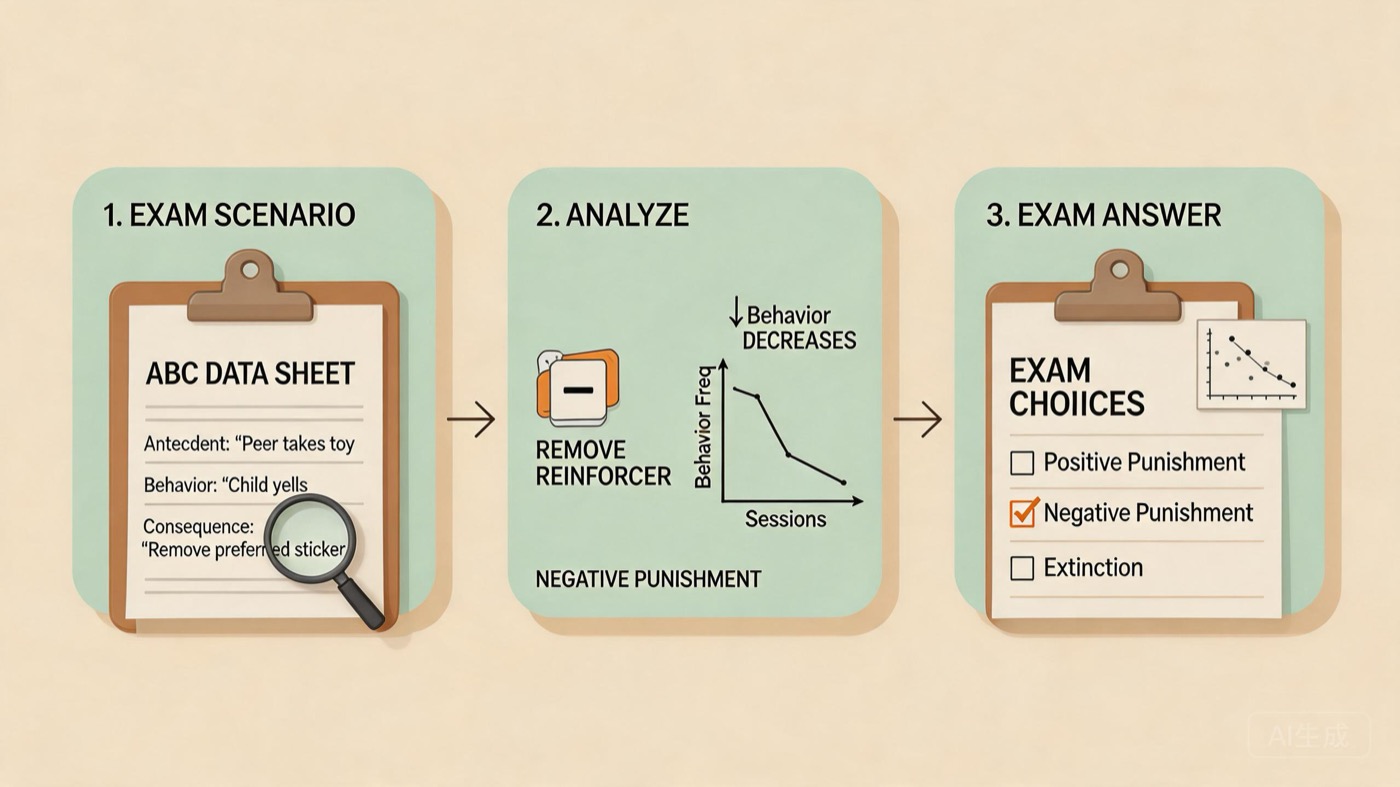
Negative Punishment Quick Checklist for Exam Day
Use this checklist to quickly evaluate whether a scenario involves negative punishment:
- Behavior: Is the target behavior identified and measurable?
- Consequence: Is a stimulus removed immediately after the behavior?
- Reinforcing nature: Is the removed stimulus a known reinforcer for the individual?
- Effect: Does the behavior decrease over time?
- Alternative procedures: Could it be extinction (no removal of reinforcer) or positive punishment (addition of aversive)?
For a broader review, see our article on punishment in ABA.
Summary: Key Takeaways for Negative Punishment
Negative punishment is a core behavioral principle that involves the removal of a reinforcing stimulus to decrease behavior. Effective use requires identifying the specific reinforcer maintaining the behavior and ensuring its removal is contingent and immediate. On the BCBA exam, focus on distinguishing negative punishment from extinction and understanding the function behind the behavior. Use the examples and checklist above to solidify your understanding. Remember that negative punishment can be an effective intervention when used ethically and as part of a comprehensive behavior reduction plan. Always consider the individual’s rights and the least restrictive alternative.



