
BCBA Negative Reinforcement Practice Questions & Exam Tips
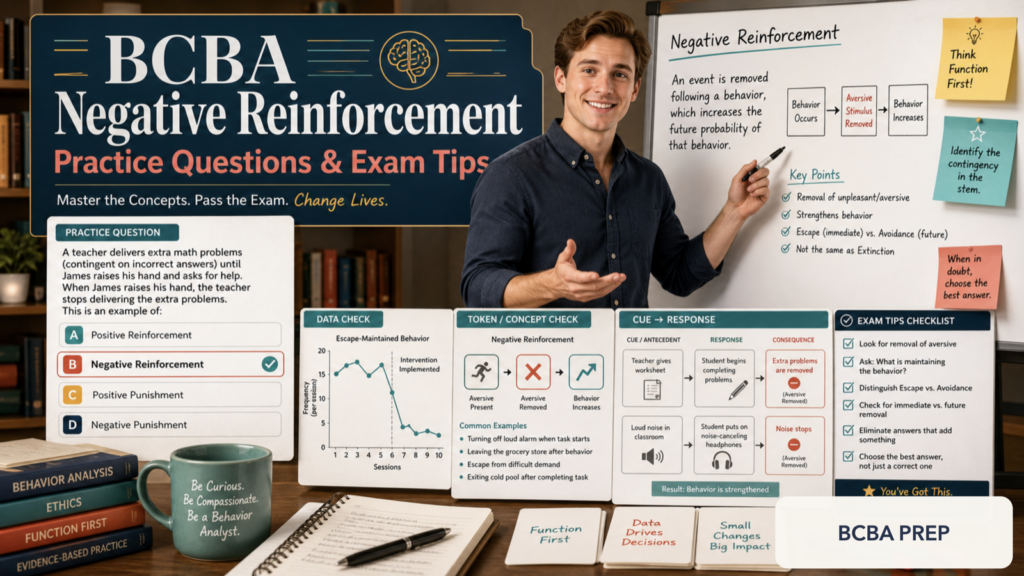
Negative reinforcement is a core concept on the BCBA exam. These practice questions test your ability to identify negative reinforcement in real-world scenarios. Each question includes an answer explanation and common exam traps.
Table of Contents
- BCBA Negative Reinforcement Practice Questions & Exam Tips
- 5 Scenario-Based Negative Reinforcement Practice Questions
- Common Exam Traps on Negative Reinforcement
- Negative Reinforcement Exam Checklist
- Ready for More? Get Your Free BCBA Mock Exam
- FAQ: Negative Reinforcement on the BCBA Exam
- References
Use these questions to sharpen your skills. After the quiz, check our test-taking checklist and download a free BCBA mock exam.

5 Scenario-Based Negative Reinforcement Practice Questions
Read each scenario carefully. Select the option that best describes negative reinforcement.
Question 1:
Scenario: A student complains of a headache every time math class starts. The teacher sends the student to the nurse. Over time, the student complains of headaches more frequently at the start of math class.
Prompt: What is the negative reinforcement contingency?
- A. The teacher’s removal of the math task reinforces the complaint behavior.
- B. The student’s headache is reinforced by attention from the nurse.
- C. The student is escaping the math class, which reinforces the complaint behavior.
- D. The teacher is positively reinforced by the student leaving.
Correct Answer: C
Why This Answer Is Correct: The student’s complaint is followed by removal from math class (aversive stimulus), which increases future complaints. This is negative reinforcement: behavior is strengthened by escape.
Why the Other Options Are Wrong:
- A describes the teacher’s behavior, not the student’s. The question asks about the student’s negative reinforcement.
- B confuses positive reinforcement (attention) with negative reinforcement.
- D incorrectly focuses on the teacher’s reinforcement, not the student’s.
Exam Trap: Don’t mistake the removal of an aversive stimulus (negative reinforcement) with a punishing consequence. Here, the behavior increases, so it’s reinforcement.
Question 2:
Scenario: A child cries when asked to clean up toys. The parent stops asking and cleans up the toys themselves. The child’s crying increases in future clean-up situations.
Prompt: Which behavior is being negatively reinforced?
- A. The parent’s behavior of cleaning up.
- B. The child’s crying behavior.
- C. The child’s compliance with clean-up.
- D. The parent’s request behavior.
Correct Answer: B
Why This Answer Is Correct: Crying results in removal of the clean-up demand (aversive). The child escapes the demand, strengthening crying.
Why the Other Options Are Wrong:
- A: Parent’s cleanup is negatively reinforced by escape from the child’s crying, but the question asks what is reinforced in the child’s behavior.
- C: Compliance is not occurring; the child is not cleaning up.
- D: Parent’s request is not reinforced; it is followed by noncompliance.
Exam Trap: Focus on the behavior that increases. Here, crying increases. The consequence is removal of demand, so it’s negative reinforcement.
Question 3:
Scenario: A teenager nags their parent to borrow the car. To stop the nagging, the parent gives in and allows the car use. The nagging becomes more frequent.
Prompt: What is the negative reinforcement contingency?
- A. The teenager receives the car (positive reinforcement).
- B. The parent’s behavior of giving in is negatively reinforced by stopping the nagging.
- C. The teenager’s nagging is negatively reinforced by the parent giving in.
- D. The parent is positively reinforced by the teenager’s quietness.
Correct Answer: B
Why This Answer Is Correct: The parent gives in (behavior) and the nagging stops (removal of aversive stimulus). This increases the parent’s future giving-in behavior. The question is ambiguous, but typical BCBA questions ask for the contingency on the behavior that is strengthened. Here the parent’s behavior is reinforced by escape from nagging.
Why the Other Options Are Wrong:
- A: The teenager receives the car, which is positive reinforcement for the teenager, but the question says ‘negative reinforcement contingency’ and doesn’t specify whose behavior.
- C: The teenager’s nagging is positively reinforced by receiving the car, not negatively.
- D: The parent’s behavior is negatively reinforced, not positively.
Exam Trap: Notice the distinction: the parent’s behavior is negatively reinforced (escape), while the teen’s behavior is positively reinforced (access). Read the question carefully.
Question 4:
Scenario: A person with OCD touches a doorknob and feels contaminated. They wash their hands repeatedly until the feeling goes away. The washing behavior increases over time.
Prompt: What maintains the hand-washing behavior?
- A. Positive reinforcement in the form of clean hands.
- B. Negative reinforcement via escape from the contamination feeling.
- C. Automatic positive reinforcement (sensory stimulation).
- D. Negative punishment by removal of anxiety.
Correct Answer: B
Why This Answer Is Correct: Washing removes the aversive feeling of contamination (escape), strengthening the washing behavior.
Why the Other Options Are Wrong:
- A: Clean hands are not a reinforcer; the relief is the key.
- C: Automatic positive reinforcement involves adding a sensation, not removing an aversive.
- D: Negative punishment would decrease behavior, but the behavior increases.
Exam Trap: Differentiate between automatic and socially mediated. This is automatic negative reinforcement (escape from private event).
Question 5:
Scenario: A dog sits and the owner stops pulling on the leash. The dog sits more often in the future.
Prompt: In this example, negative reinforcement is evident because:
- A. The owner’s pulling is removed, which increases the sitting behavior.
- B. The dog receives a treat after sitting.
- C. The owner stops pulling to punish the dog.
- D. The dog sits to avoid the owner’s attention.
Correct Answer: A
Why This Answer Is Correct: Sitting is followed by removal of the aversive leash pull, increasing sitting.
Why the Other Options Are Wrong:
- B: This describes positive reinforcement, not negative.
- C: Punishment would decrease future behavior; here behavior increases.
- D: The scenario doesn’t mention attention; it’s escape from physical aversive.
Exam Trap: Watch for ‘increase’ vs ‘decrease.’ If behavior increases and an aversive is removed, it’s negative reinforcement.
Common Exam Traps on Negative Reinforcement
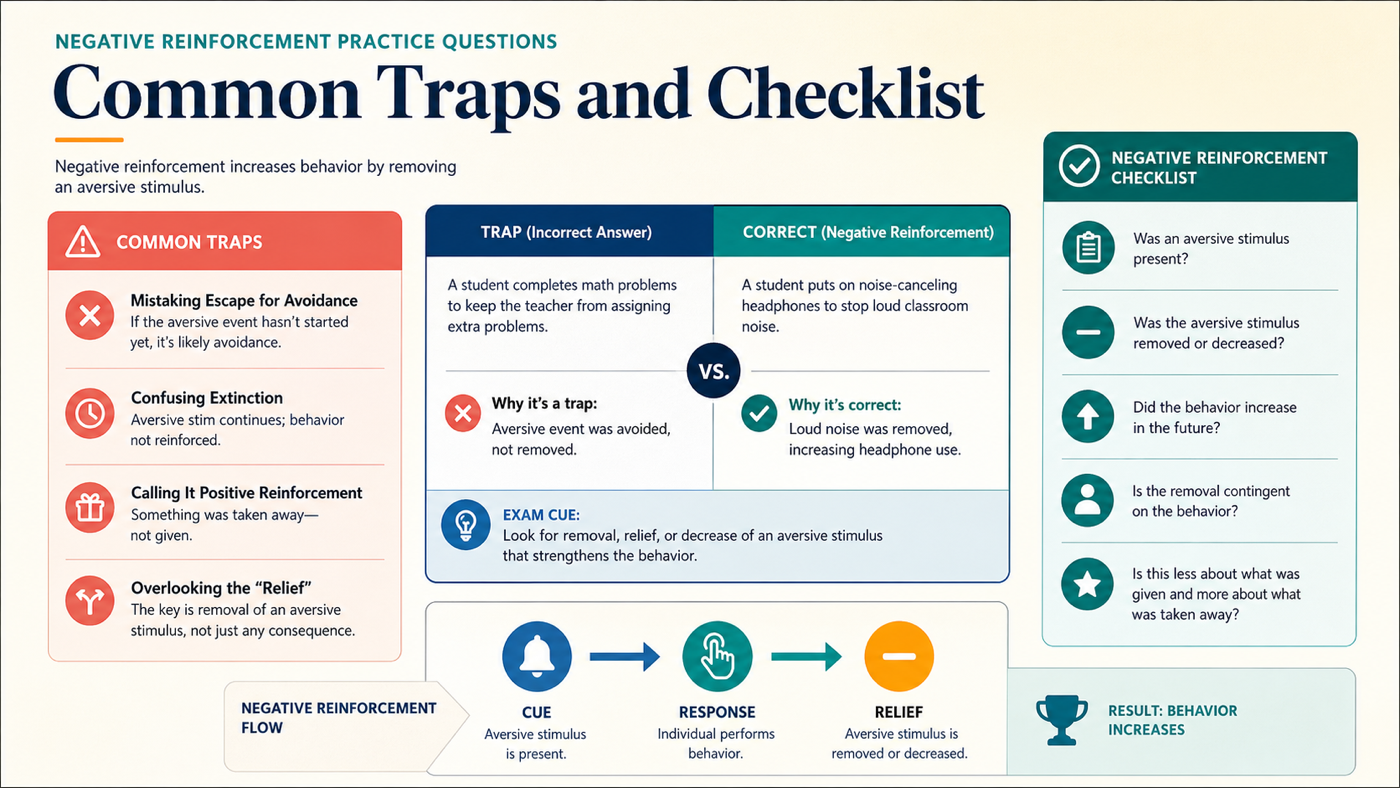
Avoid these pitfalls that trip up test-takers:
- Confusing negative reinforcement with punishment: Both involve removal, but reinforcement increases behavior, punishment decreases it.
- Thinking ‘negative’ means bad: Negative reinforcement strengthens behavior by removing something aversive.
- Focusing on the wrong person: Identify whose behavior is being reinforced by the consequence.
- Mistaking escape (negative) for avoidance: Escape occurs after the aversive starts; avoidance prevents it. Both are negative reinforcement.
Negative Reinforcement Exam Checklist
- Did the behavior increase? If not, it’s not reinforcement.
- Was the consequence removal of something aversive? If yes, it’s negative reinforcement.
- Identify the specific behavior being reinforced (often the client’s, but sometimes caregiver’s).
- Escape (terminating ongoing aversive) vs. avoidance (preventing or postponing aversive).
- Is it automatic (no social mediator) or socially mediated? Adjust terminology.
Ready for More? Get Your Free BCBA Mock Exam
Test your knowledge with a full-length BCBA mock exam covering all content areas, including detailed explanations.
Take the Free BCBA Mock Exam
Download your free mock exam now and boost your exam readiness.
FAQ: Negative Reinforcement on the BCBA Exam
Q: What is the easiest way to identify negative reinforcement on the exam?
A: Look for a behavior that increases AND is followed by the removal of something the individual finds aversive.
Q: Can negative reinforcement involve attention?
A: Yes, if attention is aversive and its removal strengthens behavior, that’s negative reinforcement (e.g., a person escapes a conversation).
Q: Is negative reinforcement the same as punishment?
A: No. Negative reinforcement increases behavior; punishment decreases it. Both can involve removal, but the effect on behavior differs.
References
Complete BCBA Exam Prep
Turn this topic into exam-day practice
Practice concepts in context with five full-length 6th Edition mock exams, two bonus practice exams, a 6th Edition study guide, and key-term flashcards—all in one $120 USD package.
Get the $120 All-in-One Prep Pack
Review everything included on the product page before ordering. No pass guarantee is implied.



