
Introduction
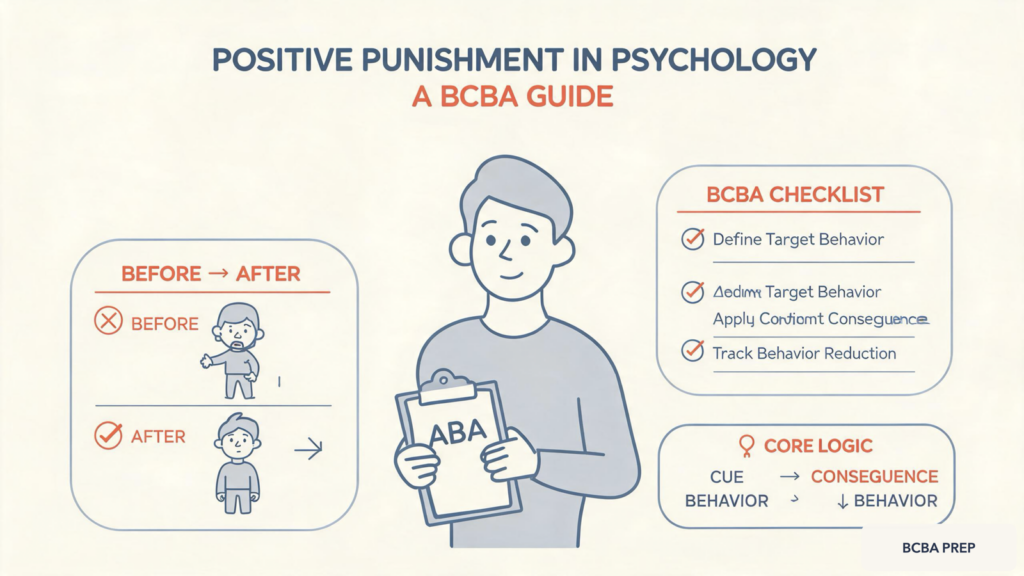
Understanding positive punishment in psychology is essential for BCBA candidates. This concept appears frequently on the exam, often disguised in tricky scenario questions. In ABA, positive punishment simply means adding an aversive stimulus after a behavior that decreases the likelihood of that behavior occurring again. This article breaks down the definition, provides practical examples using the ABC format, contrasts punishment with reinforcement, and highlights common exam traps. By the end, you will have a clear framework for identifying positive punishment questions with confidence.
Table of Contents
- Introduction
- What Is Positive Punishment? A Clear Definition
- ABA Examples of Positive Punishment with ABC Data
- Positive Punishment vs. Negative Punishment vs. Reinforcement
- Common Exam Traps and How to Avoid Them
- Quick Checklist for Positive Punishment
- Summary
- How to Study positive punishment definition psychology for BCBA-Style Questions
- How to Study positive punishment definition psychology for BCBA-Style Questions
- Take the Free BCBA Mock Exam
Let’s dive into the core principles every BCBA must know.
What Is Positive Punishment? A Clear Definition
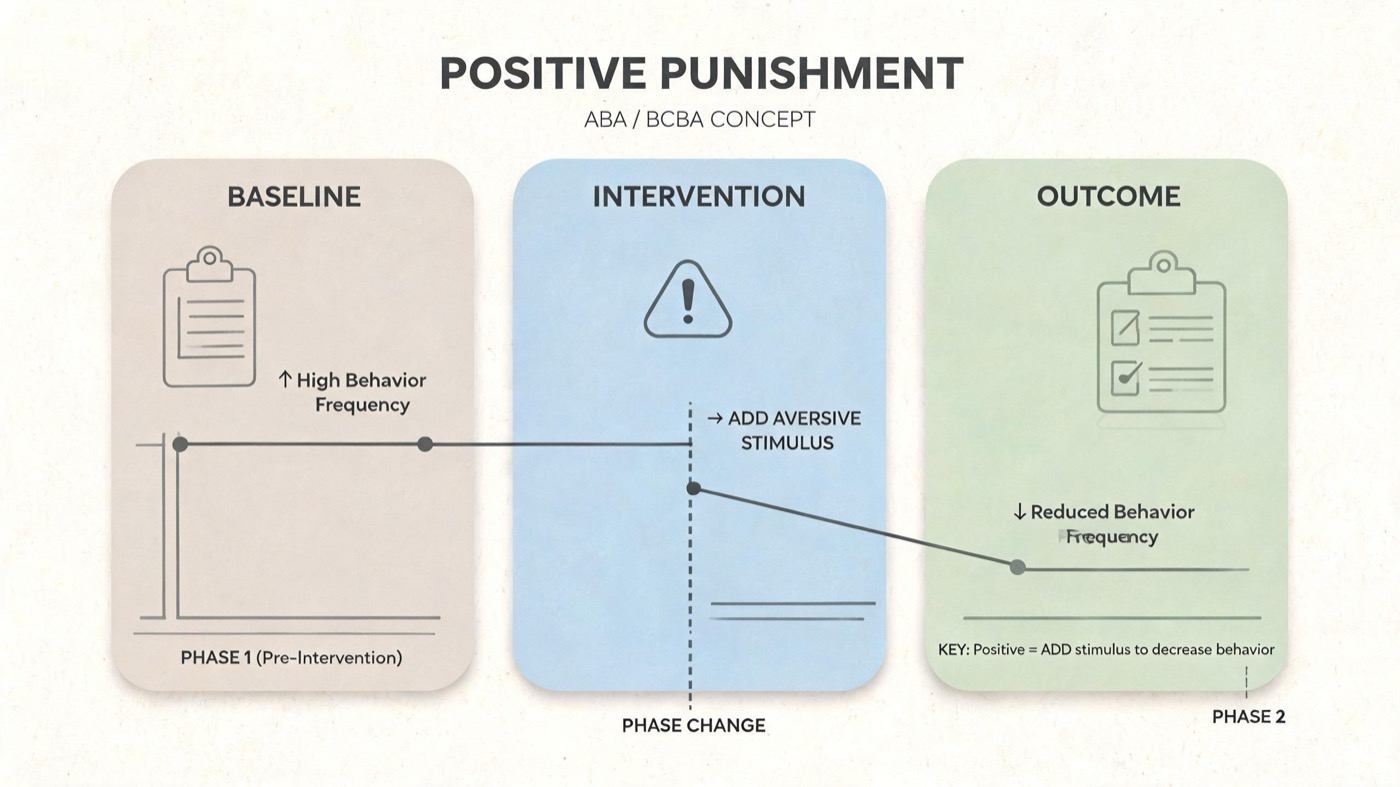
In ABA, positive punishment is one of the four operant contingencies. The term ‘positive’ means something is added (not that it is good or desirable). The term ‘punishment’ means the behavior decreases in the future. So positive punishment involves presenting an aversive stimulus contingent on a behavior, resulting in a reduced frequency of that behavior. Key Components of Positive Punishment: Use the points below as a quick study guide.
- A specific behavior occurs in the presence of an antecedent.
- An aversive stimulus is added immediately after the behavior.
- The addition is contingent on the behavior (it only happens when the behavior occurs).
- The future probability of the behavior decreases under similar conditions.
Note that the effect on behavior must be observed; intention alone does not define punishment. Also, timing matters: immediate consequences are more effective than delayed ones.
ABA Examples of Positive Punishment with ABC Data
Applying the ABC (Antecedent-Behavior-Consequence) model helps clarify how positive punishment works. Below are three examples drawn from real-world and clinical scenarios. Example 1: Child Touches Hot Stove: Use the points below as a quick study guide.
- Antecedent: The child sees a hot stove and reaches toward it.
- Behavior: The child touches the hot stove surface.
- Consequence: The child receives a painful burn (aversive stimulus).
- Future effect: The child is less likely to touch the stove again.
Here, the addition of pain (aversive) punishes the touching behavior. The hypothesized function is pain attenuation (escape from pain reinforces avoidance). Example 2: Student Talks Out of Turn: Use the points below as a quick study guide.
- Antecedent: Teacher asks the class a question.
- Behavior: Student blurts out an answer without raising hand.
- Consequence: Teacher gives a stern verbal reprimand (e.g., ‘Do not shout out!’).
- Future effect: The student decreases blurting behaviors.
The aversive stimulus is the reprimand, which may serve as an attention function for some students but as punishment for others. In this scenario, the net effect is a reduction in blurting. Example 3: Client Engages in Aggression: Use the points below as a quick study guide.
- Antecedent: Therapist presents a task demand.
- Behavior: Client hits the therapist.
- Consequence: Therapist physically blocks the hit (adding a brief pressure or manual guidance).
- Future effect: Hitting decreases over time.
Here, the addition of physical contact (blocking) serves as the aversive stimulus. Note that in ethical ABA practice, punishment is only used after reinforcement-based interventions have been tried. Always consider the function of behavior to determine if punishment is appropriate.
Positive Punishment vs. Negative Punishment vs. Reinforcement
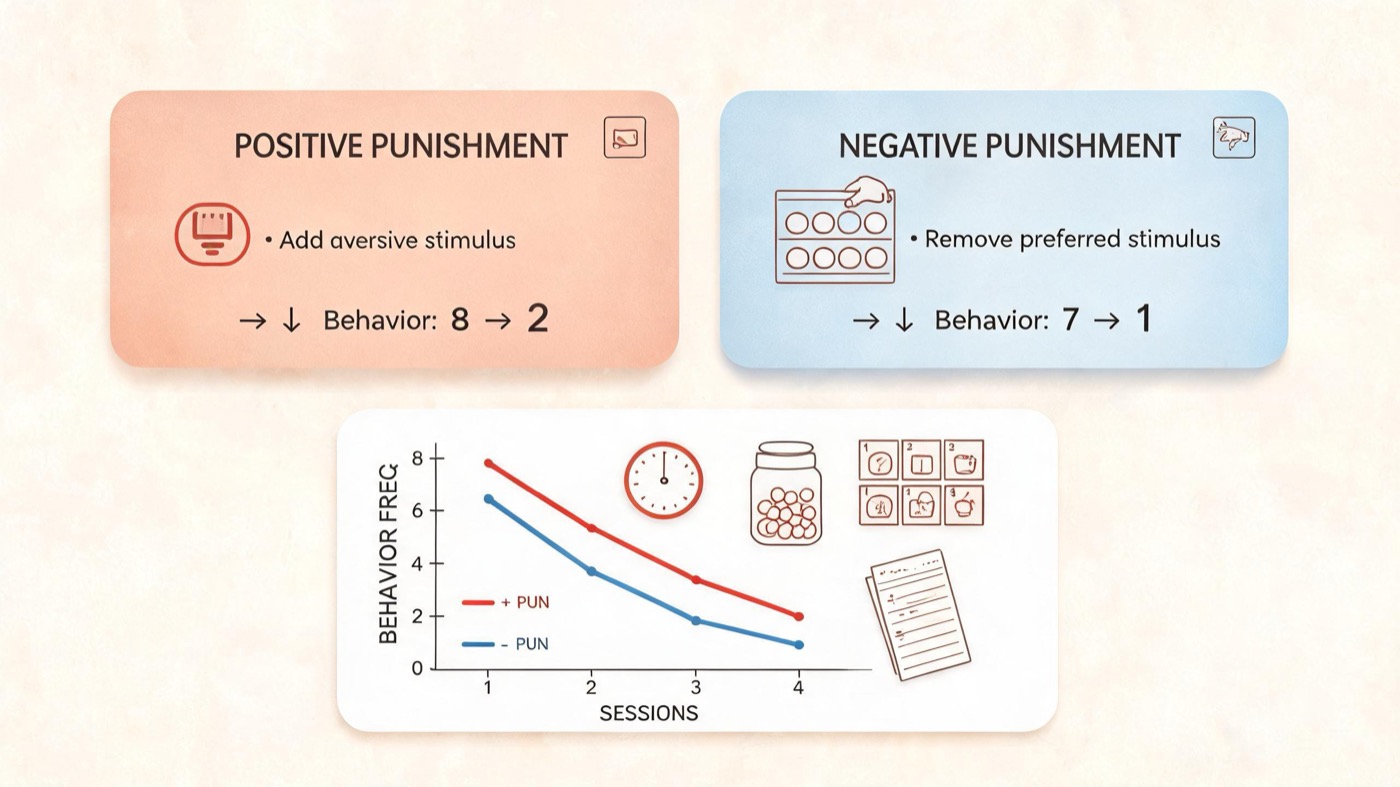
Exam questions often test your ability to distinguish between these contingencies. The key is to identify two dimensions: whether the stimulus is added or removed (positive vs. negative) and whether the behavior increases (reinforcement) or decreases (punishment). How to Tell Them Apart in Exam Questions: Use the points below as a quick study guide.
- Is a stimulus added? If yes, it is positive (positive reinforcement or positive punishment). If removed, it is negative (negative reinforcement or negative punishment).
- Does the behavior increase or decrease? Increase = reinforcement; decrease = punishment.
- Combine the two: Added + decrease = positive punishment. Removed + decrease = negative punishment. Added + increase = positive reinforcement. Removed + increase = negative reinforcement.
For example, if a student stops talking when the teacher says ‘Quiet’ (adding reprimand) and talking decreases, that is positive punishment. If a child cleans room to remove a parent’s nagging (removing aversive) and cleaning increases, that is negative reinforcement.
Common Exam Traps and How to Avoid Them
Even well-prepared students make mistakes on positive punishment questions. Here are the most frequent traps. The 'Added Stimulus' Trap: Many students assume that any added stimulus is reinforcement. However, the effect on behavior determines the function. A reprimand is added, but it does not automatically increase behavior. If the behavior decreases, it is punishment. Always ask: Does the behavior go up or down?
The 'Good/Bad' Confusion: Positive punishment is often viewed as ‘bad’ or ‘undesirable’ in everyday language. In ABA, it is neutral and defined only by its effect. A reprimand may be considered mild and ethical, but it still functions as punishment if it reduces the behavior. Also, what is aversive for one person may not be for another. Individual differences matter.
The 'Ignoring Function' Trap: Sometimes a consequence looks like punishment but actually reinforces the behavior due to its function. For example, if a student blurts out and the teacher reprimands, the reprimand might increase the behavior if it provides attention (reinforcement). Always consider the function and the observed effect on future behavior, not just the form of the consequence.
Quick Checklist for Positive Punishment
Use this checklist when analyzing exam questions or real-world scenarios:
- Identify the behavior that occurs.
- Is an aversive stimulus added immediately after the behavior?
- Does the behavior decrease in the future under similar conditions?
- Is the addition contingent on the behavior (i.e., it only occurs when the behavior does)?
- Rule out other contingencies: Could the consequence actually be reinforcing? (Check function.)
- Ethical considerations: In practice, punishment should only be used when less-intrusive interventions have failed and with proper oversight.
If all answers are yes, the scenario describes positive punishment.
Summary
Positive punishment in psychology is a key concept for the BCBA exam. Remember: ‘positive’ means addition, ‘punishment’ means the behavior decreases. Use the ABC format to analyze scenarios, and always focus on the effect on future behavior. Distinguish positive punishment from negative punishment and reinforcement by checking whether the stimulus is added/removed and whether the behavior increases/decreases. Avoid common traps like confusing reinforcement with punishment or assuming function based on appearance. Practice with mock questions to solidify your understanding.
For more BCBA prep resources, check out our BCBA mock exam and our guide on punishment in ABA ethics. Also, review the official BACB Ethics Code and the peer-reviewed literature on punishment for deeper understanding.
How to Study positive punishment definition psychology for BCBA-Style Questions
When you review positive punishment definition psychology, do not stop at the definition. The exam usually tests whether you can apply the concept inside a short scenario, separate it from similar terms, and choose the most behaviorally precise answer. A strong study routine should connect the term to observable behavior, environmental context, measurement, and likely consequences.
- Define the response: identify exactly what the learner or client does, not just the broad skill area.
- Find the context: note the antecedent, setting, materials, people, or condition that makes the concept relevant.
- Check the consequence: ask what changes after the response and whether that change supports the answer choice.
- Compare close terms: write one sentence explaining why the best answer is not a related but different ABA concept.
For practice, turn each example into a quick discrimination exercise. Ask, “What would make this answer wrong?” and then change one detail in the scenario. This builds flexible exam reasoning instead of memorizing a single phrase.
How to Study positive punishment definition psychology for BCBA-Style Questions
When you review positive punishment definition psychology, do not stop at the definition. The exam usually tests whether you can apply the concept inside a short scenario, separate it from similar terms, and choose the most behaviorally precise answer. A strong study routine should connect the term to observable behavior, environmental context, measurement, and likely consequences.
- Define the response: identify exactly what the learner or client does, not just the broad skill area.
- Find the context: note the antecedent, setting, materials, people, or condition that makes the concept relevant.
- Check the consequence: ask what changes after the response and whether that change supports the answer choice.
- Compare close terms: write one sentence explaining why the best answer is not a related but different ABA concept.
For practice, turn each example into a quick discrimination exercise. Ask, “What would make this answer wrong?” and then change one detail in the scenario. This builds flexible exam reasoning instead of memorizing a single phrase.
Take the Free BCBA Mock Exam
Ready for more practice? Use the free mock exam to keep testing your accuracy with realistic BCBA-style items. Take the Free BCBA Mock Exam



