
Defining Punishment and Reinforcement in ABA
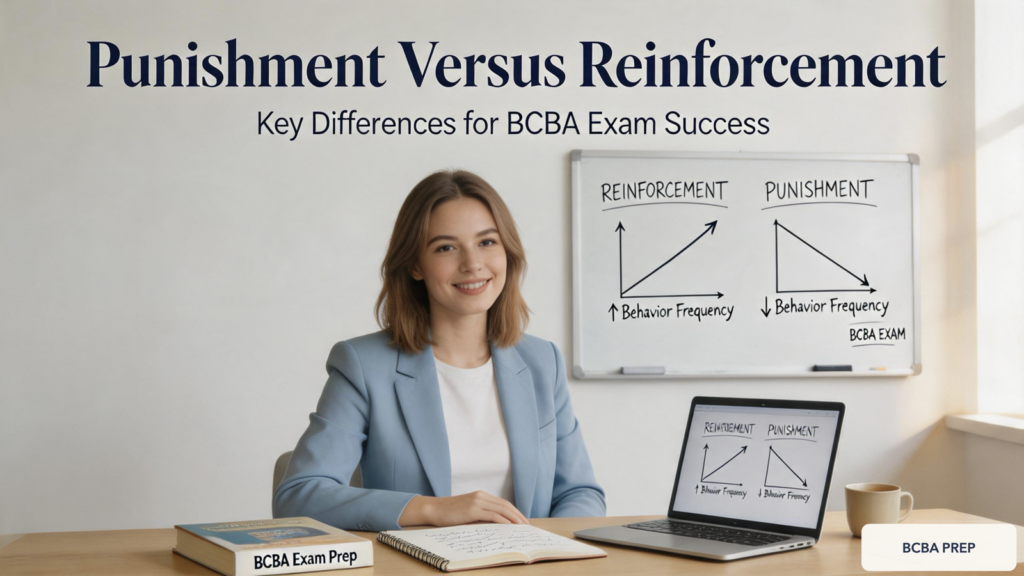
Understanding the difference between punishment versus reinforcement is essential for BCBA exam success. Both concepts are defined by their effect on future behavior, not by the subjective experience of the individual. In applied behavior analysis, we look at the three-term contingency (antecedent-behavior-consequence) to determine whether a consequence functions as reinforcement or punishment.
Practice this concept
Table of Contents
- Defining Punishment and Reinforcement in ABA
- Worked ABA Examples: Applying Punishment versus Reinforcement
- Exam Relevance and Common Traps
- Quick Checklist for BCBA Exam Success
- Summary: Your Study Guide to Punishment versus Reinforcement
What is Reinforcement?
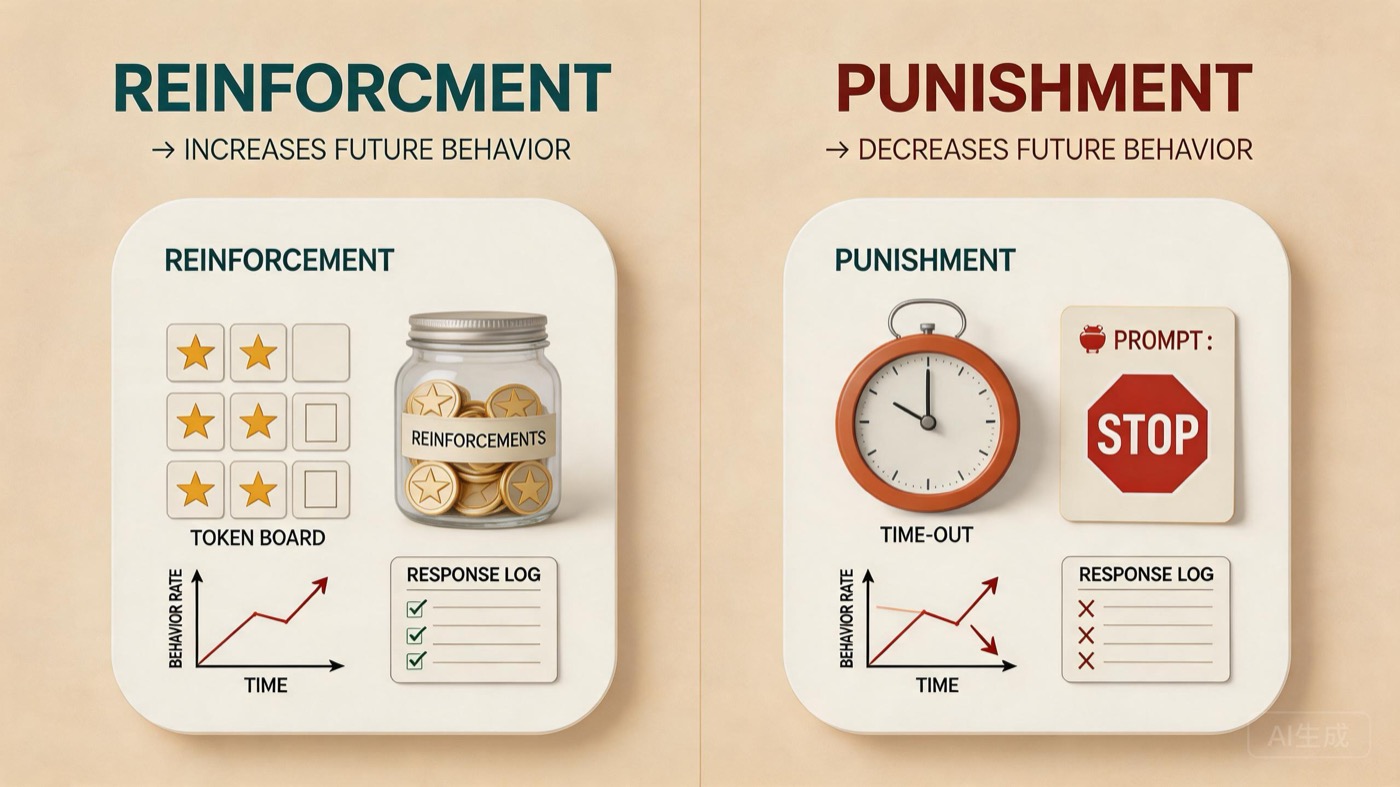
Reinforcement is a consequence that increases the future frequency of the behavior it follows. There are two types: positive reinforcement and negative reinforcement. In positive reinforcement, a stimulus is added after the behavior, leading to an increase. For example, a student completes homework and receives praise; the behavior of completing homework is more likely to occur again. In negative reinforcement, an aversive stimulus is removed after the behavior, also increasing the behavior. For instance, a child cleans their room to stop a parent’s nagging; the cleaning behavior increases. Both types result in a behavior increase.
What is Punishment?
Punishment is a consequence that decreases the future frequency of the behavior it follows. It also comes in two forms: positive punishment and negative punishment. Positive punishment involves adding an aversive stimulus after the behavior, such as a reprimand following hitting. Negative punishment involves removing a preferred stimulus, such as taking away a toy after a tantrum. Both procedures lead to a behavior decrease. Note that punishment is not defined by the intent to harm but by its functional effect on behavior.
Worked ABA Examples: Applying Punishment versus Reinforcement
Practical examples help solidify the distinction between punishment and reinforcement. Below are two detailed scenarios using the ABC format to illustrate how each consequence alters behavior.
Example 1: Increasing Compliance with Reinforcement
A teacher asks a student to clean up their desk (antecedent). The student cleans up (behavior). The teacher immediately praises the student and gives a sticker (positive reinforcement). As a result, the student is more likely to clean up in the future. The behavior increases.
Example 2: Reducing Aggression with Punishment
A child hits a peer to gain attention (antecedent). The child hits (behavior). The teacher gives a verbal reprimand and removes the child from the play area for two minutes (positive punishment via reprimand and negative punishment via timeout). The hitting behavior decreases. It is crucial to identify the hypothesized function: in this case, attention. Punishment must be carefully selected to avoid reinforcing the behavior inadvertently.
Additional Example: Negative Reinforcement vs. Negative Punishment
A common area of confusion is the difference between negative reinforcement and negative punishment. Consider a teenager who completes chores to stop a parent’s nagging. This is negative reinforcement because the behavior (chores) increases after the removal of nagging. In contrast, if a teenager loses their phone privileges (removal of a stimulus) for missing curfew, and the curfew-violation behavior decreases, that is negative punishment. The key distinction: reinforcement increases behavior, while punishment decreases it.
Exam Relevance and Common Traps
The BCBA exam frequently tests the distinction between punishment and reinforcement through scenario-based questions. Many candidates fall for common traps. Here are two of the most frequent mistakes to avoid.
Trap 1: Confusing Negative Reinforcement with Punishment
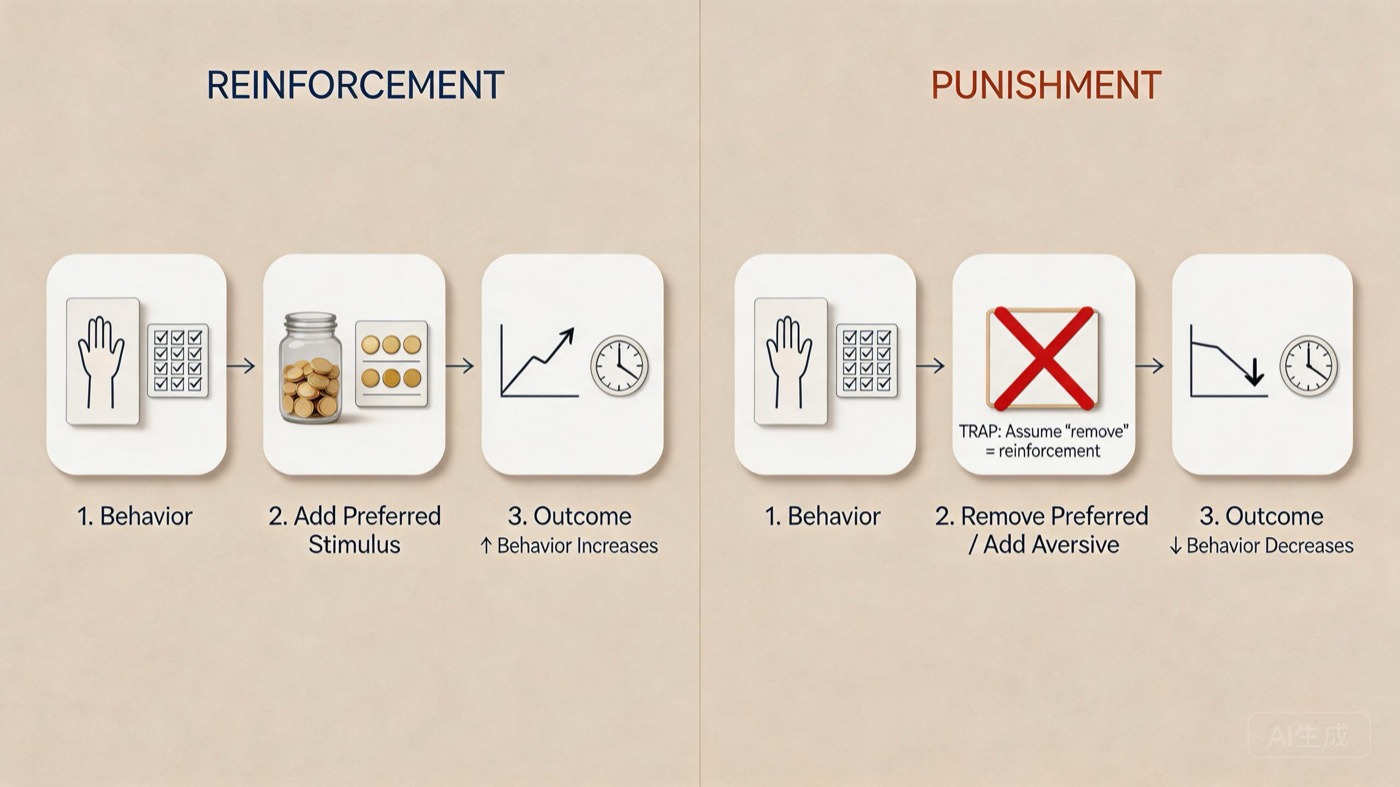
The biggest trap is assuming that because a stimulus is removed, it must be punishment. Negative reinforcement involves removal of an aversive stimulus that increases behavior. For example, a child screams to escape a loud noise; the screaming is negatively reinforced. Punishment always decreases behavior. If the consequence involves removal but the behavior goes down, it is negative punishment.
Trap 2: Mislabeling Extinction as Punishment
Extinction involves withholding the reinforcer that maintained the behavior, leading to a decrease. However, extinction is not punishment because no stimulus is added or removed after the behavior. Instead, the previously delivered reinforcer is no longer provided. The mechanism is different: punishment involves a direct consequence, while extinction relies on breaking the reinforcement history.
Trap 3: Overlooking the Function of Behavior
Before applying a procedure, always consider the function of the behavior. A consequence that is punishing in one context may be reinforcing in another. For example, a reprimand may decrease behavior for one child but serve as attention (reinforcement) for another. Always use functional assessment data to guide intervention.
Quick Checklist for BCBA Exam Success
Use this checklist to review the key points for distinguishing punishment versus reinforcement:
- Reinforcement = behavior increases. Punishment = behavior decreases.
- Positive = adding a stimulus. Negative = removing a stimulus.
- False: removal always means punishment. Check the effect on behavior.
- Extinction is not punishment; it is a separate procedure.
- Always consider the function of behavior before selecting a consequence.
- Practice with mock questions to solidify the distinction.
Summary: Your Study Guide to Punishment versus Reinforcement
Mastering the difference between punishment versus reinforcement is critical for the BCBA exam. Remember that reinforcement always increases behavior, while punishment always decreases it. The terms positive and negative refer to whether a stimulus is added or removed, not to the value of the consequence. Avoid common traps by focusing on the effect on future behavior, not the subjective experience. For more practice, visit our BCBA mock exams and explore additional resources on positive vs. negative punishment. Also check the official BACB website for the latest task list. Use the checklist above and test yourself with scenarios to ensure you can identify each procedure accurately. Good luck!



