
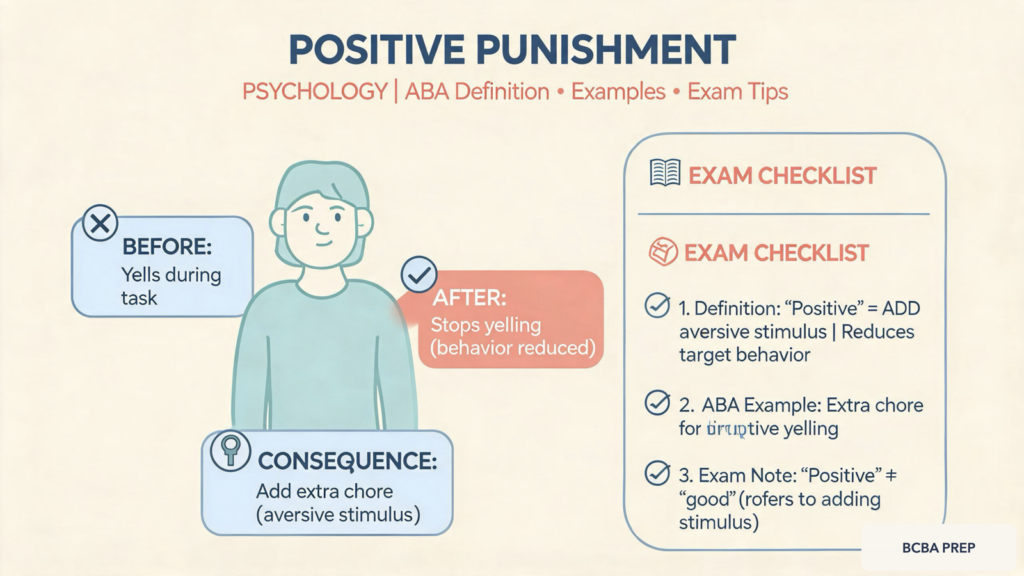
What Is Positive Punishment in Psychology?
In behavior analysis, positive punishment is a core concept you must master for the BCBA exam. The term “positive” in this context means the addition of a stimulus following a behavior, and “punishment” means that the behavior decreases in the future. So, the positive punishment psychology definition is: the presentation of an aversive stimulus immediately after a behavior, which reduces the likelihood of that behavior occurring again.
Table of Contents
- What Is Positive Punishment in Psychology?
- Real-World ABA Examples of Positive Punishment
- BCBA Exam Relevance: Common Traps and How to Avoid Them
- Positive Punishment vs. Other Behavior Change Procedures
- Summary and Exam Preparation Tips
- References
This procedure is one of four quadrants of operant conditioning. To avoid confusion, remember the key elements: a stimulus is added (positive) and the behavior decreases (punishment). If behavior increases, it is reinforcement, not punishment. For more on the broader context of punishment, see our guide on punishment in ABA.
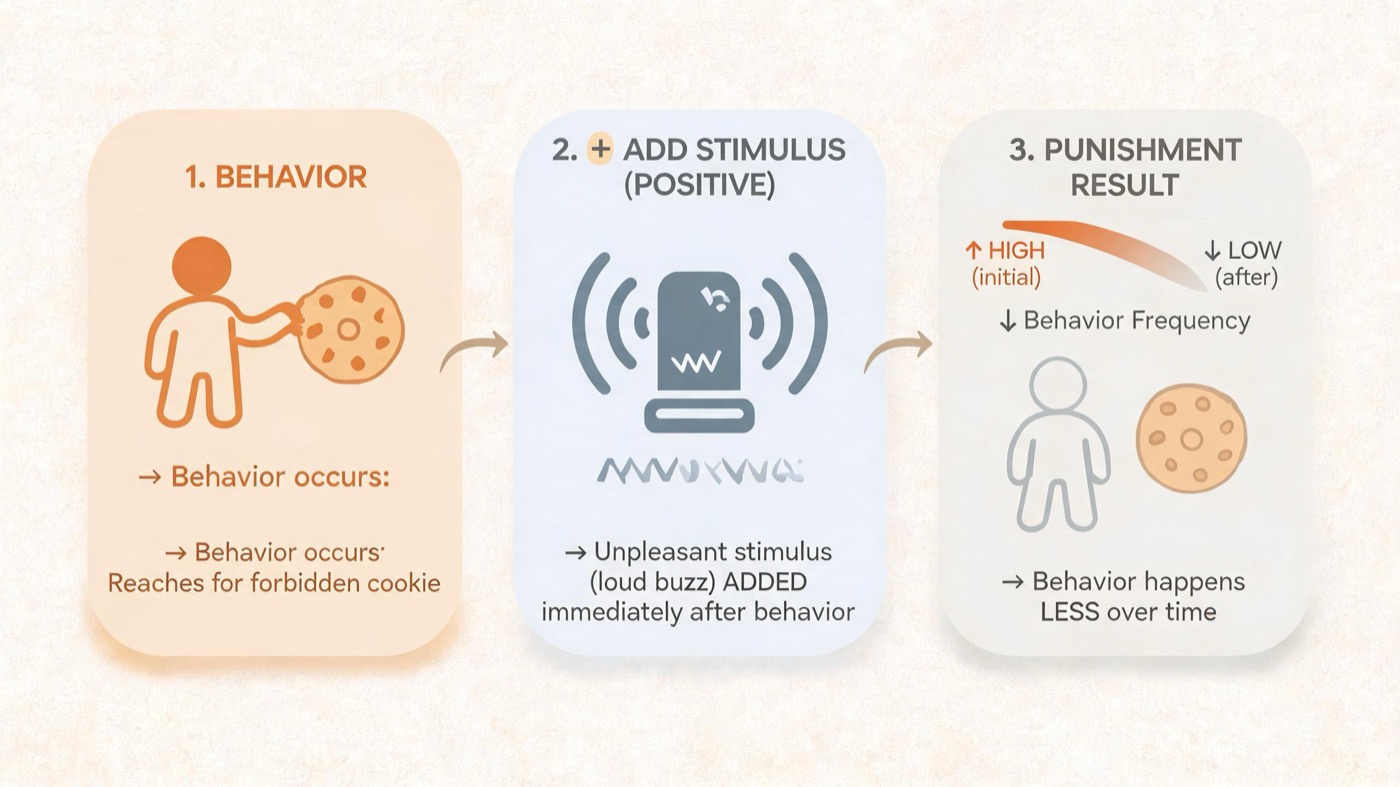
Positive Punishment vs. Negative Punishment
The critical difference lies in whether a stimulus is added or removed. Positive punishment adds an aversive stimulus (e.g., a reprimand). Negative punishment removes a reinforcing stimulus (e.g., loss of a toy). Both aim to decrease behavior. Use this mental model:
- Positive punishment: ADD stimulus → behavior decreases.
- Negative punishment: REMOVE stimulus → behavior decreases.
- Positive reinforcement: ADD stimulus → behavior increases.
- Negative reinforcement: REMOVE stimulus → behavior increases.
Why Do BCBA Candidates Need to Know This?
The BACB Task List (e.g., F-4 and F-5) requires you to identify and implement punishment procedures. Exam questions often present scenarios where you must distinguish positive punishment from other procedures. A strong grasp of the positive punishment psychology definition is essential for correctly analyzing behavior change and selecting ethical interventions.
Real-World ABA Examples of Positive Punishment
Let’s examine three diverse ABA examples using the ABC (Antecedent-Behavior-Consequence) format. Each highlights how positive punishment operates and requires hypothesizing the function of the behavior.
Example 1: Reprimanding a Child Who Screams
- Antecedent: Peer ignores the child.
- Behavior: Child screams loudly.
- Consequence: Teacher says “Stop!” in a firm tone (added stimulus).
- Hypothesized Function: Attention (peer and teacher).
- Effect: Future screaming decreases.
Example 2: Adding a Fine for Tardiness
- Antecedent: Clock reaches 9:00 AM.
- Behavior: Employee arrives late.
- Consequence: A monetary fine is deducted from paycheck (added stimulus).
- Hypothesized Function: Positive punishment via added cost.
- Effect: Punctuality increases (tardiness decreases).
Example 3: Brief Physical Prompt to Block Aggression
- Antecedent: Peer approaches with a toy.
- Behavior: Child hits the peer.
- Consequence: Therapist gently blocks the hit and guides the child away (added physical contact/redirection).
- Hypothesized Function: Escape or sensory stimulation.
- Effect: Hitting decreases over time.
BCBA Exam Relevance: Common Traps and How to Avoid Them
Exam questions often exploit subtle distinctions. Being aware of these traps will save you points. Here are two frequent pitfalls and a quick checklist to verify if a procedure is positive punishment.
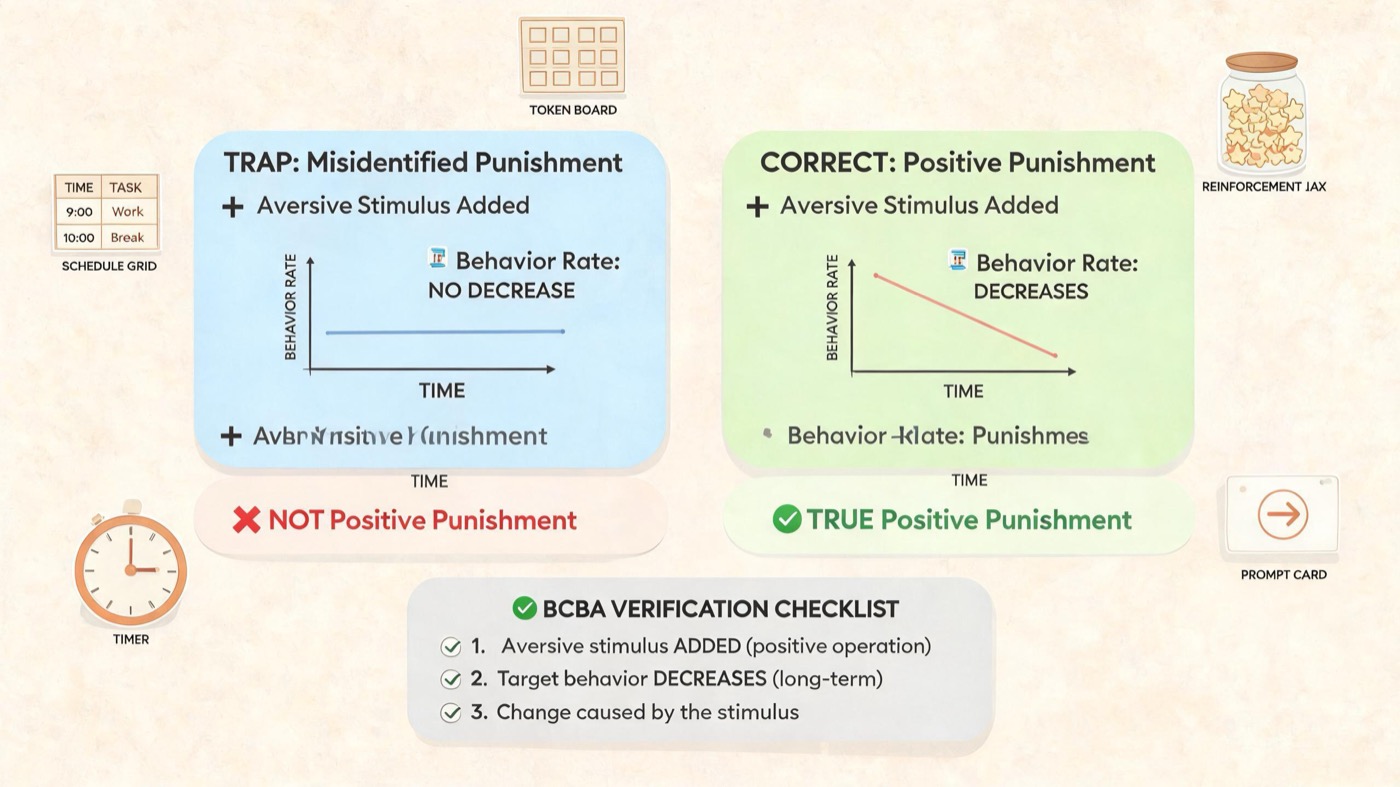
Trap 1: Confusing Positive Punishment with Negative Reinforcement
Both involve aversive stimuli, but the effect on behavior is opposite. In negative reinforcement, the removal of an aversive stimulus increases behavior. In positive punishment, the addition of an aversive stimulus decreases behavior. For example, if a student whines to escape a difficult task and the teacher removes the task, that is negative reinforcement (behavior increases). If the teacher adds a reprimand and whining decreases, that is positive punishment. To clarify further, see our post on positive vs negative punishment.
Trap 2: Misidentifying the Consequence Due to Hypothesized Function
Even if a behavior decreases, the consequence may not be punishment if the mechanism is different. For instance, if a behavior decreases because the reinforcer is no longer available (extinction), that is not punishment. Always ask: Was a stimulus added or removed? If no stimulus is added/removed, it is not punishment.
Quick Checklist: Is This Positive Punishment?
- Was a stimulus added after the behavior? (If removed, consider negative punishment.)
- Did the behavior decrease in frequency? (If increased, it is reinforcement.)
- Is the added stimulus aversive to the individual? (Otherwise, it may not function as punishment.)
- Is the decrease temporary or permanent? (Punishment often produces rapid but sometimes temporary effects.)
Positive Punishment vs. Other Behavior Change Procedures
Understanding how positive punishment differs from other interventions is critical for exam scenarios and ethical practice. Here is a quick comparison of commonly confused procedures.
Negative Punishment (Penalty)
Negative punishment involves the removal of a reinforcing stimulus to decrease behavior. Example: Taking away a tablet after a child hits. Both positive and negative punishment aim to decrease behavior, but the mechanism—adding vs. removing—is distinct.
Extinction
Extinction involves withholding the reinforcer that previously maintained the behavior. No stimulus is added or removed; the behavior decreases because it no longer produces reinforcement. For example, ignoring whining that previously got attention. On the exam, you must differentiate extinction from punishment by checking whether a stimulus is being added or removed.
Differential Reinforcement
Differential reinforcement involves reinforcing an alternative or other behavior while withholding reinforcement for the problem behavior. This is not punishment; it is a reinforcement-based strategy. Often used in combination with punishment, but the behavior decreases due to reinforcement of a replacement behavior, not due to an added aversive.
Summary and Exam Preparation Tips
To summarize, the positive punishment psychology definition is straightforward: add an aversive stimulus after a behavior to decrease its future occurrence. However, exam questions require you to apply this concept across diverse scenarios. Here are actionable tips:
- Memorize the four quadrants: positive/negative × reinforcement/punishment.
- Practice with ABC scenarios—always identify the added stimulus and the direction of behavior change.
- Watch for traps: negative reinforcement vs. positive punishment, extinction vs. punishment.
- Review ethical considerations: punishment should be used only after reinforcement-based strategies have been tried. Learn more in our guide on punishment ethics and side effects.
- Use mock exams to build fluency. For additional context, see our negative punishment BCBA exam guide.
Master the positive punishment psychology definition, and you will confidently answer any exam question on this topic. Keep practicing until the distinction becomes automatic.



