
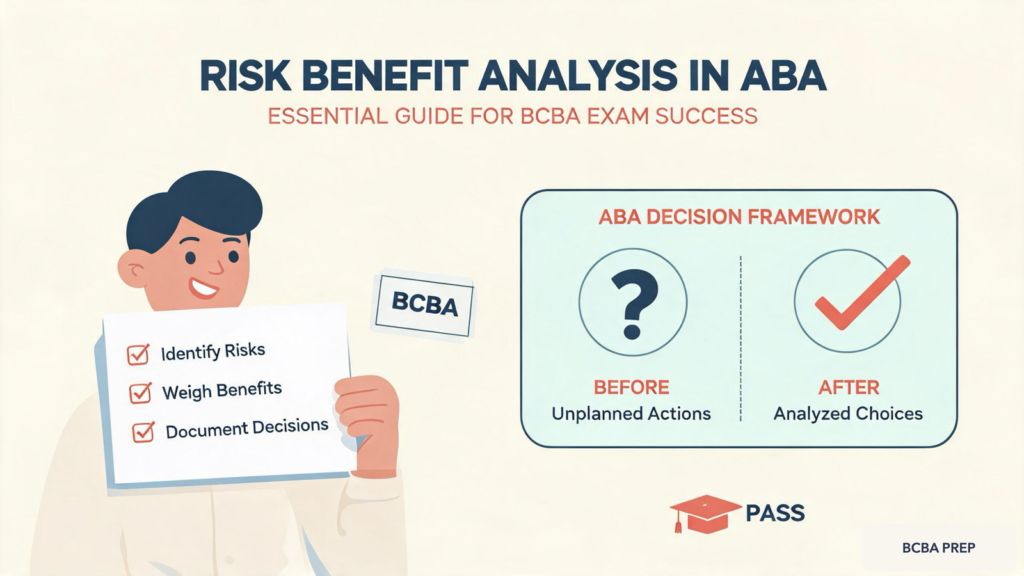
What Is Risk Benefit Analysis in ABA?
A risk benefit analysis is a systematic process used in applied behavior analysis (ABA) to weigh the potential risks and benefits of an intervention before, during, and after implementation. This analysis is essential for ethical decision-making and aligns with the BACB Ethics Code, which requires behavior analysts to prioritize client welfare.
Practice this concept
Use the related BCBA ethics practice questions to test risk-benefit reasoning in applied scenarios.
Table of Contents
- What Is Risk Benefit Analysis in ABA?
- Conducting a Risk Benefit Analysis: ABA Example Scenarios
- Common Exam Traps and How to Avoid Them
- Quick Checklist for Risk Benefit Analysis in ABA
- Putting It All Together: Summary
- References
For BCBA candidates, understanding risk benefit analysis is crucial because exam questions often present scenarios where you must choose the most ethical and effective intervention. The goal is to select interventions where benefits clearly outweigh risks, considering both immediate and long-term outcomes.
Differentiating Risk and Benefit
Risk refers to any potential harm, loss, or negative outcome that could result from an intervention. This includes physical harm (e.g., injury), emotional distress, social stigma, or loss of opportunities. Benefit refers to positive outcomes such as skill acquisition, increased independence, improved quality of life, or reduction of challenging behavior.
When conducting a risk benefit analysis, you must consider not only objective data but also client preferences and contextual factors. For example, an intervention that reduces aggression but causes significant distress may not be justified if less intrusive options exist.
Why It Matters for BCBA Candidates
The BCBA exam frequently tests your ability to apply ethical decision-making in real-world scenarios. You may be asked to identify the best course of action when multiple interventions are available. A thorough risk benefit analysis helps you justify your choice and demonstrate competence in ethical practice. Additionally, understanding this process prepares you for the real-world responsibility of ensuring client safety and dignity.
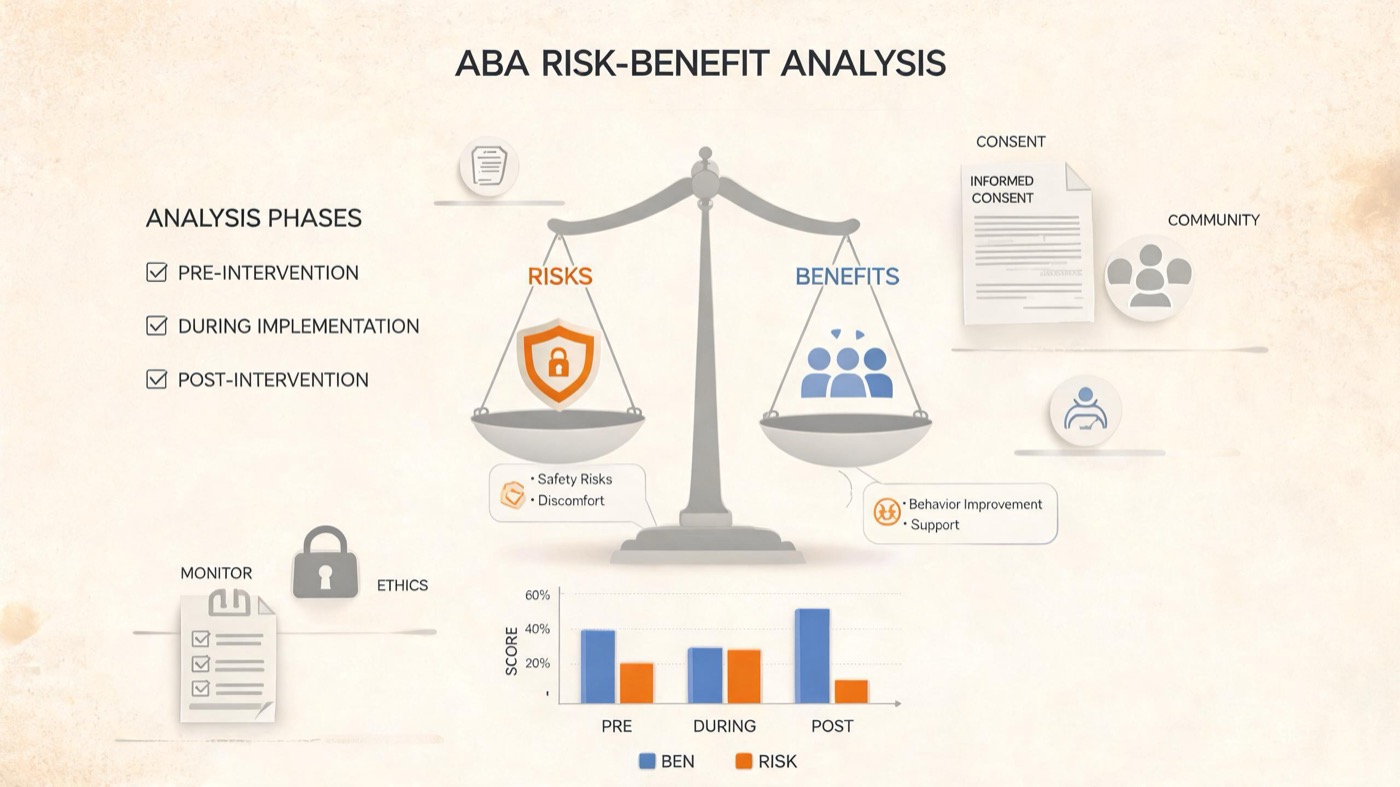
Conducting a Risk Benefit Analysis: ABA Example Scenarios
Let’s walk through three common ABA scenarios to illustrate how to apply a risk benefit analysis step by step. Each example includes an ABC analysis and hypothesized function.
Example 1: Using a Token Economy with a Child with Aggression
- ABC: Antecedent: loss of tokens; Behavior: aggression; Consequence: removal of demand.
- Hypothesized function: Escape from demands.
- Risks: Token economy may inadvertently reinforce aggression if not implemented correctly (e.g., delivering tokens after aggression). Client may become overly dependent on tokens.
- Benefits: Increased compliance with demands, improved skill acquisition, and reduced long-term aggression.
- Analysis: With proper implementation and treatment integrity, the benefits outweigh risks. Monitor data closely for any increase in aggression.
Example 2: Introducing Noncontingent Reinforcement (NCR) for Property Destruction
- ABC: Antecedent: request to clean; Behavior: property destruction; Consequence: attention.
- Hypothesized function: Attention.
- Risks: NCR may delay functional communication training (FCT) and reinforce the behavior if not combined with extinction.
- Benefits: Immediate reduction of property destruction, decreased caregiver stress, and increased safety.
- Analysis: NCR is appropriate as a short-term intervention while teaching a replacement behavior. The benefit outweighs risk if continuous monitoring is in place.
Example 3: Self-Monitoring with a Student with Autism
- ABC: Antecedent: self-monitoring sheet; Behavior: on/off task; Consequence: self-reinforcement.
- Hypothesized function: Autonomy/control.
- Risks: Student may inaccurately self-report (cheat), leading to reinforcement of off-task behavior.
- Benefits: Increased independence, self-awareness, and on-task behavior.
- Analysis: Benefits are high if integrity checks (e.g., periodic observer confirmation) are implemented. Overall, risk is low.
For more on selecting interventions based on function, see our guide on 4 functions of behavior.
Common Exam Traps and How to Avoid Them
BCBA exam questions on risk benefit analysis are designed to test your critical thinking. Watch out for these common pitfalls.
Confusing Risk with Side Effects
Risk is broader than side effects. Side effects are specific unintended outcomes, while risk includes social, ethical, and pragmatic factors. For example, a side effect of punishment might be increased aggression, but a risk could be the loss of trust or client engagement.
Overlooking Client Preferences
A risk benefit analysis must incorporate the client’s values and goals. An intervention that is effective in research may not be acceptable to the client due to personal or cultural reasons. Always consider social validity.
Assuming All Risks Are Equal
Not all risks carry the same weight. Physical harm or legal consequences should be prioritized over temporary discomfort or mild frustration. Weight risks based on severity, duration, and reversibility.
For more on ethical practice, visit our ethics in ABA practice guide.
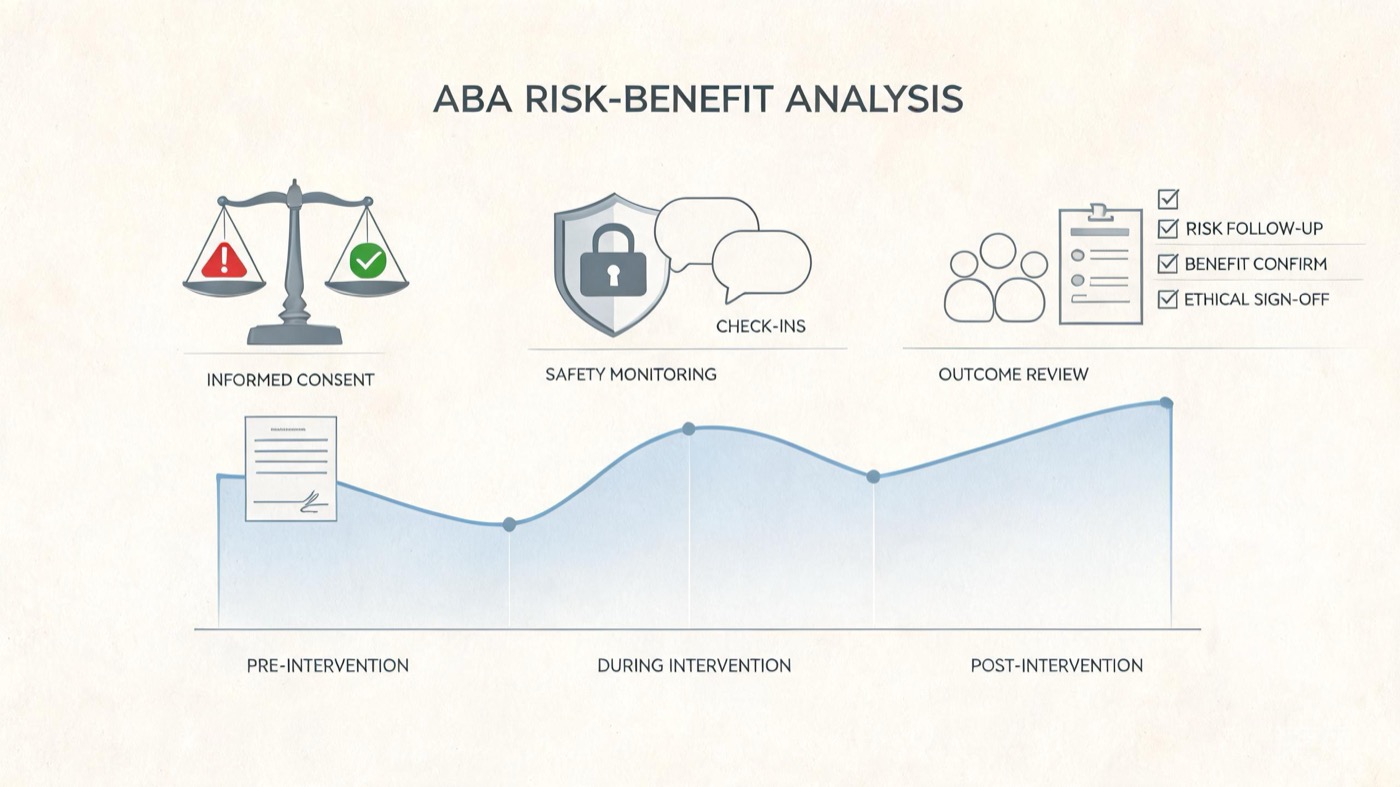
Quick Checklist for Risk Benefit Analysis in ABA
Use this checklist to systematically evaluate interventions during your BCBA exam or real-world practice. Each phase includes key steps.
Before Intervention
- Identify all potential risks (physical, emotional, social, ethical).
- Identify all potential benefits (skill acquisition, reduced challenging behavior, improved quality of life).
- Define the hypothesized function of the behavior based on FBA data.
- Consider alternative interventions that might have lower risk.
- Document your analysis and rationale.
During Intervention
- Monitor data for unanticipated risks or side effects.
- Adjust the intervention if risks begin to outweigh benefits.
- Document all decisions and modifications.
- Communicate with stakeholders about ongoing risks and benefits.
After Intervention
- Evaluate outcome against predicted risks and benefits.
- Plan for maintenance and generalization while managing residual risks.
- Conduct a post-hoc analysis to inform future decisions.
Putting It All Together: Summary
Risk benefit analysis is a core competency for BCBA candidates and practicing behavior analysts. By systematically weighing risks and benefits, you ensure that interventions are ethical, effective, and client-centered. On the exam, remember to consider all types of risks, client preferences, and the relative severity of outcomes. Use the checklist provided to structure your thinking. For additional exam prep, explore our BCBA exam prep resources.
Finally, always refer to the BACB Ethics Code for guidance on client welfare and professional conduct. A thoughtful risk benefit analysis not only helps you pass the exam but also prepares you for ethical decision-making throughout your career.
References
Complete BCBA Exam Prep
Turn this topic into exam-day practice
Practice concepts in context with five full-length 6th Edition mock exams, two bonus practice exams, a 6th Edition study guide, and key-term flashcards—all in one $120 USD package.
Get the $120 All-in-One Prep Pack
Review everything included on the product page before ordering. No pass guarantee is implied.



