
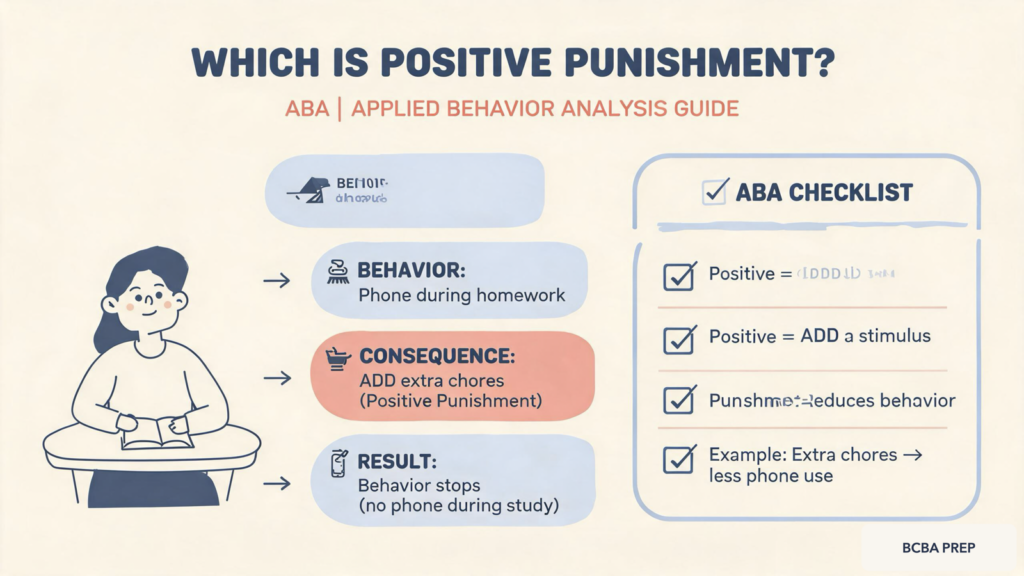
What Is Positive Punishment in ABA?
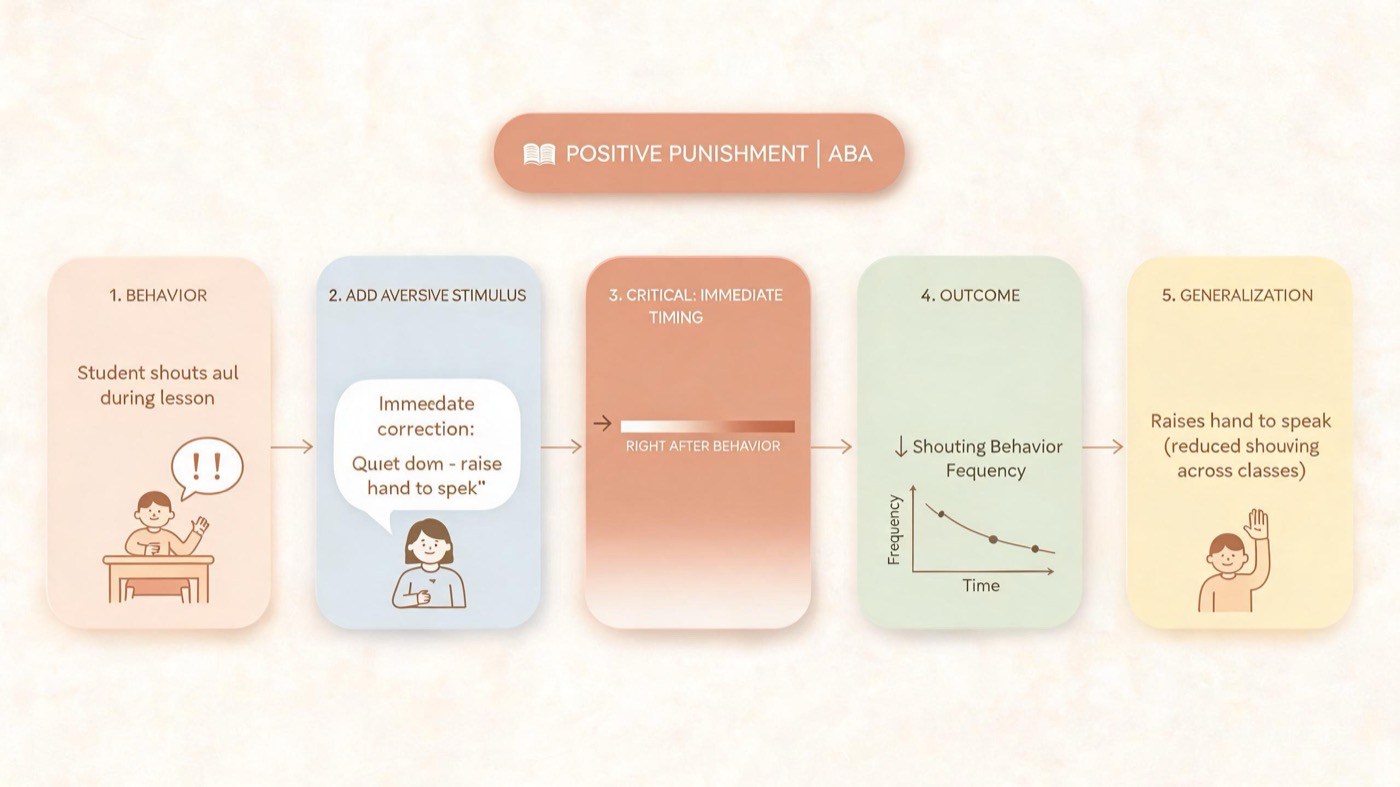
Positive punishment is a behavior reduction procedure that involves adding an aversive stimulus immediately after a behavior to decrease the likelihood of that behavior occurring again. For example, if a student shouts out and the teacher gives a verbal reprimand, and the shouting decreases, the reprimand is a positive punisher. The key is that something is added to the environment, and the behavior goes down.
Table of Contents
- What Is Positive Punishment in ABA?
- Real-World ABA Examples of Positive Punishment
- How to Answer: Which of the Following is an Example of Positive Punishment?
- Quick Checklist: Is It Positive Punishment?
- Test Your Knowledge: Positive Punishment Scenarios
Positive Punishment vs. Other Consequences
To avoid confusion, it helps to compare positive punishment with other operant consequences along two dimensions: addition vs. removal, and increase vs. decrease.
- Positive reinforcement: Add a stimulus, behavior increases (e.g., give a treat for sitting).
- Negative reinforcement: Remove a stimulus, behavior increases (e.g., stop nagging when child cleans room).
- Positive punishment: Add a stimulus, behavior decreases (e.g., harsh noise for off-task behavior).
- Negative punishment: Remove a stimulus, behavior decreases (e.g., take away a toy for hitting).
On the BCBA exam, you will often be asked to differentiate these. If the scenario describes a behavior that decreased and something was added, the answer is positive punishment.
Why It’s Crucial for the BCBA Exam
The BCBA exam frequently includes questions like “which of the following is an example of positive punishment” to test your ability to identify the added stimulus that reduces behavior. Mastering this distinction is essential for tackling applied scenarios and understanding the ethics and side effects of punishment.
Real-World ABA Examples of Positive Punishment
Let’s apply the definition to authentic ABA scenarios. Each example includes the full ABC analysis and hypothesized function.
Example 1: Loud Alarm for Off-Task Behavior
- Antecedent: Teacher gives instruction to complete a worksheet.
- Behavior: Student looks away from the worksheet (off-task).
- Consequence: Teacher sounds a loud alarm.
- Effect: Off-task behavior decreases over time.
- Hypothesized function: Escape/avoidance of academic demand (the alarm makes the task even more aversive).
This is positive punishment because the alarm (aversive stimulus) is added, and the target behavior decreases.
Example 2: Spanking for Public Tantrum
- Antecedent: Child sees candy at checkout and says “I want candy.”
- Behavior: Child screams and throws self on floor (tantrum).
- Consequence: Parent spanks the child.
- Effect: Tantrum decreases (at least temporarily).
- Hypothesized function: Access to tangible (candy) or attention. Note: Spanking is a controversial punisher; ethical considerations are critical in ABA practice.
Again, a stimulus (spanking) is added, and the behavior decreases.
Example 3: Verbal Reprimand for Profanity
- Antecedent: Peer makes a teasing comment.
- Behavior: Client says a curse word.
- Consequence: Staff says “No swearing!” firmly.
- Effect: Use of profanity decreases.
- Hypothesized function: Access to peer attention (or escape from teasing). The reprimand adds an aversive social interaction.
These examples illustrate how positive punishment works in everyday ABA settings and how you can break down any scenario using the ABC model.
How to Answer: Which of the Following is an Example of Positive Punishment?
When you encounter this type of question on the exam, use the following decision process.
Step-by-Step Decision Process
- Identify the behavior of interest – what exactly is the target behavior?
- Determine if the behavior increased or decreased – if it increased, it’s reinforcement (not punishment).
- If it decreased, ask: was a stimulus added or removed? Added = positive punishment; removed = negative punishment.
- Check the contingency – is the consequence directly applied contingent on the behavior?
Common Exam Traps to Avoid
- Confusing positive with negative punishment: Positive = adding something; negative = removing something. A common trap presents a scenario where a child loses a privilege (negative punishment) but the question asks for positive punishment.
- Mistaking reinforcement for punishment: If the behavior increases, it cannot be punishment. Watch for “escape” or “avoidance” scenarios that are actually negative reinforcement.
- Focusing on the stimulus rather than effect: The definition requires that the behavior decreases. If the behavior does not decrease, the procedure is not punishment—even if an aversive stimulus is added.
For a deeper dive into the distinctions, see our guide on positive vs. negative punishment.
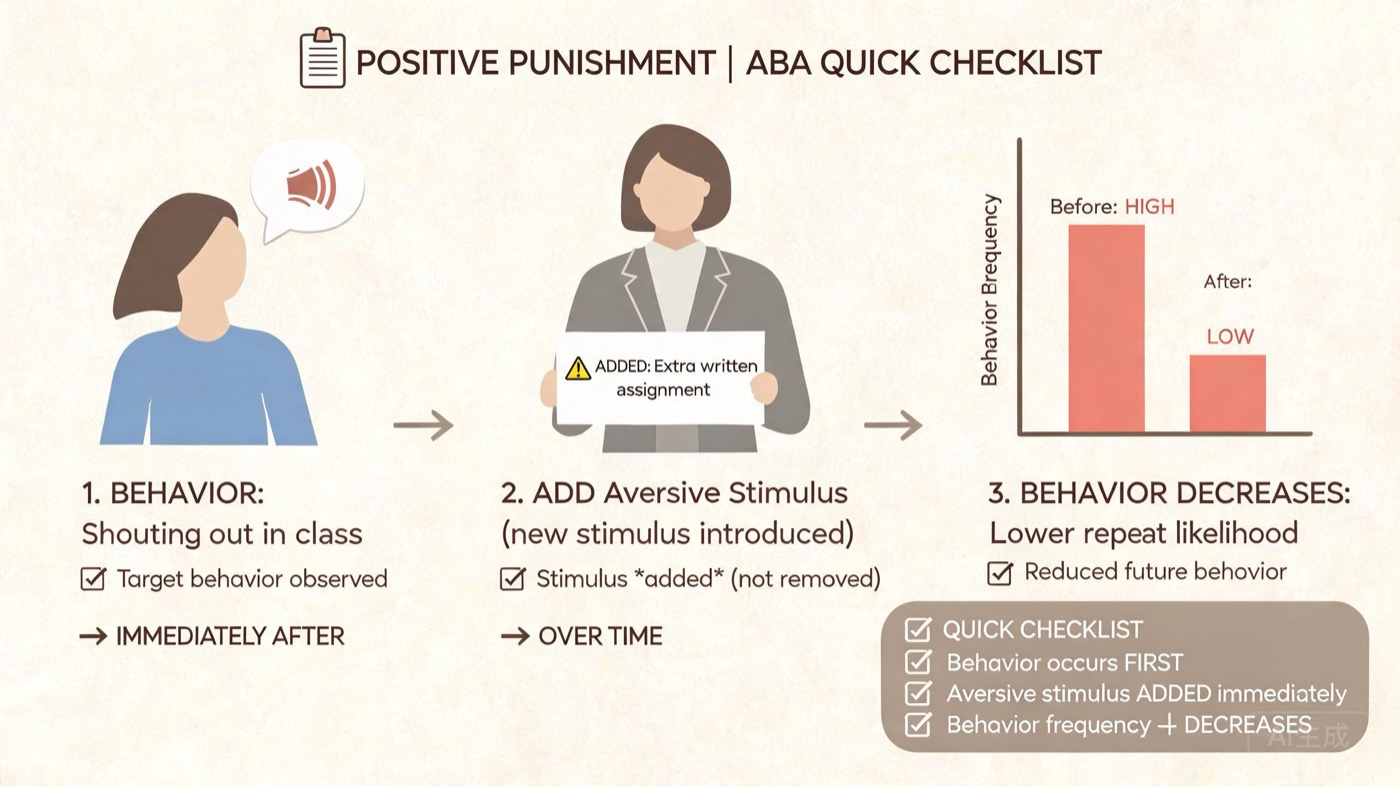
Quick Checklist: Is It Positive Punishment?
Use this checklist during the exam to verify your answer quickly.
- ☐ Behavior of interest clearly identified
- ☐ Behavior decreased (not increased)
- ☐ A stimulus was added (not removed)
- ☐ The added stimulus is aversive or leads to decreased behavior
- ☐ The consequence is delivered contingent on the behavior
Test Your Knowledge: Positive Punishment Scenarios
Practice with these low-stakes questions to reinforce your understanding.
- Scenario A: A child hits his sibling; parent immediately removes access to a favorite toy. The hitting decreases. Is this positive punishment? Answer: No, it’s negative punishment (removing something).
- Scenario B: A student calls out without raising hand; teacher adds a brief time-out in a quiet corner. Calling out decreases. Is this positive punishment? Answer: Yes, the time-out adds an aversive stimulus (removal from positive environment) and behavior decreases. Note: Time-out can be positive or negative punishment depending on implementation; here it adds a condition.
- Scenario C: A dog jumps on visitors; owner sprays water in the dog’s face. Jumping decreases. Is this positive punishment? Answer: Yes, water spray is added and behavior decreases.
For more practice, check our free BCBA mock exam practice questions.
Remember: when you see “which of the following is an example of positive punishment” on the exam, follow the decision tree: identify the behavior, confirm it decreased, and check for an added stimulus. With practice, you’ll spot positive punishment with confidence.
For authoritative information on ethical guidelines, refer to the BACB Ethics Code.



