
mean count per interval IOA measures how closely two observers’ counts agree inside each interval, then averages those interval-level agreement percentages. The formula is different from total count IOA because the session is not reduced to one pair of totals. It is also different from exact count-per-interval IOA because a near match can receive partial credit instead of being scored only as exact agreement or disagreement.
Table of Contents
- Mean Count Per Interval IOA Formula
- Worked Mean Count-Per-Interval IOA Example
- How to Handle Zero-Count Intervals
- Mean Count-Per-Interval IOA Compared With Other Count Methods
- Why Interval Averaging Matters
- Common Mean Count-Per-Interval IOA Mistakes
- Quick Review Checklist
- Practice Mean Count-Per-Interval IOA
- References
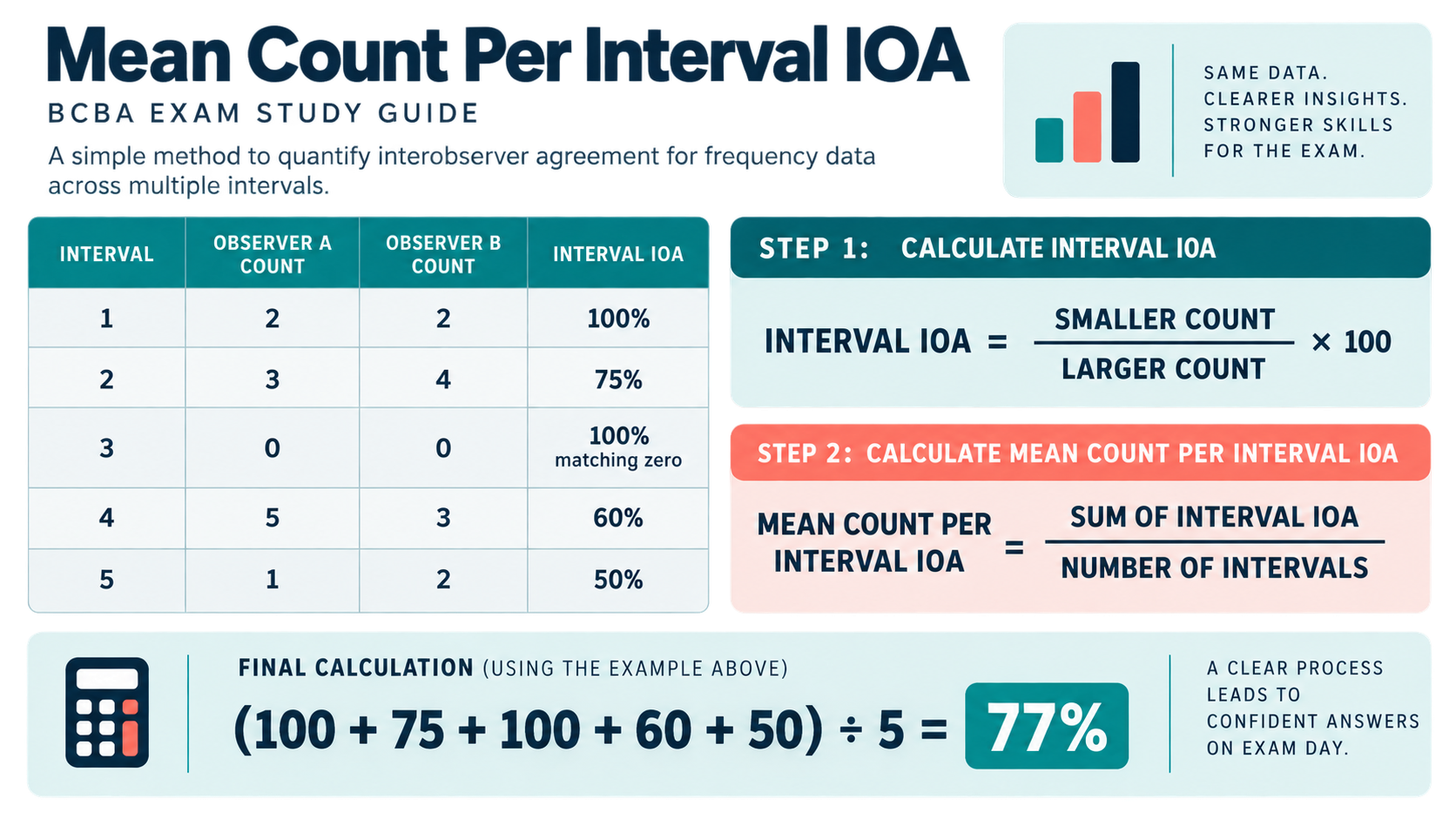
For each interval, divide the smaller count by the larger count and multiply by 100. Then add the interval IOA percentages and divide by the number of intervals. For example, interval scores of 100%, 75%, 100%, 60%, and 50% produce a mean count-per-interval IOA of 77.0%.
This method is useful for BCBA exam questions that provide count data in blocks or intervals and ask you to average agreement across the observation period. The most important clue is the sequence: calculate agreement per interval first, then average the results. Table of Contents
Mean Count Per Interval IOA Formula
Use this two-stage calculation when a question asks for mean count per interval IOA: Interval IOA (%) = smaller count in the interval ÷ larger count in the interval × 100 Mean count-per-interval IOA (%) = sum of all interval IOA percentages ÷ total number of intervals
Do not add all of Observer A’s counts and all of Observer B’s counts before calculating. That would turn the problem into total count IOA. Instead, keep the observers’ counts paired by interval, calculate one ratio for each pair, and average the ratios. The order matters because each interval contributes one equal-weight agreement value.
If an interval contains a smaller count of 2 and a larger count of 3, its interval agreement is 2 ÷ 3 × 100 = 66.7%. If the counts are 0 and 1, the interval agreement is 0 ÷ 1 × 100 = 0%. If both counts are 0, the common convention is to score that interval as 100% agreement because both observers recorded the same count. If a question or protocol gives a different rule for zero-zero intervals, follow that stated rule and show it in your work.
| Step | Question to ask | Calculation |
|---|---|---|
| 1. Pair | Which counts belong to the same interval? | Keep Observer A and Observer B aligned by interval. |
| 2. Calculate | Which count is smaller and which is larger? | Smaller interval count ÷ larger interval count × 100. |
| 3. Average | How many interval scores are there? | Add interval percentages and divide by the number of intervals. |
Worked Mean Count-Per-Interval IOA Example
Suppose two observers record the number of hand-raising responses across five equal intervals. Observer A records 2, 3, 0, 5, and 1. Observer B records 2, 4, 0, 3, and 2. Calculate the agreement separately in each interval before taking the mean.
| Interval | Observer A | Observer B | Interval calculation | Interval IOA |
|---|---|---|---|---|
| 1 | 2 | 2 | 2 ÷ 2 × 100 | 100% |
| 2 | 3 | 4 | 3 ÷ 4 × 100 | 75% |
| 3 | 0 | 0 | Both observers recorded 0 | 100% |
| 4 | 5 | 3 | 3 ÷ 5 × 100 | 60% |
| 5 | 1 | 2 | 1 ÷ 2 × 100 | 50% |
Now average the five interval scores:
- Add the interval IOA values: 100 + 75 + 100 + 60 + 50 = 385.
- Count the intervals: there are 5.
- Divide the sum by the number of intervals: 385 ÷ 5 = 77.
- Report the result: mean count-per-interval IOA = 77%.
The total count comparison would produce a different result: Observer A’s total is 11 and Observer B’s total is 11, so total count IOA would be 100%. That apparent perfect agreement hides the interval pattern. The mean count-per-interval calculation shows that the observers did not match equally well in every block.
How to Handle Zero-Count Intervals
A zero-count interval deserves attention because the usual smaller-count-over-larger-count expression becomes 0 ÷ 0 when both observers record zero. In the common mean count-per-interval convention, treat matching zeros as 100% interval agreement. This gives the interval credit for exact matching counts rather than deleting it from the average.
When one observer records zero and the other records a positive count, the interval agreement is 0%. That is not a missing value: the observers disagreed about whether any responses occurred in that interval. Keep the interval in the denominator unless the item specifically directs a different calculation.
- Both counts zero: commonly score the interval as 100% agreement.
- One count zero and the other positive: score the interval as 0% agreement.
- Both counts positive: divide the smaller count by the larger count.
- Follow an explicit scoring rule in the question if it overrides the usual convention.
Mean Count-Per-Interval IOA Compared With Other Count Methods
Several count-based IOA formulas use similar numbers but answer different questions. The measurement unit and the denominator are the fastest way to tell them apart.
| Method | What is compared? | Agreement rule | Question clue |
|---|---|---|---|
| Total count IOA | One session total per observer | Smaller total ÷ larger total × 100 | No interval breakdown |
| Mean count-per-interval IOA | Counts within every interval | Average smaller-over-larger ratios | Calculate each interval, then average |
| Exact count-per-interval IOA | Counts within every interval | Only identical counts are agreements | Percent of intervals with 100% agreement |
| Trial-by-trial IOA | Responses or outcomes on each trial | Matching trial outcomes ÷ total trials | Discrete trial sequence |
Why Interval Averaging Matters
Total count IOA can look high when the two observers’ errors offset across a session. One observer may record extra responses early and fewer responses later, while the other does the reverse. Their totals can match even though their interval-by-interval records do not. Mean count-per-interval IOA reduces that problem by preserving the location of the counts in the observation period.
Mean count-per-interval IOA is still a summary. It does not show every reason for disagreement, and it does not automatically establish that the operational definition is clear. Examine the raw data and the observation procedures when an agreement score is unexpectedly low or high.
- Keep interval boundaries identical for both observers.
- Use the same target-response definition throughout the session.
- Record the interval-level calculations before rounding the final mean.
- Name the IOA method whenever you report the percentage.
Common Mean Count-Per-Interval IOA Mistakes
- Adding the session totals first and accidentally calculating total count IOA.
- Using the larger count divided by the smaller count.
- Counting only exact matches when the question asks for mean count-per-interval IOA.
- Dropping every zero-count interval instead of applying the stated zero rule.
- Averaging the raw counts instead of the interval agreement percentages.
- Rounding every interval too aggressively before calculating the mean.
- Using the number of responses as the denominator instead of the number of intervals.
- Reporting the result without naming the IOA method.
Quick Review Checklist
Before selecting an answer, ask:
- Are counts provided separately for multiple intervals?
- Did I calculate smaller divided by larger within each interval?
- Did I preserve matching zero-count intervals according to the stated convention?
- Did I add the interval percentages rather than the raw counts?
- Did I divide by the total number of intervals?
- Am I accidentally using exact count-per-interval or total count IOA?
- Did I round only at the end when the answer choices require precision?
For targeted review, use our mean count per interval ioa practice questions to apply the concept in exam-style scenarios.
Practice Mean Count-Per-Interval IOA
Once the formula is familiar, practice with new interval tables and explain why a total-count answer may differ. Our mean count-per-interval IOA practice questions can help you separate interval averaging from total count and exact count-per-interval methods in BCBA-style scenarios. Practice is a study aid and does not replace the official BACB content outline or a supervision team’s measurement plan. Take the Free BCBA Mock Exam
References
- BACB BCBA Test Content Outline (6th ed.)
- BACB Test Content Outlines and Task Lists
- A Microsoft Excel Based Tool for Calculating Interobserver Agreement
- Applied Behavior Analysis, Global Edition



