
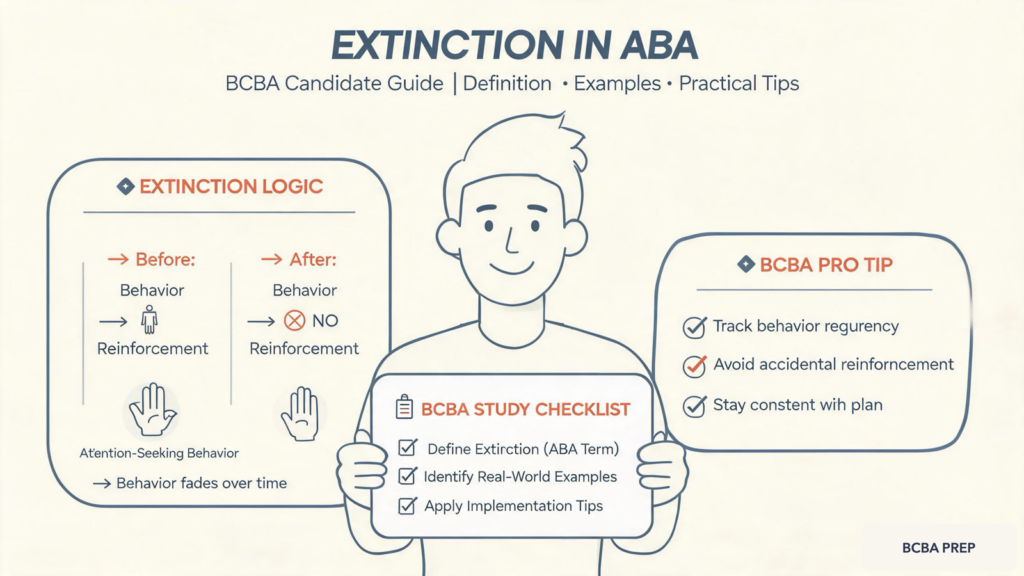
Extinction is one of the most powerful yet misunderstood procedures in applied behavior analysis. If you are studying for the BCBA exam, you need a firm grasp of extinction in ABA — not just the definition, but how it interacts with the three-term contingency, the types based on function, and the side effects that often appear on the exam. This article breaks it all down with clear examples and practical exam strategies.
Table of Contents
- What Is Extinction in Applied Behavior Analysis?
- Three Types of Extinction Every BCBA Candidate Must Know
- Extinction Burst and Spontaneous Recovery: Exam Traps
- Applying Extinction: Real-World Worked Examples
- Quick Checklist: Extinction on the BCBA Exam
- Summary: Why Extinction Is a Foundational ABA Skill
What Is Extinction in Applied Behavior Analysis?
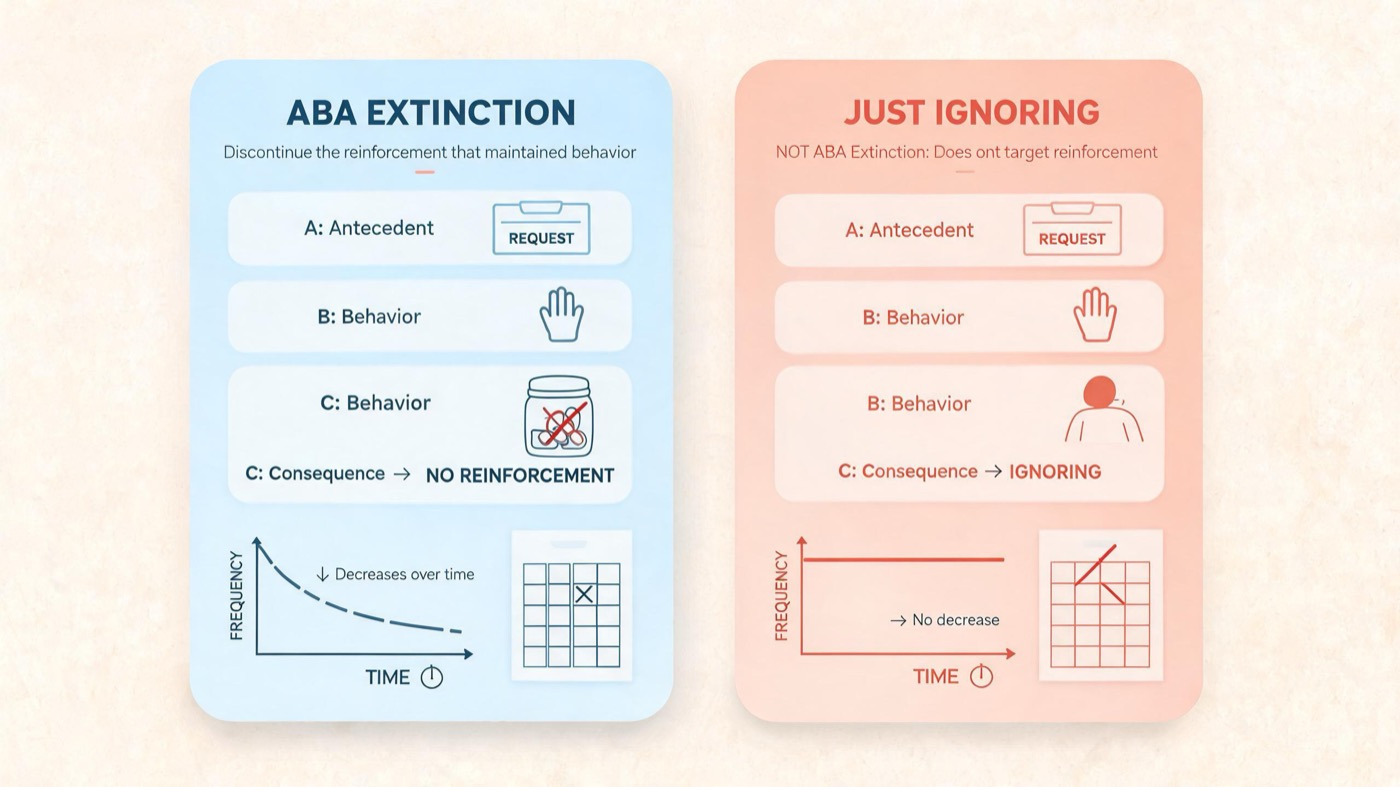
At its core, extinction means discontinuing the reinforcement that previously maintained a behavior. When reinforcement stops, the behavior should decrease over time. A common mistake is confusing extinction with ignoring — but ignoring only works if the behavior is maintained by attention. Extinction must be matched to the function of the behavior.
Consider the three-term contingency (ABC): Antecedent → Behavior → Consequence. Extinction targets the consequence. If a behavior no longer produces the reinforcer that once followed it, the behavior will weaken. For example, a child who tantrums to get a toy and no longer receives the toy will eventually tantrum less.
Here is the technical definition you need for the exam: extinction is the discontinuation of reinforcement for a previously reinforced behavior, resulting in a decrease in the future frequency of that behavior. It is a behavior reduction procedure. However, it is not a punishment procedure; it does not involve adding or removing a stimulus after the behavior — it simply removes the maintaining reinforcer.
Three Types of Extinction Every BCBA Candidate Must Know
The type of extinction you use depends on the function of the behavior. The BCBA exam often asks you to identify which type of extinction is being applied based on the reinforcer that is removed. Here are the three types, each with a real-world example.
Extinction of Positively Reinforced Behavior
When a behavior is maintained by positive reinforcement — gaining something — extinction involves withholding that item or activity. Example: A child whines for candy at the grocery store. Antecedent: denied candy. Behavior: whining. Consequence: parent gives candy. When the parent consistently stops providing candy, whining should decrease. Function: access to tangibles.
Extinction of Negatively Reinforced Behavior
When a behavior is maintained by negative reinforcement — escaping or avoiding something — extinction involves preventing escape. Example: A student asks to leave class every time a math worksheet is presented. Antecedent: teacher hands out worksheet. Behavior: student says “I need a break.” Consequence: teacher allows student to leave. To implement extinction, the teacher does not allow the student to leave contingent on the request; instead, the teacher prompts the student to begin the task. Function: escape from task demands.
Extinction of Automatically Reinforced Behavior
This type is trickier because the reinforcer is not socially mediated — it comes directly from the behavior itself. Example: A child engages in hand-flapping that provides sensory stimulation. Extinction here involves blocking the sensory consequence, such as using protective equipment or redirecting to incompatible activities. Since the reinforcer is internal, you must be creative and often use alternative procedures.
Extinction Burst and Spontaneous Recovery: Exam Traps
Two phenomena almost always show up on the BCBA exam: the extinction burst and spontaneous recovery. These are considered side effects of extinction and can easily trick test-takers.
An extinction burst is a temporary increase in the frequency, intensity, or duration of the behavior immediately after extinction begins. The learner “tries harder” to get the reinforcer. On the exam, if a behavior escalates right after an extinction procedure is introduced, the correct answer is often “extinction burst.” Not knowing this can lead you to mistakenly think extinction is not working.
Spontaneous recovery is the reappearance of a previously extinguished behavior after a period of time without the behavior occurring. If a child stops tantruming for a week and then tantrums again, that is spontaneous recovery. On the exam, remember that spontaneous recovery is temporary; reinforcement should not be provided during these episodes or the behavior may be strengthened again.
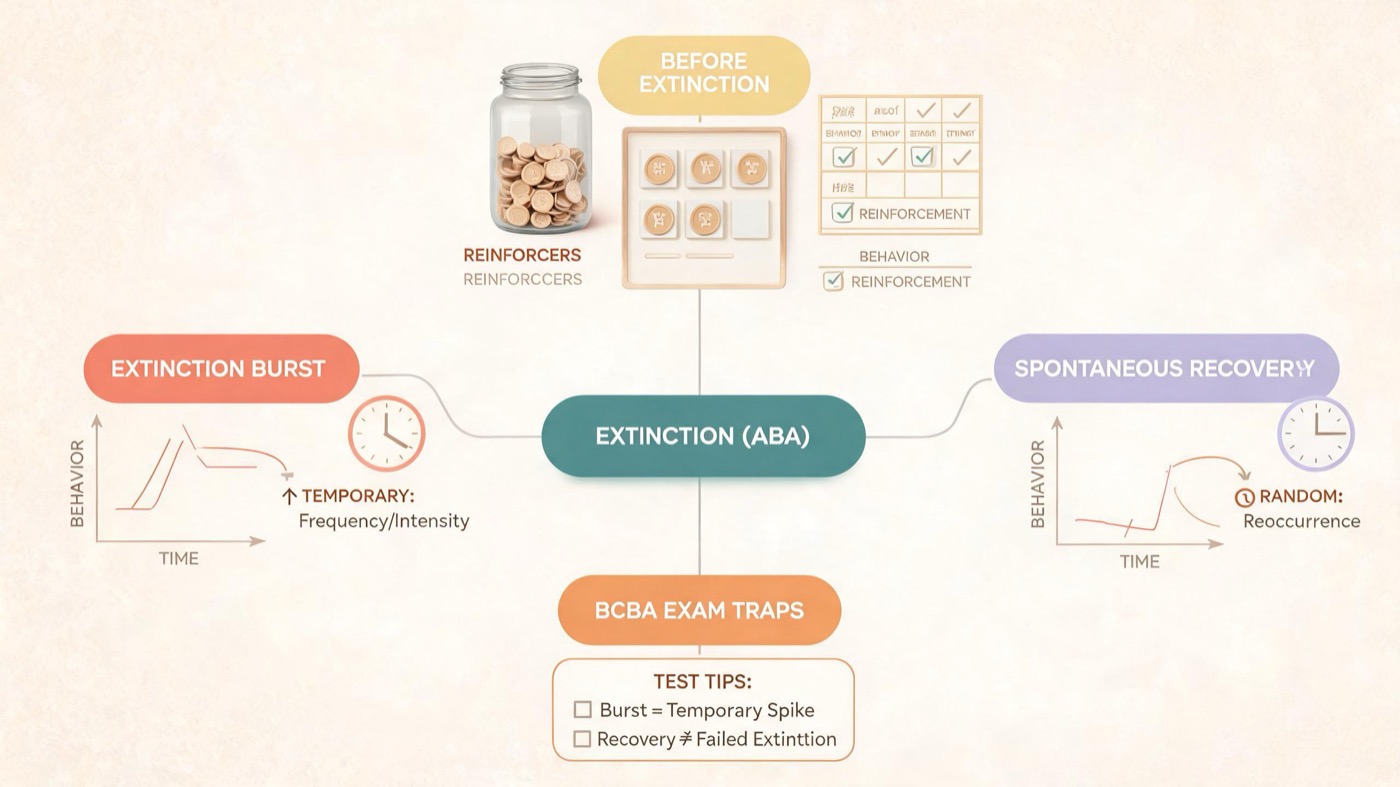
Other side effects include extinction-induced aggression (emotional outbursts) and extinction-induced variability (new behaviors emerging). The exam may ask you to identify these as natural byproducts of extinction, not reasons to stop the procedure.
Applying Extinction: Real-World Worked Examples
Seeing extinction in action through worked examples helps solidify your understanding. Here are three scenarios with ABC data and reasoning.
Example 1: Reducing Tantrums in a Classroom
ABC Data: Antecedent: teacher ignores student’s raised hand (focuses on another student). Behavior: child screams “HELP!” Consequence: teacher rushes over and gives attention. Hypothesized function: attention. Extinction procedure: planned ignoring — no eye contact, no verbal response, no physical proximity when screaming occurs. Note: expect an extinction burst; the child may scream louder initially. Consistency is critical; even one instance of providing attention can undo progress.
Example 2: Decreasing Off-Task Behavior During Homework
ABC Data: Antecedent: parent places worksheet in front of child. Behavior: child says “I need a break.” Consequence: parent allows 5-minute break. Hypothesized function: escape from task. Extinction procedure: parent does not allow break when the child requests it during the demand; instead, parent uses a prompt to continue working. Break is still available after a predetermined amount of work is completed (differential reinforcement alternative). Important: ensure the child can still access breaks appropriately; extinction only targets the escape-maintained request.
Example 3: Reducing Verbal Protest During Transitions
ABC Data: Antecedent: therapist says “time to clean up.” Behavior: child says “no, I don’t want to.” Consequence: therapist stops and waits, and eventually child avoids clean-up for 2 minutes. Hypothesized function: escape from transition. Extinction procedure: therapist does not delay the transition when the child protests; instead, the therapist physically prompts the child to begin cleaning (with minimal attention to the protest). Over time, the protest behavior decreases. Exam tip: this combines extinction with prompting and differential reinforcement.
Quick Checklist: Extinction on the BCBA Exam
Use this checklist for last-minute review before the BCBA exam. These are the key points exam questions often test.
- Identify the function first: extinction must match the maintaining reinforcer.
- Recognize extinction burst: a temporary increase in behavior after extinction begins.
- Recognize spontaneous recovery: behavior returns after a period of no occurrence.
- Watch for aggression and variability: these are natural side effects, not reasons to stop.
- Extinction is not ignoring: ignoring only works for attention-maintained behaviors.
- Ethical considerations: use extinction with reinforcement-based procedures (e.g., DRA) and monitor for harm.
- Consistency is key: intermittent reinforcement after extinction can make the behavior more resistant to extinction.
- Automatic reinforcement: extinction is challenging; consider blocking or sensory extinction.
Summary: Why Extinction Is a Foundational ABA Skill
Extinction is a cornerstone of ABA. Understanding extinction in ABA means you can reduce problem behaviors effectively when paired with reinforcement strategies. For the BCBA exam, focus on the three types, the side effects, and the ethical application. Practice with mock questions to build fluency. For more in-depth study, check out our BCBA exam prep guide and our differential reinforcement guide. You can also review the BACB website for official task list updates. Keep practicing, and good luck!
Complete BCBA Exam Prep
Turn this topic into exam-day practice
Practice concepts in context with five full-length 6th Edition mock exams, two bonus practice exams, a 6th Edition study guide, and key-term flashcards—all in one $120 USD package.
Get the $120 All-in-One Prep Pack
Review everything included on the product page before ordering. No pass guarantee is implied.



