

What Is Masking in ABA? A Precise Definition
In applied behavior analysis, masking refers to a phenomenon where the presence of a particular stimulus or condition temporarily reduces or hides the occurrence of a behavior, making it appear less frequent or even absent when it is actually occurring under other conditions. This is not a permanent loss of behavior; rather, it is a temporary interference that can significantly distort behavioral assessment data if not recognized.
Table of Contents
- What Is Masking in ABA? A Precise Definition
- Why Masking Matters in Behavioral Assessment
- Masking vs. Overshadowing: Key Distinctions
- Three Worked Examples of Masking in Real-World ABA
- Common Exam Traps and How to Avoid Them
- Quick Checklist: Identifying and Handling Masking in Your Practice
- Summary: Masking as a Critical Exam and Practice Concept
- Quick Review Checklist
- Take the Free BCBA Mock Exam
For example, a child may reliably request a toy at home but stop doing so when a strict caregiver is present. The behavior is still in the repertoire, but the environmental context masks its expression. In daily practice, masking can lead to inaccurate conclusions about behavioral function and the effectiveness of interventions. For BCBA candidates, understanding masking is essential because exam questions often present scenarios where an apparent behavior reduction is actually due to this phenomenon rather than a true change in contingency.
How Masking Differs from Extinction and Habituation: Newer behavior analysts sometimes confuse masking with extinction or habituation. In extinction, the reinforcing consequence is removed, leading to a gradual decrease in behavior. Masking, however, involves an environmental variable that suppresses the behavior without altering the reinforcement history. In other words, the behavior would rebound immediately if the masking stimulus were removed.
Habituation is a different process: a decrease in response to a repeated stimulus due to decreased responsiveness of the nervous system, not due to competition from another stimulus. For instance, a child might stop noticing a constant background noise, but that is not masking. Masking specifically involves a stimulus that ‘covers up’ the behavior’s occurrence, requiring careful differential diagnosis in assessment. Knowing these distinctions helps you choose the most appropriate intervention and avoids misinterpreting data in applied settings.
Why Masking Matters in Behavioral Assessment
When conducting a functional behavior assessment (FBA), the goal is to identify the variables maintaining problem behavior. Masking can derail this process because it may conceal the true frequency of behavior, leading to incorrect hypotheses about its function. For example, a student who engages in disruptive behavior to gain teacher attention might do so less often when a paraprofessional is present. If you only observe during paraprofessional shifts, you might wrongly conclude that the behavior is not attention-maintained.
Such misinterpretations can result in ineffective interventions. If the behavior is actually maintained by attention, but you implement an intervention based on escape function, the behavior may persist or worsen. Therefore, identifying masking is not just an academic exercise; it is a practical necessity for effective treatment planning.
Impact on Data Collection and Interpretation: Masking affects both direct observation and data analysis. When behaviors are masked, frequency counts and interval recordings will show artificially low rates. This can make a behavior seem less severe than it is, potentially leading to under-treatment. Additionally, if you are monitoring intervention effects, masking can make a successful intervention appear ineffective if the masking stimulus is present during post-intervention probes but was absent during baseline.
To mitigate this, it’s crucial to collect data across multiple settings, times, and people. For instance, if a behavior occurs mainly at home but not at school, you might suspect a masking variable at school. By systematically varying these conditions, you can uncover the true behavioral pattern and avoid drawing false conclusions. Identifying Masking During Functional Behavior Assessment (FBA): Recognizing masking requires a structured approach. Here are key strategies to incorporate into your FBA process:
- Observe across settings: Conduct observations in at least three different natural environments (e.g., home, school, community) to see if behavior varies.
- Manipulate antecedents: Systematically alter potential masking stimuli (e.g., presence of certain people, noise levels) to see if behavior emerges.
- Compare data sources: Look for discrepancies between direct observation and caregiver or teacher reports.
- Review historical data: Check if behavior occurred at higher rates in the past when certain conditions were absent.
These methods help you discriminate masking from true behavior reduction and lead to more accurate functional hypotheses.
Masking vs. Overshadowing: Key Distinctions
In stimulus control literature, masking and overshadowing are related but distinct phenomena. Both involve competition between stimuli, but they differ in their mechanisms and how they are studied. Understanding these differences is critical for answering exam questions that ask you to identify which concept applies in a given scenario.
Definitions and Mechanisms: Overshadowing occurs when two stimuli are presented together, and one stimulus gains strong control over behavior while the other gains little or no control. This typically happens during conditioning. For example, if a light and a tone are paired with reinforcement, the light may overshadow the tone, meaning the tone alone does not evoke the response. Masking, on the other hand, involves a stimulus that interferes with the expression of a behavior that has already been learned, without necessarily affecting stimulus control.
In simpler terms, overshadowing is about how stimuli acquire control, whereas masking is about how the expression of learned behavior is suppressed. Both are forms of stimulus competition, but they occur at different stages. Overshadowing occurs during acquisition, while masking occurs after the behavior is already established.
Contrived vs. Natural Conditions: Overshadowing is often studied in controlled experimental settings, such as Pavlovian conditioning experiments with animals. In contrast, masking frequently arises in natural environments, such as classrooms or homes, where multiple stimuli are present. For example, a child might use a mand (request) at home but not in a noisy classroom, where the noise masks the opportunity or motivation. In this case, the noise is not necessarily a learned inhibitor, but rather a competing stimulus that reduces the likelihood of the behavior.
For the exam, you should be able to distinguish these two. Look for clues: if the scenario involves a history of stimulus pairing, it is likely overshadowing; if it involves an environmental stimulus suppressing an already acquired behavior, masking is more likely.
Three Worked Examples of Masking in Real-World ABA
To solidify your understanding, let’s walk through three detailed examples that illustrate how masking appears in common ABA practice. Each example follows an ABC (Antecedent-Behavior-Consequence) format and highlights the hypothesized function of the behavior. These examples are modeled on realistic scenarios you might encounter in your career or on the exam.
Example 1: In a Classroom Setting: Scenario: Marcus, a 7-year-old with autism, typically raises his hand to ask questions during math lessons. However, when a new student joins the class, Marcus stops raising his hand. Observations show that when the new student is absent, Marcus raises his hand frequently. ABC analysis: Antecedent – Teacher asks a question; Behavior – Marcus raises his hand; Consequence – Teacher calls on him (attention). The new student’s presence may be an aversive stimulus (perhaps due to social anxiety), masking the hand-raising behavior. Hypothesized function: Social attention (from the teacher). The behavior is not occurring because the new student’s presence serves as an establishing operation that suppresses the behavior. This masking is transient and context-specific.
Example 2: In a Home Environment: Scenario: Lily, a 4-year-old, often requests snacks from her mother. When her grandmother visits, Lily stops requesting snacks entirely. ABC analysis: Antecedent – Snack time; Behavior – Lily asks for a snack; Consequence – Mother gives her a snack (access to tangible). Grandmother’s presence may be a discriminative stimulus for something else, or it may be an aversive condition (e.g., grandma is strict), masking the request behavior.
Hypothesized function: Access to tangibles. The masking stimulus is the grandmother, and once she leaves, the requesting behavior returns. Understanding this helps the behavior analyst design interventions that teach Lily to request in various contexts or that modify the grandmother’s presence if it is problematic.
Example 3: In a Clinic or Therapy Session: Scenario: A teenage client, Sam, engages in stereotypy (hand flapping) frequently at home. During therapy sessions with a particular therapist, Sam exhibits almost no stereotypy. ABC analysis: Antecedent – Therapy session begins; Behavior – Hand flapping; Consequence – Automatic reinforcement (sensory)。 The therapist may be a highly preferred person, and the presence of this therapist may compete with the automatic reinforcement, thus masking the hand flapping.
Hypothesized function: Automatic reinforcement. Here, masking impacts treatment evaluation because if you only take data during therapy, you might incorrectly conclude that the stereotypy is low and not in need of intervention. But the behavior is actually occurring at high rates at home. These examples demonstrate how masking can hide socially mediated and automatically reinforced behaviors alike, and why assessment must consider multiple contexts.
Common Exam Traps and How to Avoid Them
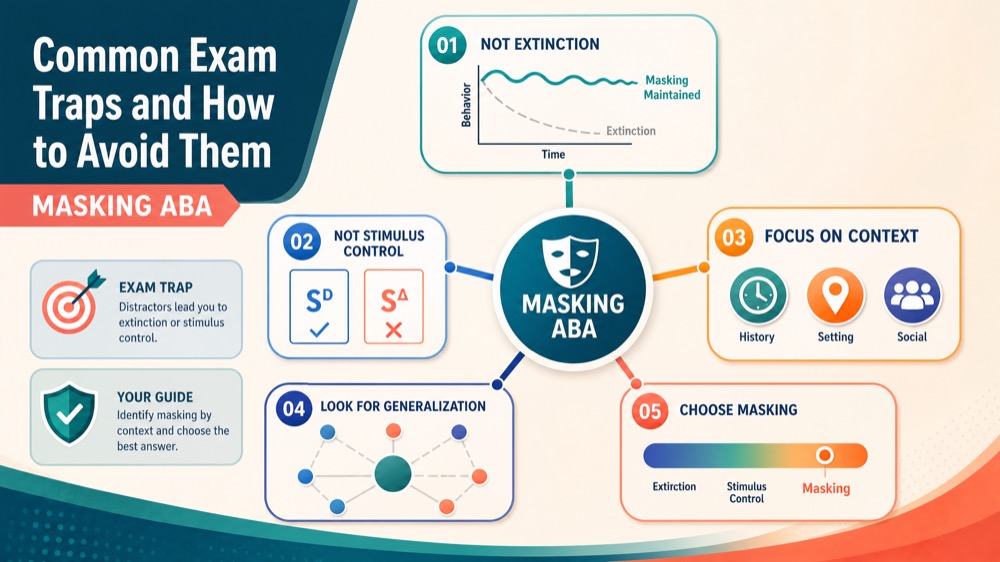
On the BCBA exam, questions about masking often include distractors that lead candidates to choose an answer related to extinction or stimulus control. Understanding common traps will help you reason through difficult items. Misinterpreting Masking as Functional Change: A common error is assuming that a decrease in behavior during intervention means the intervention is working, when in reality, a new environmental variable is masking the behavior. For example, a functional communication training (FCT) program might show a decrease in mands when a new supervisor is present, but that does not mean the FCT is ineffective. To avoid this trap, always analyze the context of data collection. Ask: Are there any new stimuli present that could be masking the behavior? If so, assess under multiple conditions before concluding that the intervention is or is not effective. Additionally, be cautious of questions that describe a behavior that occurs only in specific settings. They may be testing whether you can identify masking as a potential explanation.
Confusing Masking with Stimulus Control: Another trap is confusing masking with stimulus control. In stimulus control, a behavior occurs in the presence of a discriminative stimulus (Sd) and not in its absence. Masking, however, is not about the absence of an Sd; rather, an additional stimulus interferes with the behavior despite the Sd being present. For example, a student might have a well-established mand repertoire, but a loud noise masks the opportunity to respond. In stimulus control, there would be no response in the absence of the Sd, but here the Sd is present, yet behavior does not occur due to the masking stimulus.
To distinguish, look at the history: if the behavior is reinforced in the presence of an Sd, but fails to occur when another stimulus is present, it is masking. If the behavior only occurs in the presence of an Sd and not otherwise, it is stimulus control. Keeping these definitions clear will help you answer such questions accurately.
Quick Checklist: Identifying and Handling Masking in Your Practice
As you prepare for the exam and plan to work as a BCBA, use this checklist to guide your assessment and intervention when masking is suspected. It summarizes the key actions you can take to avoid falling into assessment traps.
- Conduct multi-setting observations: Observe the target behavior across at least three relevant environments.
- Manipulate potential masking stimuli: Systematically alter the presence of people, noise, or materials to see if behavior emerges.
- Compare data sources: Cross-reference direct observation with caregiver or teacher reports to identify discrepancies.
- Interview others: Ask parents or staff about any contexts where the behavior does not occur; they may be aware of masking factors.
- Use brief functional analysis conditions: If appropriate, conduct condition comparisons (e.g., attention vs. alone) to determine if masking is present in certain conditions.
- Monitor intervention across contexts: When evaluating an intervention, ensure that data are collected in both masking and non-masking conditions.
This checklist is not exhaustive, but it provides a practical starting point for incorporating masking awareness into your professional repertoire.
Summary: Masking as a Critical Exam and Practice Concept
Masking is a subtle but important concept in ABA that can significantly impact behavioral assessment and intervention fidelity. Failing to account for masking can lead to incorrect functional hypotheses, ineffective interventions, and wasted resources. For BCBA candidates, mastering this concept is essential not only to pass the exam but also to provide high-quality services in the field.
Remember that masking differs from extinction and overshadowing, and it is often revealed by cross-contextual observation. Use the checklist and examples above to guide your study. As you review related concepts such as functional behavior assessment and stimulus control, keep masking in mind as a variable that can influence your data. For authoritative definitions, refer to the Behavior Analyst Certification Board resources and peer-reviewed literature. By integrating masking into your assessment skill set, you will become a more accurate and effective behavior analyst.
Quick Review Checklist
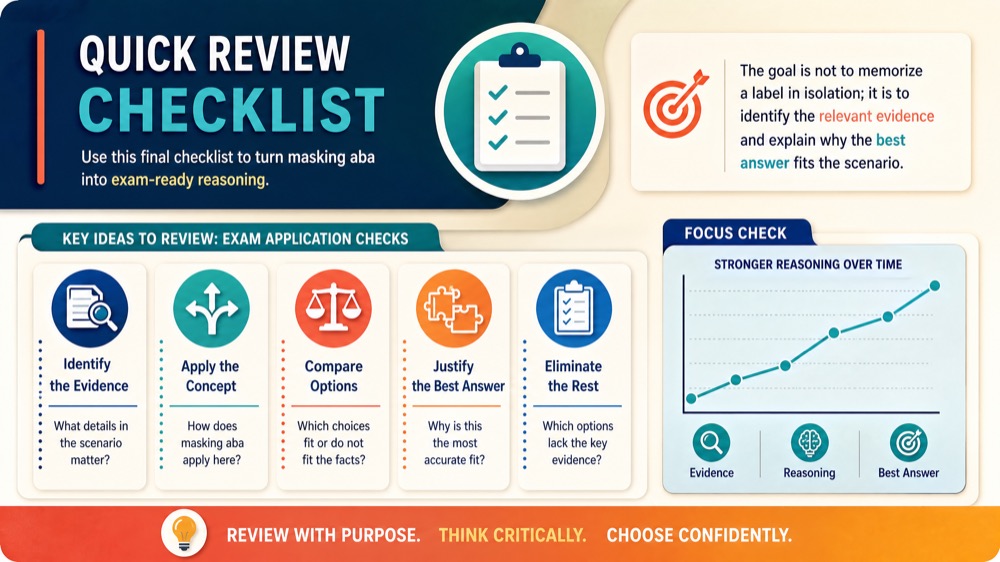
Use this final checklist to turn masking aba into exam-ready reasoning. The goal is not to memorize a label in isolation; it is to identify the relevant evidence and explain why the best answer fits the scenario. Key ideas to review:
- State the central definition or decision point for masking aba in your own words.
- Identify the detail that makes masking aba different from its closest related ABA term.
- Separate the observable facts in a scenario from assumptions that are not supported by the facts.
- Write one example and one nonexample so you can recognize the concept in a new setting.
Exam application checks:
- Ask what the question is actually requesting before comparing the answer choices.
- Mark the antecedent, response, consequence, or other evidence that supports the selected answer.
- Look for a distractor that describes a related process but does not answer the specific question.
Final self-check:
- Explain how you would verify the interpretation with clear observations or data.
- Change one detail in the scenario and decide whether your answer should change.
- Give a one-sentence rationale that a supervisor or study partner could evaluate.
Take the Free BCBA Mock Exam
Ready for more practice? Use the free mock exam to keep testing your accuracy with realistic BCBA-style items. Take the Free BCBA Mock Exam
Next step for BCBA exam prep
Turn this topic into exam-day practice
Use this topic as a focused review, then test it in exam-style conditions with a free mock before deciding whether five full-length mocks are the right next step.
Start the Free BCBA Mock ExamContinue with Five Full-Length Mocks — $99
Review the included materials and access details before ordering. No pass guarantee is implied.



