
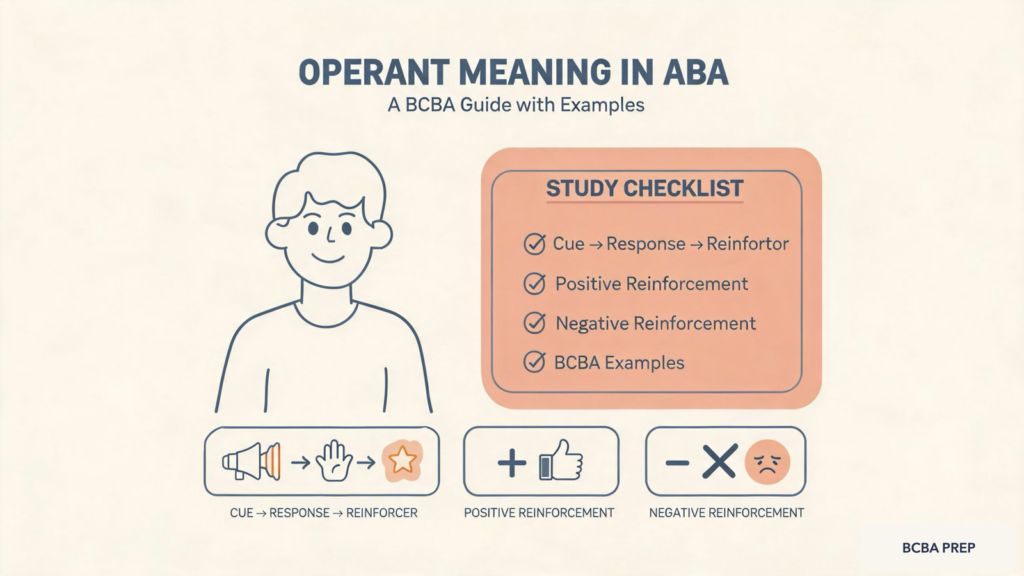
What operant means in ABA
In applied behavior analysis, an operant meaning refers to a class of behaviors that are influenced by their consequences. Unlike reflexes, which are elicited by antecedent stimuli, operant behaviors are emitted voluntarily and shaped by what happens after them. The term ‘operant’ was coined by B.F. Skinner to describe how organisms ‘operate’ on their environment to produce effects.
Table of Contents
- What operant means in ABA
- Real ABA examples of operants
- Why consequences define an operant
- Common BCBA study traps
- Quick checklist for identifying an operant
- How to Study define operant for BCBA-Style Questions
- How to Study define operant for BCBA-Style Questions
- Take the Free BCBA Mock Exam
The core idea is that consequences—reinforcement or punishment—increase or decrease the future frequency of a behavior. For the BCBA exam, you must grasp that an operant is defined by its function, not its form. This means two topographically different behaviors (e.g., saying ‘help’ vs. raising a hand) can belong to the same operant if they produce the same consequence.
How operants differ from reflexes: A reflex is an involuntary, automatic response to a specific stimulus (e.g., eyeblink to a puff of air). In contrast, an operant is a learned, voluntary behavior that is controlled by its consequences. Key differences include:
- Reflexes are elicited by antecedents; operants are evoked by antecedents but maintained by consequences.
- Reflexes have little to no variability; operants can vary in topography but still belong to the same class.
- Operants are the focus of ABA interventions because they can be strengthened, weakened, or shaped.
Real ABA examples of operants
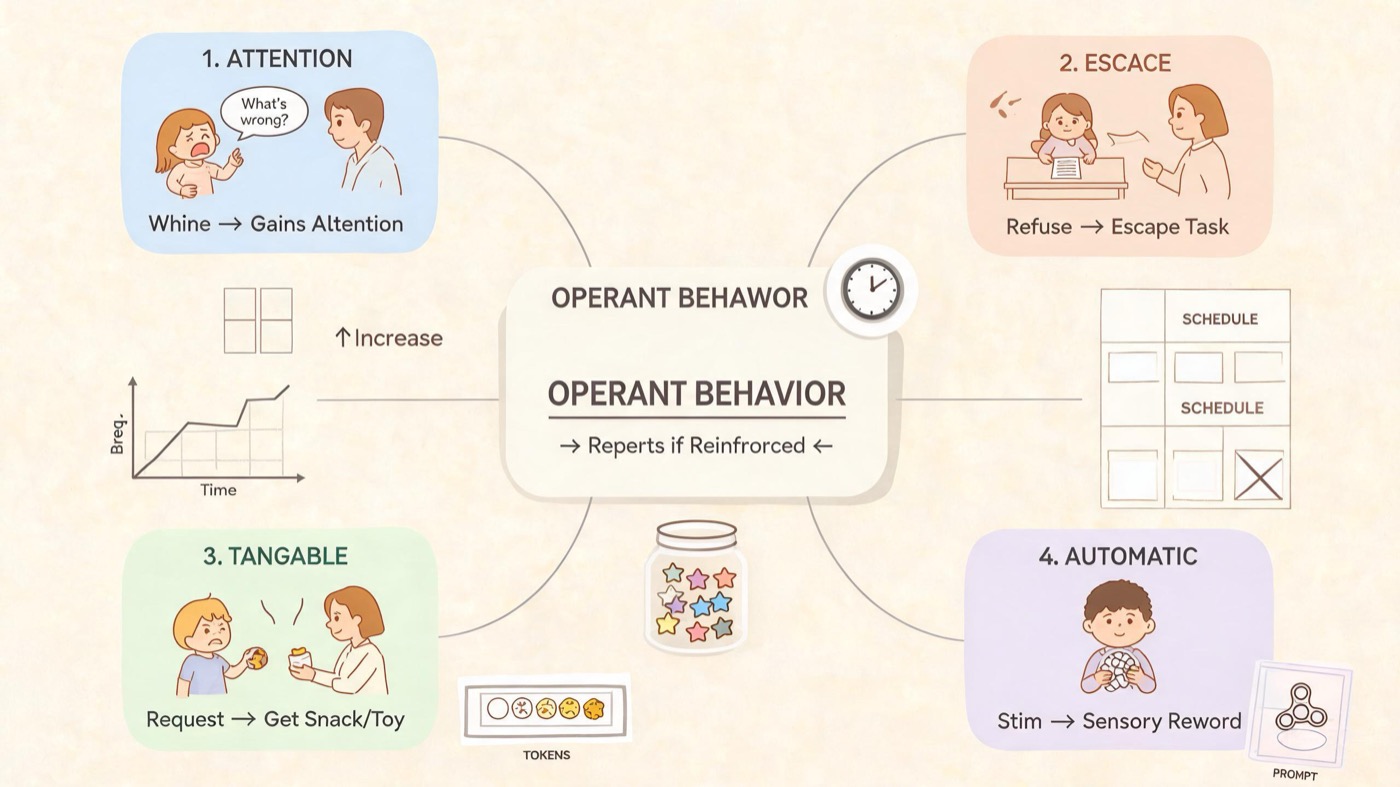
Seeing operants in action helps solidify the concept. Below are three common function-based examples you might encounter on the BCBA exam. Attention example: A child whines, and the parent immediately says, ‘What’s wrong?’ If whining increases in the future, it is an operant maintained by attention. The consequence (parent attention) reinforces the behavior. Note: the whining could take different forms—crying, tapping, or calling out—but all may be part of the same operant if they produce attention.
Escape example: A student is given a difficult math worksheet. He throws his pencil, and the teacher removes the worksheet. If throwing the pencil increases, it is an operant maintained by escape. The consequence (removal of the task) negatively reinforces the behavior. The topography could be different (e.g., ripping the paper, asking for a break), but the function remains the same.
Tangible example: A toddler wants a cookie. She says ‘cookie,’ and her mother gives her one. If saying ‘cookie’ increases, it is an operant maintained by access to tangibles. The consequence (getting the cookie) reinforces the verbal behavior. This example illustrates how operants can be shaped by positive reinforcement. For more on how consequences affect behavior, see our guide on positive reinforcement in ABA.
Why consequences define an operant
An operant is not a single behavior but a response class. This means multiple behaviors that produce the same consequence are grouped together. For the BCBA exam, remember that the consequence is the defining feature. If two behaviors produce the same reinforcer, they are members of the same operant class. If they produce different reinforcers, they belong to different classes.
Reinforcement and response class: When a behavior is reinforced, it becomes more likely to occur. However, other behaviors that produce the same consequence may also increase, a phenomenon called response induction. For example, if a child’s ‘please give me’ is reinforced with a cookie, the child may also say ‘can I have’ (a different topography) to get cookies. Both are part of the same operant because they access the same tangible item. Understanding this helps BCBA candidates design interventions that target function over form. To dive deeper, read about negative reinforcement in ABA and how it defines escape-maintained operants.
Common BCBA study traps
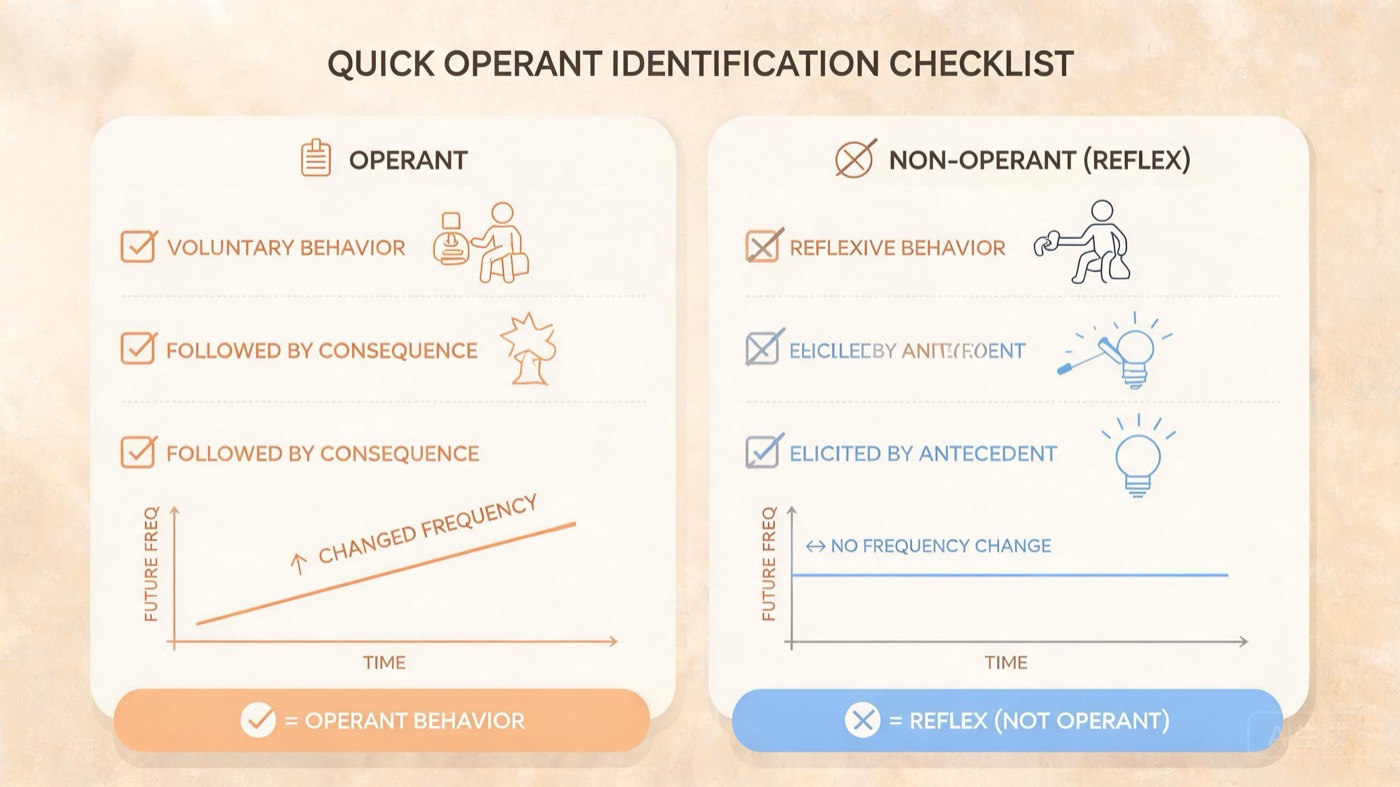
Many students confuse operants with other behavioral concepts. Here are two frequent traps on the exam, with tips to avoid them. Operant vs respondent: The easiest way to distinguish: operants are controlled by consequences; respondents are controlled by antecedents (elicited). If the behavior is involuntary and occurs automatically after a stimulus (e.g., sweating due to heat), it is respondent. If the behavior is voluntary and its future rate depends on what happens after, it is operant. Exam questions often describe a behavior followed by a consequence; that is the clue that you are dealing with an operant.
Topography vs function: Another trap is focusing on how the behavior looks (topography) rather than why it occurs (function). For example, two clients might both scream. One screams to get attention, another to escape a task. Even though the topography is identical, these are different operants because they have different functions. On the exam, always ask: What consequence maintains this behavior? That will identify the operant class. For more exam tips, see BCBA 6th edition concepts and principles study guide.
Quick checklist for identifying an operant
Use this step-by-step checklist when analyzing behavior during the exam:
- Identify the behavior. Describe it in observable, measurable terms.
- Identify the immediate consequence. What happens right after the behavior?
- Determine if the consequence is reinforcing or punishing. Does the behavior increase or decrease over time?
- Identify the function. Is the consequence social (attention, escape, tangible) or automatic (sensory)?
- Group similar behaviors. If multiple behaviors produce the same consequence, they belong to the same operant class.
Exam decision rules: When in doubt, remember these rules: If the behavior is voluntary and followed by a consequence that changes its future frequency, it is an operant. If the behavior is reflexive and elicited by an antecedent without a consequence, it is not an operant. Use the four-term contingency (EO, SD, Behavior, Consequence) to map out operant relations. Practicing with mock questions can sharpen this skill. Try our free BCBA mock exam practice questions to test your understanding.
Finally, remember that the operant meaning is foundational to ABA. Mastering this concept will help you across multiple exam domains, including measurement, assessment, and intervention. For further reading, see the BACB’s official website and peer-reviewed articles on operant conditioning.
How to Study define operant for BCBA-Style Questions
When you review define operant, do not stop at the definition. The exam usually tests whether you can apply the concept inside a short scenario, separate it from similar terms, and choose the most behaviorally precise answer. A strong study routine should connect the term to observable behavior, environmental context, measurement, and likely consequences.
- Define the response: identify exactly what the learner or client does, not just the broad skill area.
- Find the context: note the antecedent, setting, materials, people, or condition that makes the concept relevant.
- Check the consequence: ask what changes after the response and whether that change supports the answer choice.
- Compare close terms: write one sentence explaining why the best answer is not a related but different ABA concept.
For practice, turn each example into a quick discrimination exercise. Ask, “What would make this answer wrong?” and then change one detail in the scenario. This builds flexible exam reasoning instead of memorizing a single phrase.
How to Study define operant for BCBA-Style Questions
When you review define operant, do not stop at the definition. The exam usually tests whether you can apply the concept inside a short scenario, separate it from similar terms, and choose the most behaviorally precise answer. A strong study routine should connect the term to observable behavior, environmental context, measurement, and likely consequences.
- Define the response: identify exactly what the learner or client does, not just the broad skill area.
- Find the context: note the antecedent, setting, materials, people, or condition that makes the concept relevant.
- Check the consequence: ask what changes after the response and whether that change supports the answer choice.
- Compare close terms: write one sentence explaining why the best answer is not a related but different ABA concept.
For practice, turn each example into a quick discrimination exercise. Ask, “What would make this answer wrong?” and then change one detail in the scenario. This builds flexible exam reasoning instead of memorizing a single phrase.
Take the Free BCBA Mock Exam
Ready for more practice? Use the free mock exam to keep testing your accuracy with realistic BCBA-style items. Take the Free BCBA Mock Exam
Next step for BCBA exam prep
Turn this topic into exam-day practice
Use this topic as a focused review, then test it in exam-style conditions with a free mock before deciding whether five full-length mocks are the right next step.
Start the Free BCBA Mock ExamContinue with Five Full-Length Mocks — $99
Review the included materials and access details before ordering. No pass guarantee is implied.



