
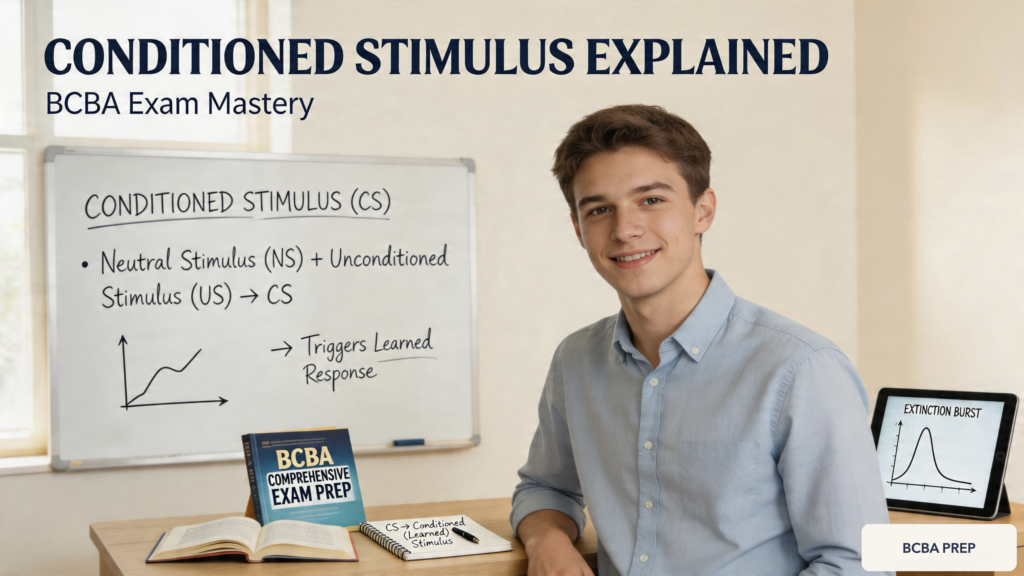
What Is a Conditioned Stimulus?
A conditioned stimulus (CS) is a previously neutral stimulus that, after repeated pairing with an unconditioned stimulus (US), begins to elicit a learned response. This process occurs within respondent conditioning, also called classical conditioning. For the BCBA exam, you must distinguish the CS from the unconditioned stimulus and the neutral stimulus.
Table of Contents
- What Is a Conditioned Stimulus?
- Function-Based Examples for the BCBA Exam
- Exam Relevance: How the BCBA Tests Conditioned Stimulus
- Quick Study Checklist: Conditioned Stimulus
- Conditioned Stimulus vs Neutral Stimulus
- Summary: Key Takeaways for the Exam
- References
Classical (Respondent) Conditioning Basics
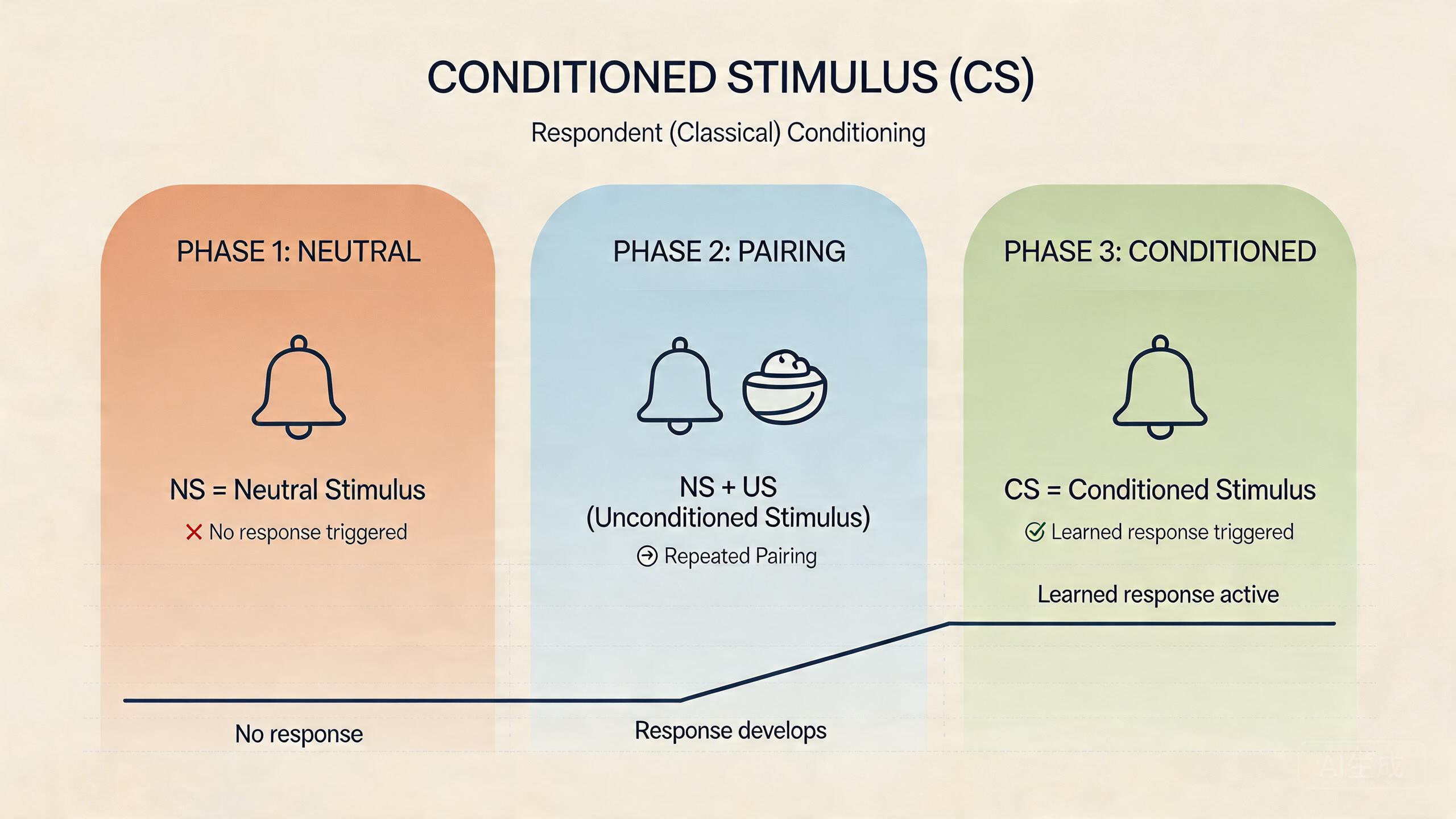
Pavlov’s famous experiment illustrates the process. A neutral stimulus (a bell) was paired with food (US), which naturally triggered salivation (UR). After several pairings, the bell alone produced salivation. At that point, the bell became a conditioned stimulus that now elicits a conditioned response (CR).
- Neutral stimulus (NS): Does not elicit the target response before conditioning.
- Unconditioned stimulus (US): Naturally elicits a reflexive response without prior learning.
- Conditioned stimulus (CS): Acquires the ability to elicit a response through pairing.
- Conditioned response (CR): The learned response elicited by the CS.
Conditioned Stimulus vs. Unconditioned Stimulus
The key difference lies in learning history. A US works from birth (e.g., food, pain, light), while the CS only works after conditioning. For example, a loud noise is an innate US; a therapist’s white coat becomes a CS only after being paired with pain. On the BCBA exam, questions may present scenarios where you identify which stimulus is learned versus unlearned.
Function-Based Examples for the BCBA Exam
Applying the conditioned stimulus concept to real ABA scenarios helps solidify your understanding. Here are three examples you might encounter on the exam.
Example 1: Bell Predicting Food in a Classroom
A teacher rings a bell (NS) just before snack time (US, food). After several days, students salivate when they hear the bell, even before food appears. The bell is now a conditioned stimulus that elicits salivation (CR). In an ABC analysis, the antecedent (bell) triggers the behavior (salivation), and the consequence (food) reinforces the pairing. Respondent conditioning is at work here, not operant.
Example 2: White Coat Eliciting Anxiety
A child experiences pain during medical procedures (US) while a doctor wears a white coat (NS). Over time, the white coat alone causes crying and avoidance (CR). The white coat becomes a CS. The function: automatic negative reinforcement? Actually, the crying may lead to parent comfort, but the initial response is respondent. On the exam, recognize that the CS-elicted behavior is involuntary, unlike operant behaviors maintained by consequences.
Example 3: Toilet Flushing Sound
A child is startled by a loud flush (US). A parent says ‘flush’ just before flushing (NS). After pairings, the word ‘flush’ alone elicits a flinch or startle (CR). The word becomes a conditioned stimulus. This example highlights how CS can involve verbal stimuli, which is important for understanding language acquisition in respondent frameworks.
Exam Relevance: How the BCBA Tests Conditioned Stimulus
The BCBA exam frequently tests your ability to differentiate the conditioned stimulus from other stimuli and to apply the concept in novel scenarios. Let’s review common traps and a sample question.
Common Exam Traps
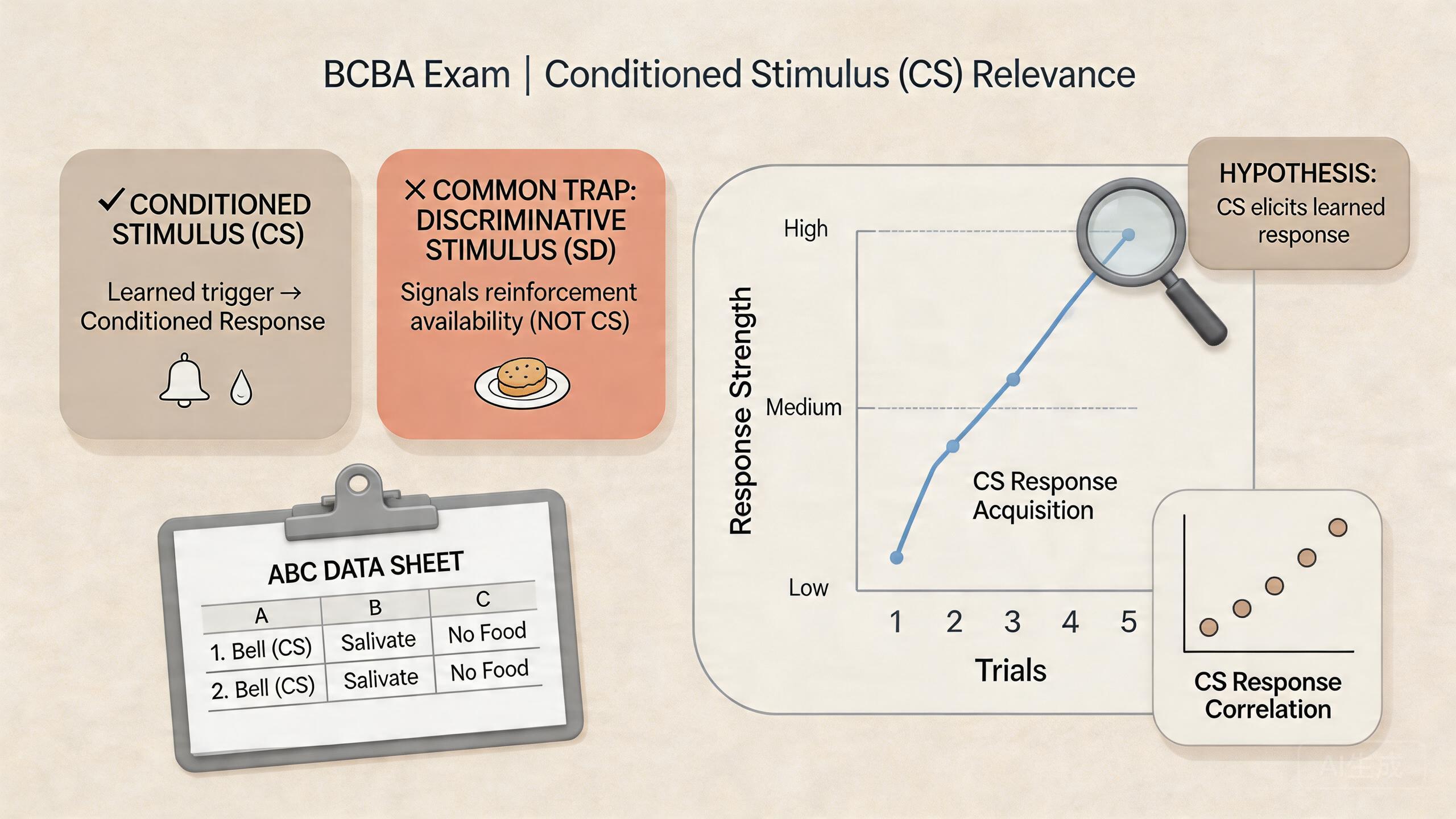
One major pitfall is confusing the conditioned stimulus with a discriminative stimulus (SD). An SD signals that a response will be reinforced in operant conditioning; a CS elicits a reflexive response automatically. For example, a bell that signals food is available if you press a lever is an SD, not a CS. Another trap: mixing up CS with US or NS. Always ask: Does this stimulus require learning to produce the response? For more on the SD, see our guide on discriminative stimulus in ABA.
Sample Exam Question Walkthrough
Scenario: A child flinches when a nurse says ‘shot’ because the word was previously paired with a needle prick. What is the conditioned stimulus?
Options: A) Needle prick, B) Flinching, C) The word ‘shot’, D) The nurse.
Correct answer: C) The word ‘shot’.
Reasoning: The needle prick is the US (innate pain). Flinching is the CR. The word ‘shot’ was neutral but after pairing now elicits flinching, so it is the CS.
Quick Study Checklist: Conditioned Stimulus
Use this checklist for last-minute review before the exam.
- Define conditioned stimulus in your own words.
- Identify US, NS, CS, and CR in a described scenario.
- Explain why a CS is not an SD (different mechanisms).
- Describe one real-world ABA example of respondent conditioning.
- Review the Pavlovian procedure: NS + US → CS → CR.
Conditioned Stimulus vs Neutral Stimulus
A neutral stimulus is simply a stimulus that does not yet produce the target reflex. A conditioned stimulus is what that same neutral stimulus becomes after repeated pairing with an unconditioned stimulus.
This distinction matters because BCBA questions often test the moment before learning versus the moment after learning. If the stimulus has not been paired enough to change responding, it is still neutral.
- Before pairing: bell = neutral stimulus.
- During pairing: bell + food = conditioning process.
- After pairing: bell alone evokes salivation = conditioned stimulus.
- Exam tip: ask whether the response is learned or unlearned before naming the stimulus.
Summary: Key Takeaways for the Exam
- A conditioned stimulus is a learned trigger for a reflexive response.
- It arises from pairing a neutral stimulus with an unconditioned stimulus.
- On the BCBA exam, watch for traps that confuse CS with SD or US.
- Use the ABC framework for respondent behavior: Antecedent (CS) → Behavior (CR) → Consequence (maintains pairing).
- For more on respondent conditioning, check this respondent conditioning guide.



