
Maintenance is one of the most important — and most overlooked — goals in applied behavior analysis. A skill that disappears the moment teaching stops was never truly useful. This guide explains what maintenance means, how it differs from generalization, and the concrete strategies that make behavior last.
Table of Contents
- What maintenance means in ABA
- Maintenance vs generalization
- Strategies to promote maintenance
- How to measure maintenance
- Exam relevance & common traps
- Why behaviors fail to maintain
- Build maintenance into the plan from day one
- Acquisition vs maintenance: different goals, different tactics
- A quick maintenance checklist
- Worked examples: programming for maintenance
- Bottom line
- Generalization and maintenance: the full picture
- Frequently Asked Questions
- References
- References
Short answer: maintenance is the continued performance of a behavior after the intervention is faded or removed — sometimes called generalization across time or response durability. You program for it on purpose; it rarely happens by accident.
What maintenance means in ABA
Maintenance refers to the extent to which a learner continues to perform a target behavior after the teaching procedures have been reduced or withdrawn. If a child learns to request a break during a structured program, maintenance is whether they still request a break weeks later, once the intensive teaching is over.
Because it concerns behavior lasting over time, maintenance is often described as generalization across time. It is a core part of Stokes and Baer’s classic framework for programming behavior change that endures beyond the teaching setting.
Maintenance vs generalization
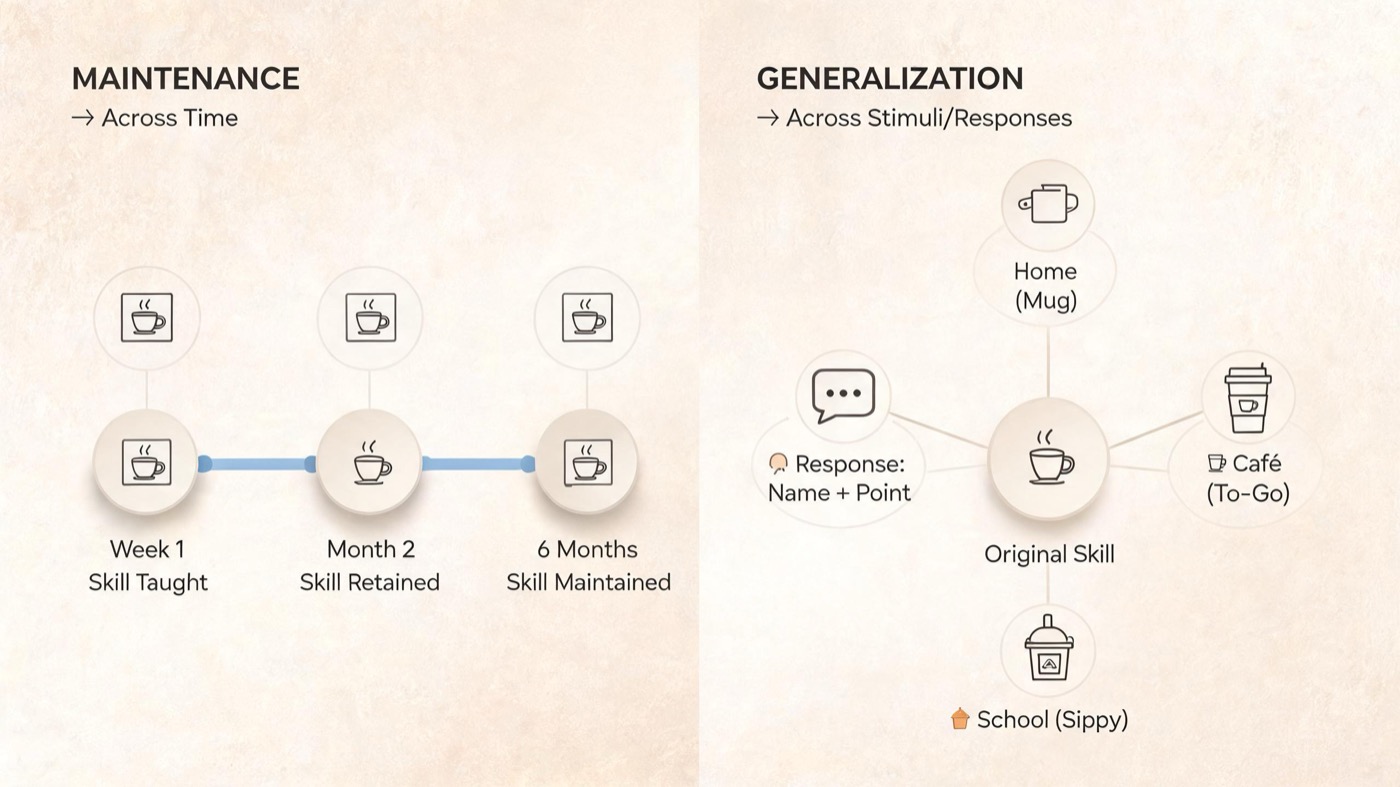
These terms are closely related and easy to confuse on the exam:
- Maintenance: the behavior persists over time after teaching ends (durability).
- Stimulus generalization: the same response occurs across different but similar stimuli.
- Response generalization: different responses that serve the same function emerge.
Memory hook: maintenance = across time; generalization = across stimuli or responses.
Strategies to promote maintenance
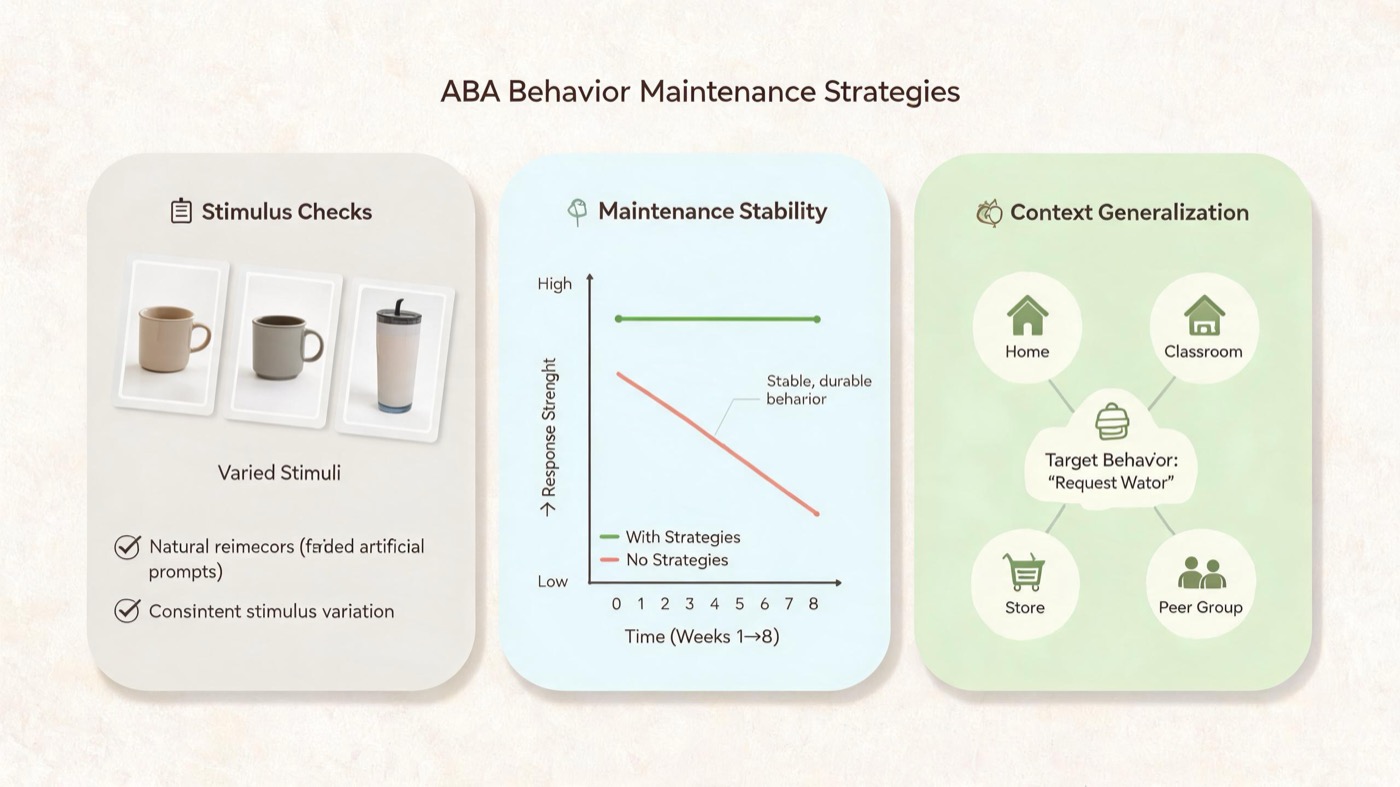
Durable behavior is built deliberately. The most effective strategies:
- Thin the reinforcement schedule. Move from continuous to intermittent reinforcement, which is more resistant to extinction and more like the natural environment.
- Teach to natural communities of reinforcement. Target behaviors that the everyday environment will naturally reinforce (a behavioral “trap”), so teaching becomes unnecessary.
- Program common stimuli. Include features of the natural setting in teaching so the behavior transfers and persists there.
- Teach enough examples. Multiple exemplars build flexible, durable responding rather than rote performance.
- Build self-management. When learners prompt and reinforce their own behavior, it no longer depends on the instructor.
- Use booster sessions. Brief, occasional re-teaching maintains skills that show signs of fading.
How to measure maintenance
Maintenance is assessed with maintenance probes — checking the behavior at intervals (for example, 1, 3, and 6 months) after the intervention has ended, without re-teaching. Stable performance across probes indicates the skill has maintained; a downward trend signals that booster teaching or a richer maintenance plan is needed.
Exam relevance & common traps
- Don’t confuse maintenance with generalization. If the question emphasizes time after teaching ends, it’s maintenance.
- Continuous reinforcement is for acquisition, not maintenance. Thinning to intermittent schedules supports durability.
- Maintenance is planned, not assumed. The exam rewards proactive programming (natural reinforcement, common stimuli) over hoping a skill sticks.
For the bigger picture on how these concepts are tested, see the hardest BCBA domains and the official pass rate.
Why behaviors fail to maintain
Understanding why skills disappear helps you prevent it. The most common causes:
- Reinforcement is removed too abruptly. Going from continuous reinforcement straight to nothing puts the behavior on extinction. Thin gradually instead.
- The natural environment does not reinforce the skill. If nothing in daily life maintains the behavior, it fades once teaching stops.
- The skill was taught in isolation. Behaviors trained in a single, contrived setting often do not carry over — and do not last — without programming for the real world.
- No maintenance plan existed. Teams that treat acquisition as the finish line frequently see regression weeks later.
Build maintenance into the plan from day one
Maintenance should be designed at the start of intervention, not bolted on at the end. Practically, that means choosing socially meaningful target behaviors the natural environment will support, planning how reinforcement will be thinned, and deciding up front how and when maintenance will be probed. When maintenance is part of the original behavior plan, durable performance becomes the expected outcome rather than a pleasant surprise.
Acquisition vs maintenance: different goals, different tactics
The two phases call for different reinforcement strategies:
- Acquisition (learning the skill) uses dense, often continuous reinforcement and heavy prompting to get the behavior established quickly.
- Maintenance (keeping the skill) uses intermittent, leaner reinforcement, faded prompts, and connections to natural reinforcers so the behavior survives on its own.
Confusing the two — for example, keeping continuous reinforcement forever, or thinning before the skill is solid — is a common reason interventions stall.
A quick maintenance checklist
- Is the target behavior useful enough that the natural environment will reinforce it?
- Have you thinned reinforcement toward an intermittent schedule?
- Did you teach multiple examples across people, settings, and materials?
- Have you faded prompts to independent responding?
- Is there a probe schedule to catch fading early?
- Is a booster plan ready if performance slips?
Worked examples: programming for maintenance
These show how the strategies come together in practice:
- Requesting a break. A learner is taught to ask for a break to escape difficult work. To maintain it, the team thins reinforcement from every request to intermittent honoring, and ensures teachers across settings respond — so the skill is reinforced naturally wherever the learner goes.
- Hand-washing. Taught with hand-over-hand prompting and praise. Maintenance comes from fading prompts to independence and letting the natural outcome (clean, dry hands) plus occasional praise carry the behavior, with monthly probes to confirm it holds.
- Greeting peers. Trained with multiple peers in multiple settings (multiple exemplars) so it generalizes and persists, rather than being practiced with one adult in one room.
- Tooth-brushing. A visual self-management checklist lets the learner prompt and check their own steps, removing reliance on the instructor and supporting long-term maintenance.
In every case, maintenance is achieved by connecting the behavior to reinforcement that will still be there once formal teaching ends.
Bottom line
A behavior that does not maintain has limited value. Treat maintenance as a planned outcome: pick socially meaningful targets, thin reinforcement deliberately, teach across enough examples, fade prompts, and probe over time. Do that, and the skills you teach keep working long after the program ends — which is the real goal of behavior analysis. To see how generalization and maintenance are tested, try a free BCBA mock exam.
Generalization and maintenance: the full picture
Maintenance is one piece of a larger goal — making behavior change useful beyond the teaching session. The complete picture has three parts that the BCBA exam expects you to keep straight:
- Maintenance — the behavior lasts over time after teaching ends.
- Stimulus generalization — it occurs across new, similar situations, not just the training context.
- Response generalization — useful variations of the behavior emerge without direct teaching.
A truly successful program delivers all three: the learner performs the skill later (maintenance), elsewhere (stimulus generalization), and in flexible forms (response generalization). When you plan an intervention, ask how you will build each one in from the beginning — because none of them can be assumed, and all of them can be programmed.
Test your generalization & maintenance knowledge
Try a free, full-length BCBA mock exam — real exam-style questions with instant scoring and explanations.
Start the Free BCBA Mock Exam →
Frequently Asked Questions
What is maintenance in ABA?
Maintenance is the continued performance of a behavior after the intervention that taught it has been reduced or removed — also called generalization across time or response durability.
What is the difference between maintenance and generalization?
Maintenance is durability over time (the behavior lasts after teaching stops); stimulus and response generalization are about the behavior occurring across different stimuli or in different forms.
How do you promote maintenance of a behavior?
Thin reinforcement to intermittent schedules, teach to natural communities of reinforcement, program common stimuli, teach enough examples, build self-management, and use occasional booster sessions.
How is maintenance measured?
With maintenance probes — assessing the behavior at intervals after the intervention ends to confirm it persists without ongoing teaching.
References
- Cooper, J. O., Heron, T. E., & Heward, W. L. (2020). Applied Behavior Analysis (3rd ed.) — generalization & maintenance.
- Stokes, T. F., & Baer, D. M. (1977). An implicit technology of generalization. JABA.
References
Complete BCBA Exam Prep
Turn this topic into exam-day practice
Practice concepts in context with five full-length 6th Edition mock exams, two bonus practice exams, a 6th Edition study guide, and key-term flashcards—all in one $120 USD package.
Get the $120 All-in-One Prep Pack
Review everything included on the product page before ordering. No pass guarantee is implied.



