
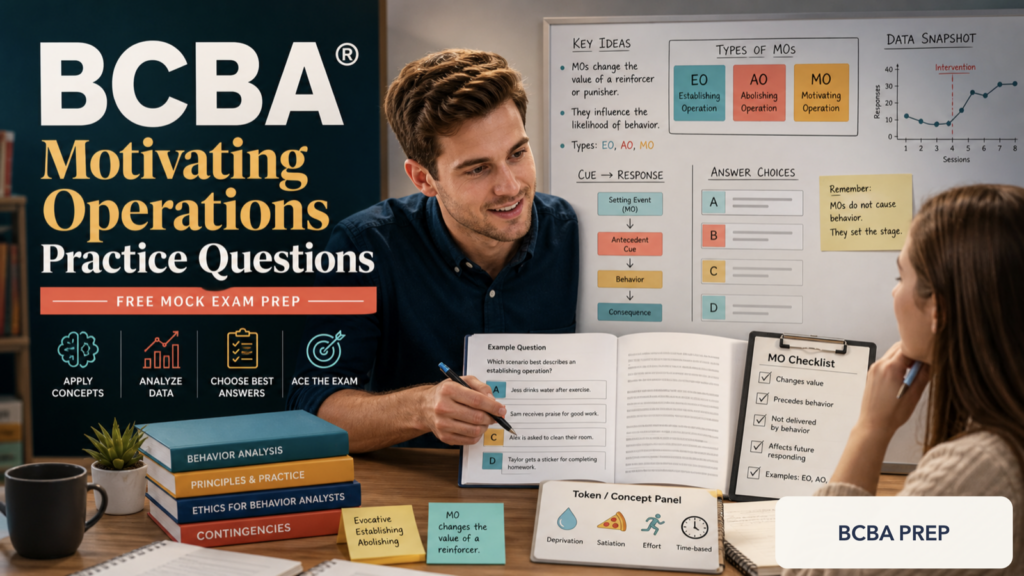
Master Motivating Operations for the BCBA® Exam
Motivating operations (MOs) are environmental variables that momentarily alter the value of a reinforcer or punisher and the frequency of behavior that has been reinforced or punished by that stimulus. Understanding MOs is critical for the BCBA® exam.
Table of Contents
- Master Motivating Operations for the BCBA® Exam
- BCBA® Motivating Operations Practice Questions
- Common Exam Traps for Motivating Operations
- Quick Checklist: MOs on the BCBA® Exam
- Ready for More? Take the Full Free BCBA® Mock Exam
- Frequently Asked Questions About Motivating Operations
- References
Test your knowledge with these five free practice questions designed to mirror the exam format. Each question includes a detailed rationale and exam traps to avoid.

BCBA® Motivating Operations Practice Questions
Answer the following questions based on your knowledge of motivating operations. Select the best option for each scenario.
Question 1:
Scenario: A student refuses to complete her math worksheet. The teacher notices that the student had a large breakfast but did not have any water for several hours. The student frequently requests water breaks.
Prompt: In this scenario, the deprivation of water serves as what type of motivating operation for the behavior of requesting water?
- A. Abolishing operation (AO)
- B. Establishing operation (EO)
- C. Conditioned motivating operation (CMO)
- D. Unconditioned motivating operation (UMO)
Correct Answer: B
Why This Answer Is Correct: Deprivation of water increases the value of water as a reinforcer and increases the likelihood of behaviors that have historically produced water (e.g., requesting). This is an establishing operation (EO).
Why the Other Options Are Wrong:
- A: An AO would decrease the value of a reinforcer, not increase it. Sated states are AOs.
- C: A CMO is learned, not unlearned. Water deprivation is an unlearned, unconditioned MO (but the question asks for type of MO; the best answer is EO).
- D: While water deprivation is an unconditioned MO, the term “EO” is more specific to the momentary effect on behavior. However, UMO is also correct, but EO is the standard term for the effect described.
Exam Trap: Distinguish between EO and UMO. An EO increases the reinforcing effectiveness of a stimulus and the frequency of behavior. A UMO refers to the MO being unlearned. In practice, all UMOs are EOs when they increase value.
Question 2:
Scenario: After a long run, an individual feels very thirsty. They stop at a water fountain to drink.
Prompt: The increase in the value of water as a reinforcer after the run is due to which motivating operation?
- A. Abolishing operation
- B. Establishing operation
- C. Conditioned punishment
- D. Satiation
Correct Answer: B
Why This Answer Is Correct: Exercise-induced thirst creates a deprivation state for water, increasing its reinforcing value and the likelihood of drinking behavior. This is an establishing operation.
Why the Other Options Are Wrong:
- A: An AO would decrease the value; thirst increases it.
- C: This involves punishment, not reinforcement value.
- D: Satiation decreases the value, opposite of this scenario.
Exam Trap: Remember that exercise can create an EO for water, not an AO. Thirst is a classic example of an EO.
Question 3:
Scenario: A child who usually enjoys playing with a specific toy suddenly stops playing with it after playing with it for an hour.
Prompt: The decrease in the reinforcing value of the toy after prolonged play is due to what motivating operation?
- A. Deprivation
- B. Satiation
- C. Abolishing operation
- D. Establishing operation
Correct Answer: C
Why This Answer Is Correct: Satiation (prolonged access) decreases the reinforcing effectiveness of the toy, which is an abolishing operation (AO). An AO reduces the value of a reinforcer and the frequency of behavior.
Why the Other Options Are Wrong:
- A: Deprivation would increase value, not decrease.
- B: Satiation is the process, but the MO that results from satiation is an AO. The question asks for the MO, so “Abolishing operation” is the best answer.
- D: An EO would increase value.
Exam Trap: Satiation is the state; the resulting MO is an abolishing operation. Know the difference between the process and the MO.
Question 4:
Scenario: A teacher has a rule that students can earn a token for completing homework. One day, the teacher announces that tokens can be exchanged for extra recess time, which the students highly value. The students complete more homework.
Prompt: The announcement that tokens can be exchanged for recess serves as what type of motivating operation?
- A. Unconditioned motivating operation
- B. Transitive conditioned motivating operation (CMO-T)
- C. Reflexive conditioned motivating operation (CMO-R)
- D. Surrogate conditioned motivating operation (CMO-S)
Correct Answer: B
Why This Answer Is Correct: The announcement establishes recess as a reinforcer, making tokens (which are a means to get recess) more valuable. The tokens become a conditioned reinforcer via a transitive CMO: the value of the token depends on the value of recess.
Why the Other Options Are Wrong:
- A: This is a learned MO, not unlearned.
- C: A CMO-R involves an aversive stimulus that establishes escape as reinforcement (e.g., a warning signal).
- D: A CMO-S occurs when a stimulus acquires MO properties by being paired with another MO (e.g., a neutral stimulus paired with deprivation).
Exam Trap: Transitive CMOs involve a stimulus that becomes a reinforcer because it is needed to access another reinforcer. Remember the three types of CMOs.
Question 5:
Scenario: A person with a history of being bullied avoids a specific hallway where the bullying occurred. When they hear footsteps approaching in that hallway, they feel anxious and quickly leave.
Prompt: The footsteps that signal potential bullying serve as what type of conditioned motivating operation?
- A. Transitive CMO
- B. Reflexive CMO
- C. Surrogate CMO
- D. Unconditioned MO
Correct Answer: B
Why This Answer Is Correct: The footsteps have been paired with the aversive event (bullying), so they become a warning stimulus that establishes escape as reinforcement. This is a reflexive CMO (CMO-R): the stimulus itself evokes behavior that terminates it (leaving the hallway).
Why the Other Options Are Wrong:
- A: A transitive CMO involves a stimulus that becomes a reinforcer because it allows access to another reinforcer, not escape.
- C: A surrogate CMO acquires the same MO properties as another MO through pairing, not directly establishing escape.
- D: This is a learned MO, not unlearned.
Exam Trap: CMO-Rs are often warnings or signals for aversive events. The behavior that follows is typically escape or avoidance. Remember, in CMO-R, the stimulus itself becomes aversive.
Common Exam Traps for Motivating Operations
Avoid these pitfalls when answering MO questions on the BCBA® exam.
- Confusing establishing operations (EO) with unconditioned motivating operations (UMO): All UMOs that increase value are EOs, but not all EOs are UMOs (e.g., CMO-T).
- Mixing up satiation (a state) with abolishing operation (the resulting MO): Satiation is the process; the resulting effect on reinforcer value is an AO.
- Forgetting that CMO-T involves a stimulus that becomes valuable because it is a means to an end (e.g., keys to start a car).
- Thinking that all MOs are unlearned: Conditioned MOs (CMOs) are learned through experience.
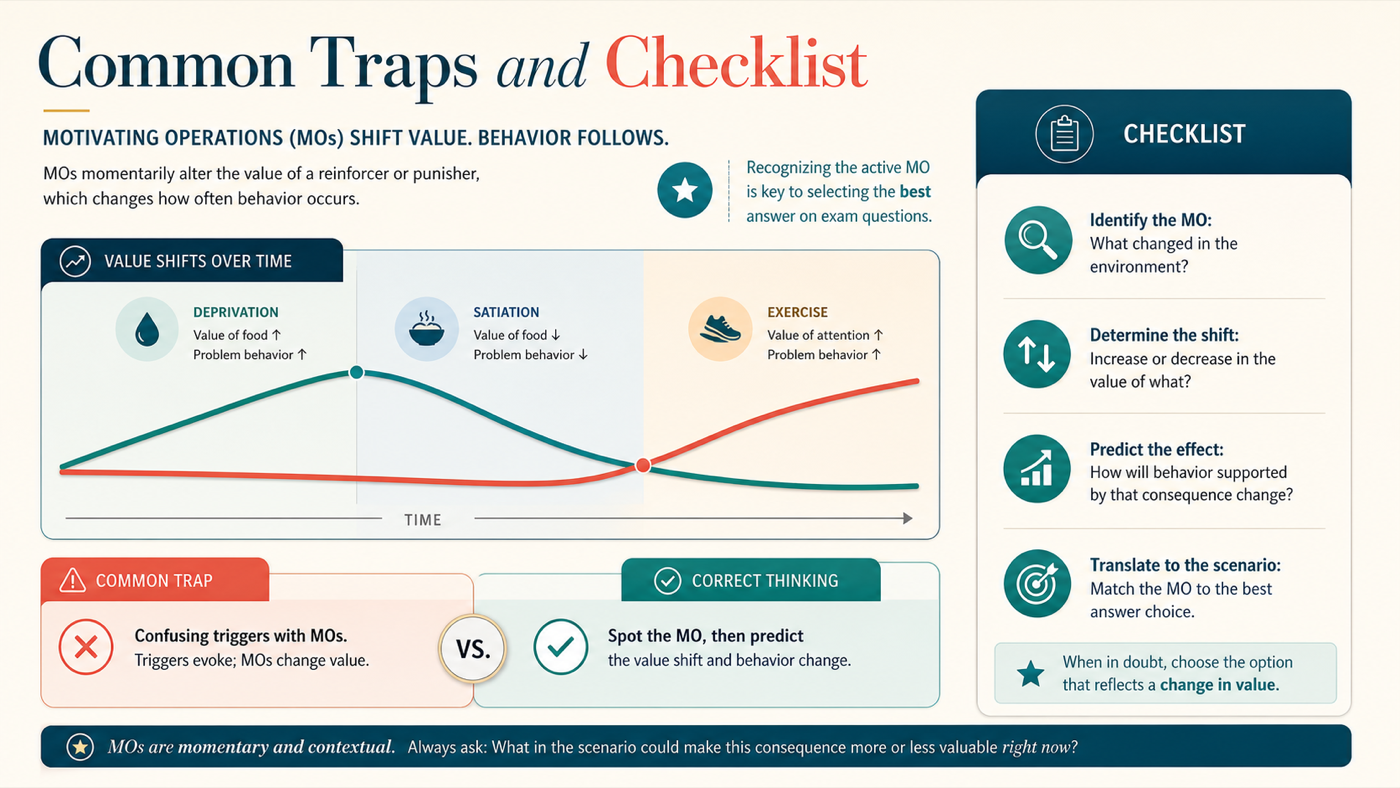
Quick Checklist: MOs on the BCBA® Exam
- Can you identify whether the MO increases (EO) or decreases (AO) the value of a reinforcer?
- Do you know the three types of CMOs: transitive, reflexive, and surrogate?
- Can you distinguish between unconditioned MOs (e.g., food deprivation) and conditioned MOs (e.g., a signal for food)?
- Do you remember that MOs alter both the value of a stimulus and the frequency of behavior?
- Are you careful not to confuse MOs with discriminative stimuli (S^D)?
Ready for More? Take the Full Free BCBA® Mock Exam
Practice with 150+ questions covering the entire BCBA® task list, including detailed explanations for every answer.
Take the Free BCBA Mock Exam
Click below to access your free full-length mock exam and track your progress to exam day!
Frequently Asked Questions About Motivating Operations
Q: What is the difference between an MO and an SD?
A: An MO alters the value of a reinforcer, while an SD signals the availability of that reinforcer. For example, food deprivation (MO) makes food valuable; a refrigerator (SD) signals that food is available.
Q: Can an MO be both unconditioned and conditioned?
A: No. An MO is either unconditioned (innate) or conditioned (learned). Unconditioned MOs include deprivation/satiation for basic needs; conditioned MOs are learned via stimulus-stimulus pairings.
Q: How do I remember the three types of CMOs?
A: Think: Transitive (means to an end), Reflexive (escape from a warning signal), Surrogate (paired with another MO). Use the mnemonic ‘TRS’.
Video Study: Motivating Operations
Watch: BCBA® Section B16 Explained | 6th ed. Motivation Operations
Watch this focused lesson as a visual companion to the definitions, comparisons, and applied examples in this article.
Prefer a second pass? Open this lesson on YouTube.
References
Next step for BCBA exam prep
Turn this topic into exam-day practice
Use this topic as a focused review, then test it in exam-style conditions with a free mock before deciding whether five full-length mocks are the right next step.
Start the Free BCBA Mock Exam
Continue with Five Full-Length Mocks — $99
Review the included materials and access details before ordering. No pass guarantee is implied.




Pingback: MO ABA: Motivating Operations in ABA Explained (BCBA