
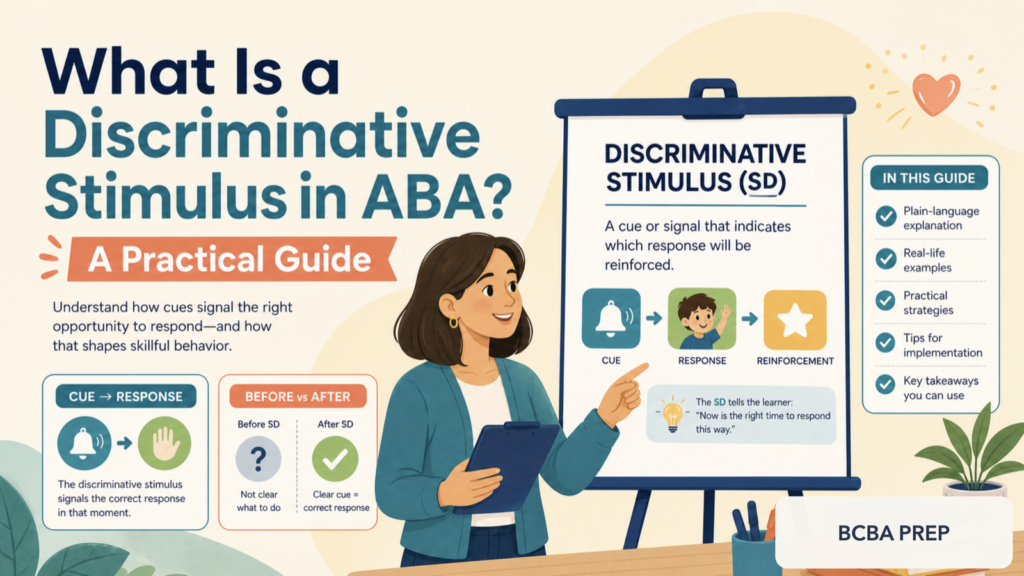
What Is a Discriminative Stimulus? Core Definition and Purpose
A discriminative stimulus (SD) is an environmental cue that signals the availability of a specific reinforcer for a particular behavior. In operant conditioning, the SD sets the occasion for a response because that response has been reinforced in the presence of the SD in the past.
Table of Contents
- What Is a Discriminative Stimulus? Core Definition and Purpose
- How Discriminative Stimuli Function in ABA: The ABC Contingency
- BCBA Exam Examples: Discriminative Stimulus in Practice
- Common Exam Traps and How to Avoid Them
- Quick Checklist for Identifying a Discriminative Stimulus
- Final Summary
- References
For example, a green traffic light is an SD for driving forward – the behavior of pressing the accelerator is reinforced by forward movement. Without the green light, that behavior would not be reinforced (and could be dangerous).
How SD Differs From Other Antecedent Stimuli
The discriminative stimulus is often confused with other antecedents. Here’s a quick comparison:
- S-delta (SΔ): Signals that a behavior will not be reinforced. In a classroom, an S-delta might be the teacher’s back turned – asking for attention then is unlikely to work.
- Prompt: An extra cue that helps a learner engage in the correct behavior. A prompt may be verbal, gestural, or physical, and is often faded over time.
- Motivating operation (MO): Alters the value of a reinforcer (e.g., food deprivation makes food more valuable). The SD merely signals its availability.
Understanding these distinctions is key for the BCBA exam, as questions often test your ability to differentiate among antecedents.
How Discriminative Stimuli Function in ABA: The ABC Contingency
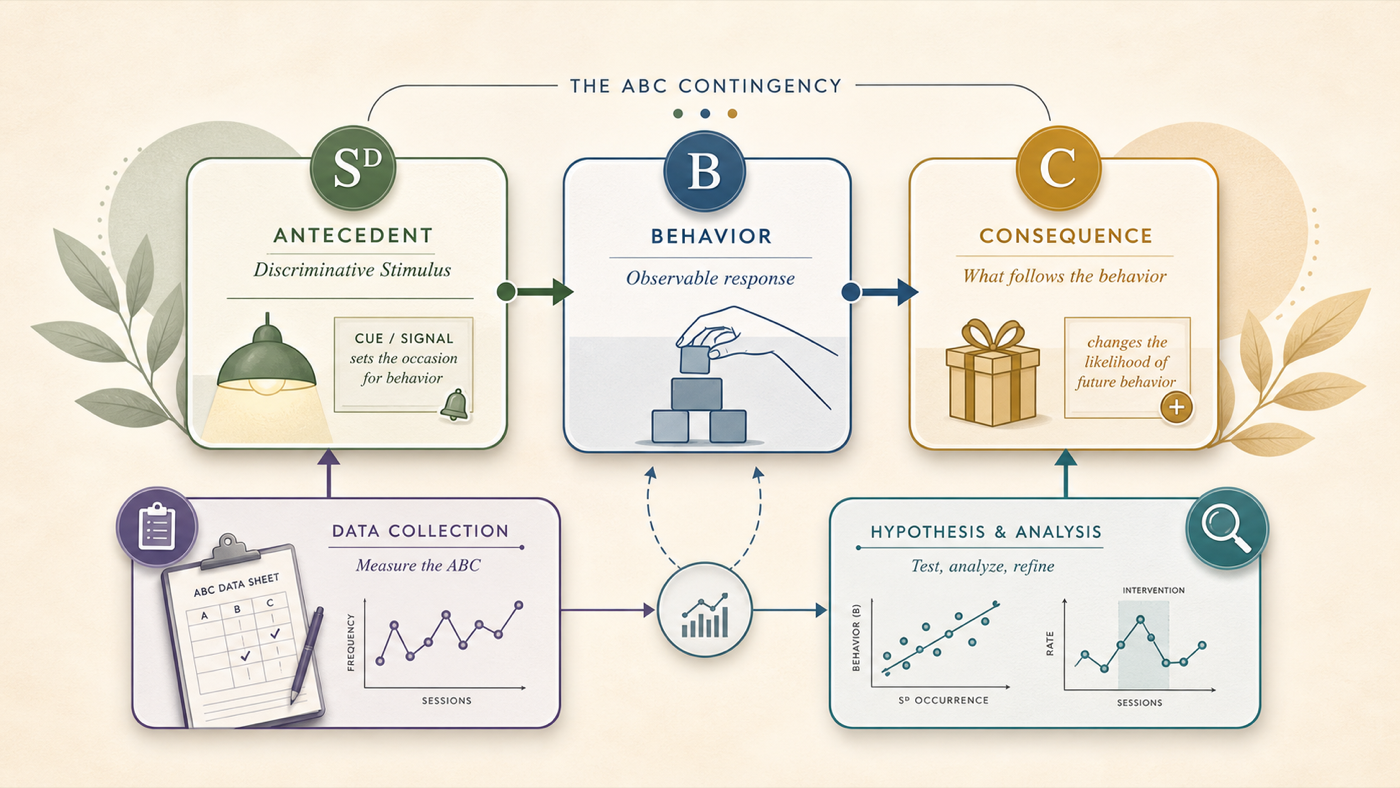
In ABA, behavior is understood through the three-term contingency: Antecedent → Behavior → Consequence. The discriminative stimulus is a type of antecedent.
Here is how the ABC model works with an SD:
- Antecedent (SD): The specific cue that reinforcement is available.
- Behavior: The action that has been reinforced in the presence of that SD.
- Consequence: The reinforcer that follows the behavior.
Example: A child sees a cookie jar (SD) → says ‘cookie’ (behavior) → receives a cookie (reinforcer). The cookie jar is the SD because it signals that saying ‘cookie’ will be reinforced.
SD and S-Delta: A Critical Distinction
On the BCBA exam, you will frequently be asked to identify whether an antecedent is an SD or an S-delta. The key difference: the SD signals reinforcement is available; the S-delta signals it is not. For instance, when a phone rings (SD), answering it often leads to a conversation. When it is silent (S-delta), picking up the phone rarely results in reinforcement.
Mastering this distinction is essential. A helpful resource is our guide on SD vs S-delta for more practice.
BCBA Exam Examples: Discriminative Stimulus in Practice
Applying the concept to real-life scenarios solidifies your understanding. Here are two worked examples with ABC analysis.
Example 1: Classroom Setting
- Antecedent (SD): Teacher raises her hand and says ‘Quiet.’
- Behavior: Students raise their hands and wait to be called on.
- Consequence: Teacher calls on a student and provides praise.
- Function: Attention (access to teacher acknowledgment).
The raised hand is the discriminative stimulus – it signals that raising your own hand will be reinforced with attention. Without that cue, calling out would likely not get praise.
Example 2: Self-Care Task
- Antecedent (SD): Toothbrush placed on the counter with toothpaste.
- Behavior: Child picks up toothbrush and begins brushing.
- Consequence: Parent says ‘Great job brushing!’ and later gives a sticker.
- Function: Access to tangibles (sticker) and attention (praise).
The visible toothbrush is an SD that signals brushing leads to reinforcement. Over time, the child learns to brush independently when the toothbrush is present.
For more practice examples, check out our functions of behavior guide.
Common Exam Traps and How to Avoid Them
The BCBA exam often includes tricky questions about discriminative stimuli. Here are two common traps:
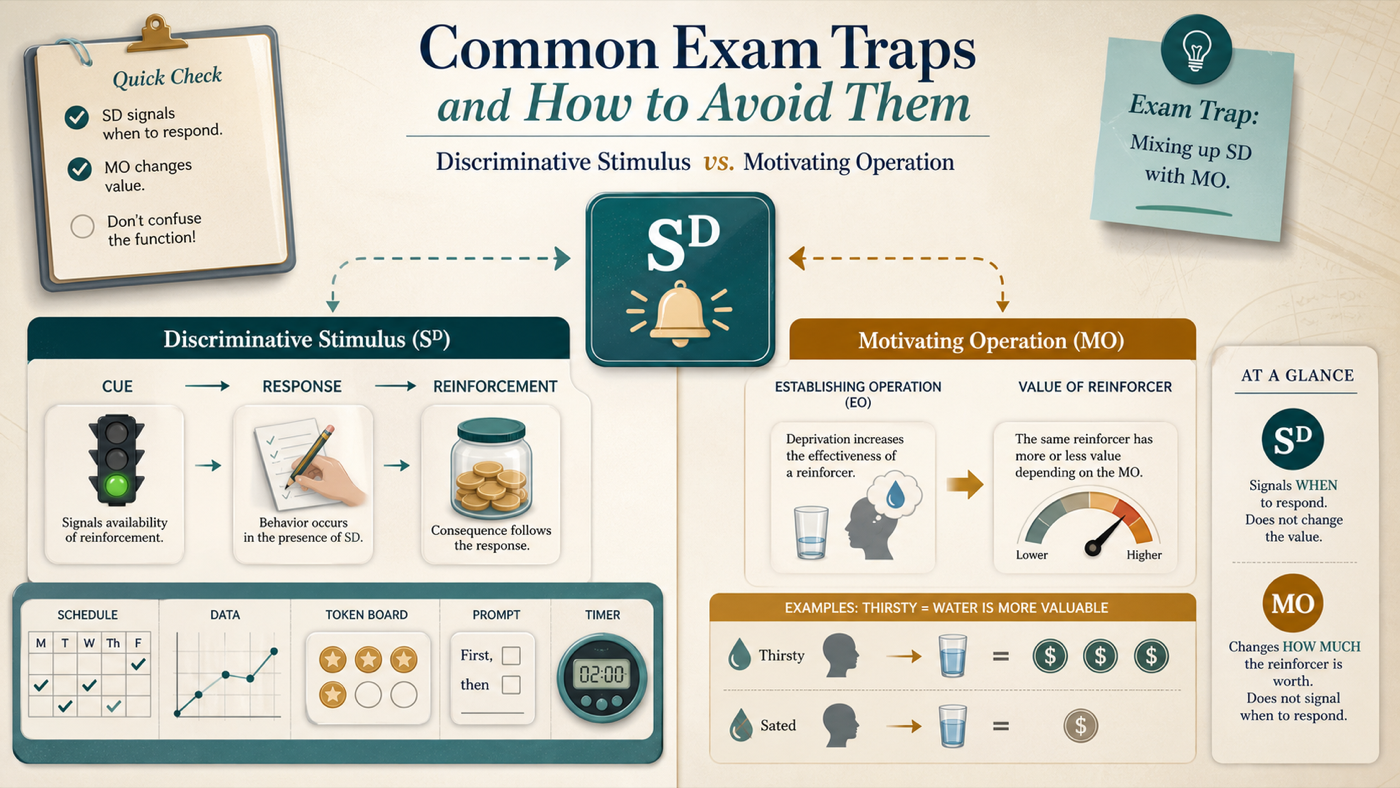
Confusing SD With Motivating Operations
Students frequently confuse discriminative stimuli with motivating operations (MOs). Remember: an MO alters the value of a reinforcer (e.g., being thirsty makes water more valuable). An SD signals that a reinforcer is available (e.g., a water fountain). You can be thirsty (MO) without seeing a fountain; only the fountain is the SD for drinking.
Overlooking the Three-Term Contingency
When identifying an SD, always check the entire ABC contingency. If you cannot identify a specific behavior and consequence that has been reinforced in that context, it may not be an SD. For example, a bell ringing is only an SD if it has historically been followed by reinforcement for a particular response (like answering).
Quick Checklist for Identifying a Discriminative Stimulus
Use this checklist to quickly analyze exam scenarios:
- Does the antecedent signal that a specific reinforcer is available?
- Has the behavior been reinforced in the presence of this cue before?
- Is there a clear three-term contingency (SD → behavior → reinforcer)?
- Does the antecedent differ from an S-delta (which signals non-reinforcement)?
- Is the function of the behavior identifiable (e.g., attention, tangible, escape, automatic)?
If you answer yes to all, you have likely identified a discriminative stimulus.
Final Summary
In ABA, the discriminative stimulus is a fundamental concept that sets the stage for learning. It is an antecedent that signals the availability of a specific reinforcer. Distinguishing it from S-delta, prompts, and motivating operations is vital for exam success. By practicing with ABC examples and using the checklist above, you can confidently answer questions about SDs. For further study, refer to the BACB Task List and our comprehensive BCBA exam prep resources.
References
Complete BCBA Exam Prep
Turn this topic into exam-day practice
Practice concepts in context with five full-length 6th Edition mock exams, two bonus practice exams, a 6th Edition study guide, and key-term flashcards—all in one $120 USD package.
Get the $120 All-in-One Prep Pack
Review everything included on the product page before ordering. No pass guarantee is implied.



