
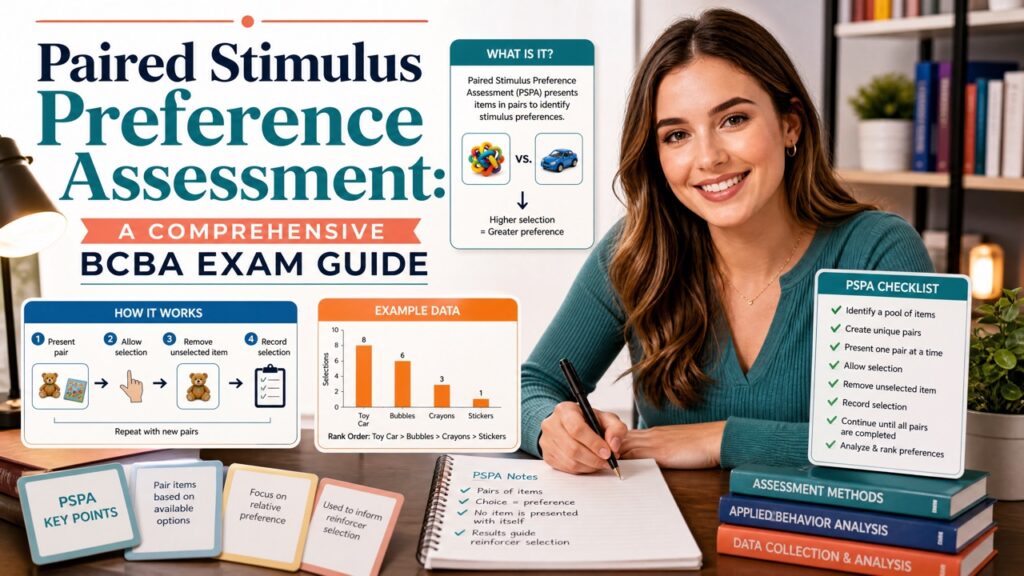
What is a Paired Stimulus Preference Assessment?
A paired stimulus preference assessment is a systematic method used in applied behavior analysis (ABA) to identify a learner’s preferred items or activities. Also known as a forced-choice method, it involves presenting two stimuli simultaneously and recording which one the learner selects. The item chosen more often across trials is considered more preferred, and this information guides the selection of reinforcers for behavior intervention plans. This assessment is a core skill for BCBA candidates because it helps ensure interventions are based on data rather than assumptions, increasing the likelihood that reinforcement will be effective.
Table of Contents
- What is a Paired Stimulus Preference Assessment?
- Step-by-Step Procedure for Conducting a Paired Stimulus Preference Assessment
- Real-World ABA Examples of Paired Stimulus Preference Assessments
- BCBA Exam Relevance and Common Traps
- Quick Checklist for Paired Stimulus Preference Assessments
- Summary
- Take the Free BCBA Mock Exam
The key difference between a paired stimulus assessment and other methods like multiple stimulus without replacement (MSW) is the number of items presented at one time. In a paired assessment, only two items are shown, which reduces the cognitive load on the learner and makes it easier to detect preferences, especially for individuals with limited verbal skills. Compared to a single stimulus assessment, the paired format provides a more rigorous comparison because the learner must choose between two options, minimizing the risk of selecting an item simply due to its position or novelty. This balance of rigor and practicality makes it a widely taught and tested method on the BCBA exam.
Why Use a Paired Stimulus Assessment?: The paired stimulus method offers several advantages that make it a go-to choice in clinical practice. It is less time-consuming than a full multiple stimulus with replacement (MSW) assessment, yet it provides more reliable data than a single stimulus presentation because it forces a direct comparison. Additionally, it is ideal for learners who may become overwhelmed by arrays of multiple items, as it simplifies the task to a choice between two. For BCBA exam purposes, understanding these benefits helps you answer questions about when to use this method over others, a common scenario in scenario-based questions.
Step-by-Step Procedure for Conducting a Paired Stimulus Preference Assessment
To conduct a paired stimulus preference assessment correctly, you need to follow a structured procedure that ensures valid and reliable results. This is a critical skill for the BCBA exam, where you may be asked to identify the correct steps or detect errors in a described procedure. Below is a step-by-step breakdown, starting with materials and setup.
Materials and Setup: Before beginning, gather the necessary materials: a set of potential stimuli (e.g., toys, edibles, activities), a data sheet to record selections, a timer, and a quiet area with minimal distractions. Ensure that all stimuli are equally accessible and that the environment is consistent across trials. The number of stimuli typically ranges from 4 to 7 items, as this keeps the total number of pairs manageable. For example, with 5 stimuli, there are 10 possible pairs.
Randomization and Presentation: Randomization is essential to avoid bias. Each stimulus should be paired with every other stimulus an equal number of times, and the order of presentation should be randomized. Also, the left-right position of each stimulus should be alternated across trials to prevent a side bias. During each trial, present the two stimuli side by side, at equal distance from the learner, and use a neutral instruction such as “pick one.” After the learner selects one, provide brief access to the chosen item (e.g., 10-15 seconds) before removing it and presenting the next pair. This ensures that the selection is reinforced and maintains consistent exposure.
Scoring and Data Collection: Record each selection on the data sheet, noting which item was chosen. After all pairs have been presented, calculate the selection percentage for each stimulus by dividing the number of times it was chosen by the number of times it was presented, then multiplying by 100. The items are then ranked from highest to lowest percentage, with the top items considered high-preference. A stimulus chosen at least 80% of the time is often considered a strong reinforcer, while items chosen less than 50% may be low-preference. This data-driven ranking informs which items to use as reinforcers in therapy.
Real-World ABA Examples of Paired Stimulus Preference Assessments
Seeing how the paired stimulus assessment works in practice helps solidify your understanding. Below are two practical examples that illustrate the procedure, the ABC (antecedent-behavior-consequence) recording, and the hypothesized function of the behavior. Example 1: Identifying High-Preference Edibles: Imagine a BCBA working with a 4-year-old child with autism who has limited vocal behavior. The goal is to identify which edibles (e.g., goldfish crackers, fruit snacks, pretzels) are most reinforcing to use during discrete trial training. The assessment presents pairs such as goldfish vs. fruit snack, fruit snack vs. pretzel, and goldfish vs. pretzel. The behavior recorded is reaching for or pointing at one item. The consequence is 10 seconds of access to the chosen edible. The hypothesized function is automatic reinforcement (positive reinforcement) because the edible itself is the reinforcer. After 10 trials, the data show fruit snacks chosen 90% of the time, making them the highest-preference item. This information directly guides the therapist to use fruit snacks as the primary reward during teaching sessions.
Example 2: Toy Preference for Increasing Play Skills: Another scenario involves a 7-year-old student who is working on increasing independent play skills. The BCBA is considering which toys to incorporate. The paired assessment includes a puzzle, a ball, and a musical instrument. The antecedent is the presentation of two toys, the behavior is the student pointing to or vocally requesting one toy, and the consequence is 5 minutes of playtime with that toy. The hypothesized function here is automatic reinforcement, as the play itself is inherently reinforcing. The results show the ball selected most often, suggesting it should be used as a reinforcer for completing play tasks and as a means to encourage the student to engage with other toys through pairing. This application demonstrates how the assessment findings translate directly into person-centered intervention planning.
BCBA Exam Relevance and Common Traps
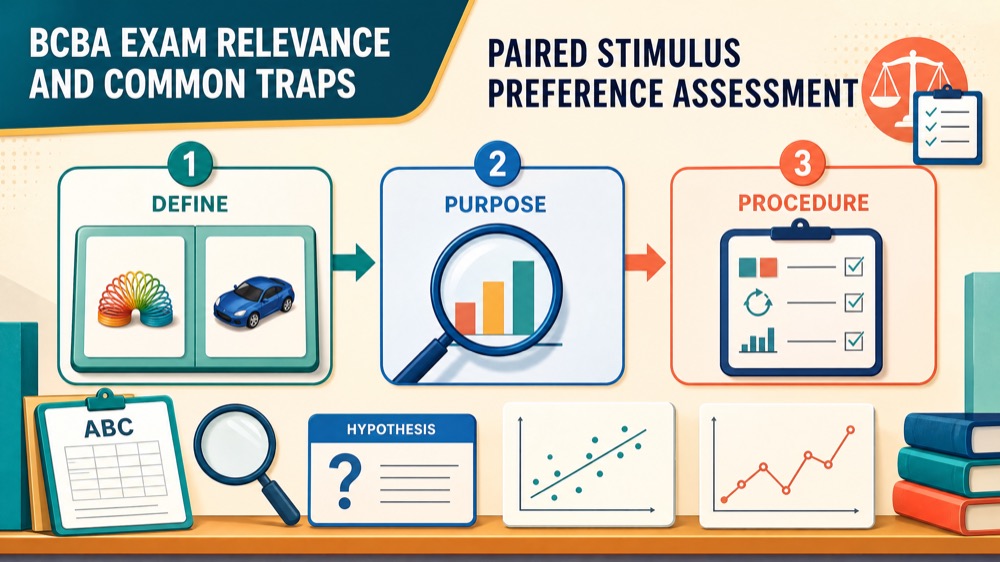
Paired stimulus preference assessment is a favorite topic for the BCBA exam, where you’ll encounter questions that test your knowledge of its definition, purpose, and procedural details. These questions often present a clinical scenario and ask you to identify the correct method or interpret data from a preference assessment. The 6th edition test content outline includes “preference assessments” as a key area under assessment, so being able to distinguish between different types is crucial. In fact, our BCBA exam guide on preference assessments covers the broader category to help you see how this method fits into your study plan.
Key Concepts to Remember: To excel on exam questions, solidify your understanding of these core concepts:
- Forced-choice format: The learner must choose one of two items, which reduces the likelihood of arbitrary selections.
- Equal exposure: Each stimulus appears the same number of times, ensuring that selection percentages are not influenced by presentation frequency.
- Selection percentage: This is the primary metric; a higher percentage indicates a stronger preference.
Memorizing these elements helps you quickly recognize the essential features of the assessment when reading an exam vignette. Common Mistakes to Avoid: Even seasoned practitioners can fall into traps. Here are the most common pitfalls to steer clear of on the exam:
- Confusing paired stimulus with MSW: The key difference is the number of items presented simultaneously; MSW presents multiple items, while paired presents only two.
- Misinterpreting percentages: A 50% selection rate does not necessarily mean low preference; it could indicate that the item is moderately preferred compared to the alternatives.
- Forgetting to randomize: Without randomization, position bias can inflate the preference for a specific item.
- Using the wrong reinforcement duration: The time of access should be consistent across all selections to maintain procedural integrity.
Recognizing these errors can prevent you from choosing a wrong answer in a multiple-choice question.
Quick Checklist for Paired Stimulus Preference Assessments
This checklist is your go-to review tool before the exam. It condenses the procedural steps and critical considerations into action items you can rapidly recall.
- Select 4-7 stimuli that are “candidate” reinforcers (e.g., toys, edibles, activities).
- Create all possible pairs and ensure each stimulus is presented with every other one.
- Randomize the order of pairs and alternate the left-right position of stimuli on each trial.
- Present each pair with a neutral instruction like “Choose one.”
- Give brief access (e.g., 10-15 seconds) to the chosen item after each selection.
- Record the selection on a data sheet immediately.
- Calculate the selection percentage for each stimulus (number of selections / number of presentations x 100).
- Rank items from highest to lowest percentage; choose the top items as potential reinforcers.
- Consider repeating the assessment a few times to verify stability of preferences.
Use this checklist to mentally rehearse the steps when you encounter a question about implementing this assessment.
Summary
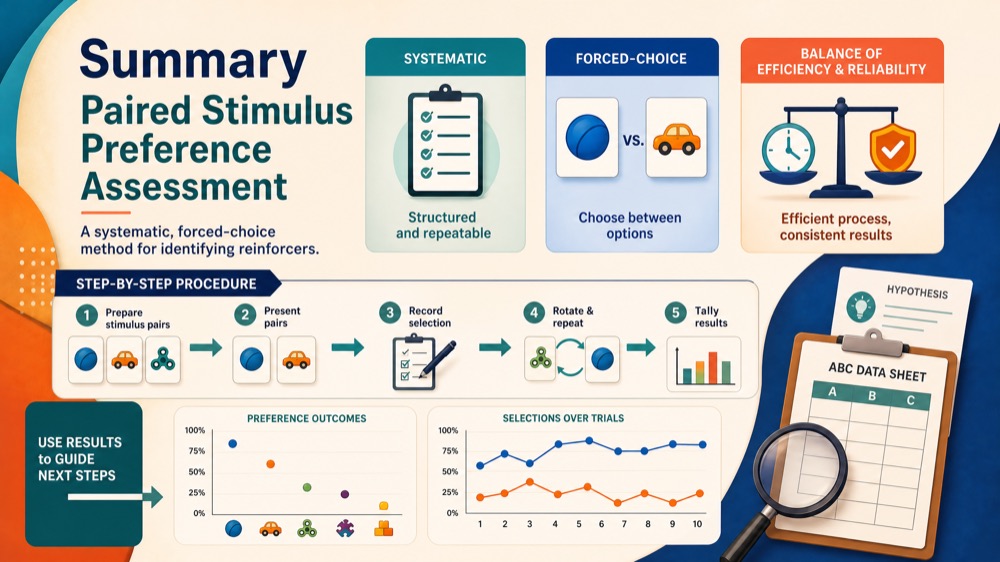
In summary, the paired stimulus preference assessment is a systematic, forced-choice method for identifying reinforcers, standing out for its balance of efficiency and reliability. You learned the definition, the step-by-step procedure including randomization and scoring, and real-world examples that illustrate its application. You also reviewed the key concepts and common traps that are likely to appear on the BCBA exam. Remember to focus on the forced-choice format, equal exposure, and calculation of selection percentages. To further reinforce your skills, explore our assessment in ABA page for a broader perspective. For authoritative information, refer to the BACB’s guidelines on preference assessments and related research. Now, take a deep breath and apply this knowledge to your practice questions—you’re one step closer to mastering this essential assessment technique.
Take the Free BCBA Mock Exam
Ready for more practice? Use the free mock exam to keep testing your accuracy with realistic BCBA-style items. Take the Free BCBA Mock Exam
Next step for BCBA exam prep
Turn this topic into exam-day practice
Use this topic as a focused review, then test it in exam-style conditions with a free mock before deciding whether five full-length mocks are the right next step.
Start the Free BCBA Mock Exam
Continue with Five Full-Length Mocks — $99
Review the included materials and access details before ordering. No pass guarantee is implied.



