

Convergent control in ABA describes a situation in which two or more variables work together to influence one verbal response. In verbal behavior analysis, a response may be more likely because of a motivating operation, a verbal prompt, a nonverbal stimulus, or the interaction among these variables. The BCBA exam tests whether you can identify the controlling variables instead of assigning a label from the response form alone.
Table of Contents
- How Convergent Control Is Tested on the BCBA Exam
- What Is Convergent Multiple Control?
- How the Controlling Variables Work Together
- Convergent vs Divergent Control
- Convergent Control Examples in ABA
- How to Analyze a Convergent Control Scenario
- Teaching and Measuring Convergent Control
- Common Convergent Control Exam Traps
- Quick Review Checklist
- Frequently Asked Questions
- Take the Free BCBA Mock Exam
- References
This guide explains convergent multiple control in ABA with practical examples, a functional analysis sequence, measurement ideas, and common BCBA exam traps. The goal is not to memorize one example. The goal is to ask what each variable contributes, whether the response depends on their combination, and what evidence would show that control is actually convergent. For related background, review our verbal operants guide and stimulus control guide.
How Convergent Control Is Tested on the BCBA Exam
Questions about convergent control usually give you a response and several antecedent details. One detail may be a motivating operation, another may be a verbal stimulus, and a third may be a nonverbal event. The item may ask which variables control the response, which verbal operant is involved, or what additional assessment would clarify the analysis.
The exam is not asking whether the learner used a sentence or whether another person spoke first. It is asking how the response is related to its variables. For example, a learner says “I want juice” after seeing a glass of juice, feeling thirsty, and hearing an adult ask what they want. The motivating operation, the nonverbal stimulus, and the verbal prompt may all contribute, but their roles are not automatically equal. The analyst must describe the specific arrangement. Look for evidence that multiple variables jointly influence one response:
- The response changes when one variable is removed even though the others remain.
- Two or more variables are present in the same opportunity and each has a plausible learning history.
- The response is more likely when the variables converge than when either variable occurs alone.
- The consequence or response form is consistent with the relevant verbal-operant analysis.
- The scenario distinguishes a controlling variable from a mere event that happened nearby.
A strong answer does not list every event in the room as a controlling variable. It identifies the variables that have a functional relation with the response. If the scenario does not provide enough history or data, the best answer may be to collect more information rather than claim certainty.
What Is Convergent Multiple Control?
Convergent multiple control occurs when multiple sources of control converge on a single response. The response may be strengthened or evoked by several variables at once. In verbal behavior, one response can be influenced by a motivating operation and by a verbal or nonverbal stimulus. For example, a learner who is hungry, sees a sandwich, and hears “What would you like?” may say “sandwich.” Those events can jointly support the response, but the analyst must still specify the role of each event.
“Multiple” means more than one variable is relevant. “Convergent” means the control comes together on one response. This is different from saying that one variable controls many different responses. That latter pattern is divergent multiple control. The direction of the relationship is the key distinction.
Convergent control does not mean that every variable has identical strength or that the response would be impossible without every variable. One variable may be necessary, another may supplement control, and another may prompt or occasion the response under the current conditions. The analysis should reflect the actual evidence rather than use the acronym as a shortcut. When evaluating a convergent-control example, identify:
- Target response: the exact spoken, signed, selected, written, or gestured response being analyzed.
- Motivating operation: the condition that changes the value of a consequence and evokes relevant behavior.
- Verbal stimulus: a question, instruction, statement, or other verbal event that may contribute to the response.
- Nonverbal stimulus: an object, event, property, or relation that may control a tact-like component.
- Consequence: what follows the response and whether it changes future responding.
A response can have a complex history without being impossible to classify. The analyst can state that a response is multiply controlled, then describe the dominant or relevant variables for the question. If the stem asks for a single verbal operant, use the variable and consequence emphasized by the item and acknowledge when the arrangement includes additional control.
How the Controlling Variables Work Together
Different variables can contribute different functions to one response. A motivating operation can increase the value of a specific consequence and make a mand more likely. A nonverbal stimulus can evoke a tact. A verbal stimulus can occasion an intraverbal or can function as part of a question-and-answer arrangement. When these variables occur together, the response may be under convergent multiple control.
Consider the response “cookie please.” If the learner has not had a snack, a motivating operation may increase the value of a cookie. If the learner sees a cookie, the nonverbal stimulus may contribute tact-like control. If a caregiver asks “What do you want?” the verbal question may help occasion a response. If the learner then receives the cookie, the consequence may support a mand component. The correct analysis depends on the response history and the purpose of the question.
Do not assume that an adult question creates motivation. A verbal prompt can bring a response under the control of the question while the current value of the requested consequence comes from a separate motivating operation. Prompting and motivation can coexist. The analyst should not confuse the event that prompts a response with the condition that makes the consequence valuable. Use this functional mapping:
- Ask what consequence the speaker appears to contact.
- Identify what current condition changes the value of that consequence.
- Identify any verbal stimulus that occasions or supplements the response.
- Identify any nonverbal stimulus that the response names or describes.
- Test whether the response changes when one variable is altered while the others are held as constant as possible.
The important word is “contributes.” A variable can contribute to the probability of a response without being the only controlling variable. In a difficult BCBA item, answer choices that use absolute language such as “the response is controlled only by” may be less accurate when the stem clearly provides multiple sources of control.
Convergent vs Divergent Control
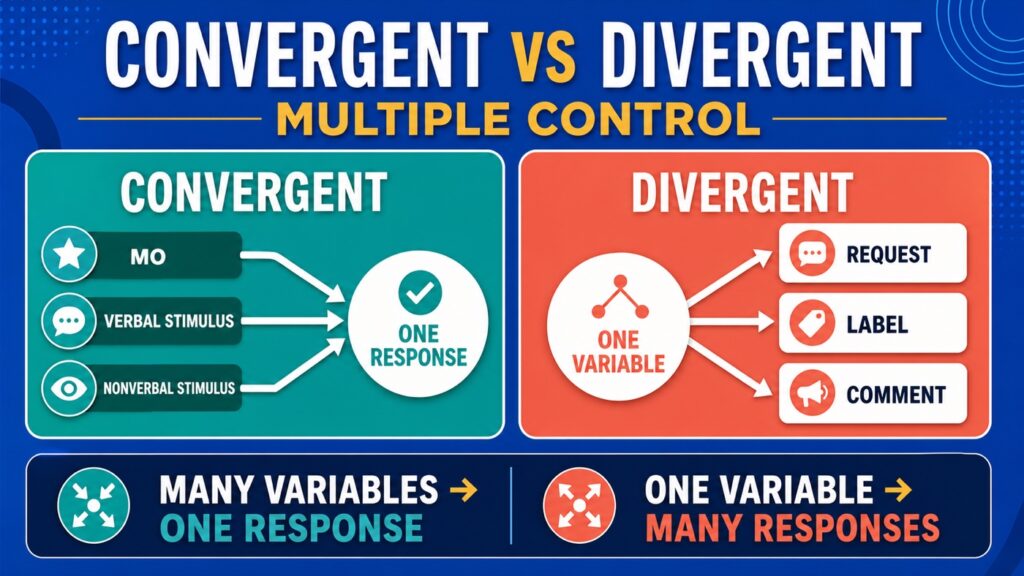
Convergent and divergent multiple control describe opposite directions. In convergent control, multiple variables influence one response. In divergent control, one variable influences multiple responses. Both patterns can occur in the same interaction, and a question may ask you to identify which direction is being described.
- Convergent: motivating operation plus a question plus a nonverbal event contribute to one verbal response.
- Divergent: one motivating operation evokes several responses, such as requesting, approaching, and selecting a preferred item.
- Convergent question: Which variables jointly control this one response?
- Divergent question: Which different responses are affected by this one variable?
- Common mistake: using “multiple” without checking whether the variables come together on one response or spread across several responses.
Suppose thirst increases the likelihood of saying “water,” pointing to a water bottle, and walking toward the dispenser. The single motivating operation may have divergent effects on several responses. If thirst, a question, and the sight of a water bottle jointly influence the spoken response “water,” that is a convergent pattern. The same episode can contain both patterns if the analyst describes different response units. The visual comparison below makes the direction explicit. It shows several arrows converging on one response for convergent control and one source branching toward several responses for divergent control.
Convergent Control Examples in ABA
Example 1: Requesting a snack. A learner is hungry, sees a closed snack container, and hears a caregiver ask, “What do you want?” The learner says “crackers,” and the caregiver provides crackers. Hunger can increase the value of food, the question can occasion a response, and the visible container can provide contextual or nonverbal control. The response may contain several functional components; do not classify it from the word alone.
Example 2: Answering a question about an object. A teacher holds up a red cup and asks, “What color is it?” The learner says “red.” The visible cup and its color are nonverbal stimuli, while the verbal question may contribute to the response. If the learner receives praise, the response may include tact and intraverbal influences. The precise analysis depends on the learner’s history and what the item asks you to identify.
Example 3: Asking for help. A learner encounters a difficult puzzle, hears an adult say “Tell me what you need,” and says “help please.” The task difficulty may function as an establishing operation for assistance, the verbal event may occasion the response, and the consequence may be adult help. A good analysis separates the value-altering event from the verbal prompt.
Example 4: Describing a community event. A learner sees a bus arrive, hears a peer ask “What is that?” and says “The bus is here.” The nonverbal event and the verbal question may jointly influence the response. If the learner is also waiting for a ride, a motivating operation may contribute to the relevant information or activity. Do not assume that a question makes every answer an intraverbal with no nonverbal control.
Example 5: Communication device selection. A learner sees a preferred activity, has a history of selecting an icon to request it, and hears a partner say “Choose.” The learner selects the icon and receives access to the activity. The visual activity, the verbal prompt, and the current value of the outcome may all contribute. The response should be analyzed as a specific selection under a specific arrangement, not merely as “using AAC.”
These examples are not fixed formulas. If the consequence, motivation, or stimulus history changes, the analysis may change even when the response form stays the same. The BCBA exam rewards functional reasoning: identify what changes the response and what outcome follows it.
How to Analyze a Convergent Control Scenario
When a scenario includes several possible variables, use a repeatable sequence. Start with one response and do not analyze the whole conversation as if it were a single unit. Then map events before and after the response and note what history would make each event functional.
- Define the response: Write the exact response topography and the unit being classified.
- List candidate variables: Separate motivating operations, verbal stimuli, nonverbal stimuli, prompts, and contextual events.
- Map likely consequences: Identify the item, action, information, attention, or other outcome following the response.
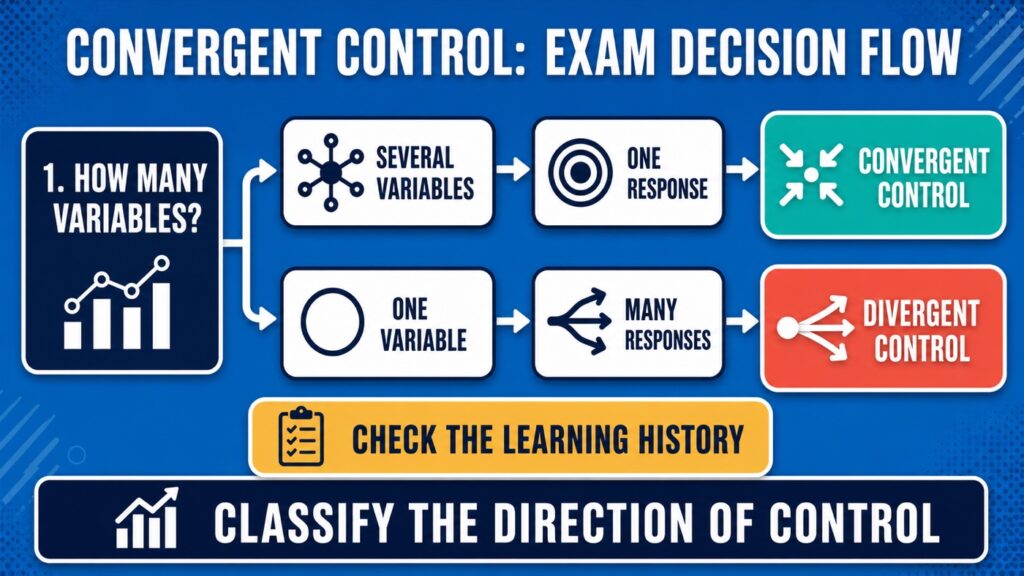
- Check direction: Decide whether several variables influence one response or one variable influences several responses.
- Check evidence: Ask whether the scenario provides a learning history, repeated pattern, or only an adult interpretation.
- Choose the narrowest label: State the component the question asks for without claiming that one variable explains everything.
For example, if a learner says “ball” after seeing a ball and hearing “What is it?” the verbal question may help occasion the response, but the nonverbal object may remain relevant. If the learner then receives the ball, the consequence may add a mand component. A response can be multiply controlled even when the item asks you to identify one most relevant relation.
If the scenario lacks information about what happened after the response, do not claim reinforcement. A consequence is not automatically a reinforcer, and a prompt is not automatically the controlling variable. Select the answer that recommends observation, a controlled probe, or a review of the learning history when the evidence is incomplete.
Teaching and Measuring Convergent Control
Teaching multiply controlled language requires more than teaching a memorized response to one prompt. The learner should contact varied examples in which the relevant variables are present, absent, and combined. The analyst should also watch for restricted stimulus control, prompt dependence, and responses that are emitted only after an adult question.
- Vary motivating operations: Arrange or capture appropriate motivation ethically and measure whether the response changes with the value of the consequence.
- Vary verbal stimuli: Use different questions, statements, partners, and levels of prompting.
- Vary nonverbal stimuli: Probe novel objects, events, properties, examples, and settings.
- Measure independence: Record prompted versus independent responses and fade prompts systematically.
- Measure consequences: Record what was delivered and whether future responding changed under similar conditions.
- Probe flexibility: Check whether the learner responds when one source of control is absent or changes.
One useful assessment arrangement compares conditions with the same response opportunity but different antecedent combinations. For instance, present the nonverbal stimulus alone, the verbal question alone, both together, and neither when appropriate. The plan must be individualized and safe, but the logic is to determine which variables occasion the response and whether their effects combine.
Measurement should not rely only on correct answers. Record latency, prompt level, response variability, generalization, and the consequence contacted. A learner who answers “red” only after the question “What color?” may have a different control pattern from a learner who independently comments on novel red objects. The response form is identical; the controlling variables differ.
When designing instruction, use functional communication and socially meaningful outcomes. Do not require a learner to respond to irrelevant verbal prompts merely to make data look more complex. The objective is flexible, effective communication that contacts appropriate consequences across real environments.
Common Convergent Control Exam Traps
The first trap is confusing convergent with divergent control. Count the response units and the variables. Several variables influencing one response is convergent; one variable affecting several responses is divergent. The second trap is treating a question as the only controlling variable. Questions can occasion responses, but motivation and nonverbal stimuli may also matter.
The third trap is classifying by grammar or response form. A sentence can be a mand, tact, intraverbal, or multiply controlled response depending on its variables and consequence. The fourth trap is calling a consequence a reinforcer without evidence that future behavior increased. The fifth trap is assuming that an adult’s prompt created the learner’s motivation.
- Do not use “multiple control” without identifying the direction of control.
- Do not assume every event before a response is a controlling variable.
- Do not treat a verbal prompt as proof that nonverbal control is absent.
- Do not call a response a pure mand or pure tact when the stem describes several active variables.
- Do not infer reinforcement from one delivery of a consequence.
- Do not ignore the response-consequence relation when analyzing motivation.
- Do not confuse prompt dependence with flexible convergent control.
- Do not claim a broad verbal repertoire from one trained question-answer pair.
When two answer choices remain, rewrite each one as a functional statement. Ask, “Which variables jointly increase the probability of this exact response?” Then ask, “What evidence would change my conclusion?” This process is more reliable than selecting the answer with the most technical vocabulary.
Quick Review Checklist
Use this checklist before answering a convergent ABA question:
- Define the exact response being analyzed.
- List motivating operations, verbal stimuli, nonverbal stimuli, and prompts separately.
- Identify the consequence and avoid calling it reinforcement without behavior-change evidence.
- Several variables on one response points to convergent control.
- One variable on several responses points to divergent control.
- Keep motivation separate from the event that prompts or occasions a response.
- Classify verbal behavior from controlling variables, not grammar alone.
- Consider what happens when one variable is removed or changed.
- Record independent and prompted responding separately.
- Choose the narrowest claim supported by the learning history and data.
A quick self-test is to write one response and three possible antecedent variables. Then remove one variable at a time and predict what should happen. If several variables converge on the same response, you are testing convergent control. If one variable changes several different responses, you are testing divergent control. The second visual below summarizes this decision path so you can use it during exam review without reducing the concept to a surface-level word rule.
Frequently Asked Questions
What does convergent control mean in ABA?: Convergent control means that two or more variables jointly influence one response. In verbal behavior, the variables may include a motivating operation, a verbal stimulus, a nonverbal stimulus, or a combination of these.
What is convergent multiple control in verbal behavior?: It is a pattern in which multiple sources of control come together on one verbal response. A request may be influenced by motivation, a question, and an available item, but the exact analysis depends on the response history and consequence.
How is convergent control different from divergent control?: Convergent control describes several variables influencing one response. Divergent control describes one variable influencing multiple responses. Count the variables and the response units before choosing the label.
Does a question make a response an intraverbal?: Not automatically. A question may contribute verbal control, but a response can also be controlled by motivation or a nonverbal stimulus. Analyze the full arrangement and the relevant learning history. How should convergent control be measured?: Measure the exact response across conditions in which candidate variables occur alone and together when appropriate. Record independence, prompts, latency, generalization, consequences, and future changes in responding.
Take the Free BCBA Mock Exam
Ready to apply convergent multiple control to new scenarios? Take the free BCBA mock exam and practice mapping the target response, motivating operation, verbal and nonverbal stimuli, consequence, and closest distractor. After choosing an answer, explain whether the variables converge on one response or diverge across several responses.
References
For the current BCBA examination framework and task-list context, consult the BACB BCBA Test Content Outline. Use the official outline together with current coursework, supervision, and applicable clinical guidance when checking terminology and implementation decisions.
Next step for BCBA exam prep
Turn this topic into exam-day practice
Use this topic as a focused review, then test it in exam-style conditions with a free mock before deciding whether five full-length mocks are the right next step.
Start the Free BCBA Mock ExamContinue with Five Full-Length Mocks — $99
Review the included materials and access details before ordering. No pass guarantee is implied.



