

A list of ABA assessments is only useful when each tool is matched to the question you need to answer. Use this guide to compare screening, descriptive, functional, preference, reinforcer, and skills assessments without confusing one result for another.
Table of Contents
- List of ABA Assessments: Start With the Question
- The Core List of ABA Assessments
- What Each Assessment Family Tells You
- How to Choose the Right ABA Assessment
- List of ABA Assessments on the BCBA Exam
- Data Quality and Ethical Boundaries
- Turn the List Into a BCBA Study Plan
- Frequently Asked Questions
- Official Sources and Verification Notes
- Quick Review Checklist
- Take the Free BCBA Mock Exam
If you search for a list of ABA assessments, you may find a long collection of acronyms and tools with no clear way to choose between them. The practical answer is to start with the question: Are you screening for a possible need, describing what happens, testing a hypothesis about function, identifying preferences, or measuring a skill to teach? Different assessment families produce different kinds of information.
This guide is an exam-oriented taxonomy and selection aid. It does not replace a qualified professional’s assessment, a current BACB requirement, informed consent, or a complete clinical record. The published functional-assessment article on this site covers one important part of the topic; this new guide stays broader by showing where functional assessment fits among the other assessment choices.
List of ABA Assessments: Start With the Question
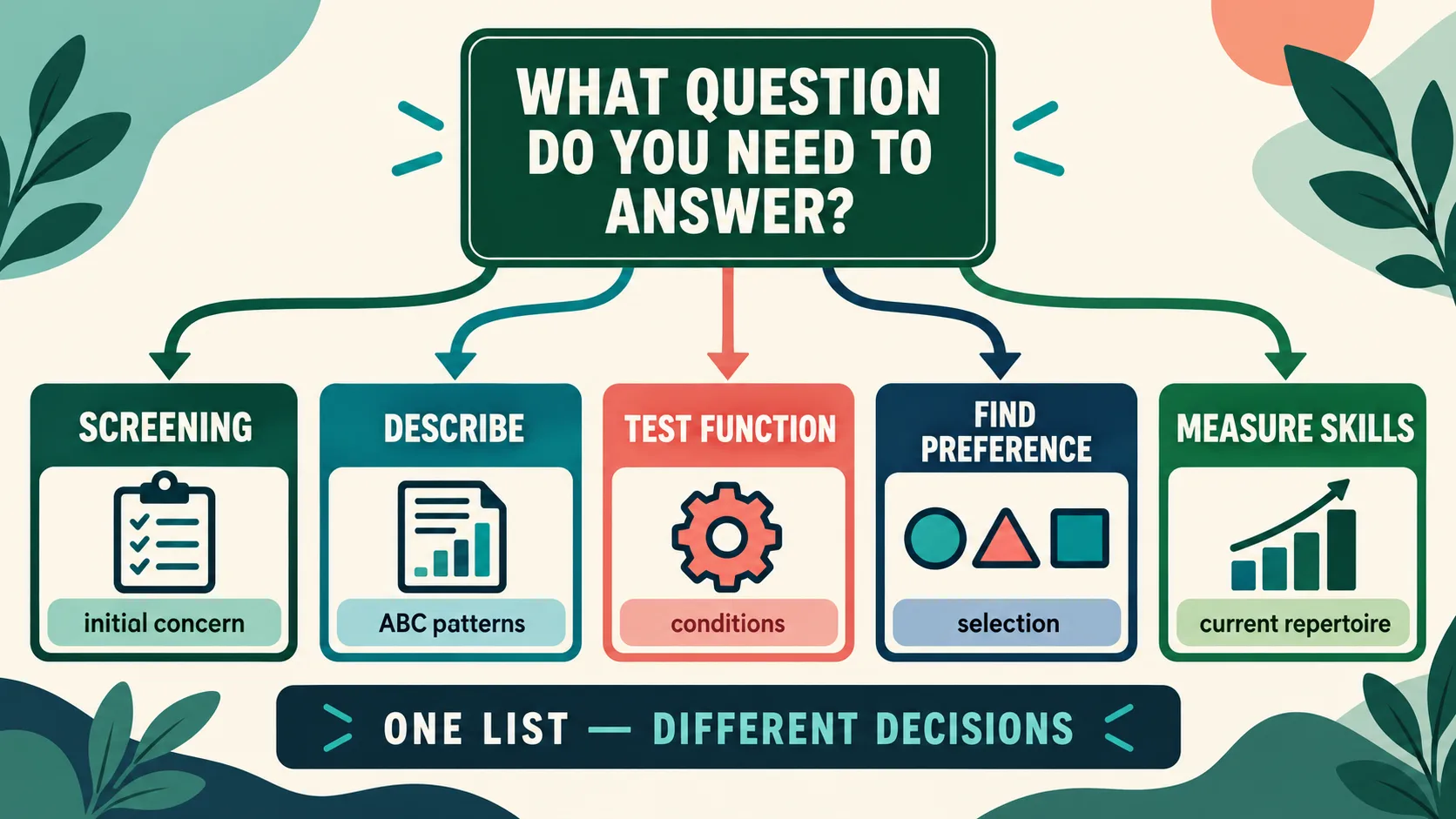
Assessment is not one test. It is a process of gathering and interpreting information so that a decision can be made. The right assessment depends on the decision. If the decision is “Does this learner need a more detailed evaluation?”, a screening tool may be appropriate. If the decision is “What happens immediately before and after this behavior?”, direct descriptive data may be the right starting point. If the decision is “What consequence is likely to function as reinforcement?”, a preference assessment may help, but it does not automatically prove that the item will reinforce a specific response. For BCBA study, keep three distinctions visible:
- Assessment question: what information is needed?
- Measurement method: how will the information be collected?
- Decision: what will change because the data were collected?
A frequency recording system, for example, is a measurement method. It is not automatically a complete assessment. The same is true of an interview, a checklist, or an ABC form: each can contribute useful evidence, but the tool should be interpreted within a clear question and context.
The Core List of ABA Assessments
The following table organizes the list by purpose rather than by acronym. “Assessment” is used broadly here to include common ABA assessment processes and related evaluation activities. A real case may use more than one row, and the sequence should be individualized.
| Assessment family | Main question | Typical output | Common mistake |
|---|---|---|---|
| Screening or intake | Is there enough information to decide whether a fuller assessment is needed? | Initial concerns, history, priorities, and referral questions. | Treating a screen as a diagnosis or final treatment recommendation. |
| Indirect assessment | What do the learner, caregiver, teacher, or staff report about the pattern? | Reports, ratings, history, and preliminary hypotheses. | Assuming a report proves a behavioral function without direct observation. |
| Descriptive or direct assessment | What reliably occurs before, during, and after the target behavior? | ABC patterns, scatterplot patterns, rate, duration, latency, or other direct measures. | Calling a correlation a confirmed function. |
| Functional behavior assessment | Which environmental variables may be related to the behavior and what should be tested next? | Integrated information and a function-based hypothesis. | Using “FBA” as if it always means an experimental functional analysis. |
| Functional analysis | Does behavior change systematically when relevant antecedent and consequence conditions are manipulated? | Experimental evidence supporting or weakening a functional hypothesis. | Describing a simple observation as an experimental analysis. |
| Preference assessment | Which items, activities, or stimuli are selected or approached at this time? | A relative preference ranking under specified conditions. | Assuming the top-ranked item is always a reinforcer. |
| Reinforcer assessment | Does access to a consequence increase a target response under defined conditions? | Evidence about reinforcement effectiveness for a person, response, and context. | Confusing liking, preference, or access with demonstrated reinforcement. |
| Skills, language, or academic assessment | What can the learner do now, and what is the next teachable target? | Current repertoire, strengths, barriers, and instructional priorities. | Selecting goals from a score without considering function, context, or social validity. |
| Social-validity or treatment-monitoring assessment | Are the goals, procedures, outcomes, and practical effects meaningful and implemented as intended? | Stakeholder feedback, fidelity information, generalization data, and outcome review. | Treating satisfaction alone as proof that an intervention is effective. |
What Each Assessment Family Tells You
Screening and intake assessments: Screening is a first look that organizes concerns and identifies whether a fuller process is warranted. It is not a diagnosis or final treatment recommendation. Indirect and descriptive assessment: Indirect methods collect information from people who know the learner or situation. They are often efficient and useful for history and hypothesis generation. Descriptive methods observe what happens in the natural environment and may use ABC recording, scatterplots, event recording, duration, latency, or rate. Both can contribute to a functional behavior assessment, but neither alone automatically demonstrates causation.
Functional assessment and functional analysis: A functional behavior assessment is a broader process of integrating information to understand environmental relations and develop a testable hypothesis. A functional analysis is an experimental procedure in which relevant conditions are arranged and compared. The exam may make the distinction by changing one word: “observed pattern” suggests descriptive evidence, while “systematically manipulated condition” suggests experimental analysis. For a fuller discussion of this narrower topic, use the existing functional assessment BCBA exam guide without treating this page as a replacement for it.
Preference, reinforcer, and skills assessments: A preference assessment identifies relative selection or approach. A reinforcer assessment asks a stronger question: does the consequence increase behavior under defined conditions? That is why “preferred” and “reinforcing” are not synonyms. Skills, language, or academic assessments answer a different question again: what repertoire is present, what is missing, and what target is socially meaningful to teach?
How to Choose the Right ABA Assessment
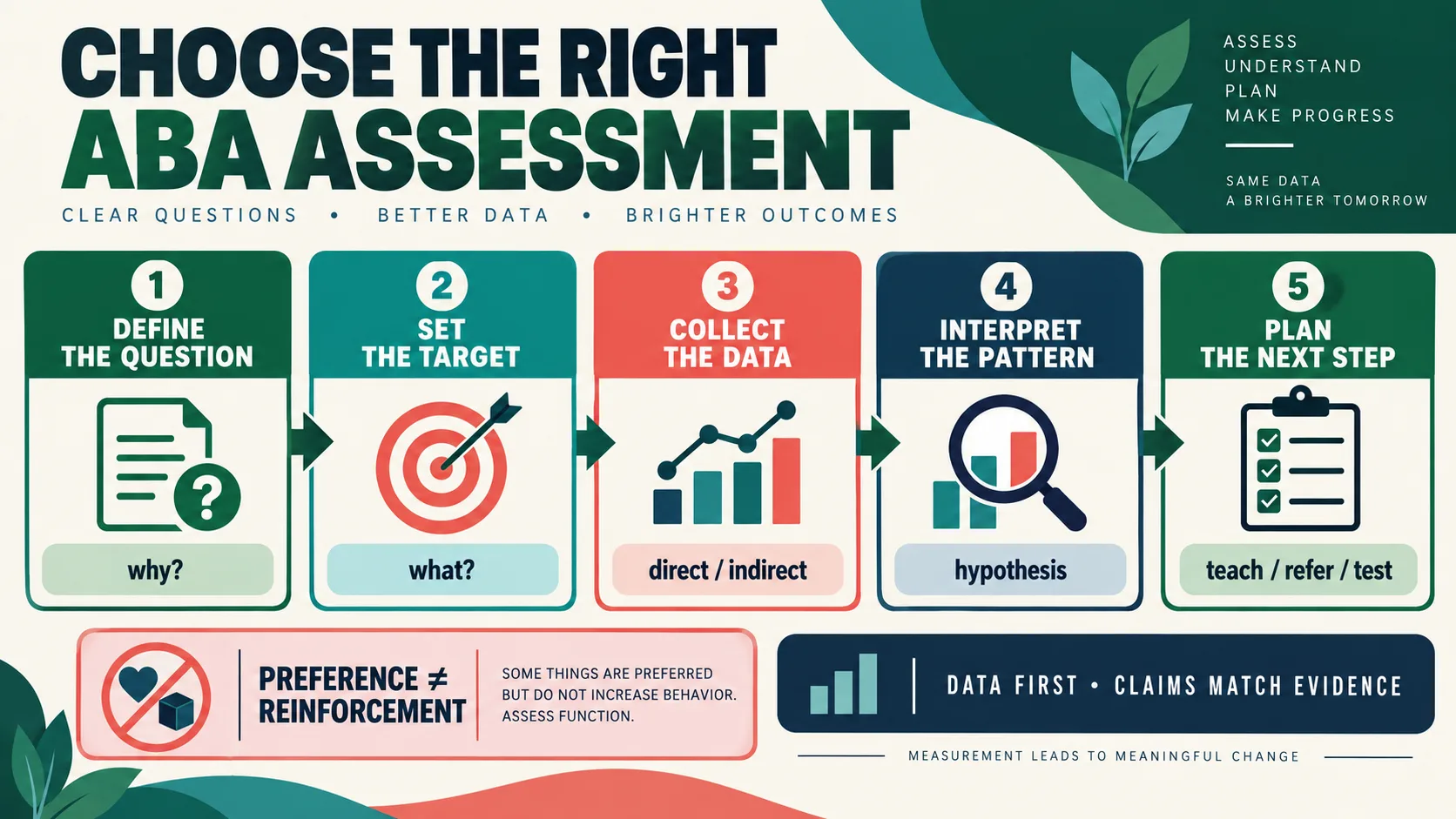
Use this sequence before reaching for a form or named tool:
- Write the decision in one sentence. For example: “I need to know whether the behavior is related to task presentation,” or “I need to select a starting communication target.”
- Define the target and context. Use observable definitions, identify the people and settings involved, and decide what counts as a meaningful change.
- Start with the least intrusive information that can answer the question. History and interviews may be a sensible first step; direct observation or experimental analysis may be needed when uncertainty remains.
- Match the method to the decision. Do not use a preference ranking to choose a skill goal, or a skills assessment to claim a behavioral function.
- Plan the next action before collecting data. Decide how results will change teaching, reinforcement, referral, safety planning, or the need for a more rigorous assessment.
Consider a learner who leaves the table when writing begins. An interview may reveal history, direct ABC data may show the pattern, and a functional assessment may generate an escape hypothesis. None of those steps should be confused with a preference assessment. If the next decision is which reinforcer to test after an appropriate response, a preference assessment may be relevant—but it answers a different question.
List of ABA Assessments on the BCBA Exam
The current BACB BCBA Test Content Outline, 6th edition, lists Behavior Assessment as Domain F and assigns it 23 questions, or 13% of the outline’s scored exam content. BACB’s examination information describes 185 questions for the BCBA examination, including scored and unscored questions. Use the official outline and current handbook for the requirements that apply to your application; use this article to organize study decisions.
| Exam distinction | What to identify | Fast check |
|---|---|---|
| Indirect versus direct | Who is providing the information and whether the behavior was observed directly. | Report or rating is not the same as an observation. |
| Descriptive versus experimental | Whether conditions were merely observed or systematically manipulated. | A pattern can suggest a hypothesis without proving it. |
| Preference versus reinforcer | Selection or approach versus an increase in a response after the consequence. | Top-ranked does not mean guaranteed reinforcer. |
| Topography versus function | What behavior looks like versus the environmental relation maintaining it. | The same topography can have different functions. |
| Assessment versus intervention | Gathering evidence and making a plan are connected but not identical steps. | “What should happen first?” usually rewards the data-informed step. |
When practicing, label every question with the decision it is asking you to make. If the scenario gives an antecedent, behavior, and consequence, identify the observable relation before guessing a function. If it describes a multiple-stimulus arrangement and selection order, think preference assessment. If it says access to a consequence increases responding, think reinforcement evidence.
Data Quality and Ethical Boundaries
A long list of assessments does not make a plan rigorous. Quality comes from clear definitions, representative observations, reliable measurement, appropriate interpretation, and a defensible link between data and action. Document who collected the information, when and where it was collected, what instructions were used, and what limitations remain.
- Use culturally responsive, respectful assessment procedures and explain the purpose in understandable language.
- Protect privacy and share only the information needed for the professional decision.
- Do not make a diagnosis, eligibility promise, or treatment claim outside the relevant scope and authority.
- Review whether the data represent the situations that matter, rather than relying on one unusual observation.
- Reassess when the environment, skill level, health, communication, or reinforcement conditions change.
These boundaries also improve exam answers. The best answer is rarely the most elaborate tool. It is usually the method that answers the stated question with appropriate precision, least unnecessary burden, and enough evidence for the next decision.
Turn the List Into a BCBA Study Plan
Build a one-page assessment map with five columns: assessment family, question, data source, output, and common trap. Then use short scenarios to practice choosing the family before recalling the acronym. Review errors by asking: Did I confuse preference with reinforcement? Did I treat a correlation as function? Did I skip the need for a direct measure? Did I choose an intervention before the assessment supported it?
After you have mapped the concepts, use the free BCBA Mock Exam as a readiness diagnostic. Focus your review on the assessment questions you missed, not only on your total score. A mock exam cannot determine BACB eligibility and does not replace supervised training, but it can show whether you can retrieve distinctions under time pressure.
Frequently Asked Questions
What is the most important item on a list of ABA assessments?: There is no single most important assessment. The correct choice depends on the decision. Functional assessment is central when the question concerns environmental variables related to behavior, while preference, skills, and screening assessments answer different questions.
Is an FBA the same as a functional analysis?: No. FBA is a broader assessment process that can include indirect and descriptive information. Functional analysis involves systematic manipulation of conditions to test a hypothesis. Always read the method described in the scenario.
Does a preference assessment prove that something is a reinforcer?: No. It identifies relative preference under the assessment conditions. A reinforcer is demonstrated by its effect on behavior, so reinforcement should be evaluated in relation to a response and context.
Can a skills assessment choose goals by itself?: It can provide valuable information about current skills and possible targets, but goal selection should also consider function, context, social validity, communication needs, generalization, and the learner’s priorities.
Official Sources and Verification Notes
For current exam content and certification information, verify the details directly with the BACB BCBA Test Content Outline, 6th edition, the BACB examination information page, and the official BCBA resource hub. Review the BACB ethics resources before applying an assessment process in practice. Official requirements and exam information can change, so a study article should be used as an organized learning aid—not as an eligibility ruling.
Quick Review Checklist
Use this final checklist to turn list of aba assessments into exam-ready reasoning. The goal is not to memorize a label in isolation; it is to identify the relevant evidence and explain why the best answer fits the scenario. Key ideas to review:
- State the central definition or decision point for list of aba assessments in your own words.
- Identify the detail that makes list of aba assessments different from its closest related ABA term.
- Separate the observable facts in a scenario from assumptions that are not supported by the facts.
- Write one example and one nonexample so you can recognize the concept in a new setting.
Exam application checks:
- Ask what the question is actually requesting before comparing the answer choices.
- Mark the antecedent, response, consequence, or other evidence that supports the selected answer.
- Look for a distractor that describes a related process but does not answer the specific question.
Final self-check:
- Explain how you would verify the interpretation with clear observations or data.
- Change one detail in the scenario and decide whether your answer should change.
- Give a one-sentence rationale that a supervisor or study partner could evaluate.
Take the Free BCBA Mock Exam
A useful next step is to apply this idea in a fresh set of BCBA-style practice questions and review the feedback. Take the Free BCBA Mock Exam



